

Thinking about becoming a certified/recognised translator or just need a certified translation for immigration or court? This guide explains the difference, shows real certification pathways (e.g., ATA), and helps you decide the best route.
Upload Your File
Use this guide to understand professional translator credentials and how they differ from the certification statement required with a USCIS translation.
TL;DR
Translator certification usually means passing a recognised exam (e.g., ATA in the US) to validate your professional skill. Certified translation, by contrast, is a translation accompanied by a signed statement of accuracy—commonly required for immigration and courts. USCIS does not require the translator to hold a specific licence or ATA certificate, but it does require a proper certification statement with the translation. If you need a certified translation now, upload your file and we’ll deliver a compliant PDF with the translator’s certification.
Upload Your File
What is Translator Certification?
Translator certification is a formal credential proving you’ve met a professional benchmark in translation. It typically involves a proctored exam that tests translation accuracy, terminology control, style, and ethics.
Common forms of recognition
- ATA Certification (US) — language-pair exam for experienced translators.
- Court / government rosters (jurisdiction-specific) — some courts or agencies maintain lists of qualified translators/interpreters.
- University/CPD certificates — proof of training; not a licence, but valuable for employability.
Important distinction: Translator certification (a credential) ≠ Certified translation (a type of deliverable with a signed statement). You can produce a USCIS-compliant certified translation without holding an ATA certificate, provided the statement of accuracy meets the requirements.
Need a certified translation? Get a Quote
Do You Need Translator Certification for Immigration?
For USCIS immigration, the critical requirement is a certified translation (a complete, word-for-word translation with a signed Statement of Accuracy and Competence). USCIS does not require a specific translator licence or ATA credential.
However, translator certification helps your career (credibility, higher rates, more clients) and may be expected by some courts, law firms, or agencies. For certain legal contexts, local courts may have their own rules.
Upload Your File (for USCIS-compliant certified translations)
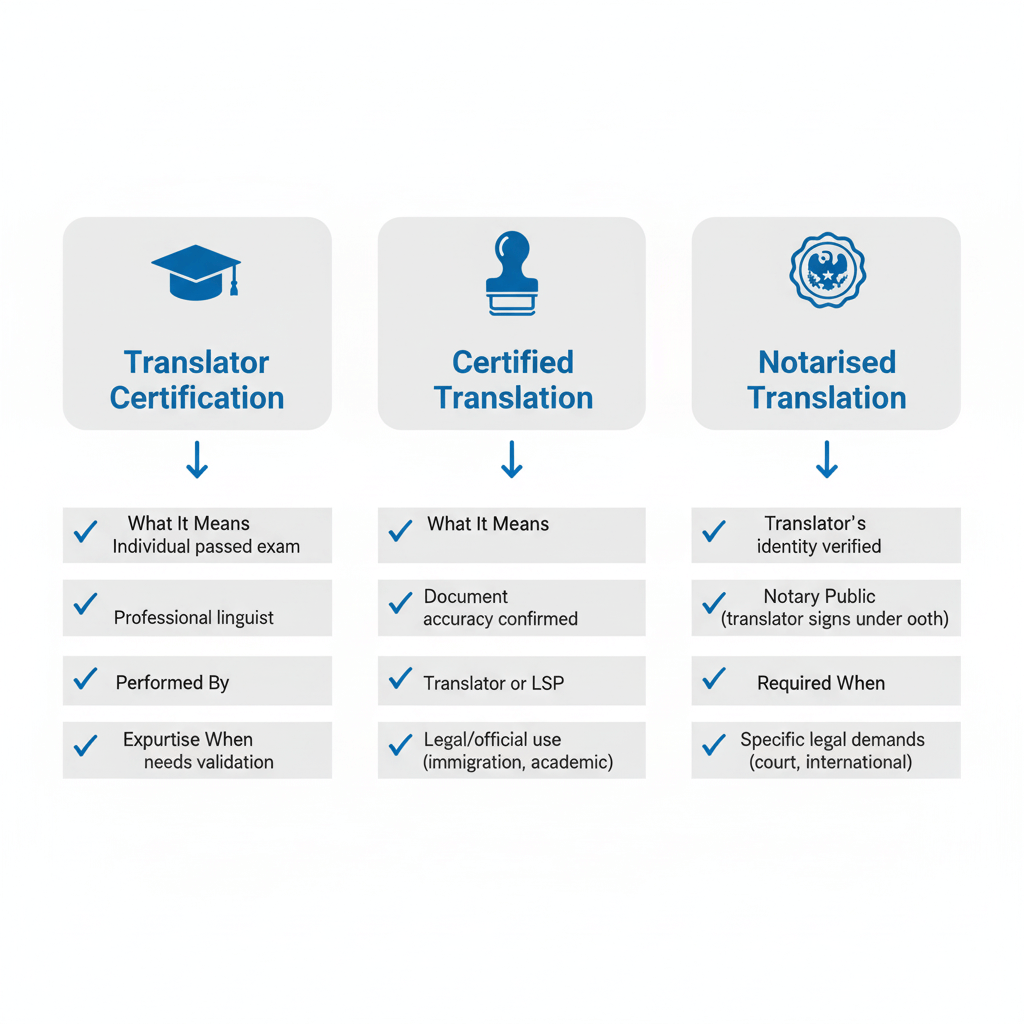
Certification vs Certified Translation vs Notarisation
- Translator certification (credential): You pass a recognised exam (e.g., ATA).
- Certified translation (deliverable): A translation plus a signed statement attesting to accuracy and completeness.
- Notarised translation: A translator’s certification statement is notarised (the notary confirms identity/signature—not the translation quality). Required only when the requesting authority asks for it.
Start Your Project — choose digital delivery or add notarisation if requested.
Popular Paths to Translator Certification (US-focused, globally relevant)
1) ATA Certification (American Translators Association)
- Who it’s for: Experienced translators seeking a rigorous professional credential.
- What it tests: Translation accuracy, completeness, style, terminology, and error handling.
- Preparation: Practice passages, glossaries, style guides, time-bound mock exams.
- Outcome: Use the ATA-certified designation in your language pair(s).
2) Court / Government Recognition
- Courts: Some jurisdictions maintain rosters or qualification processes.
- Agencies: Certain public bodies (domestic or abroad) may require vetted translators for specific document types.
3) Academic & Professional Certificates
- Graduate programmes, diplomas, CPD courses: Strengthen skills and credibility; useful stepping-stones toward passing high-stakes exams.
Ask Us About Certification Paths — we’ll point you to the right exam or course.
How to Become a Professional Translator (Step-by-Step)
- Choose a niche & language direction (e.g., legal/immigration, medical, technical; source → target).
- Train deeply — degree/diploma, specialist courses, and real-world practice.
- Build resources — glossaries, termbases, style sheets, CAT tools.
- Start with supervised projects — mentoring, pair reviews, QA feedback.
- Sit a recognised exam (e.g., ATA) once you consistently meet professional quality.
- Create a compliance workflow — templates for certified translations (statement of accuracy), secure file handling, versioning.
- Join professional bodies — networking, CPD, ethics, visibility.
- Collect proof of quality — references, case studies, acceptance rates, on-time delivery metrics.
Download a Sample Certified Translation (PDF)
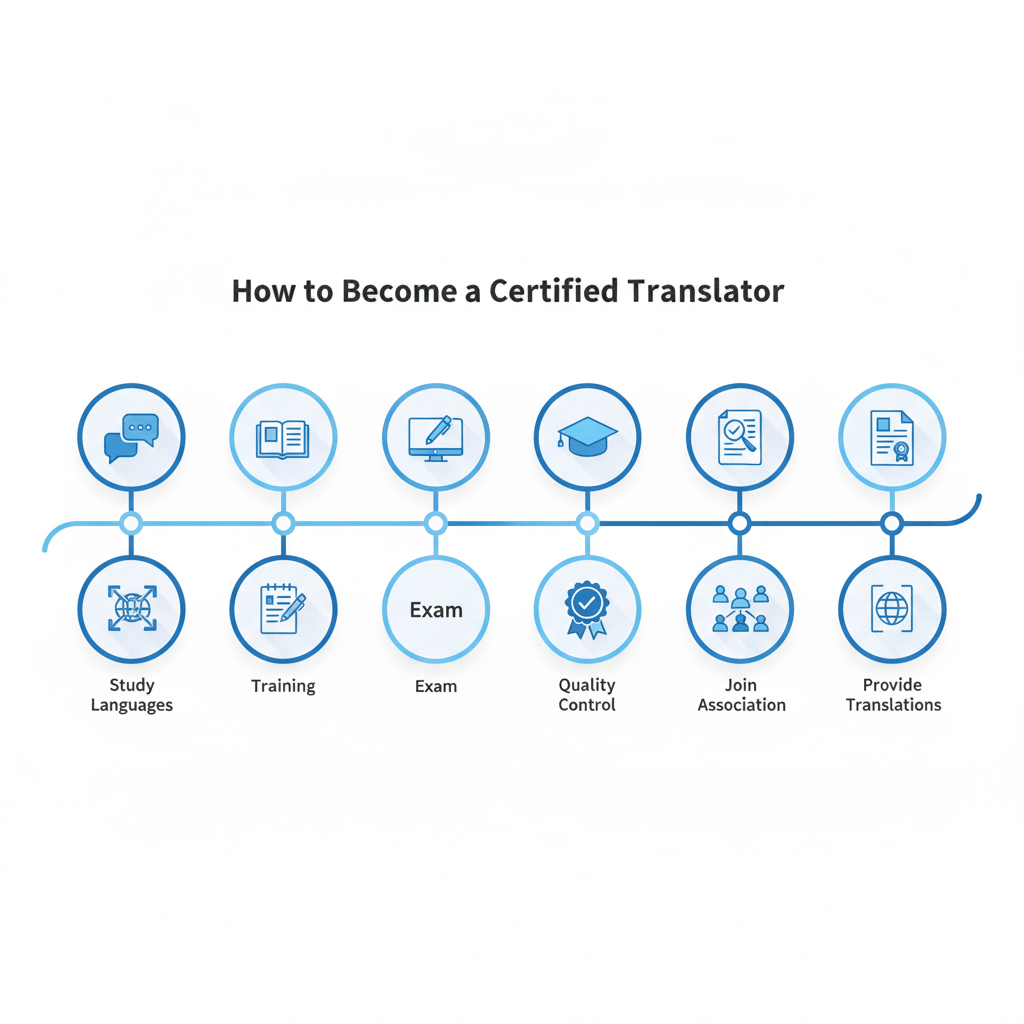
Spanish Translator Certification & Language-Specific Routes
Many searches are for Spanish translator certification or how to become a certified Spanish translator. The process is similar: prove proficiency, pass an exam (e.g., ATA Spanish<>English), and master legal/immigration terminology if you serve that market. For courts or consulates, check local rules—some countries use the term “sworn translator” with formal appointment procedures.
Get a USCIS-Compliant Spanish Translation
State-Specific Searches (Florida, New Jersey & more)
Queries like “how to become a certified translator in Florida/NJ” reflect a common misconception. In many US states, translators are not “licensed” by the state the way lawyers or doctors are. What you’ll likely need instead:
- A professional credential (e.g., ATA).
- Court-specific or agency requirements if you appear in legal contexts.
- The ability to issue certified translations with the correct statement of accuracy (and notarisation if asked).
Always check the target court or authority’s written instructions.
Ask Compliance — We’ll Check the Requirement for You
Interpreter vs Translator Certification (and why both matter)
- Translators work with written text; interpreters work with spoken language.
- Interpreter certification may be mandatory for certain courts/medical settings.
- If you do both, pursue separate credentials and CPD.
Related keyword coverage: language interpreter certification; interpreting and translation certification.
Certification for Translation Services (What Clients Expect)
When businesses, lawyers or individuals ask for “certification”, they often mean:
- A USCIS-ready certified translation with a signed statement (and optional notarisation).
- A provider with proven quality controls and recognised credentials (e.g., ATA-certified linguists, specialist reviewers).
- Secure handling of PII, audit trail if needed, and on-time delivery.
Get a Quote — for a complete English translation with the required translator certification.
Document Translation Certification: Our Compliance Workflow
- Complete, word-for-word translation (no omissions).
- Independent QA (terminology, names, dates, seals, stamps).
- Translator’s Certification Statement (signed; includes name, competence statement, and contact).
- Optional Notarisation on request.
- Secure digital PDF delivery + hard-copy available.
Upload Your File
Translator Certification Test: How to Prepare (ATA-style readiness)
- Baseline diagnostics: translate past papers under timed conditions.
- Error taxonomy: classify errors (mistranslation, omission, register, terminology) and fix patterns.
- Reference discipline: build subject-specific glossaries; know reliable sources.
- Style control: consistent punctuation, capitalisation, and audience-appropriate register.
- Peer review: join study groups; simulate proctoring.
- Ethics: confidentiality, impartiality, conflict-of-interest awareness.
Example Immigration Translation Workflow
An immigration filing may include a birth certificate, marriage certificate, police certificate or passport. Each foreign-language document should be translated in full and accompanied by the translator’s certification of completeness, accuracy and competence.
Start Your Project
FAQs
Do I need to be an ATA-certified translator for USCIS?
No. USCIS requires a certified translation (a complete translation with a signed statement of accuracy and competence). It does not require the translator to hold an ATA certificate. Professional translator certification is valuable but not mandatory for USCIS filings. See our New York translator certification guide for state-specific information.
What is a certified translation certificate?
It’s the translator’s signed statement confirming the translation is complete and accurate, and that the translator is competent in both languages. We include this with every USCIS-ready certified translation.
How can I become a certified translator?
Build skills through training and practice, then pass a recognised translator certification test (e.g., ATA). Add court/agency recognition if you work in legal settings, and maintain CPD.
Is notarisation the same as certification?
No. Certification is the translator’s signed accuracy statement. Notarisation verifies the identity/signature of the person signing the statement, not the translation quality. Some authorities request notarisation in addition to certification.
How do I become a certified Spanish translator?
The route mirrors other languages: advanced proficiency, specialisation (e.g., immigration/legal), and a recognised exam (e.g., ATA Spanish<>English). For “sworn” status in certain countries, follow that jurisdiction’s appointment process.
Can you certify my translation for court?
Yes. We provide court-style certified translations, and where required we can notarise the translator’s statement. Tell us the court’s written requirements and we’ll match them.
