
What Is a Sworn Translator?
A sworn translator is a translator formally authorised under the rules of a particular country or jurisdiction to produce official translations for specified uses. The designation and requirements differ between countries. This page explains how sworn translators work and when one may be required. If you already know you need the service, see our sworn translation services.
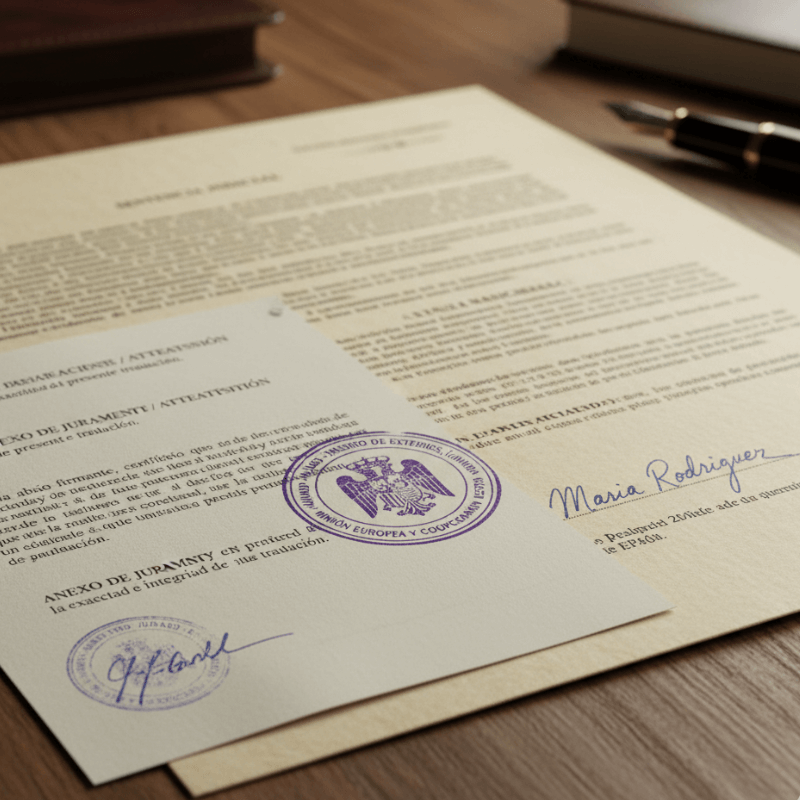
How to verify a sworn translator
Check the destination country first. “Sworn”, “authorised”, “certified” and “court-appointed” do not mean the same thing in every jurisdiction.
Verify the translator in an official register where one exists. France publishes Court of Appeal expert lists, Spain maintains a Ministry of Foreign Affairs register, and Germany has a justice-administered interpreter and translator database.
Check the receiving authority’s current instructions. Some authorities require a signature, stamp, original hard copy, electronic signature or additional legalisation.
Do not apply European sworn-translator rules to USCIS. For U.S. immigration, 8 CFR 103.2(b)(3) requires a full English translation plus the translator’s certification of completeness, accuracy and competence.
This page focuses on the role of the sworn translator. The exact appointment system and terminology depend on the country where the translation will be used. For a quotation or to arrange an authorised translation, use our sworn translation service.
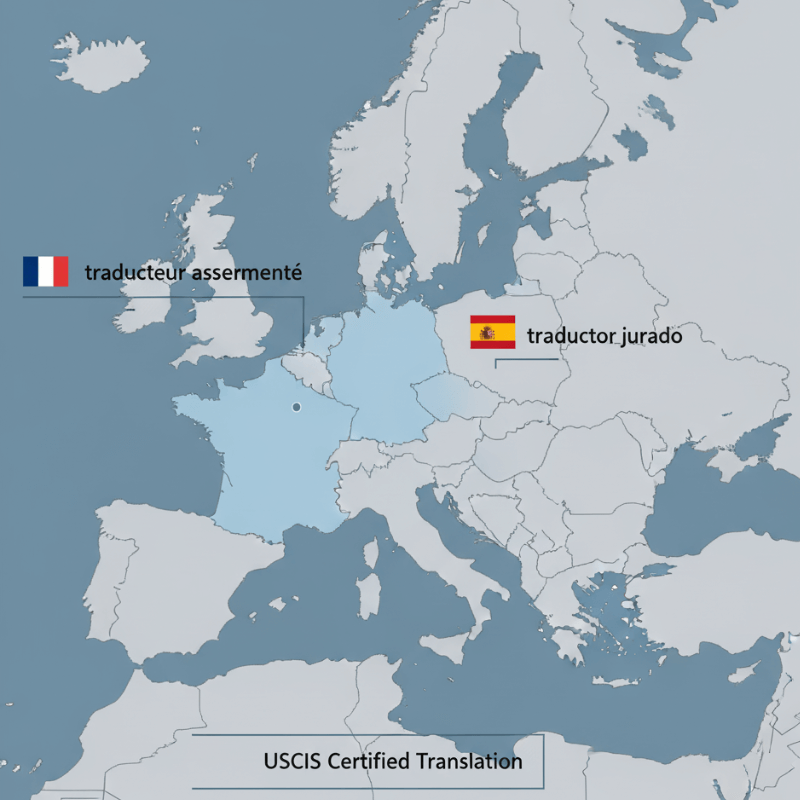
What is a “sworn translator”?
A sworn translator is a translator whose official status comes from the law or appointment system of a particular jurisdiction. There is no single worldwide sworn-translator credential.
France: translators appear within the judicial-expert lists maintained for the Courts of Appeal. The Cour de cassation explains that translators are listed under the “Interprétariat – Traduction” section of those expert lists. Check the French Court of Cassation directory.
Spain: the Ministry of Foreign Affairs grants the titles Traductor/a Jurado/a and Intérprete Jurado/a. The Ministry states that translations produced by these professionals have official character and maintains a searchable register. See the Spanish Ministry guidance.
Germany: official status may involve general swearing, public appointment or authorisation under federal or state law. The German justice administrations provide a searchable database of registered interpreters and translators. Search the German justice database.
For USCIS: the United States does not use a federal “sworn translator” title for immigration filings. A foreign-language document submitted to USCIS must be accompanied by a full English translation and a translator certification covering completeness, accuracy and competence under 8 CFR 103.2(b)(3). See our translator certification guide for the U.S. route.
When do you need a sworn translator vs a certified translation?
You need a sworn translator when the destination authority explicitly requires a sworn/official translation produced by a court-appointed or ministerially authorised translator (common for civil registry filings, court procedures, notarial acts in parts of the EU).
You need a certified translation (not sworn) for USCIS and many other authorities that accept a translator’s certificate (statement of accuracy + competence).
Not sure which route applies? Send the request letter or destination link and we’ll confirm requirements before you order.
Documents we handle most
Birth, marriage, divorce, and death certificates
Court judgments, powers of attorney, police certificates
Academic transcripts, diplomas, and professional licences
Company statutes, commercial registry extracts, financials
Medical letters and lab results
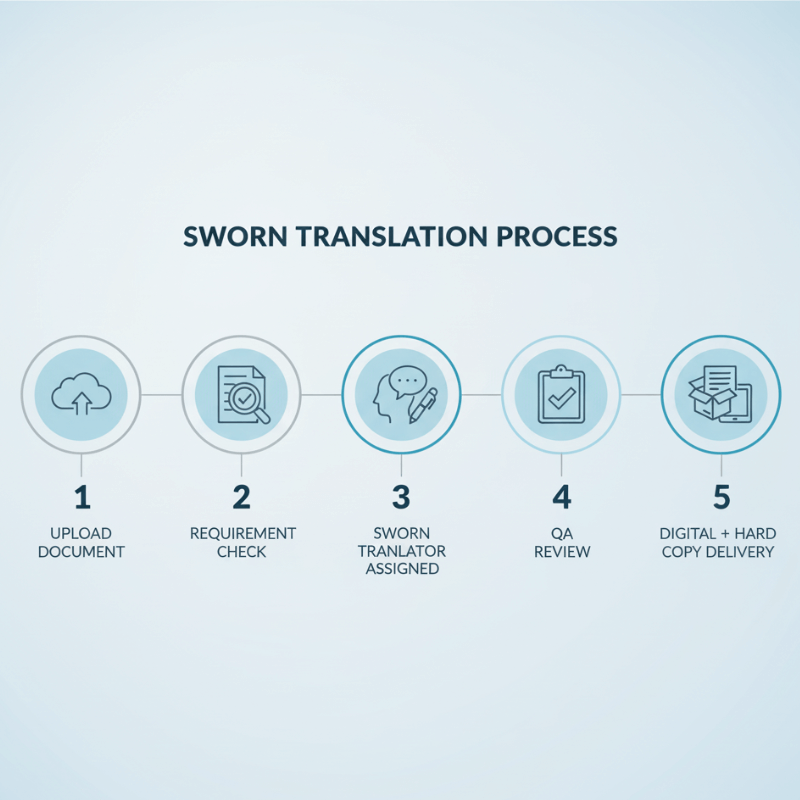
How our sworn translation service works
Upload your file (PDF, scans, photos; multi-page supported).
Requirement check: we verify whether a sworn translator is required, the exact jurisdiction, and any formatting (stamps, oath page, annexing).
Assignment: we route to a court-appointed/ministerially authorised translator in the destination country (e.g., France/Spain) or to a USCIS-compliant certified translator for the U.S.
Quality review: legal/terminology checks, pagination and seal placement, certificate wording, and cross-reference to the authority’s guidance.
Delivery: secure digital copy + original stamped hard copy where mandated, with tracked shipping options.
Aftercare: free amendments for clerical issues and guidance on Apostille/legalisation if needed for cross-border use.
Turnaround & pricing
Turnaround varies by jurisdiction and translator availability. Sworn translations can require an authorised individual translator, specific certification wording, stamps or an original signed copy.
Digital versus hard copy: some authorities accept digitally signed or electronic sworn translations, while others may still request an original stamped document. Confirm this with the receiving authority before ordering.
USCIS certified translations: if your document is for U.S. immigration rather than a sworn-translation jurisdiction, see our USCIS certified translation service.
Quote basis: price and delivery depend on the language pair, document length, destination country and whether originals, legalisation or courier delivery are required.
Send the document and destination authority details for a fixed quote and requirement check.
Checks before you order
Destination authority: identify the country, court, registry, consulate, university or other body receiving the translation.
Translator status: confirm whether the authority asks for a sworn, court-appointed, authorised or simply certified translator.
Format: check whether a stamp, signature, declaration, pagination, annexing or original hard copy is required.
Legalisation: determine separately whether the underlying document or the translator’s signature needs an Apostille or other legalisation. Translation and legalisation are different steps.
Official directories and legal sources
Use these primary sources to verify terminology and translator status before relying on a commercial provider’s description:
France — Cour de cassation: Experts agréés par les cours d’appel, including the Court of Appeal lists where translators appear under “Interprétariat – Traduction”.
Spain — Ministry of Foreign Affairs: Traductores/as – Intérpretes Jurados/as, including the official register and rules on signature, stamp and official character.
Germany — justice administrations: Dolmetscher- und Übersetzerdatenbank, covering generally sworn, publicly appointed and authorised professionals recorded by the German justice system.
United States — eCFR: 8 CFR 103.2(b)(3), the federal rule governing translations submitted to USCIS.
Practical rule: use the terminology and verification route of the authority receiving the document, not the label used by a translation company.
FAQs
1) What is a sworn translator?
A sworn translator is officially appointed by a court or ministry to produce translations with legal value in that jurisdiction (e.g., France Courts of Appeal; Spain’s Ministry of Foreign Affairs).
2) Do I need a sworn translation for USCIS?
No. USCIS requires a certified English translation with the translator’s statement of completeness, accuracy, and competence; there is no “sworn translator” designation in the U.S.
3) Can you provide sworn translations for France and Spain?
Yes. We work with sworn translators listed with French Courts of Appeal and Spanish traductores/intérpretes jurados authorised by the Ministry of Foreign Affairs.
4) Do I need notarisation or an Apostille as well?
That depends on the destination authority and whether the document will circulate internationally. We’ll advise if notarisation/legalisation is necessary after reviewing your request.
5) How long does a sworn translation take?
Most single-page civil documents complete in 2–5 working days once assigned; complex legal or multi-document sets may take longer. We’ll confirm an ETA with your quote.