
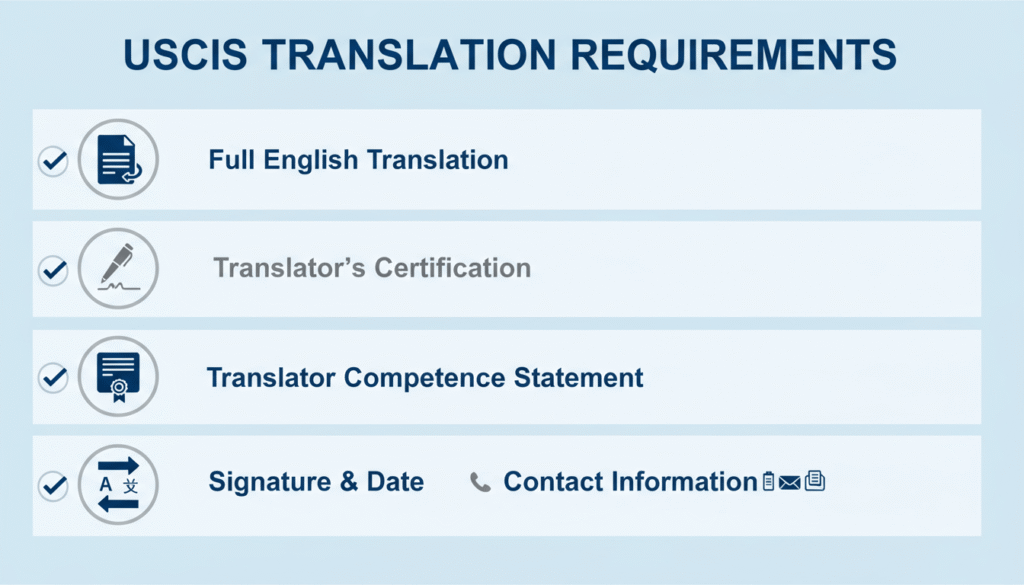
If you submit a document in a foreign language to U.S. Citizenship and Immigration Services (USCIS), it generally needs to be accompanied by a full English translation and the translator’s certification.
The translation should address all readable text and include the certification USCIS requires.
Missing, incomplete or uncertified translations can lead to avoidable follow-up requests or delays.
This guide explains the core USCIS translation rule, what a translator certification should contain, which documents commonly need translation, and when notarization is or is not relevant.
If you need a professional translation rather than a DIY checklist, see our USCIS certified translation service for current pricing, secure document upload and turnaround options.
Free USCIS Translation Requirements Checklist (PDF)
Before you file, use this step-by-step checklist to make sure every translation meets USCIS standards for 2025.🔽 Download the USCIS Translation Requirements Checklist (Free PDF) below
What Are the Official USCIS Translation Requirements?
The core rule is simple and strict:
Whenever you submit a document in a foreign language to USCIS, it must be accompanied by:
- A full English translation (no summaries, no partial extracts).
- A signed certification from the translator that:
- The translation is complete and accurate, and
- The translator is competent to translate from the original language into English.
If any of these elements is missing or weak, USCIS can treat the evidence as insufficient and issue a Request for Evidence (RFE) or question the reliability of your documents.
Key point: USCIS cares about completeness, accuracy, and accountability, not pretty layouts or logos.

Legal Basis: Where USCIS Translation Requirements Come From
USCIS translation rules are grounded in:
- 8 CFR 103.2(b)(3) – Requires any foreign-language document to be filed with a full English translation and a translator’s certification of completeness, accuracy, and competence.
- USCIS Policy Manual (Evidence & Documentation chapters) – Confirms that all foreign-language evidence must be supported by a certified English translation across benefit types (family, employment, humanitarian, naturalisation, etc.).
This means the same standard applies whether you are filing:
- I-130, I-485, I-539, I-765, N-400, I-131, I-751, I-829, waiver applications, VAWA, asylum-related forms, or others—if the supporting evidence is not in English, it must be translated and certified.
Which Documents Must Be Translated for USCIS?
If it supports your immigration case and is not in English, assume it must be translated.
Common examples:
Vital Records
- Birth certificates (including multi-language, handwritten, or older formats)
- Marriage certificates
- Divorce decrees
- Death certificates
- Adoption records
- Name change or court orders
Identity & Civil Status
- Passports (non-English bio pages, visas, entry/exit stamps if relevant)
- National ID cards
- Family registry documents (e.g. Libro de Familia, Koseki Tohon, etc.)
Academic & Professional
- Diplomas and transcripts
- Professional licences
- Training certificates
Legal & Immigration
- Police clearance certificates
- Court judgments or criminal records
- Prior immigration decisions, deportation orders, asylum decisions issued abroad
Financial & Supporting Evidence
- Employment letters
- Business registrations
- Bank documents, contracts, or affidavits submitted as evidence
If any part of a document in another language is relevant—even a stamp, endorsement, or handwritten note—it should be translated or clearly addressed.
Certified vs Notarized vs Sworn: What USCIS Actually Requires
There is constant confusion here, so let’s make it unambiguous.
Does USCIS require certified translations?
Yes.
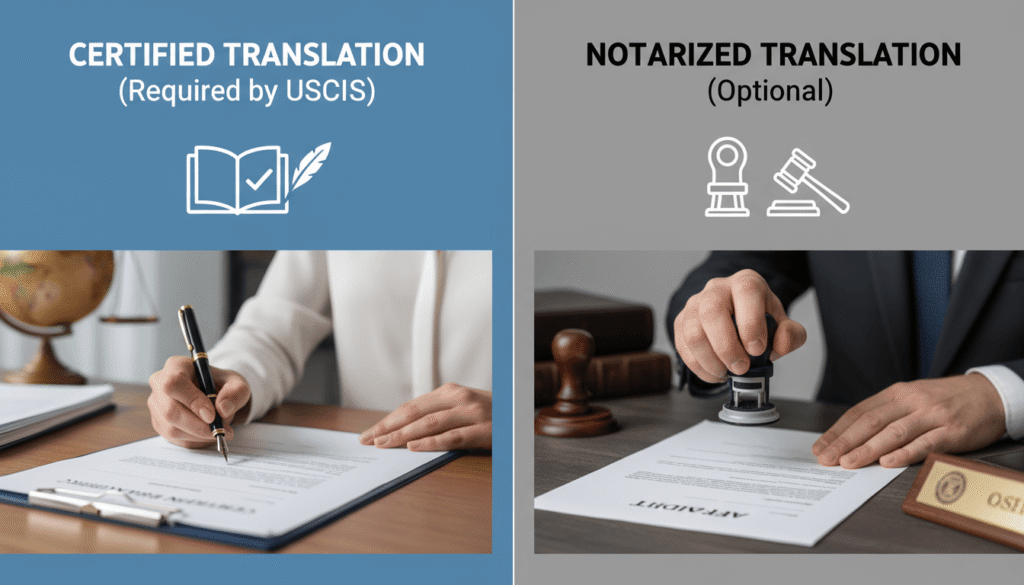
For any foreign-language document, USCIS requires a certified translation, meaning:
- The translator (or translation company) provides a signed statement confirming:
- They are competent to translate from the specific foreign language into English; and
- The translation is complete and accurate.
This is the “USCIS certified translation” standard referred to across guidance and practice.
Does USCIS require notarized translations?
No—USCIS does not require notarisation of translations.
- A notarised translation is only needed if another authority (e.g. a state court, university, or foreign consulate) asks for it.
- For USCIS, what matters is a valid translator certification, not a notary seal.
Some applicants still choose notarisation as an extra layer of reassurance. That’s optional, and a professional provider like USCIS Official Translation can supply it when needed.
Does USCIS require original translations or wet signatures?
Current policy allows:
- Reproduced (scanned/photocopied) copies of originally signed documents, including translator certifications, unless specific form instructions require originals.
- Typed names without an original or properly reproduced signature are not acceptable as a valid certification statement.
Best practice:
- Obtain a translation with a real signature from the translator or agency.
- Submit a clear scan with your application, and keep the original on file.
Exact USCIS-Certified Translation Requirements (Checklist)
Every translation for USCIS should include:
- Full English translation
- No omissions.
- All stamps, seals, handwriting, margins, notes, and numbers translated or explained.
- Translator’s Certification Statement, including:
- Statement of competence (able to translate from X language into English).
- Statement of completeness and accuracy.
- Language pair and document name.
- Translator’s full name.
- Translator/agency signature.
- Date of certification.
- Contact details (address, email and/or phone).
- Formatting that helps USCIS
- Source and translation clearly separated or labeled.
- Same layout/order as the original where possible.
- Consistent spellings of names and places across all documents.
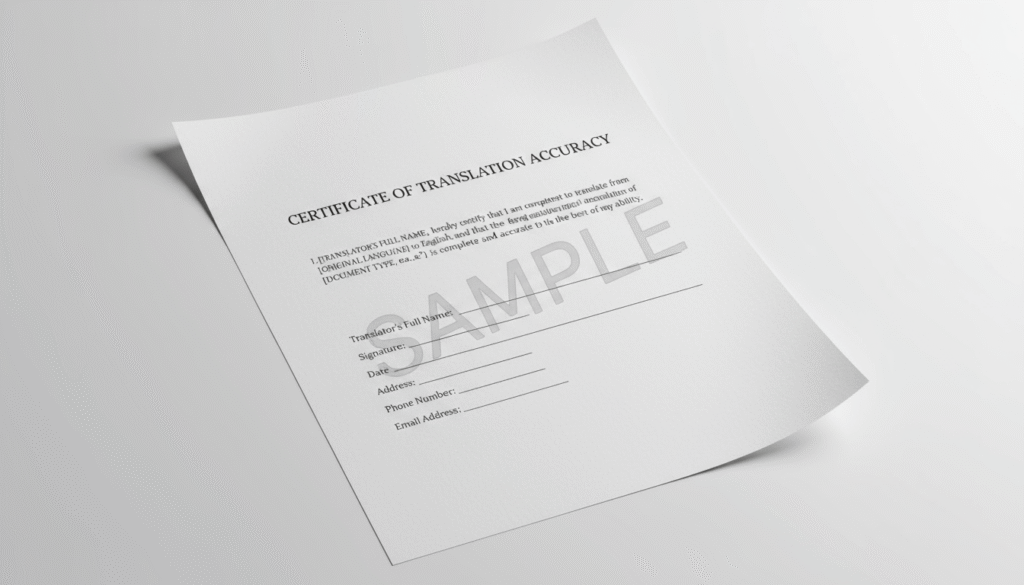
Sample Translator Certification (USCIS-Compliant)
You can adapt the following structure:
I, [Full Name], certify that I am competent to translate from [Language] into English and that the attached translation of [Document Title] is complete and accurate to the best of my knowledge.
[Signature]
[Full Name]
[Date]
[Contact Details]
Use this as the minimum standard for every translation you submit.
Who Can Translate Documents for USCIS?
USCIS does not require:
- A “USCIS-licensed” translator (no such status).
- A court-certified or government-certified translator (though it can help credibility).
- A translator located in the United States.
USCIS requires the translator to be:
- Fluent in both languages, and
- Willing to sign the certification of accuracy and competence.
Can you translate your own documents?
Technically, USCIS does not explicitly forbid self-translation in the regulation, but it is strongly discouraged:
- It can raise credibility issues.
- It may be questioned at interview or trigger RFEs.
- For critical documents (birth, marriage, criminal records), using a neutral professional is safer.
Who should not translate?
To avoid conflicts or credibility issues, avoid using:
- Petitioners or beneficiaries translating each other’s key evidence.
- Close family members in sensitive cases.
- Anyone unwilling to be identified and contactable.
USCIS Official Translation uses professional translators whose credentials and certifications are ready for USCIS review—removing that risk.
USCIS Translation Requirements by Document Type
1. Birth Certificates (USCIS Birth Certificate Translation Requirements)
For non-English birth certificates:
- Full translation of:
- Name, parents’ names, place and date of birth
- Registration numbers
- Stamps, seals, margins, and annotations
- Certified translator’s statement attached.
Missing lines, shortened names, or skipped stamps are classic triggers for RFEs in family and naturalisation cases.
2. Marriage, Divorce, Adoption & Court Orders
USCIS expects:
- Every page and clause translated.
- Clear indication of:
- Parties’ full names
- Dates
- Legal effect (married, dissolved, adopted, changed name, etc.)
3. Academic, Work & Professional Documents
Where used as evidence (e.g. H-1B, EB-2, EB-3, NIW):
- Diplomas, transcripts, reference letters, licences, registrations
- Exact terminology matters—mistranslations can misstate your qualifications.
4. Police, Criminal & Immigration Records
These are high-scrutiny documents:
- No paraphrasing.
- Every term, article, charge, dismissal, or sentence must be faithfully translated.
Do USCIS Translation Requirements Vary by Language?
No.
Any foreign language = same USCIS translation requirement:
- Arabic, Spanish, French, Mandarin, Urdu, Russian, Portuguese, Farsi, Korean, Turkish, etc.—all must have a certified English translation when submitted to USCIS.
There is no list of “approved languages” or special exemption: USCIS only accepts English for official adjudication.
Common Mistakes That Cause Problems (And How to Avoid Them)
Avoid these frequent reasons USCIS questions translations:
- Partial translations
- Only translating “important” parts and skipping seals, stamps, or backs of documents.
- No or weak certification
- Missing competence statement.
- No signature.
- No contact details.
- Inconsistent data
- Spelling of names differs between documents.
- Date formats incorrectly flipped (e.g. 03/07 vs 07/03).
- Machine translation
- Using tools like Google Translate without human review or certification.
- Untraceable translators
- No real-world identity, no contact info—USCIS may question authenticity.
- Improvised formats
- Illegible scans, unclear page references, no link between original and translation.
USCIS Official Translation is built specifically to eliminate these risks with audited templates, specialist reviewers, and strict quality control.
2026 Context: What’s New & What Hasn’t Changed
As of late 2025:
- The core rule from 8 CFR 103.2(b)(3) remains the backbone: full English translation + certified statement + competent translator.
- USCIS continues to accept reproduced copies of originally signed certifications (scanned/photocopied), consistent with its permanent signature flexibility, unless a form or notice specifically demands an original.
- There is no new universal requirement that translations be notarized or that translators hold a particular government licence.
- Scrutiny is higher on:
- Consistency of personal data.
- Authenticity and traceability of translators.
- Clear, professional presentation.
For applicants, that means: follow the established rule precisely, use verifiable translators, and document everything.
How USCIS Official Translation Protects Your Case
If you prefer to have a professional prepare the English translation and signed certification, our USCIS certified translation service explains the ordering process, current pricing and delivery options.
At USCIS Official Translation, every project is built around USCIS expectations:
- 100% USCIS-compliant certified translations
- Clear certificate of translation accuracy on every file
- Specialised immigration translators across 80+ languages
- Fast turnaround with urgent options for time-sensitive filings
- Digital delivery + optional notarisation & hard copies
- Secure handling of personal and legal documents
Get a Free USCIS Translation Quote
Step-by-Step: How to Get a USCIS-Ready Translation Today
Use this as a visual or numbered process on the page:
- Upload your document
- Scan or photo: all pages, clear and readable.
- Get an instant quote
- Price per page or per word, shown upfront.
- We assign a qualified translator
- Native-level, experienced in immigration terminology.
- Quality review & certification
- Second-level review for accuracy and compliance.
- Certificate of Translation Accuracy prepared and signed.
- Receive your files
- PDF certified translation + certificate.
- Optional notarised copy or hard copy courier if requested.
Start Your USCIS Translation Now
FAQ: USCIS Translation Requirements (2026)
Use these in FAQ blocks and structured data.
1. What are the official USCIS translation requirements?
USCIS requires a full English translation of any foreign-language document plus a signed certification stating the translation is complete, accurate, and the translator is competent.
2. Does USCIS require certified translations to be notarized?
No. USCIS requires certified, not necessarily notarized, translations. Notarisation is optional unless another authority specifically requests it.
3. Which documents need translation for USCIS?
Any non-English document submitted as evidence: birth, marriage, divorce, police records, court judgments, passports (where relevant), diplomas, employment letters, etc.
4. Can I or a family member translate my own documents for USCIS?
It’s not expressly banned in the regulation, but it’s risky and may affect credibility. Using an independent professional translator or agency is strongly recommended.
5. What must be included in a USCIS translator certification statement?
It must confirm:
- Translator’s competence,
- Completeness and accuracy of the translation,
- Document details,
- Translator’s name, signature, date, and contact information.
6. Does USCIS accept digital or scanned signatures on translator certificates?
Yes, USCIS accepts reproduced copies of originally signed documents (such as scanned certificates), provided the underlying signature is genuine and form instructions do not require an original.
