
Want to understand CTP certification translation and how it relates to USCIS-compliant certified translations? This guide explains the Certified Translation Professional (CTP) program, how it compares to recognised credentials (like ATA and CIOL DipTrans), and—crucially—what USCIS actually requires for immigration applications. Then, if you simply need a certified translation for immigration, you can start your project in minutes.
Quick answer — do you need CTP certification for a USCIS “certified translation”?
No. USCIS does not require translators to hold a specific credential (such as CTP). USCIS requires that any foreign-language document include a full English translation plus a signed certification by the translator stating the translation is complete and accurate and that the translator is competent in both languages.
If your goal is to file immigration paperwork, you need a certified translation (a document + signed statement), not a translator with a particular certificate.
Start now: Upload Your File → we deliver USCIS-compliant certified translations with a signed Certificate of Accuracy.
What is the CTP (Certified Translation Professional) program?
The CTP is a private, online translator training and examination program. Providers state the course includes video modules, study guides, practice tests, and an exam; the exam typically covers multiple-choice questions, essays, and two translation passages (bidirectional).
- Duration: often advertised as 3–5 months self-paced.
- Languages: ~25–28 language pairs available.
- Fees: commonly listed at $475 for one language pair, with add-ons for more pairs.
- Marketing claims: positioned as a popular online translator certification with thousands of members. (Note: these are the provider’s own claims.)
Important context on recognition
Recognition of CTP is not regulated by any government; acceptance varies by clients/employers. Community discussions often recommend considering ATA Certification (US) or CIOL DipTrans (UK) when seeking widely recognised credentials.
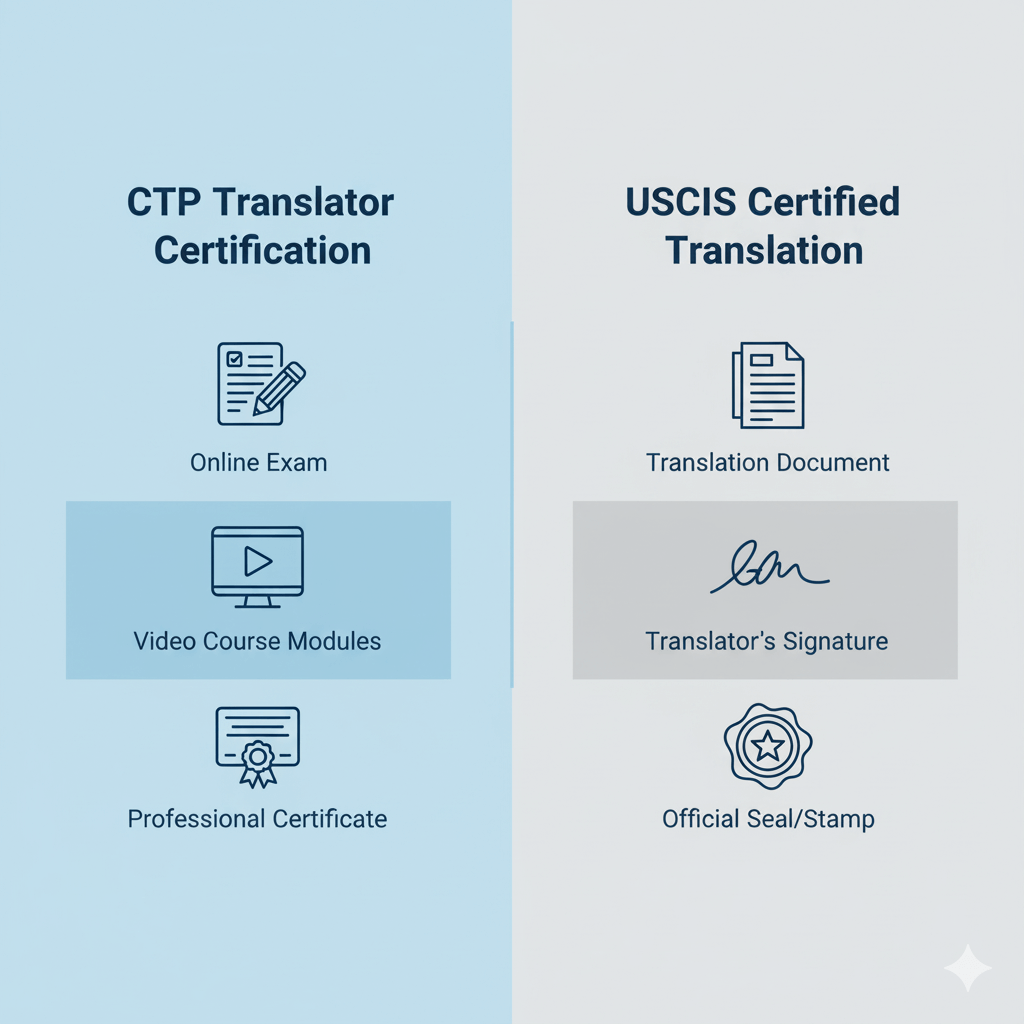
CTP vs “certified translation” for immigration — key differences
| Purpose | CTP (translator certification program) | USCIS certified translation (for your documents) |
|---|---|---|
| What it is | A training/credential for translators offered by a private provider | A translation + signed certification statement attached to each document you submit |
| Who needs it | Translators seeking a credential | Applicants submitting documents to USCIS |
| Requirement basis | Provider’s syllabus/exam | Federal regulation (8 CFR 103.2(b)(3)) and USCIS Policy Manual |
| Is it mandatory for USCIS? | No | Yes — every foreign-language document must include a certified English translation |
| Typical contents | Lessons, practice, and an exam (MCQs, essays, translations) | The translated document + translator’s certification (complete, accurate, competent) |
| Citation | Provider pages | eCFR / USCIS Policy Manual / EOIR guidance |
Sources: CTP program pages for structure/exam/fees; eCFR 8 CFR 103.2(b)(3) and USCIS Policy Manual for certified translation requirements.
Recognised translator credentials you’ll see in the market
If your interest is a translator career path, two well-established options to research:
ATA Certification (US)
- Three-hour proctored exam; widely used as a competence benchmark in the US market.
- Official information on exam availability, requirements and preparation is maintained by ATA.
CIOL DipTrans (UK, Level 7)
- Master’s-level professional qualification regulated in the UK; long-standing international recognition.
(Note: None of the above are required by USCIS to certify translations for immigration. USCIS focuses on the translator’s signed certification statement, not a particular badge.)
If you just need USCIS-compliant certified translations, here’s how it works
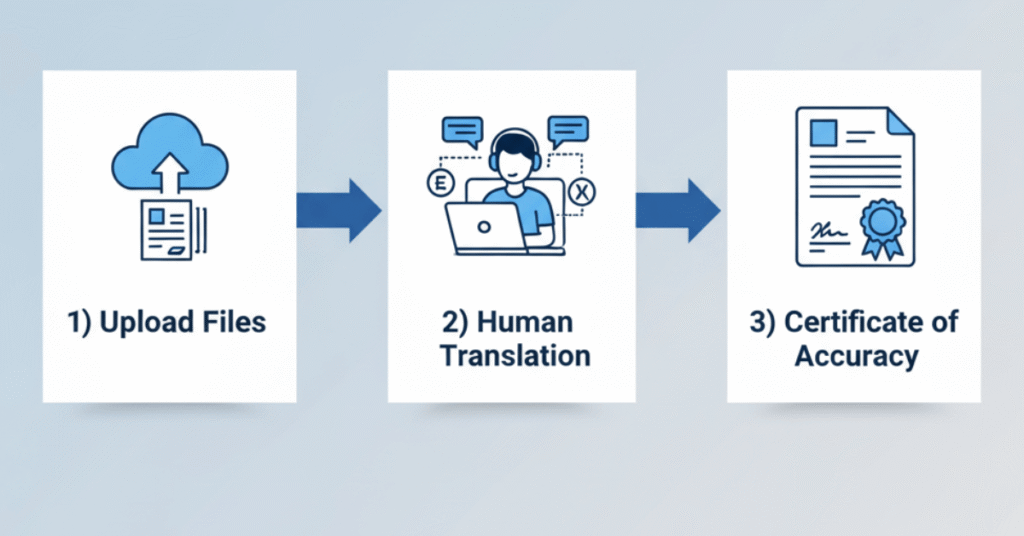
Our 3-step process
- Upload your files (photos, PDFs, scans).
- Human translation + QA by a qualified linguist in your language pair.
- Certificate of Accuracy (signed, dated, with translator’s name and contact info) delivered with your translation; digital copy included, hard copies on request.
Every translation includes the wording USCIS expects (complete & accurate; translator competent in both languages).
Trust signals:
- USCIS-compliant certification language (per 8 CFR 103.2(b)(3)).
- Secure data handling; professional project management.
- Fast turnaround and tracked delivery options.
CTP certification translation — when this phrase actually applies
The phrase “CTP certification translation” is used in two ways:
- Research intent: People exploring the translator certification program (“CTP”)—looking for a translator certification overview or translator certification video.
- Document intent: Rarely, a person may need to translate a CTP certificate itself for use abroad. In that case, you’d still need a certified translation of the certificate for authorities (USCIS or otherwise). Requirements depend on the receiving body (USCIS/EOIR follow the rules cited above).
Mini guide — becoming CTP-certified (if that’s your goal)
- Review syllabus & videos, then register for an exam date.
- Prepare for a mixed-format exam (MCQs, essays, two translation passages).
- Confirm fees & language pair(s); note add-on fees for multiple pairs.
- Compare with ATA or CIOL DipTrans if you want broader market recognition.
Why choose us for immigration translations
- USCIS-compliant: Our certificate meets 8 CFR 103.2(b)(3) language (complete, accurate, competent).
- Expert linguists: Native-level specialists in legal, civil status, academic and police records.
- Speed & reliability: Transparent timelines, digital delivery, optional hard copies.
- All formats: Birth/marriage certificates, diplomas/transcripts, police clearances, bank statements, affidavits, court documents, and more.
FAQs
What is a Certified Translation Professional (CTP)?
Answer: A private, online translator certification program featuring course modules and an exam (MCQs, essays, two translations). Recognition is market-driven (by clients/employers), not government-issued.
Does USCIS require translators to hold CTP (or any specific certificate)?
Answer: No. USCIS requires a certified translation (document + signed certification statement) per 8 CFR 103.2(b)(3); it does not mandate a particular translator credential.
What must the translator’s certification include for USCIS?
Answer: A statement that the translation is complete and accurate and that the translator is competent in both languages. Signature, date, and contact details are standard practice; EOIR guidance is similar for court filings.
Is CTP widely recognised like ATA or CIOL DipTrans?
Answer: CTP recognition varies. For widely recognised credentials, review ATA Certification (US) and CIOL DipTrans (UK).
I just need a certified translation for immigration. What should I do?
Answer: Upload your files. We’ll return the translation with a signed Certificate of Accuracy that aligns with USCIS requirements.
Testimonials
“Seamless experience. We uploaded our documents and received USCIS-ready certified translations within 24 hours.” — Immigration client, 2025
