

Confidently prove your language ability — and get the certified translations you need for immigration, study, and work.
At USCIS Official Translation, we help you choose the right exam, prepare your documents, and deliver USCIS-compliant certified translations the first time.
Who this guide is for
If you need to prove language proficiency for immigration, university admissions, professional licensing, or employment, this page explains the main certificate types, how to choose the right one, and the exact steps to register, prepare, sit the test, and submit results — plus how to get certified translations of your certificates for government use (including USCIS). For context, the CEFR framework defines levels A1–C2; many exams map to these levels and are widely recognised by schools and employers.
What is a language certificate?
A language certificate is an official document from a recognised exam body confirming your proficiency (speaking, listening, reading, writing) at a certain level (e.g., CEFR B2 or ACTFL Advanced). Examples include IELTS and TOEFL for English, TEF/TCF for French (Canada immigration), DELE for Spanish, and the Global Seal of Biliteracy used across education and employment.
Immigration note (USCIS): While U.S. immigration generally doesn’t require a language certificate, any foreign-language document you file must include a certified English translation meeting 8 CFR 103.2(b)(3). We provide these translations daily.
Quick selector: Which certificate do you need?
- Immigration (Canada): IELTS General Training (English) or TEF Canada (French) — required under Express Entry and related programmes.
- University admissions (global): IELTS Academic or TOEFL iBT accepted by thousands of institutions.
- Professional/Work: Employer or regulator may accept CEFR-aligned or ACTFL credentials (e.g., OPI/OPIc/WPT via LTI) or the Global Seal of Biliteracy.
- Government/Official language diplomas: DELE (Spanish), DELF/DALF (French), Goethe-Zertifikat (German), JLPT (Japanese), etc., often used for residency, study, or employment abroad.
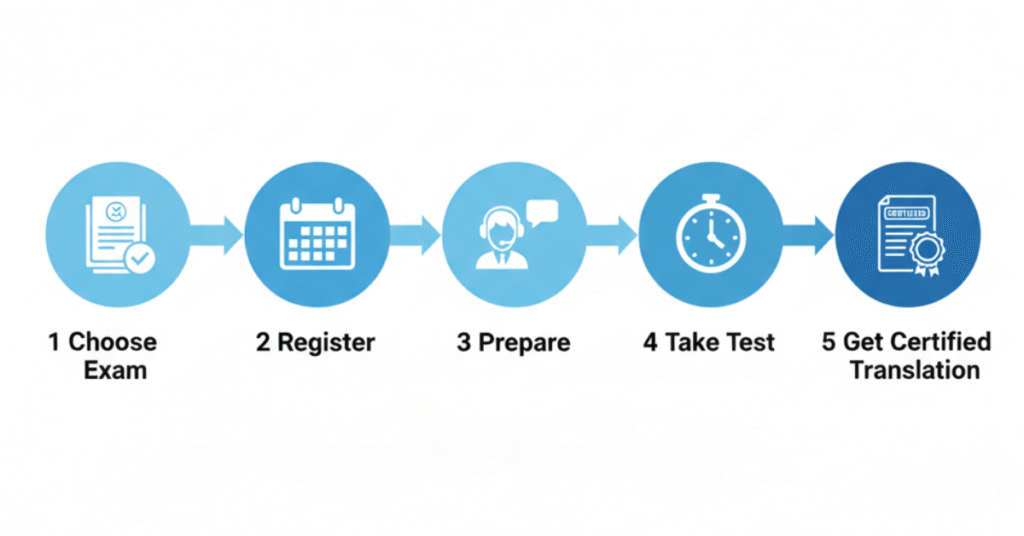
Step-by-step: How to get a language certificate
1) Define your goal and required level
- Confirm the purpose (immigration, study, work).
- Check the required test and level (e.g., CEFR B2, IELTS 6.5, TOEFL 85) with the relevant authority (university, regulator, immigration programme).
- Use CEFR descriptors to understand what each level means in practice.
2) Pick the right exam (and variant)
- English: IELTS Academic (study) vs IELTS General Training (work/immigration); TOEFL iBT for academic admission worldwide.
- French (Canada): TEF Canada accepted for Express Entry and citizenship pathways.
- Spanish: DELE diplomas are official and do not expire.
3) Register at an authorised test centre (or approved at-home option)
- Create an account with the exam provider, choose a date/location, and pay the fee.
- Some exams allow secure at-home testing (e.g., TOEFL iBT Home Edition) — verify availability and rules.
4) Prepare efficiently (4–6 weeks typical)
- Download the official test format and practice materials.
- Focus on the four skills; take timed mock tests; align practice to CEFR descriptors for target level.
5) Sit the exam and receive your results
- Bring valid ID, arrive early, follow centre rules.
- Results are usually available within days to weeks (varies by exam and location).
- Some exams report section scores (Reading, Listening, Speaking, Writing) — e.g., TOEFL iBT uses four sections.
6) Get certified translations (if you’ll submit to government or courts)
- If the certificate (or supporting documents like birth/marriage certificates, degree transcripts) is not in English, USCIS requires a full certified translation with a translator’s statement of accuracy and competence. We handle this end-to-end.
Popular certificate types at a glance
English
- IELTS — Academic & General Training; variants for UKVI and Life Skills exist for UK immigration.
- TOEFL iBT — four sections, accepted by 13K+ institutions globally.
French
- TEF Canada / TCF Canada — used for Canada immigration and citizenship.
Spanish
- DELE — official diplomas issued by Spain’s Ministry of Education via Instituto Cervantes; no expiry.
Cross-language frameworks & credentials
- CEFR levels (A1–C2) — widely referenced by schools, employers, and test providers.
- ACTFL OPI/OPIc/WPT — proficiency interviews and writing tests used by employers and schools.
- Global Seal of Biliteracy — portable credential signalling functional through working fluency.
Timelines, fees, and validity
- Registration windows: Popular dates fill quickly; book 2–6 weeks in advance where possible.
- Fees: Vary by country and test provider; expect a range roughly from modest to several hundred (local currency).
- Score validity: Many academic English scores are valid 2 years; government diplomas (e.g., DELE) may not expire — verify per exam before booking.
Submitting certificates for immigration & official use
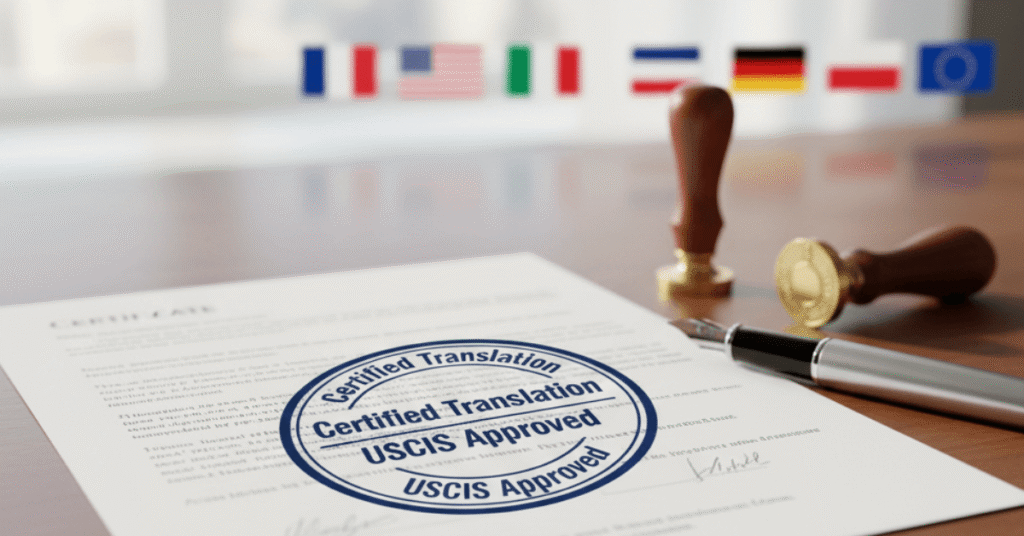
- USCIS (United States): No standard language test is required in most cases, but all non-English documents must include a certified translation meeting 8 CFR 103.2(b)(3). We prepare compliant translations and include the translator’s signed certification.
- Canada: Programmes such as Express Entry accept specific tests, including IELTS General Training and TEF Canada, with minimum scores across four abilities.
How we help (USCIS Official Translation)
- Guided test selection: We’ll point you to the correct exam for your purpose and target level.
- Document readiness: Certified translations of certificates, IDs, civil status documents, degrees, transcripts — formatted for USCIS, courts, and universities.
- Fast turnaround: Digital PDF delivery same day where possible; hard copies available on request.
- Quality assurance: Native linguists, double-review process, signed statement of accuracy.
★★★★★ 4.9/5 average rating · Accepted by USCIS, universities, and government bodies · Secure payments · NDA on request
Common mistakes to avoid
- Booking the wrong exam variant (e.g., IELTS Academic instead of General Training for immigration).
- Ignoring section-level requirements (minimums per skill).
- Submitting uncertified translations — USCIS will not accept them.
- Missing ID or centre rules, leading to a refused test day.
- Waiting too long to book; popular dates sell out.
FAQs
What is the difference between a language certificate and a certified translation?
A language certificate proves your proficiency from an exam body. A certified translation is a translator’s signed statement that a translation is accurate and complete — required by USCIS for any non-English document you submit.
Which English test should I take for immigration vs. university?
For immigration to Canada, IELTS General Training or TEF Canada are accepted. For university admissions, institutions commonly accept IELTS Academic or TOEFL iBT — always check your programme’s rules.
How are levels like B2 or C1 determined?
Many exams align to CEFR levels (A1–C2) with descriptors that define what you can do at each level.
Do language certificates expire?
Some do (e.g., many academic English scores are valid two years), while government diplomas such as DELE do not expire; confirm for your specific test.
Do I need a certified translation of my test certificate?
If you’re filing with USCIS and any document is not in English, include a certified translation compliant with 8 CFR 103.2(b)(3). We provide this for all languages.
Testimonials
“Superb service — they explained which test I needed and delivered certified translations within 24 hours. My application sailed through.” — Maya K.
“Precise, professional, and fast. The certification letter made USCIS submission straightforward.” — Rafael G.
