
Become a Certified Medical Language Professional — and Get Documents Accepted the First Time
Thinking about medical translator certification or medical interpreter certification for hospital work, immigration cases, or clinical research? This guide explains the pathways (translator vs interpreter), recognised credentials (NBCMI or CCHI), required training, exam steps, and how USCIS Official Translation can support you with certified, compliant document translations for immigration and healthcare.
Why Certification Matters in Healthcare & Immigration
- Patient safety & legal compliance: In hospitals and clinics, qualified language professionals reduce risk and support compliance with federal language-access rules. Title VI and Section 1557 require covered entities to provide language assistance for people with Limited English Proficiency (LEP).
- Trust for official documents: For immigration, courts, insurers and IRBs, accurate, word-for-word certified translations help avoid delays and repeat submissions.
- Career credibility: Credentials signal mastery of medical terminology, ethics, and confidentiality — critical in clinical and regulatory settings.
Translator vs Interpreter: Choose the Right Path
Medical Translator (Written Documents)
- Works on written content: medical records, vaccination cards, discharge summaries, lab reports, clinical trial forms, device IFUs, consent forms.
- Typical credentials: strong domain portfolio; ATA certification (where available) demonstrates professional translator competence (not medical-specific but widely respected).
- Certified translations in the US: A translator (or LSP representative) signs a certification statement attesting to accuracy — the translator does not need to hold a government licence to certify a translation.
How we help translators: style guides, bilingual glossaries, QA checklists, HIPAA-aware workflows, and final translator’s certificate for official use.
Medical Interpreter (Spoken Communication)
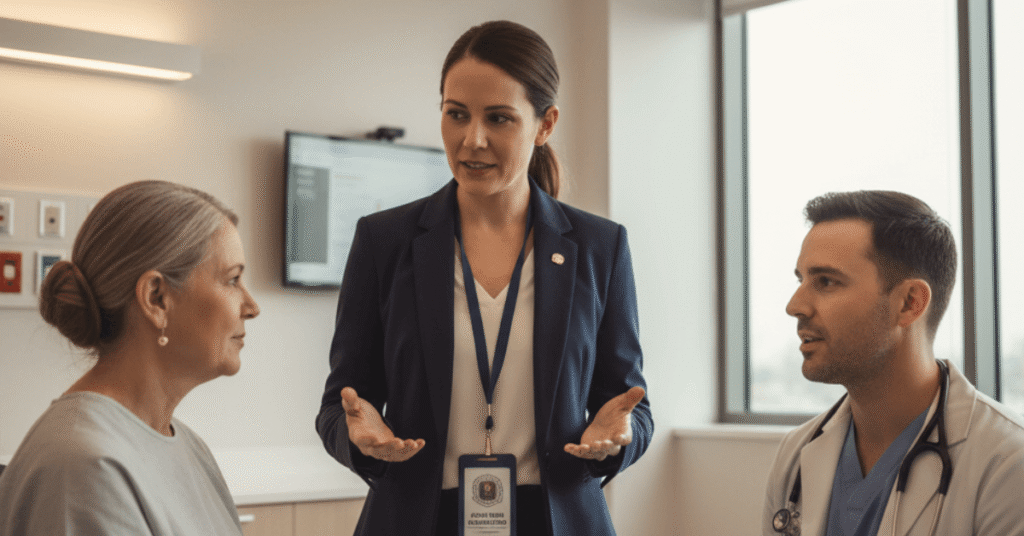
- Works in live settings: A&E, wards, surgery consent, telehealth, mental health, pharmacy counselling.
- Two national US certification bodies: CCHI (Certification Commission for Healthcare Interpreters) and NBCMI (National Board of Certification for Medical Interpreters).
- Core eligibility typically includes age 18+, high-school diploma (or equivalent), dual-language proficiency, and ≥40 hours of healthcare-interpreter training before exams.
Paths to Certification (Step-by-Step)
How to Become a Medical Interpreter (CCHI or NBCMI)
1) Confirm Eligibility
- Be 18+ with secondary education completion (US diploma/GED or recognised foreign equivalent).
- Prove language proficiency in English and your LOTE (language other than English).
- Complete ≥40 hours of healthcare interpreter training (academic or non-academic).
2) Choose Your Credential
- CCHI offers CoreCHI-P™ (knowledge + ETOE™ performance) for all languages, and CHI™ performance certifications for specific languages.
- NBCMI offers Hub-CMI (written) and CMI (written + oral) credentials; full CMI currently available in select languages (e.g., Spanish, Cantonese, Mandarin, Russian, Korean, Vietnamese).
3) Register & Schedule Exams
- Apply with your training proof and ID, then book knowledge and (where applicable) oral/performance exams at approved testing centres or online.
4) Prepare to Pass
- Study medical terminology, ethics, note-taking, sight translation, consecutive and simultaneous interpreting.
- Practise with real-world scenarios (ER intake, oncology consults, pharmacy counselling).
5) Maintain & Renew
- Complete continuing education (CE/CU) hours and renew per board rules.
- 2025 update: CCHI is sunsetting the legacy CoreCHI™; interpreters must pass ETOE and upgrade to CoreCHI-P™ to remain certified.
How to Get Certified as a Medical Translator (Documents)
Important distinction: In the US there is no single government-issued “medical translator licence.” Many document translators pursue ATA certification (where available for their language pair) to demonstrate professional competence; for official submissions (USCIS, courts, hospitals), what matters is a proper translator’s certification statement attached to the translation.
1) Build Domain Expertise
- Study anatomy/physiology, drug classes, clinical workflows, and adverse event language; maintain personal termbases.
2) Formal Training & Mentored Projects
- University modules, CPD courses, or in-house LQA programmes focused on medical registers and readability.
3) Consider ATA Certification
- If available for your language pair, sit the ATA exam to earn the CT credential and boost market credibility with hospitals, CROs, and law firms.
4) Deliver Certified Translations for Official Use
- Attach a signed certificate of accuracy with translator details, date, and statement of competence; ensure tamper-evident PDFs for e-filings.
Working in Hospitals: Compliance & Ethics
- Language access obligations: Covered healthcare providers must offer qualified interpreters and may not charge patients for language services. Policies flow from Title VI and Section 1557 and associated HHS guidance.
- Best practice for documents: Use trained translators; apply terminology controls; perform bilingual QA; preserve source meaning; include certification statements for official filings.
How USCIS Official Translation Helps
For Interpreters
- Training & exam prep pointers, glossaries, scenario banks, and reference packs.
- Credential tracking for teams (upload CCHI/NBCMI proof).
- HIPAA-aware NDAs and secure workspaces for hospital partners.
For Translators
- Medical document translation with rigorous QA and a signed translator’s certification accepted by government offices, courts, and hospitals.
- Format handling: EMR exports (PDF/HTML), scans, photos, DICOM captions, lab sheets, vaccination cards.
- Rush options for time-sensitive filings.
Frequently Asked Questions (FAQ)
Do I need certification to provide a certified translation for USCIS?
Short answer: Not legally — in the US, a translator (or LSP) may certify their translation with a signed statement. However, ATA certification is a strong credential and often preferred by clients.
Is “medical translator certification” the same as “medical interpreter certification”?
No. Translators work with written text; interpreters work with spoken communication. US national certifications (CCHI, NBCMI) are interpreter-focused, although many medical translators also hold ATA certification for written work.
How many training hours do I need before interpreter exams?
Most candidates need at least 40 hours of healthcare interpreter training before sitting the exams (plus proof of language proficiency and secondary education).
Which is better — NBCMI or CCHI?
Both are nationally recognised; availability and exam format vary by language. Some professionals hold both credentials. Review languages offered and exam structure, then choose what fits your goals.
H3: What changed with CCHI in 2025?
CCHI began sunsetting the CoreCHI™ credential; to remain certified, professionals must pass the ETOE and earn CoreCHI-P™.
Testimonials & Proof
“Fast, precise, and straightforward. My medical records were accepted without any issues.” — Immigration client, New York
“Their terminology control and QA checklist made hospital onboarding painless.” — Language Services Manager, Regional Hospital
