
Form I-130 petitions rely on supporting evidence that establishes the petitioner’s qualifying status and the claimed family relationship. Missing, inconsistent or insufficient I-130 supporting documents can lead to follow-up requests or other filing problems, so the evidence should be checked against the current USCIS instructions for the specific relationship.
This guide gives a practical evidence overview by relationship type and explains the translation requirements. It is not a substitute for the current Form I-130 instructions, because the exact evidence depends on who is filing, the beneficiary’s relationship to the petitioner, and the facts of the case.
What Is Form I-130 and Why Supporting Documents Matter
Form I-130, also known as the Petition for Alien Relative, establishes the qualifying relationship between a U.S. citizen or permanent resident and a foreign relative.
USCIS requires documentary evidence of the qualifying relationship. If supporting evidence contains foreign-language information, it must be accompanied by a full English translation that meets USCIS certification requirements.
Missing, inconsistent or insufficient evidence can:
- Delay processing by months
- Trigger an RFE
- Lead to denial
I-130 Supporting Evidence Overview
Below is a structured overview based on petition type. Use it together with the current USCIS Form I-130 instructions, because additional evidence may apply to adoption, legitimation, step-relationships, prior marriages, name changes and other circumstances.

Petitioner Status Evidence
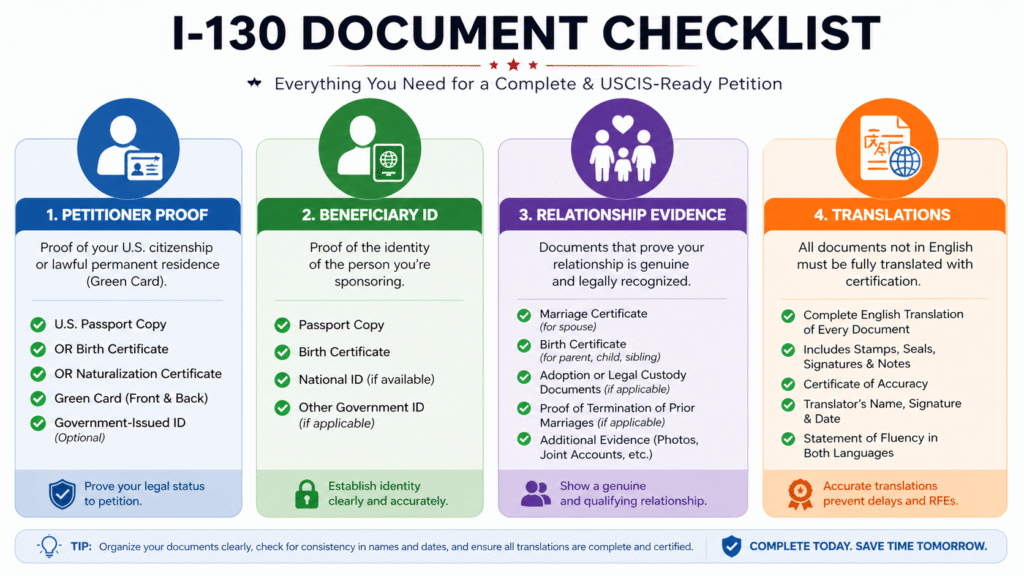
The petitioner must submit evidence showing the U.S. citizenship or lawful permanent resident status that makes them eligible to file the petition.
Required documents:
- Proof of U.S. citizenship:
- U.S. passport copy
- Birth certificate
- Naturalisation certificate
- OR proof of lawful permanent residence:
- Green card (front and back)
Beneficiary and Relationship Evidence
The beneficiary evidence depends on the relationship being claimed. For example, spouse petitions rely on marriage and bona-fide-marriage evidence, child and parent petitions often rely on birth records, and sibling petitions require records showing the shared parent. Additional documents may apply where there are prior marriages, adoption, legitimation, step-relationships or legal name changes.
Important: Any supporting document containing foreign-language information must be accompanied by a full English translation with the required translator certification.
Relationship-Specific Documents
This is where most applicants make mistakes. USCIS requirements change depending on the relationship.
Spouse Petition (Marriage-Based I-130)
Required:
- Marriage certificate
- Proof of termination of prior marriages (if applicable)
Strong supporting evidence (highly recommended):
- Joint bank statements
- Lease agreements
- Photos together
- Travel records
- Affidavits from friends/family
Note: For a spouse petition, USCIS instructions ask for evidence showing a bona fide marital relationship. Relevant evidence can include joint property, shared residence, combined finances, children born to the marriage, affidavits, or other documentation showing an ongoing marital union.
Parent Petition
Required:
- Petitioner’s birth certificate (showing parent’s name)
- Adoption records (if applicable)
Child Petition
Required:
- Child’s birth certificate
- Adoption or legitimation documents (if relevant)
Sibling Petition
Required:
- Birth certificates for both siblings showing at least one shared parent
Translation Checklist for I-130 Documents
This is one of the most overlooked parts of the process.
USCIS requires that a document containing foreign-language information be accompanied by a full English translation and the translator’s certification. See our USCIS translation requirements guide for the current certification details.
What Must Be Translated
- Entire document (not summaries)
- Stamps and seals
- Signatures (described, not recreated)
- Handwritten notes
- Marginal text
Translation Requirements
For USCIS use, the translator certification should identify the translator and confirm the required completeness, accuracy and competence. Current Form I-130 instructions specify:
- Complete and accurate English translation
- Certification that the English translation is complete and accurate
- Translator’s printed name and signature
- Signature date
- Certification that the translator is competent to translate from the foreign language into English
- Translator contact information
Common Translation Mistakes
Avoid these at all costs:
- Partial translations
- Machine translations without review
- Missing certification
- Inconsistent names or dates
- Ignoring stamps or official markings
Why Completeness Matters
USCIS requires the English translation to be full and complete. Stamps, seals, marginal notes and other meaningful foreign-language content should therefore be accounted for rather than omitted.

How to Organise Your I-130 Petition Package
A well-organised submission increases clarity and reduces risk.
Recommended structure:
- Cover letter
- Form I-130
- Filing fee receipt
- Petitioner documents
- Beneficiary documents
- Relationship evidence
- Translations + certificates
How Long Does Form I-130 Take?
There is no single I-130 processing time that applies to every case. Timing varies by petition category, workload and case circumstances. Use USCIS’s current processing-time information for the relevant filing rather than relying on a fixed estimate. Complete, organised evidence can reduce avoidable follow-up, but it does not guarantee faster adjudication.
Pre-Filing Document Check
Before submitting, confirm:
- All documents are included
- All non-English documents are translated
- Names match across all documents
- Dates are consistent
- Translations include certification
Trusted Translation Support for I-130 Petitions
When your case depends on accuracy, cutting corners on translation is risky.
For foreign-language evidence, our certified translation service can provide:
- full English translation prepared for USCIS submission
- standard and urgent turnaround options confirmed according to document scope and availability
- signed translator certification for certified USCIS orders
- review of names, dates and visible document text before delivery
If you are preparing an I-130 petition, you can upload foreign-language supporting documents for a quote and tell us the intended USCIS use so the certification scope can be confirmed before work begins.
Frequently Asked Questions
What are the main I-130 supporting documents required?
You need proof of your status, identity documents for both parties, and evidence of your relationship, such as marriage or birth certificates.
Do all I-130 documents need translation?
Only documents not in English must be translated, but they must be translated in full with certification.
Can I translate my own I-130 documents?
USCIS requires a full English translation and a signed translator certification stating that the translation is complete and accurate and that the translator is competent to translate from the foreign language into English. The regulation does not itself say the translator must be a licensed professional or translation company. Whoever signs the certification should be able to stand behind the accuracy and completeness of the translation.
What happens if I submit incomplete documents?
USCIS may issue an RFE or deny the petition, causing delays and additional costs.
How detailed does the translation need to be?
Every part of the document must be translated, including stamps, seals, and handwritten notes.
