
Yes, you can obtain a certified translation and then have the translator’s signed Certificate of Accuracy notarised. In the United States, USCIS requires a complete and accurate English translation with a translator’s certification; notarisation is not required by USCIS but may be requested by courts, universities, or other authorities.
What you’ll learn on this page
- When notarisation is (and isn’t) required
- Whether a notary can translate a document
- The safest way to handle self-translation
- A simple 3-step process to get a certified, optionally notarised translation
- How this connects to our broader legal translation online services
The quick answer
- USCIS rule: Any foreign-language document must be accompanied by a full English translation with a signed statement by the translator affirming accuracy and competence. USCIS does not require notarisation.
- When notarisation is asked for: Some courts, school registrars, professional boards, or overseas authorities may require the translator’s certificate to be notarised.
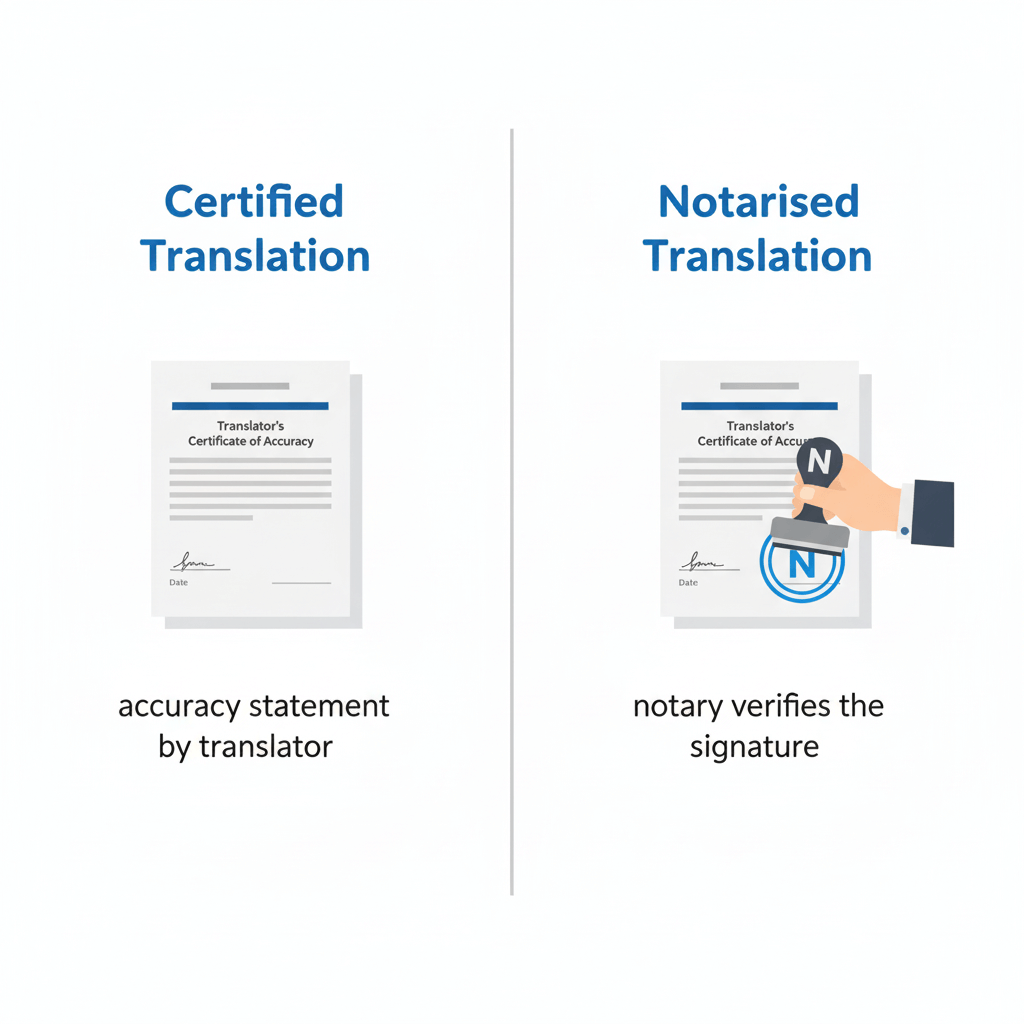
- Who signs: The translator (or agency certifier) signs a Certificate of Accuracy. A notary public verifies that signature—not the translation itself. Authoritative notary guidance confirms notaries generally cannot translate and notarise the same document due to conflict-of-interest rules.
Can a notary translate a document?
A U.S. notary’s role is to verify identities and witness signatures—not to judge translation quality. Notary associations advise that if a notary also translates, they must not notarise their own translator declaration; another notary must perform the notarisation.

Do I need notarisation for USCIS?
For immigration filings, USCIS accepts certified translations without notarisation. The essential elements are: full translation, translator competence, and a signed certification. Choose notarisation only if another recipient specifically asks for it (e.g., a courthouse or university).
Should I translate my own document and get it notarised?
Self-translation often creates problems:
- Many institutions require an impartial third-party translator.
- If you self-translate, you cannot credibly certify your own competence for official use—and you still may be asked for notarisation by a third party.
- Using a professional service avoids delays, rejections, or rework.
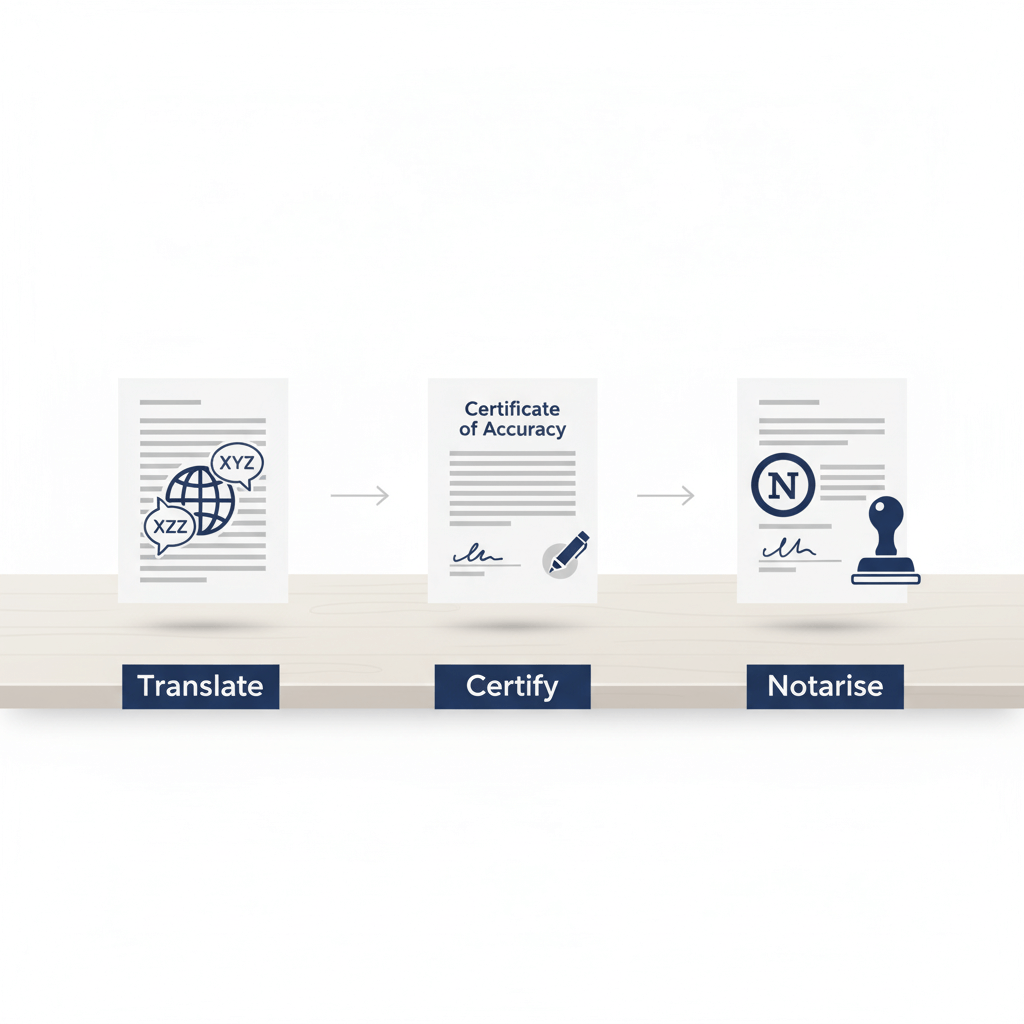
How notarised translations actually work (3 simple steps)
Certified translation
We produce a verbatim translation and attach a Certificate of Accuracy signed by a qualified translator/agency representative.
Notarisation (if requested)
We arrange a notary to witness the translator/agency representative signing the certificate and affix the notarial seal. The notary is verifying the signature/identity—not the translation’s accuracy.
(Optional) Apostille/legalisation
If you’re sending documents abroad, you may also need an apostille or consular legalisation after notarisation, depending on the destination. Check the receiving authority’s rules.
What goes into a USCIS-ready certified translation
- Full, line-by-line translation of every element (stamps, seals, marginal notes)
- Translator’s Certificate of Accuracy with name, signature, date, and contact details
- Clear reproduction of dates, names, and official numbers as they appear
- Delivery as secure PDF; hard copies available on request
Common scenarios we handle
- Birth, marriage, and divorce certificates for immigration, courts, and universities
- Police clearances and medical records for visas or licensing
- Academic transcripts and diplomas for admissions and credentialing boards
- Power of attorney and affidavits where a court clerk requests notarisation
Pricing & turnaround
- Transparent per-page pricing for civil status documents
- Bundle pricing for multi-document immigration packs
- 24–48-hour standard with same-day options for short documents
- Add-on notarisation and apostille/legalisation available
Why choose USCIS Official Translation
- Immigration-ready quality: Built around USCIS’s documentary rules.
- Court & university familiarity: We routinely prepare notarised translator certificates where required. (See notary guidelines on conflicts and procedure.)
- Speed & scale: Rapid turnaround with rigorous QA.
- End-to-end help: From translation to notarisation and, where needed, apostille/legalisation.
How this fits within Legal Translation Online
If you’re exploring broader legal needs (contracts, court filings, POAs, declarations), see our Legal Translation Online service—built for high-stakes legal documents and cross-border use.
Featured snippet-ready definitions
Certified translation (US): A translation delivered with a signed Certificate of Accuracy from the translator/agency affirming completeness and competence. (USCIS accepts certified translations without notarisation.)
Notarised translation: A certified translation where the translator (or agency certifier) signs the certificate in front of a notary, and the notary authenticates that signature. Notaries do not vouch for translation accuracy.
FAQs
Can a notary translate a document and notarise it?
A notary may translate or notarise, but typically not both on the same document; notarising one’s own translator declaration is a conflict of interest.
Do translations have to be notarised for USCIS?
No. USCIS requires a full English translation with a signed certification; notarisation is not required by USCIS. Some other institutions may still ask for notarisation.
Can I translate my own document and get it notarised?
It’s risky. Many recipients expect an independent translator. Even if a notary notarises a signature, self-translations are commonly rejected. Use a third-party certified translator to avoid delays.
Can a notary notarise a document written in a foreign language?
Often yes. Notary guidance notes that the notarial certificate must be in English and the notary must be able to communicate with the signer; the notary is authenticating the signature, not the language content. Requirements vary by state.
What if the court/registry asks for an apostille?
If the translated pack will be used abroad, you may need an apostille after notarisation. We can advise based on the destination country’s rules.
