
If you’re asking yourself “where do I translate a birth certificate?” it usually means a deadline is looming — a visa interview, green card filing, passport application, university start date, or a marriage registration.
The short answer:
You should translate your birth certificate with a professional service that provides certified, immigration-ready translations, ideally one that specialises in USCIS-compliant documents, accepts scans/photos online, and can deliver within 24–48 hours.
But because different authorities (USCIS, embassies, universities, courts) have slightly different rules, simply “finding a translator” isn’t enough. Getting this wrong can delay or even derail an application. US immigration rules, for example, state that any foreign-language document must be accompanied by a complete English translation and a certification from the translator confirming accuracy and competence.
The Short Answer: Where Do I Translate a Birth Certificate?
When you type “where do I translate a birth certificate” into a search engine, you’ll see three main types of options:
- Online professional translation services (recommended)
- Local translation offices / sworn translators / notary-linked translators
- Do-it-yourself or “friend who speaks English” translations
Here’s how they compare.
1. Online professional translation services (best for most people)
The most reliable and convenient place to translate a birth certificate today is an online certified translation agency that:
- Specialises in immigration and legal documents
- Provides a signed certificate of accuracy meeting USCIS rules
- Accepts scans or photos (no need to mail originals)
- Offers clear per-page pricing and fast delivery (often within 24 hours)
Industry data from immigration resources and specialist providers shows typical pricing in the $20–$40 per page range with standard 24-hour turnaround for simple civil documents like birth certificates.
At USCIS Official Translation, this is exactly what we do: you upload your document, and we return a complete, certified translation package that’s formatted and worded to meet immigration expectations.
Practical rule of thumb:
If your birth certificate is for USCIS, a consulate, or any government body, use a professional certified translation service, not a casual translator.
2. Local translation office, sworn translator, or notary-linked translator
Depending on your country, another common answer to “where do I translate a birth certificate” is:
- A sworn translator (e.g. in parts of Europe or Latin America)
- A notary-approved translator
- A legal translation office recognised by local ministries
In places like the UAE, for example, legal translations must be done by translators licensed by the Ministry of Justice, and these translations can then be notarised and legalised.
This route is especially relevant if:
- Your home country authorities require sworn or legalised translations
- You need the translation for local use (e.g. local birth registry, local court, or in-country civil status changes)
You can still use USCIS Official Translation for the English certified translation and, where required, pair it with local notarisation/legalisation arranged in your country.
3. Can I translate my own birth certificate?
Technically, US immigration rules don’t require the translator to be a government-certified professional. Guidance summarising USCIS rules notes that any person competent in both languages can provide the translation and certification.
However, immigration and translation bodies strongly caution against:
- Translating your own documents
- Using a close family member as the “translator”
- Submitting a rough or Google-translated version
Specialist immigration and translation organisations highlight that while self-translation might be theoretically possible, it is risky and can be viewed as biased, potentially triggering a Request for Evidence (RFE) or outright rejection if the translation looks unprofessional.
If the document matters enough to affect your visa, status, or citizenship, it matters enough to pay a professional.
What USCIS and Other Authorities Actually Require
Before deciding where to translate your birth certificate, you need to understand what the end user (USCIS, embassy, university, court) expects.
USCIS (United States Citizenship and Immigration Services)
USCIS has a simple but strict rule:
- Any foreign-language document submitted to USCIS must be accompanied by a full English translation, and
- The translator must certify that the translation is complete and accurate and that they are competent to translate from the foreign language to English.
When it comes to birth certificates specifically, USCIS policy notes that each foreign birth certificate must include a certified English translation.
In practice, this means your translation must include:
- A complete, word-for-word translation of the entire certificate, including seals, stamps and marginal notes
- A signed certification statement from the translator confirming:
- The translation is complete and accurate
- They are competent in both languages
- Their name, signature, date and contact details appear on the certificate
USCIS does not require notarisation of the translation itself, although other authorities sometimes do.
Certified vs Notarised vs Sworn Translation: What’s the Difference?
When you look for where to translate a birth certificate, you’ll see different labels. Here’s what they mean in plain language:
- Certified translation
- Includes the translation plus a signed certificate of accuracy by the translator or agency.
- Required by USCIS and many other immigration authorities.
- Notarised translation
- The translator signs the certification in front of a Notary Public, who verifies the identity of the signer (not the quality of the translation).
- Sometimes requested by courts, schools or foreign authorities. USCIS itself generally does not require notarisation.
- Sworn translation
- In some countries, certain translators take an oath before a court or ministry and are authorised as sworn translators.
- Their translations carry a particular legal status in that country and may be required for local procedures or certain consulates.
USCIS Official Translation provides certified translations that comply with USCIS and consular requirements, and we can advise when an extra notarised or sworn step is needed.
Online vs Local vs DIY: Which Option Should You Choose?
Let’s answer “where do I translate a birth certificate” in a more practical, side-by-side way.
Online professional service (like USCIS Official Translation)
Best when:
- You are inside or outside the US and need a translation for USCIS or a consulate
- You want to upload a scan/photo, pay online, and receive a PDF (and, if needed, a hard copy)
- You need a fast, predictable turnaround and a clear acceptance guarantee
Typical benefits backed by industry norms:
- Transparent per-page pricing around $20–$40
- 24–48-hour delivery for straightforward certificates, with faster rush options available
- Translators specialised in immigration and legal terminology
This is the option USCIS Official Translation is built for. You can upload your birth certificate now, choose your language pair, and receive a compliant translation package without leaving home.
Local translation office / sworn translator
Best when:
- You need the translation for local legal use in your home country
- A court, ministry or registry office insists on “sworn” or “legal” translation
- You are more comfortable meeting someone in person
You’ll usually:
- Bring the original or a certified copy
- Pay per page at a locally set rate
- Receive paper copies, sometimes with stamps and embossing
This is often more expensive and slower, but sometimes legally necessary depending on the country.
DIY or “friend who speaks English”
Realistically:
- You save money up front but risk delays, RFEs, or refusals later
- You must still produce a proper certification letter with full details of the translator
- If the translation looks unprofessional, officers are more likely to question it
For immigration-grade documents like birth certificates, professional translation is almost always the smarter choice.
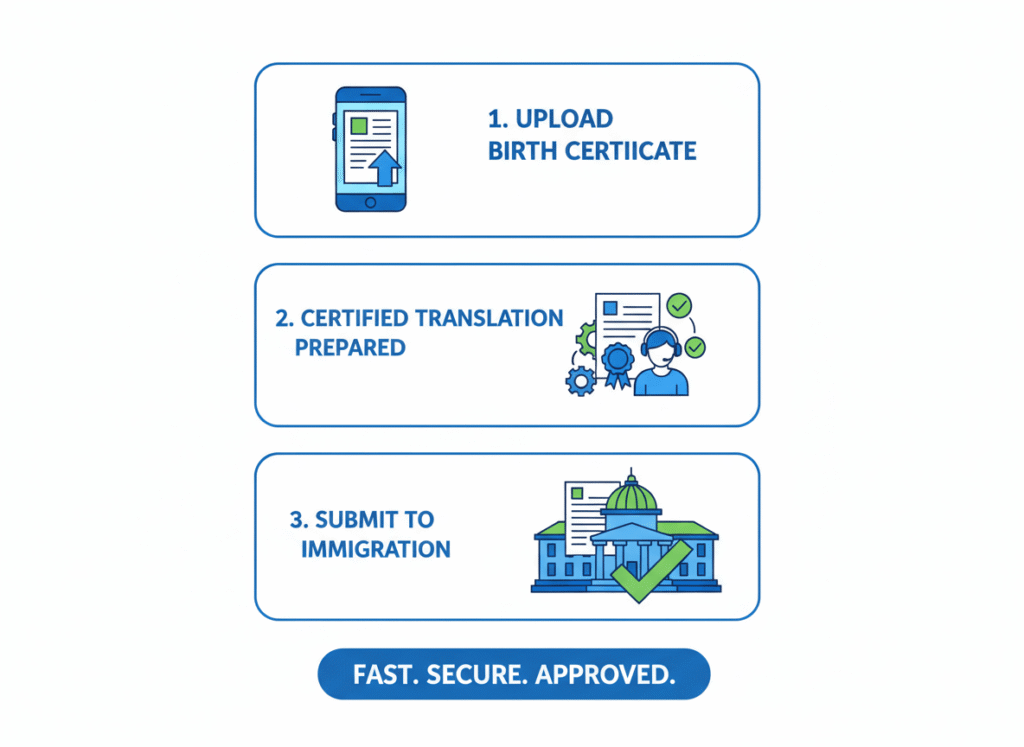
Step-by-Step: How to Translate a Birth Certificate with USCIS Official Translation
Here’s how a smooth, compliant process looks from start to finish.
Step 1: Gather your document in the best possible quality
- Obtain a clear scan or high-resolution photo of the entire birth certificate, including:
- Front and back (if there is text there)
- All stamps, seals, marginal notes, and handwritten comments
- If the certificate is damaged or hard to read, request a fresh official copy if possible.
Step 2: Confirm which authority will receive the translation
Before you order, quickly confirm:
- Is this for USCIS, a US embassy/consulate, or a foreign authority?
- Do they mention certified, sworn, or notarised translation anywhere?
- Do they require originals, copies, or allow scans?
This helps us tailor the translation and certificate to your exact use case.
Step 3: Upload your birth certificate and details
On the USCIS Official Translation platform:
- Upload your scan or photo (PDF, JPG, PNG)
- Select source language → English (or other required language)
- Add a note if you have specific spellings (e.g. how your name appears on your passport)
- Provide delivery preferences (PDF only, or PDF + hard copy)
You’ll see a clear quote before you commit, with no hidden extras for certification.
Step 4: Professional translation and quality checks
Our process typically includes:
- Assignment to a professional translator fluent in both languages and experienced with civil registry documents
- A full, literal translation of every word, stamp and note, preserving layout and structure for easy comparison
- Internal quality review to ensure names, dates and places match your supporting documents (passport, IDs, etc.)
Step 5: Certificate of Translation Accuracy
Your final package includes a signed certification statement confirming:
- The translation is complete and accurate
- The translator is competent in both languages
- The translator’s name, signature, date and contact details
This aligns with requirements drawn from USCIS practice, US State Department guidance, and immigration best practice.
Step 6: Delivery and use
You receive:
- A PDF of the translation and certificate (ready to upload to portals or print)
- (If requested) Printed copies by post for in-person submissions
From there, you simply attach the translation package to your immigration or legal application wherever a translated birth certificate is required.
Country-Specific Notes: When Requirements Change
Although this guide focuses on US immigration, many clients use the same translation for other countries.
- United States (USCIS) – requires a certified English translation with a proper certificate of accuracy; notarisation is not usually necessary.
- Canada (IRCC) – generally requires a certified translator and often an affidavit sworn before a commissioner of oaths or notary.
- United Kingdom (UKVI) – expects a fully certified translation with the translator’s or agency’s details and a statement of accuracy, often on letterhead.
- Australia (Department of Home Affairs) – typically requires translations done by NAATI-accredited translators.
If you plan to reuse your translation for multiple countries, tell us so we can structure the certificate to support more than one authority where possible.
What a Proper Birth Certificate Translation Package Should Include
Wherever you translate your birth certificate, make sure you receive:
- Copy of the original document (scan or photocopy)
- Typed translation that mirrors the layout and structure of the original
- Certificate of Translation Accuracy that states:
- The translation is complete and accurate
- The translator is competent in both languages
- Translator’s full name, signature, date and contact information
If any of these are missing, immigration officers or consular staff may question the translation.
How Much Does It Cost and How Long Will It Take?
While every provider is different, independent resources and specialist providers report:
- Typical price: around $20–$40 per page for a certified birth certificate translation
- Standard turnaround: usually within 24 hours for 1–3 pages
- Rush options: same-day or a few hours for urgent cases (often at higher cost)
At USCIS Official Translation, we keep pricing transparent and per page, and offer expedited options when you’re working against immigration or consular deadlines.
Common Mistakes That Cause Delays (and How We Help You Avoid Them)
Translation-related issues frequently trigger Requests for Evidence (RFEs) or slow processing. Common problems include:
- Partial translations (only some sections translated)
- Missing stamps or marginal notes in the translation
- Inconsistent name spellings compared to passports or IDs
- Illegible scans or cropped photos
- No certification statement, or one lacking key details (signature, date, contact information)
When you work with USCIS Official Translation, we:
- Translate every visible element of the certificate, including seals and notes
- Flag obvious inconsistencies in spelling or dates so you can address them before submission
- Build a complete certification with the correct legal wording and translator details
That way, you are submitting a translation that’s designed to meet expectations the first time.
Why Choose USCIS Official Translation?
If you’re still asking “where do I translate a birth certificate,” here’s why thousands of applicants choose a specialist immigration translation service:
- Dedicated to immigration documents – birth, marriage, police records, diplomas and more, all in one place
- USCIS-oriented – translations structured around the requirements of US immigration authorities and consular posts
- Secure online ordering – upload from your phone or laptop, no need to mail originals
- Multi-language coverage – support for major and less-common language pairs
- Professional translators – experienced linguists, not generic machine outputs
When your status, visa or application depends on a single page of paper, you want a partner who understands exactly what’s at stake.
Ready to move forward?
Upload your birth certificate today and receive a certified, immigration-ready translation package prepared for real-world scrutiny.
FAQ: Where to Translate a Birth Certificate
1. Where do I translate a birth certificate for USCIS?
The safest and most efficient option is a professional online translation service that provides certified translations specifically for immigration, including a signed certificate of accuracy. USCIS requires a complete English translation and a certification affirming accuracy and translator competence with every foreign-language document.
2. Can I translate my own birth certificate for USCIS?
Regulations allow any competent person to certify a translation, but immigration and translation experts recommend against self-translation because it can appear biased and is more likely to be questioned.
Using a professional service like USCIS Official Translation greatly reduces the risk of RFEs or refusals due to translation issues.
3. Do I need a notarised translation for USCIS?
In most cases, no. USCIS requires a certified translation, not a notarised one. Some other authorities (courts, universities, foreign ministries) may ask for notarisation in addition to certification, so always check the specific instructions.
4. Do I have to send the original birth certificate?
For translation purposes, you can almost always send a clear scan or photo rather than the physical original. Many authorities are happy to accept a copy of the original plus the certified translation. Some may later ask to see the original in person, but that is separate from the translation itself.
5. How long does it take to translate a birth certificate?
Most professional services deliver within 24 hours for a 1–2 page birth certificate, with faster options available for urgent cases. Turnaround can be longer for rare languages or complex handwritten documents.
6. Can I use Google Translate or another machine tool?
No, not on its own. USCIS requires a certified translation with a signed statement from a human translator confirming the translation is complete, accurate and that they are competent in both languages. A raw machine translation without human verification and certification will not meet this requirement.
