
If you’re asking yourself, “where can I translate my birth certificate to English?” you’re probably in the middle of something important – a visa, green card, citizenship, marriage, university, or passport application. The stakes are high, and the last thing you want is a delay or refusal because of a translation issue.
This guide walks you through every realistic option for translating your birth certificate to English, what different authorities actually require, how much it costs, how long it takes, and how to choose a provider you can trust.
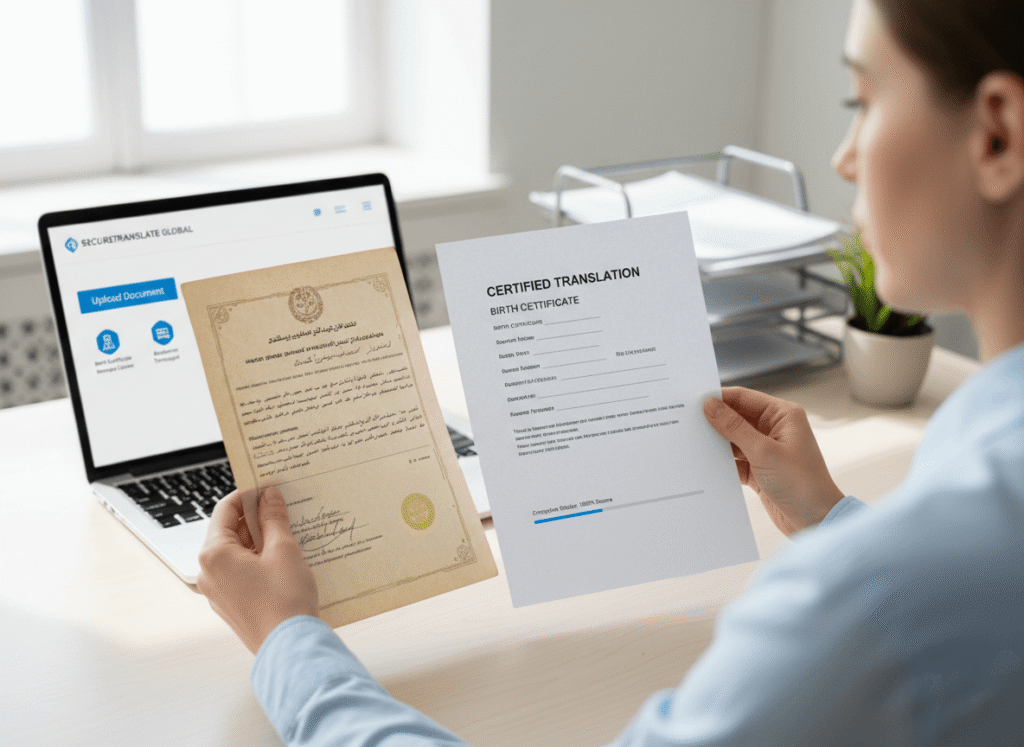
Quick answer: where can I translate my birth certificate to English?
Most people end up using one of these:
- Professional online translation agency (fast, secure, accepted for immigration, courts, universities)
- Specialised local translation office in your city
- Independent professional translator who can provide a written certification
- Embassy / consulate referrals or approved lists for specific countries
- Not DIY or machine translation – these nearly always fail for official use
If you need a certified English translation for USCIS or other authorities, the safest option is a professional service that:
- Provides a full, word-for-word translation
- Includes a signed translator’s certification confirming accuracy and language competence
- Delivers the translation in a clear, printable format you can upload or post with your application
Why you need an official English translation of your birth certificate
Your birth certificate is a foundational identity document. Authorities may ask for it when you:
- Apply for a US visa, green card or naturalisation
- Prove identity for citizenship, passport or Social Security
- Register a marriage or civil partnership abroad
- Enrol at a school or university
- Finalise adoption, guardianship, or inheritance procedures
- Deal with courts, banks or government agencies in another country
For US immigration, any document that isn’t in English must be submitted with a full English translation that the translator has certified as complete and accurate, plus a statement that they are competent to translate from the foreign language into English. USCIS policy also explicitly notes that foreign birth certificates must include a certified English translation.
Where can I translate my birth certificate to English?
1. Professional online translation agencies
For most people, the simplest and safest answer to “where can I translate my birth certificate to English?” is: a reputable online translation agency that specialises in certified document translations.
Typical advantages
- You can order entirely online – upload a scan or photo of your birth certificate
- Clear pricing (usually per page) and instant quotes
- Turnaround for a single-page birth certificate is often around 24 hours, with faster rush options available
- The translation comes with a signed certification statement containing the translator or company details, date, and a declaration of accuracy
- Many services are experienced with USCIS, embassies, universities, courts and banks, so they know how to format the translation correctly
How USCIS Official Translation fits here
USCIS Official Translation is positioned in exactly this space: a dedicated, document-focused service for people who need certified English translations of personal documents for immigration and other official procedures. You upload your file, confirm your details, and receive a professionally formatted, certified translation ready to attach to your application.
You avoid hunting for local offices, chasing freelancers, or worrying whether the wording of the certificate of accuracy will be accepted.
Ready to move on? Upload your birth certificate to USCIS Official Translation and receive a certified English translation prepared for immigration officers and other authorities.
2. Local translation offices and language service providers
If you prefer face-to-face support, you can look for a local translation company or “sworn” translator (where that concept exists) in your city.
Pros
- You can show your original document in person
- Easier if you also need notarisation or apostille assistance
- Some offices are officially registered with local ministries of justice or foreign affairs
Things to check
- Can they provide a certified English translation with a formal declaration of accuracy?
- Are they familiar with USCIS or the specific authority you’re dealing with?
- Do they return both PDF and paper copies if needed?
Local providers can be excellent, especially if you’re also arranging legalisation, but they may be slower or more expensive than streamlined online services.
3. Independent professional translators
You can also hire a freelance translator directly, often through professional directories or referrals.
According to guidance widely cited in the industry, any individual who is fluent in English and the original language can, in principle, certify their own translation for USCIS, as long as they include a signed statement of accuracy and competence.
However, in practice authorities are much more comfortable with experienced professionals, especially for tricky scripts, older documents, handwritten certificates or multiple stamps and annotations.
If you choose this route, make sure the translator:
- Works into English as a native or near-native language
- Has clear experience with official documents and immigration
- Provides a formal certificate of translation on letterhead, with contact details
- Delivers in a clean, typed layout that mirrors your original
4. Embassies, consulates and official lists
Some countries’ embassies or consulates publish lists of approved or recommended translators, particularly where sworn translators or court-certified translators exist.
This can be useful if:
- You are translating a birth certificate issued in that country for use abroad
- The receiving authority requires a translator registered with a specific body
- You need both translation and legalisation in one chain
Bear in mind that embassies rarely do the translation themselves – they usually refer you to external professionals.
5. Community contacts, friends and “someone who speaks English”
This is where many applications go wrong.
While a bilingual friend might understand the content of your birth certificate, they usually cannot produce a legally robust, formally certified translation. They may also miss subtle issues like:
- Spelling of names vs. passports
- Transcribing handwritten entries
- Translating old terminology or regional place names
- Interpreting stamps, seals and marginal notes
Immigration officers and other authorities are trained to spot “homemade” translations. Using one can lead to questions, requests for evidence, or outright rejection.
6. Machine translation and AI tools
Online machine translation tools (including free ones) are great for getting the gist of a casual email. They are not appropriate for official birth certificate translations.
- They often mishandle names, abbreviations, and official terminology
- They can’t add the required translator’s certification
- Using them may violate data protection rules if you upload sensitive personal documents
For official purposes, machine translation is a useful background tool for professionals – not a replacement for a certified translator.
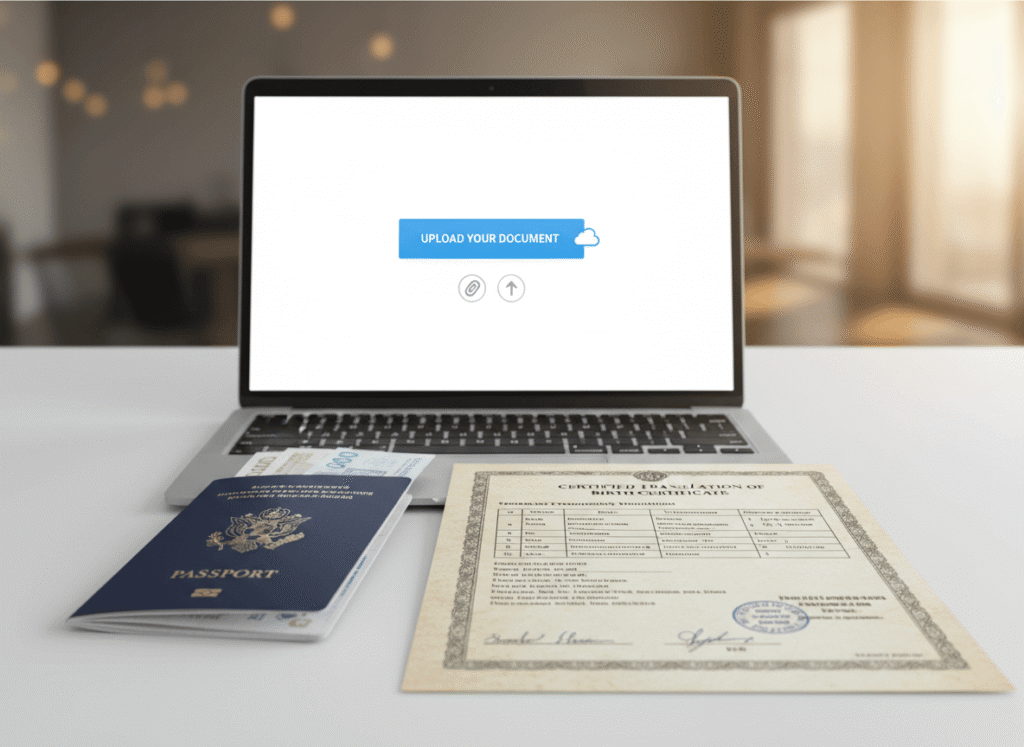
What makes a translation valid for immigration and other official uses?
Different authorities have slightly different rules, but they tend to expect the same core elements:
1. Full, word-for-word translation
A valid translation must:
- Include all text on the birth certificate – headings, stamps, annotations, margins
- Mirror the structure and order of the original as closely as possible
- Indicate if a part of the document is illegible rather than guessing
For USCIS, the translation must be a full English translation of the document, not a summary.
2. Certification of accuracy and competence
A proper certified translation of your birth certificate will be accompanied by a signed statement (often on the translator’s or agency’s letterhead) stating:
- The translator’s name
- That they are competent to translate from the source language into English
- That the translation is complete and accurate
- The date and place of certification
- Contact details (address, email, phone)
US government guidance and professional associations emphasise that the translator must clearly certify both their competence and the accuracy of the translation.
3. Clear identification of the original document
The translation and certificate should:
- Refer to the type of document (e.g. “birth certificate for [Name]”)
- Include any reference numbers, registry details or book/page numbers
- State whether the translation was based on a copy or original
4. When notarisation or apostille is needed
USCIS itself generally requires certified translations, not notarised ones. Some courts, universities, state offices or foreign authorities, however, may ask for:
- Notarisation of the translator’s signature; or
- An apostille attached to the translated document or the underlying birth certificate
In those cases, it’s often easiest to work with a provider (such as USCIS Official Translation and its partners) that can help coordinate translation + notarisation + apostille as a single chain.
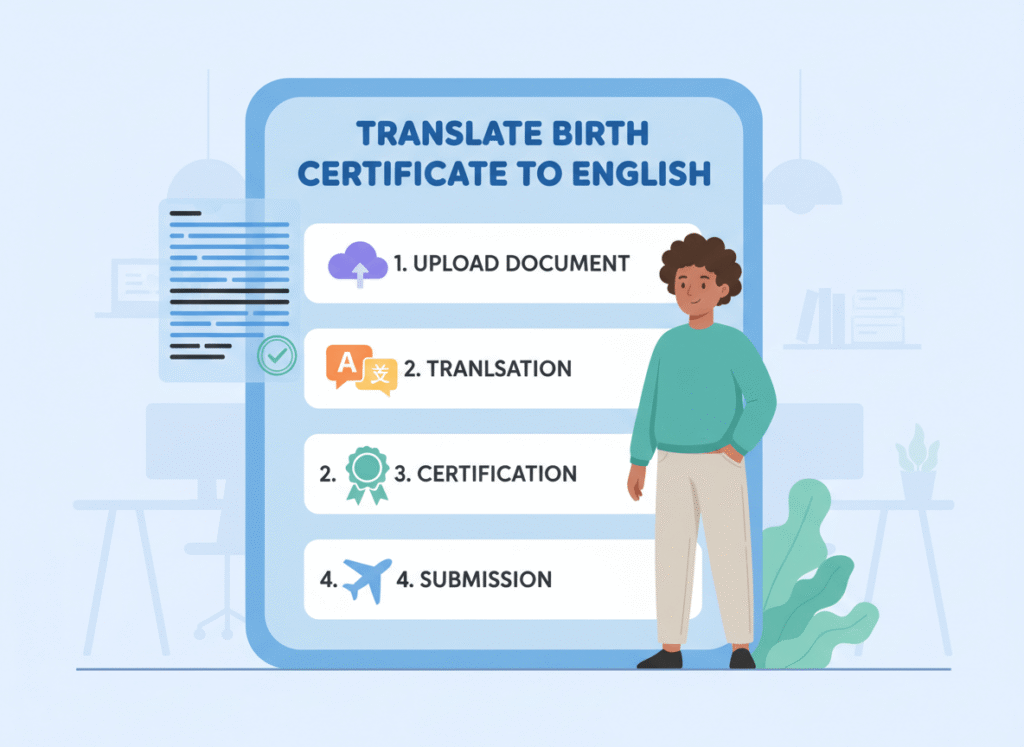
Step-by-step: how to translate your birth certificate to English
The process is easier when you break it down:
Step 1: Confirm what the receiving authority requires
Before choosing where to translate your birth certificate to English, check:
- Do they explicitly say “certified translation”, “sworn translation” or “notarised translation”?
- Are there any specific wording requirements for the certification?
- Do they require a long-form birth certificate rather than a short, wallet-sized one?
Most immigration lawyers recommend getting the long-form version where possible, as it contains full parental and registration details.
Step 2: Get a clear digital copy
Authorities and translators both need to be able to read the document:
- Scan your birth certificate in colour, high resolution
- Make sure all corners, stamps and margins are visible
- If two sides are used (front/back), scan both sides
- For very old or damaged certificates, consider ordering a fresh certified copy
Step 3: Choose your translation provider
Now that you know the requirements, choose between:
- USCIS Official Translation – streamlined online ordering, immigration-focused, fully certified translations
- Another online agency – if you have a country-specific need (for example, a sworn translator in a specific jurisdiction)
- Local office or specific translator recommended by an embassy or legal adviser
Look for:
- Clear mention of certified translations for birth certificates
- Experience with USCIS, IRCC, UKVI, embassies or courts
- Transparent pricing and turnarounds
- Secure handling of your documents
To skip the research, you can upload your file directly to USCIS Official Translation and receive a quote and delivery time before you proceed.
Step 4: Place your order and share any special instructions
When ordering:
- Provide your full name exactly as it appears on your passport
- Mention any preferred spelling of names or places if they differ from the original script
- Specify where you’ll use the translation (USCIS, Home Office, university, court, etc.) so the provider can tailor formatting and certification
- Ask whether you’ll receive both PDF and printed copies
Step 5: Review and store the translation
When you receive your translation:
- Check that all personal details match your passports/IDs
- Verify that dates are in the correct format (e.g. 31/01/1990 vs. 01/31/1990)
- Confirm that the translator’s certification is attached and signed
- Keep digital and paper copies together for future applications
If you’ve used USCIS Official Translation and spot a typo or mismatch, simply request a correction – reputable providers will fix minor issues quickly without extra cost.
How much does it cost to translate a birth certificate to English?
Prices vary by language pair, country and level of service, but there are clear patterns:
- Many international providers charge roughly $18–$40 per page for standard certified translations of birth certificates.
- Some services in higher-cost regions or rare languages charge more, especially when notarisation or sworn status is required.
- In parts of the Middle East and Europe, typical price bands for birth certificate translation are broadly equivalent when converted to USD, though quoted in local currencies and sometimes as part of package fees.
Factors that can increase the price:
- Rare language combinations
- Rush services (same-day or a few hours)
- Additional services such as notarisation, apostille, or courier delivery
How long will my birth certificate translation take?
For a standard, one-page birth certificate:
- Many online providers deliver within 24 hours for a regular order
- Same-day or urgent 4–8 hour options are often available for an additional fee, especially if you upload during office hours
Larger documents, very old certificates, rare language pairs and added services (like notarisation or apostille) can extend the timeline.
If your immigration or consular appointment is approaching, it’s wise to:
- Order your translation at least a week in advance, and
- Keep spare copies in case another authority later asks for the same document
How to choose the right provider to translate your birth certificate
To avoid delays and rejections, treat the choice of provider as seriously as any other part of your application.
Checklist: a good provider will
- Clearly state that they offer certified English translations of birth certificates
- Provide a sample certificate of translation or sample layout on their site
- Use human translators with experience in civil registry documents
- Offer secure upload and data protection
- Have verifiable reviews and a physical business presence
- Respond quickly and clearly to questions
Red flags to avoid
- “We use AI translation only” with no human review
- No mention of a signed certification
- No physical address, phone number or verifiable company details
- Vague promises like “USCIS-style translation” without explicitly saying certified
- Asking you to edit the translation yourself
Common mistakes that cause delays or rejections
Even with a good translator, applications can be held up by avoidable issues:
- Partial scans – cutting off seals, margins or reverse sides
- Submitting a short-form birth certificate when a long-form is required
- Inconsistent spellings of names across passports, IDs and translations
- Attempting to translate the document yourself and signing as translator when you’re also the applicant
- Using a provider that omits the certification statement or leaves out their contact details
- Forgetting to include both the original and the translation in your application bundle
Working with a specialist service like USCIS Official Translation significantly reduces these risks, because this is the type of document they handle every day.
Why choose USCIS Official Translation for your birth certificate?
When your question is “where can I translate my birth certificate to English so that it’s actually accepted?” you want to maximise certainty and minimise hassle.
With USCIS Official Translation you get:
- Certified English translations tailored for immigration, consular and academic use
- Translators experienced in civil registry documents across dozens of countries and languages
- A simple online process – upload, confirm details, receive your translation
- Fast turnaround, with express options for urgent cases
- Professional layouts that mirror your original certificate and highlight seals, stamps and margins
- Dedicated support if an officer requests clarification or a minor adjustment
FAQs: Translating your birth certificate to English
1. Where can I translate my birth certificate to English near me?
You can use:
- Online certified translation services like USCIS Official Translation
- Local translation offices specialising in legal or immigration documents
- Independent professional translators found via reputable directories
Because most applications accept scanned copies and PDF translations, the physical location of the translator is usually less important than their ability to produce a properly certified translation.
2. Can I translate my own birth certificate for USCIS?
Technically, US regulations allow any competent person to certify a translation, including non-professionals, as long as they provide a signed statement of accuracy and competence.
However, self-translation is strongly discouraged because:
- Officers may see a conflict of interest
- You could misread handwritten or legal terms
- It’s easier for USCIS to question or doubt the translation
Using a professional service like USCIS Official Translation gives you a neutral, expert translator and a properly worded certificate of accuracy.
3. Is Google Translate or other machine translation accepted?
No. Official bodies expect a human-produced, certified translation. Machine translations:
- Do not provide the required certificate of accuracy
- Are prone to errors in names, dates, places and legal wording
- Can expose your data if you paste sensitive documents into public tools
You can use these tools privately to understand the gist of the document, but not as the submission version.
4. Do I need a notarised translation, or is certified enough?
For USCIS, a certified translation is normally sufficient – they do not routinely require notarisation of the translator’s signature.
Some other authorities, such as:
- State courts
- Certain universities
- Some foreign consulates or ministries
may require a notarised translation or an apostille on the underlying birth certificate. Always check the official instructions and, if necessary, choose a provider (like USCIS Official Translation and partners) who can arrange notarisation or advise on legalisation.
5. How long is a translated birth certificate valid?
In most cases, a certified English translation of your birth certificate does not expire as long as:
- The information on the original certificate hasn’t changed; and
- The translation reflects that original accurately
However, some authorities prefer translations dated within the last 6–12 months, especially in fast-changing immigration regimes. If your translation is several years old and you’re starting a new process, it may be worth ordering an updated version.
6. What if my birth certificate is damaged, missing, or in very poor condition?
If your birth certificate is:
- Heavily damaged
- Illegible in parts
- Missing entirely
You should first:
- Request a new certified copy from the relevant registry office or civil authority.
- Once you have a clear, official copy, submit it to USCIS Official Translation for a certified English translation.
Translators are trained to flag any illegible sections rather than guess, but starting from a clean copy gives you the best chance of smooth approval.
