
If you’re typing “where can I translate a birth certificate” into a search bar, there’s almost always something big on the line: a green card filing, a citizenship application, a K-1 visa, a passport for your child, or a university or licensing application that cannot move forward without that document.
You don’t just need any translation. You need one that an immigration officer, consular official, or university administrator will quietly accept and move on from—no delays, no Requests for Evidence (RFEs), no back-and-forth over wording.
This guide walks you through exactly where you can translate a birth certificate, which options are risky, which are safe, and how to choose a provider that delivers a translation that meets U.S. expectations, including the strict rules applied by U.S. Citizenship and Immigration Services (USCIS).
Along the way, you’ll also see why thousands of applicants choose USCIS Official Translation for fast, fully certified birth certificate translations they can reuse for multiple applications.
Before You Decide Where to Translate, Understand What “Acceptable” Means
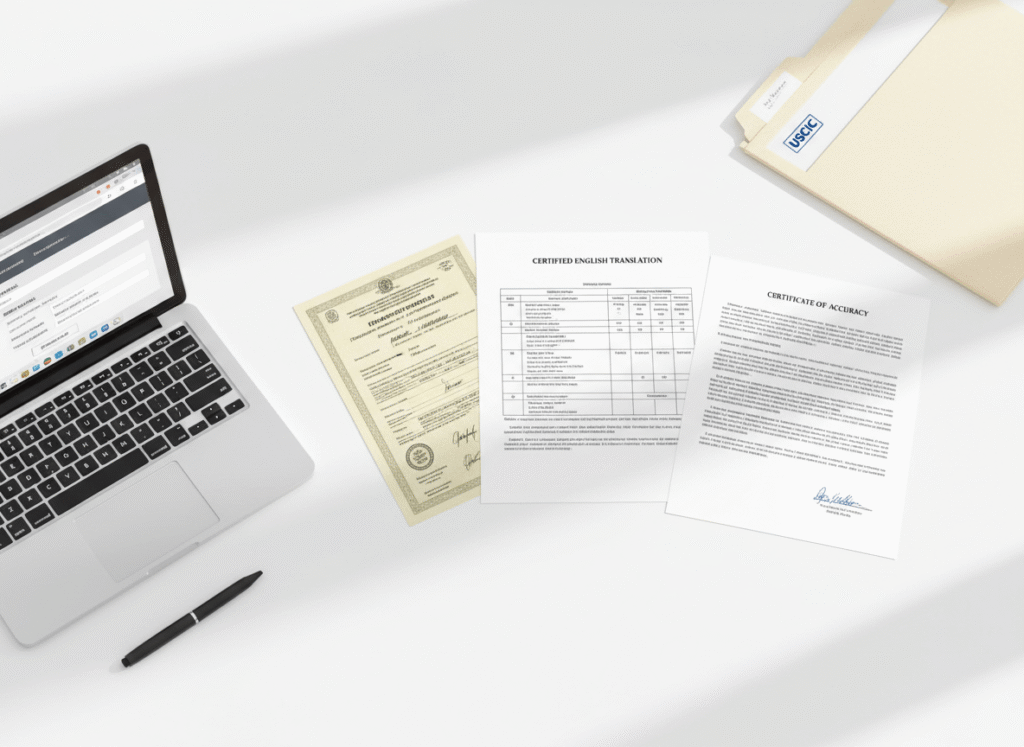
Different authorities have different formats and preferences, but they all care about the same core idea: the translation must be complete, accurate, and accountable.
For USCIS, the underlying rule is simple but strict:
- Any foreign-language document must be submitted with:
- a full English translation, and
- a signed certification from the translator confirming that the translation is complete and accurate and that they are competent in both languages.
In practice, that means your birth certificate translation should:
- Translate every visible element: text, stamps, seals, margins, amendments, registration numbers.
- Reproduce the layout clearly enough that an officer can compare it with the original.
- Include a separate certificate of accuracy (translator’s certification) that names the translator or agency, states their competence, and is signed and dated.
Your Main Options for Translating a Birth Certificate (from Risky to Reliable)
People generally end up choosing from the same handful of options. Some are safe; others are shortcuts that come back to bite you later.
Here’s an at-a-glance comparison you can turn into a visual table on the page:
- Free machine translation tools (e.g. Google Translate)
- Friends, relatives or community members
- Law firms, notaries or general offices that “also translate”
- Local walk-in translation agencies
- Professional online certified translation services (specialising in immigration)
Let’s look at each.
Free Machine Translation Tools
This is the fastest and cheapest option—and also the one most likely to cause serious problems.
Machine tools:
- Often mistranslate names, abbreviations and legal terms.
- Have no way to add a proper certification statement.
- Can’t take responsibility for accuracy or answer questions from an officer.
Submitting a machine-generated text, even if you sign something yourself, can look careless or deceptive. It’s fine if you just want to understand your own document; it’s not fine for immigration or official applications.
Friends, Relatives or Community Members
Most U.S. guidance says that any competent bilingual person can certify a translation. In theory, that includes you, your spouse, or a friend. In reality:
- Officers can question bias when the translator is closely involved in the case.
- Informal templates or missing wording in the certification statement can lead to RFEs.
- If something is mistranslated, you have no professional support to fix it quickly or explain.
Because a birth certificate is a core identity document, many immigration lawyers strongly recommend using a neutral professional rather than a relative, especially when USCIS is involved.
Law Firms, Notaries and General Offices
It’s common to assume that “notary” automatically means “translation”. In fact:
- A notary usually witnesses signatures; they don’t translate themselves.
- Some law firms outsource translation to third-party providers, which can work well—but you’re paying an extra layer.
- Staff may be excellent at legal work but not trained translators.
If you go this route, confirm who actually does the translation, whether they provide a proper certificate of accuracy, and whether they have documented experience with immigration or consular work.
Local Walk-In Translation Agencies or Sworn Translators
In many cities, you’ll find small agencies near consulates, court buildings, or government offices that offer “certified translation” for civil status documents like birth, marriage and police certificates.
These can be a good choice if:
- You prefer face-to-face contact and want to hand over documents in person.
- Your country requires a sworn or court-appointed translator for use with local authorities.
- You need a stamped paper original for a particular consulate.
However, quality and familiarity with USCIS-style requirements can vary. Before you commit, ask:
- Do you provide a word-for-word translation of the entire certificate, including stamps?
- Will I receive a signed translator’s certification that meets U.S. immigration standards?
- How often are your translations used for U.S. immigration, visas or universities?
If the answers are vague, consider a more specialised provider.
Professional Online Certified Translation Services (Best Overall for USCIS)
For most people searching “where can I translate a birth certificate”, the most reliable answer is:
A professional online certified translation service that specialises in immigration and USCIS work.
Modern online services like USCIS Official Translation are designed around exactly this use case:
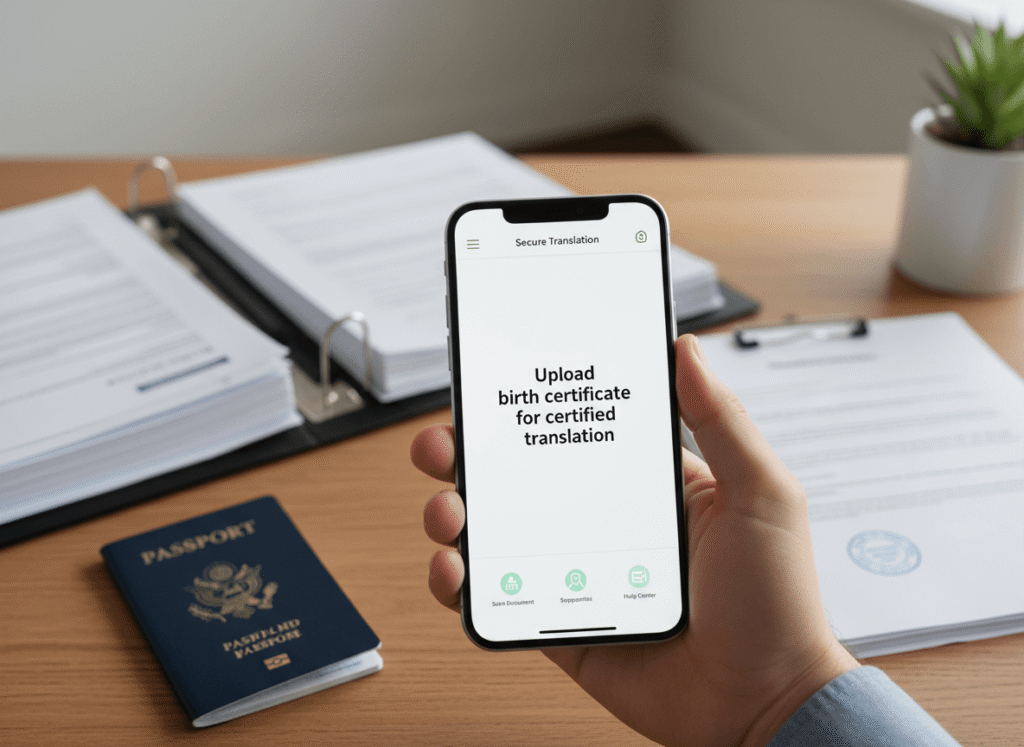
- You upload a clear scan or photo of your birth certificate.
- A specialist translator prepares a full, word-for-word translation.
- A certificate of accuracy is added, with the translator’s name, signature, date and contact details.
- You receive a PDF you can print or upload, with optional hard copies or notarisation if another authority requires it.
Typical benefits include:
- Fast turnaround – often 12–24 hours for standard one-page certificates.
- Transparent, per-page pricing – starting from around $18–$40 per certificate for common languages.
- Experience with USCIS, NVC, consulates and universities, so the wording and layout feel familiar to officers.
- Secure upload and storage, so you never risk losing your original.

How to Decide Where to Translate: A Simple Checklist
Use this practical checklist to compare any provider—online or local—before handing over your birth certificate.
You want a provider that can confidently say “yes” to as many of these as possible:
- Full, literal translation
- Do they translate everything on the page, including stamps, seals, margins and handwritten notes?
- Proper translator’s certification
- Do you receive a separate signed statement confirming that the translation is complete and accurate, and that the translator is competent in both languages, as required by USCIS rules?
- USCIS and immigration experience
- Have their translations been used successfully in immigration cases, not just casual or marketing content?
- Clear acceptance record
- Can they point to a strong track record of translations being accepted by USCIS and other authorities, or even offer an acceptance guarantee?
- Transparent pricing
- Is pricing straightforward (for example, a fixed price per birth certificate) with no hidden “certification” extras?
- Reasonable turnaround with rush options
- Can they deliver within your filing timeline and offer rush service if your biometrics, medical or interview date is close?
- Secure upload and data protection
- Do they use encrypted connections and clear privacy policies, especially if you’re submitting passports or other sensitive documents at the same time?
- Re-issue and support
- Will they correct minor spelling issues or re-issue a certificate if an officer requests clarification?
- Reusability
- Is the translation formatted so you can reuse it for future applications (for example, citizenship after a green card, or a later university enrolment)?
How It Works When You Translate a Birth Certificate Online with USCIS Official Translation
Here’s what happens when you decide to handle your birth certificate translation online instead of hunting around for a local shop:
1. Upload Your Birth Certificate Securely
Take a clear scan or photo of:
- the front and back of your birth certificate, if both sides contain information
- any attachments or amendments issued by the registry
Then upload them through USCIS Official Translation’s secure order form. You don’t have to send the original by post in order to receive a certified translation.
2. Receive a Firm Quote and Delivery Time
You see the cost upfront, typically per document for standard one-page certificates. You also see the expected delivery time and can choose a rush option if you’re up against a filing or interview deadline.
3. Your Document Goes to a Specialist Translator
Your birth certificate is assigned to a translator who works with civil records and immigration paperwork every day. They:
- translate every element on the page
- follow consistent spelling and date formats
- flag any unclear sections that may need notes or clarification
If your document uses older handwriting, multiple languages, or marginal notes, additional checks help avoid errors.
4. Quality Review and Certification
A second linguist or reviewer verifies:
- names, dates and places against the original
- that no stamps or notes have been skipped
- that the layout allows an officer to compare original and translation easily
The final package includes:
- the full English translation
- a signed certificate of accuracy, with the translator’s details and the required competence and completeness statements
5. Delivery and Next Steps
You receive a PDF that you can:
- print and add to a paper filing, or
- upload to an online portal (for example, for certain forms filed online)
If you need notarisation or hard-copy originals for another authority (court, consulate, state agency), you can request that as an add-on.
From there, your part is simple:
- attach a copy of your original birth certificate,
- place the certified translation and certificate immediately after it,
- and submit the package with your application.
Which Option Is Best for You?
You may still be wondering which path to choose. Here’s a quick guide based on common situations:
- U.S. immigration (USCIS, NVC, consular processing)
- Best choice: professional online certified translation service specialising in USCIS documents, such as USCIS Official Translation.
- Reason: The provider lives and breathes the exact requirements you need to meet.
- University admission, licensing or employment in the U.S.
- Best choice: specialised online service or a reputable local agency with clear experience of U.S. requirements.
- Reason: standards are usually similar to USCIS, and a USCIS-grade translation often works perfectly.
- Consular or court use outside the U.S.
- Best choice: whichever provider can meet that authority’s extra rules (for example, sworn translators or notarised translations). A USCIS-level translation often forms the base, with additional notarisation or legalisation on top.
- Trying to save as much as possible
- Tempting choices: machine translation or a friend.
- Reality: the cost of fixing a refusal or RFE, or paying an attorney to untangle a problem, is almost always higher than the price of getting the translation done properly the first time.
Frequently Asked Questions: Where Can I Translate a Birth Certificate?
Where can I translate a birth certificate for USCIS?
You can translate a birth certificate for USCIS through:
- a professional online certified translation service that specialises in immigration documents (usually the most convenient and reliable option), or
- a local translation agency or sworn translator with clear experience providing certified translations for U.S. immigration.
USCIS doesn’t endorse any particular company, but it does require that every foreign-language document be accompanied by a full English translation and a signed translator’s certification confirming completeness, accuracy and competence.
Choosing a provider that works with USCIS cases every day—such as USCIS Official Translation—reduces the risk of technical mistakes that can slow your case down.
Can I translate my own birth certificate?
Technically, U.S. regulations allow any competent person to certify a translation. In other words, you could translate your own birth certificate and sign the certificate of accuracy.
In practice, this is strongly discouraged because:
- officers can see self-translation as biased
- small errors in names or dates can cause doubts and RFEs
- you have no independent professional standing behind the work
Most immigration lawyers and professional bodies advise using a neutral third-party translator or agency, especially for key documents like birth certificates, marriage certificates and police records.
Does my translated birth certificate need to be notarised?
For most USCIS applications, no. USCIS requires a certified translation, not a notarised one. A certified translation is:
- a complete English translation of the document, plus
- a signed certification from the translator confirming accuracy and competence.
A notarised translation adds a notary public who witnesses the translator’s signature. This may be requested by some courts, universities, or foreign consulates, but it goes beyond what USCIS itself normally requires.
If you think you’ll need notarisation as well, choose a provider that can easily add it to the package.
Will USCIS accept an online translation?
Yes. USCIS evaluates the content and certification, not whether you ordered the translation online or in person.
The key is that the translation:
- is complete and legible,
- includes a proper certificate of accuracy, and
- is signed by a translator who can be identified and contacted if necessary.
USCIS has long accepted scanned copies of originally signed translator certifications in most cases, so a professionally prepared PDF from a trusted online service is widely used and accepted.
How long does it take and how much does it cost to translate a birth certificate?
Time and cost depend on:
- the languages involved
- the complexity or legibility of the document
- whether you need rush service
As broad benchmarks:
- Many providers charge around $20–$40 per birth certificate for common languages on standard timelines.
- Delivery times of 12–48 hours are common for a one-page birth certificate, with rush options available for urgent cases.
USCIS Official Translation offers clear, upfront per-document pricing, fast turnaround options, and support if you need a re-issue or minor correction.
Can I reuse one translation for multiple applications?
In many cases, yes. A well-prepared, certified translation of your birth certificate can often be reused for:
- future USCIS filings
- U.S. passport applications
- some university or licensing procedures
Be aware that:
- some institutions impose time limits on how old a translation can be
- particular authorities may ask for additional steps (like notarisation or consular legalisation)
This is another reason to store your translation PDF securely—so you can reuse it when new opportunities or applications arise.
