
If you’re applying for a U.S. visa, green card, citizenship, or any other immigration benefit and your birth certificate is not in English, you must submit a translated version. The problem is that many applicants only discover translation problems when USCIS issues a Request for Evidence (RFE) or, worse, denies or delays the case.
This guide explains exactly where you can translate a birth certificate to English, what “certified translation” really means, what USCIS requires, and how to choose a provider that won’t put your application at risk.
Throughout, we’ll also show how USCIS Official Translation can handle the entire process for you—from file upload to a compliant certificate of translation—so you can submit your application with confidence.
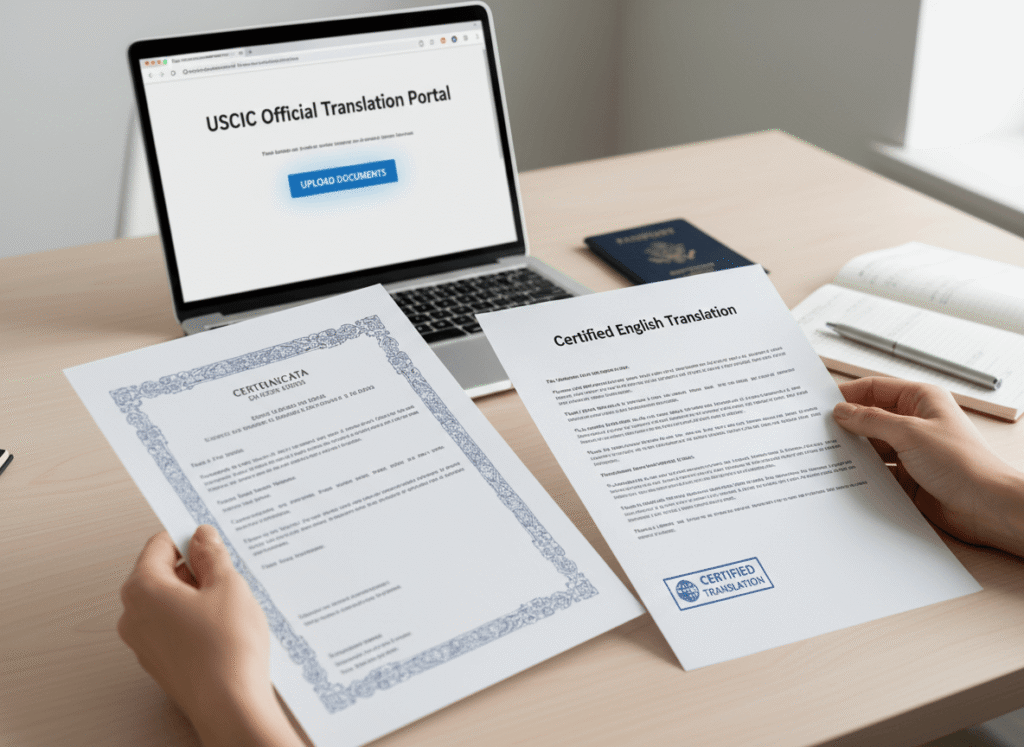
Why You Need an English Translation of Your Birth Certificate
U.S. immigration rules are clear: any document in a foreign language that you submit to USCIS must come with a full English translation and a certification from the translator.
The regulation at 8 C.F.R. § 103.2(b)(3) states that:
Any document containing foreign language submitted to USCIS shall be accompanied by a full English language translation which the translator has certified as complete and accurate, and by the translator’s certification that he or she is competent to translate from the foreign language into English.
USCIS also repeats this requirement across its Policy Manual and form instructions (for example, in the evidence checklists for Form I-485).
That’s why you need a proper translation in situations such as:
- Green card applications (family-based, employment-based, etc.)
- Citizenship applications (Form N-400)
- K-1 fiancé(e) visas and spousal visas
- Consular processing at U.S. embassies/consulates
- US-born child claims, derivative citizenship, and other complex cases
Your birth certificate is usually one of the first documents officers review to confirm your identity, date and place of birth, and family relationships. A sloppy or incomplete translation can cause confusion, RFEs, or avoidable delays.
What Counts as a “Certified Translation” for USCIS?
“Certified translation” is often misunderstood. For USCIS, it doesn’t mean:
- The translator must be sworn by a court
- The translator must be “officially approved” by USCIS
- The translation has to be notarised (in most immigration cases)
Instead, USCIS cares about what the translation includes, not who the translator is licensed by.
Core USCIS Requirements
According to federal regulations and USCIS guidance, a compliant translation must:e
- Translate the entire document
- Every word, stamp, annotation, handwritten note, seal, and margin remark should be translated. Omitting stamps or notes can cause questions later.
- Mirror the original layout as closely as practical
- Names, dates, registration numbers, and headings should appear clearly, usually in a similar order to the original.
- Include a signed translator’s certification confirming that:
- The translation is complete and accurate, and
- The translator is competent to translate from the original language into English.
A typical certificate of translation includes:
- Translator’s full name
- Statement of fluency/competence in both languages
- Statement that the translation is complete and accurate
- Title/role and sometimes qualifications
- Signature, date, and contact details
Professional bodies such as the American Translators Association (ATA) provide consistent guidance on how this certification should look and how to find a qualified translator.
Where Can You Translate a Birth Certificate to English?
Let’s look at the main options—what they involve, and what to watch out for.
1. Professional Online Translation Agencies
Best for: Most immigration cases, tight deadlines, global applicants
Specialised online agencies that focus on immigration and legal translations are usually the safest and most convenient answer to “Where can I translate a birth certificate to English?”.
A good agency will:
- Accept scans or high-quality photos of your birth certificate
- Provide a certified English translation that meets 8 C.F.R. § 103.2(b)(3) requirements
- Deliver PDF copies (and printed originals if needed)
- Offer clear pricing per page and urgent turnaround options
- Have translators experienced in names, dates, and civil registry formats across countries
At USCIS Official Translation, this is exactly what we do every day: you upload the file, we assign it to a vetted translator with immigration experience, and you receive a formatted, certified translation ready to attach to your application.
When this option works best
- You live abroad or far from big cities
- You need fast turnaround (same-day / 24-hour)
- You have multiple documents (birth, marriage, police certificates, etc.)
- You want a simple, online process without appointments or travel
2. Local Certified Translators and Language Service Providers
Best for: Applicants who prefer in-person service
Many cities have:
- Independent professional translators
- Small translation offices
- Language service companies
You may find them via:
- Local directories
- Community recommendations
- Professional associations like ATA’s translator directory
If you go local, make sure that:
- They know USCIS rules, not just general legal translation
- You receive a written certificate of translation, not just a stamped page
- They will correct minor typos or layout issues if USCIS raises questions
The main drawback is that local offices might have limited language coverage and slower turnaround compared with a dedicated online provider.
3. Law Firms and Notaries
Some people first ask a notary public or lawyer, especially if they’re already helping with the immigration case.
Important distinctions:
- A notary can notarise the translator’s signature, confirming identity—not the quality of the translation.
- USCIS itself does not require notarisation of translations for most standard immigration applications; the key is the translator’s certificate.
However, notarised translations can be useful when:
- A consulate, foreign registry office, or university specifically asks for notarisation
- The translation will be reused for non-USCIS legal purposes, such as court filings or academic evaluation
If you use a law firm or notary, verify that:
- The translation itself is done by a competent translator, not just a bilingual staff member
- The USCIS requirements under 8 C.F.R. § 103.2(b)(3) are followed
4. Community, Volunteer, or Low-Cost Options
In some communities, churches, non-profits, or local organisations offer help with translations.
While these options can be affordable, they come with risks:
- Volunteers may be bilingual but not trained in legal translation
- Formatting, dates, and official terminology may be mishandled
- The certificate of translation might lack the language USCIS expects
Using such options for a critical immigration document often ends up costing more in the long run if you receive RFEs or have to redo the translation.
5. Machine Translation or Translating It Yourself
Tools like Google Translate are useful for rough understanding, but they are not appropriate for a certified birth certificate translation.
Common problems:
- Wrong or inconsistent name spellings
- Misread dates (day/month vs month/day)
- Incorrect place names and official titles
- Missing stamps, seals, or hand-written remarks
Can you translate your own birth certificate to English for USCIS? Technically, U.S. rules allow any competent person to certify a translation, including the applicant or a family member.
But:
- USCIS may see self-translation as biased or unreliable
- Officers may scrutinise your case more closely
- You carry all responsibility for any error
For such an important document, it’s usually far safer to use a professional service that handles USCIS translations daily.
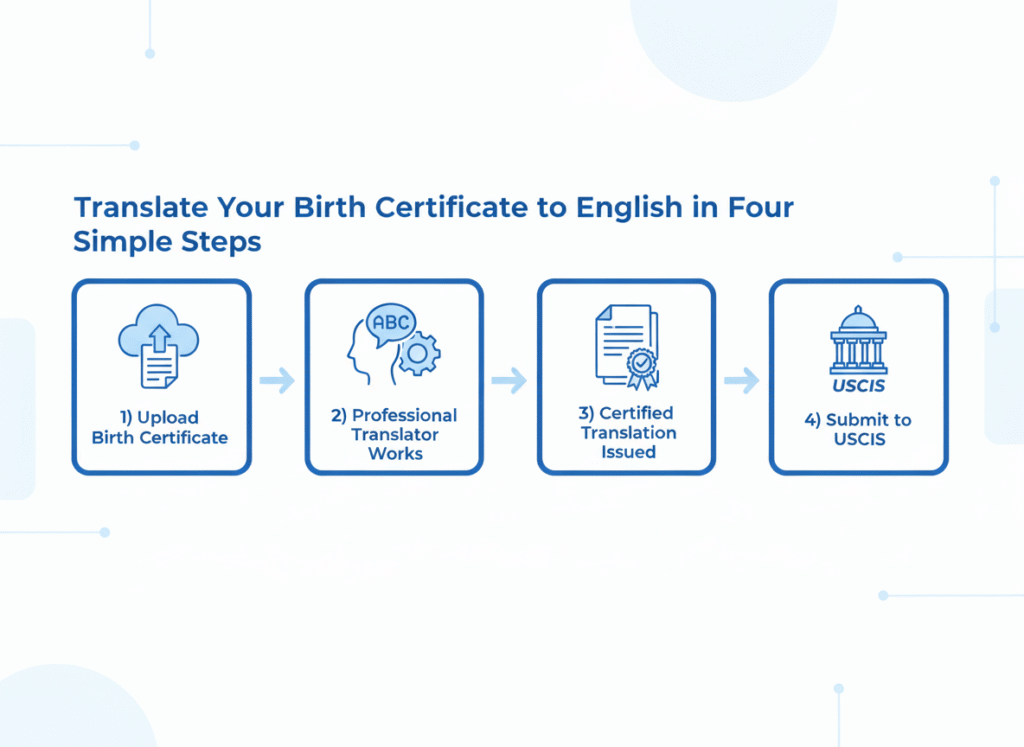
How to Choose the Right Birth Certificate Translation Service
When you’re deciding where to translate a birth certificate to English, use this checklist:
1. Proven experience with immigration cases
Look for a provider that:
- Explicitly mentions USCIS-compliant translations
- Handles birth certificates, marriage certificates, police records, and other standard immigration documents
2. Clear, written certification
Confirm that each translation includes:
- A separate certificate of translation
- The translator’s name, signature, date
- A statement that the translation is complete and accurate
- A statement that the translator is competent to translate between the languages
3. Accurate formatting
A good provider will:
- Preserve the structure of the original document as much as possible
- Clearly display names, places, registration numbers, stamps, and seals
- Use standards for transliteration (especially for names in non-Latin scripts)
4. Turnaround times and pricing
Check:
- Standard turnaround (often 24–48 hours per short document)
- Rush options and fees
- Whether price is per word, per page, or per document
5. Data protection and confidentiality
Your birth certificate contains extremely sensitive personal data. Reputable providers have:
- Confidentiality processes
- Secure file upload and storage
- Document retention policies (e.g. automatic deletion after a set number of days)
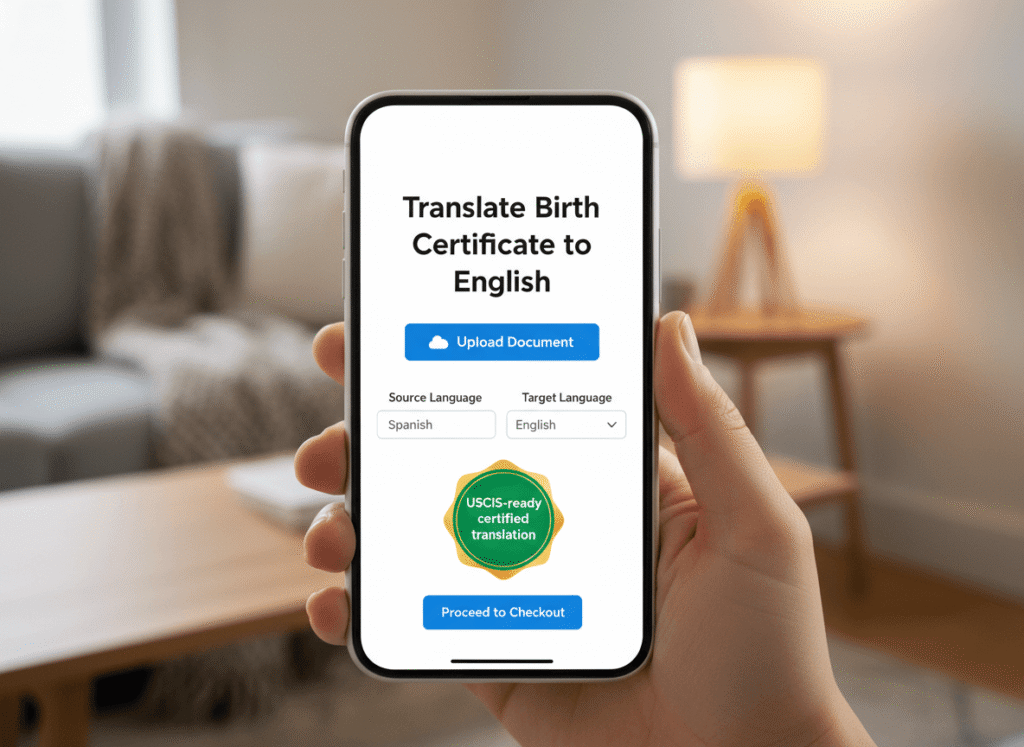
How the Process Works with USCIS Official Translation
Here’s how you can get a USCIS-ready English translation of your birth certificate with us, from anywhere in the world.
Step 1 – Upload your birth certificate
Take a clear scan or high-resolution photo of:
- The front and back, if both sides have content
- Any stamps, seals, or annotations added later
Then upload the files directly through our secure online form.
Step 2 – Receive a clear quote and timeline
We assess:
- The language pair (e.g. Spanish → English, Arabic → English)
- The length and complexity (multiple stamps, handwritten notes, etc.)
You’ll see your final price and expected delivery time before you confirm.
Step 3 – We assign a specialist immigration translator
Your document is assigned to a translator who:
- Is fully fluent in both languages
- Has experience with civil status documents and immigration cases
- Understands USCIS expectations on dates, names, and registry formats
The translator produces:
- A full English translation mirroring the structure of the original
- A signed certificate of translation containing all the elements USCIS requires under 8 C.F.R. § 103.2(b)(3).
Step 4 – You receive your certified translation
You receive:
- A PDF copy for online submission (where allowed)
- The option to request printed originals by post if an attorney, consulate, or another authority asks for them
You can then attach the translation to your USCIS form package or provide it to your immigration lawyer.
Ready to move forward?
Upload your birth certificate now and let USCIS Official Translation prepare a certified English translation you can submit with confidence.
Special Situations: Old, Damaged, or Unavailable Birth Certificates
Sometimes your birth certificate isn’t straightforward. For example:
- It’s very old, handwritten, or partially faded
- It has multiple over-stamps or corrections
- You only have a short-form extract, not a long-form certificate
- Your birth was registered late, or details were corrected years later
Professional translators can still work with these, but they may need:
- Extra time to decipher handwriting and stamps
- Clarification on preferred spellings of names in English
- Notes from you or your lawyer on any known discrepancies
If you cannot obtain a birth certificate at all, USCIS may accept secondary evidence (such as religious records, school records, or affidavits), depending on the case. Form instructions and the USCIS Policy Manual explain what alternatives are allowed for particular applications.
In those cases, you still need to translate any non-English documents, and the same certification rules apply.
Common Mistakes to Avoid
To avoid delays, rejections, or RFEs, watch out for these frequent issues:
- Partial translations
- Only translating “the important parts” and ignoring stamps or marginal text.
- Missing translator certification
- Submitting the translation without a signed certificate of accuracy and competence.
- Incorrect names or dates
- Inconsistent spelling across documents, or wrong date formats.
- Relying on machine translation
- Submitting print-outs from Google Translate or similar tools instead of a professionally prepared translation.
- Using providers unfamiliar with USCIS
- Some general translation services may not format documents or word certificates in line with U.S. immigration practice, increasing the risk of questions from officers.
Working with a specialist service significantly reduces these risks.
What It Usually Costs to Translate a Birth Certificate to English
Each provider sets its own prices, but most charge either:
- A flat fee per page/document for simple civil status documents, or
- A per-word rate for longer or more complex texts
Factors that influence price:
- Language pair (common vs rare languages)
- Complexity (handwritten entries, multiple stamps, poor legibility)
- Urgency (same-day or weekend delivery)
USCIS Official Translation keeps pricing transparent: you always see the final amount before you pay, and there are no surprise fees for the certificate or basic formatting.
How Long Does Birth Certificate Translation Take?
Typical time frames:
- Standard service: 1–3 working days
- Rush / same-day service: where available, for an additional fee
- Complex cases: older handwritten documents may take slightly longer
The key is to start early. Don’t wait until your immigration deadline to arrange translations. Doing it now gives you time to correct any spelling issues or inconsistencies across your documents
FAQs: Translating a Birth Certificate to English
1. Where can I translate a birth certificate to English for USCIS?
You can use:
- A professional online immigration translation service
- A local translator or translation office with experience in USCIS cases
- In some situations, a law firm or notary working with a professional translator
The safest choice is a provider that specialises in certified translations for immigration and explicitly follows USCIS rules under 8 C.F.R. § 103.2(b)(3).
USCIS Official Translation offers exactly this: upload your document online, and we prepare a certified English translation tailored to USCIS requirements.
2. Can I translate my own birth certificate to English for USCIS?
Technically, U.S. regulations don’t forbid it. Any competent person can certify a translation as complete and accurate, and the translator doesn’t have to be “approved” by USCIS.
However, self-translation is risky:
- Officers may treat self-translated documents as less objective
- Any errors or omissions are more likely
- You may face RFEs or delays if USCIS isn’t satisfied
For such a foundational document, it is usually much safer to use a professional translator or agency.
3. Does my birth certificate translation need to be notarised?
In most USCIS immigration applications, a notarised translation is not required. What matters is that the translation is complete, accurate, and accompanied by a proper certification from the translator.
Some non-USCIS authorities—certain foreign consulates, civil registries, or universities—may still ask for notarised translations or apostilles. Always follow the specific instructions for each authority. If you’re unsure, ask both your lawyer and the provider preparing the translation.
4. Do I need to send the original birth certificate with the translation?
For many USCIS applications, you submit copies of the original document together with the certified translation. USCIS may ask to see an original later in the process, and certain forms or consular processes may have specific rules.
Your immigration lawyer or the official USCIS form instructions will tell you whether copies are sufficient or an original is needed at any stage.
5. Can I use a translation done abroad?
Yes. USCIS generally accepts translations prepared anywhere in the world as long as:
- The translator is competent in both languages
- The document is fully translated
- The certification clearly states that it is complete and accurate and that the translator is competent to translate from the original language into English
If the translation provider abroad is unfamiliar with USCIS, it may still be wise to have it reviewed or redone by a U.S.-based service that specialises in immigration.
6. How long is a birth certificate translation valid?
In most cases, a certified translation does not expire as long as:
- The underlying document has not changed, and
- The information is still accurate
However, if your birth certificate is later re-issued or corrected (e.g. names or dates), you should obtain a new translation based on the updated document..
