
If you’re asking “where can I go to get my birth certificate translated?”, you’re probably facing a time-sensitive application: a green card, visa, passport, university admission, or a marriage-based immigration case. Get it wrong and you risk delays, Requests for Evidence (RFEs), or even a refusal.
Why You Need a Translated Birth Certificate in the First Place
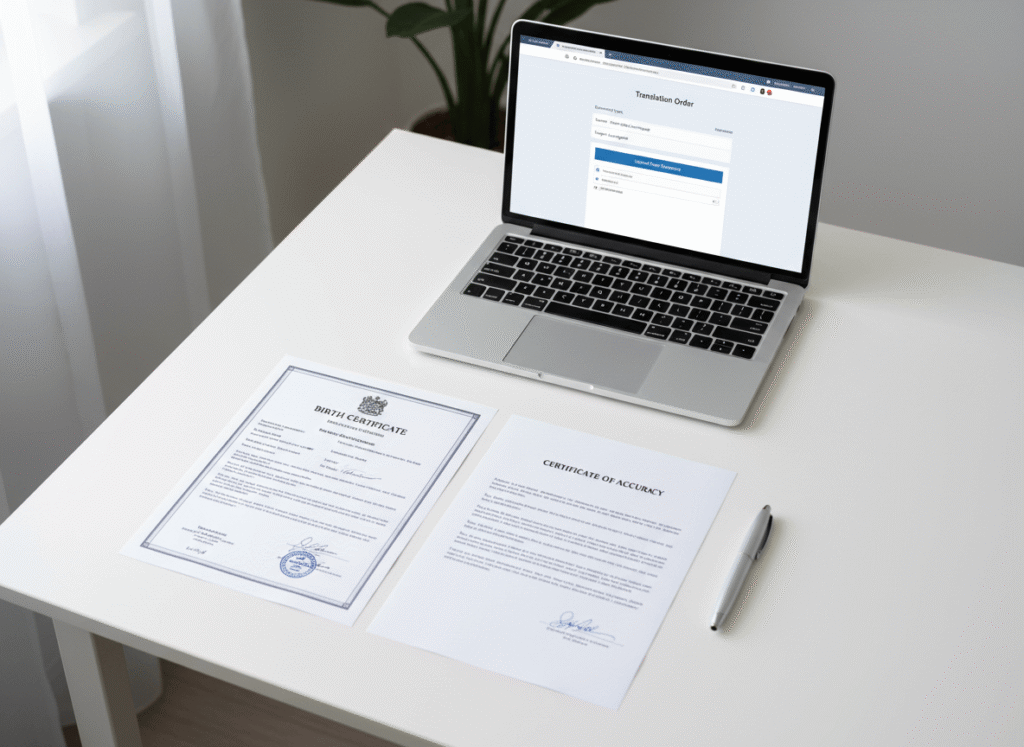
For most U.S. immigration cases, any document not in English must be submitted with a full English translation plus a signed certification from the translator confirming accuracy and their language competence.
A translated birth certificate is typically needed for:
- Green card applications (family, employment, or diversity)
- Adjustment of status and consular processing
- Naturalisation or citizenship-related filings
- K-1 fiancé(e) visa and other family visas
- Certain work visas where civil documents are required
- University admissions, scholarships, or professional licensing
- Marriage, divorce, or name change proceedings abroad
What a Compliant Birth Certificate Translation Must Include
Before you decide where to go, you need to understand what you are actually buying.
Required elements in the translation
For U.S. immigration purposes, a compliant translation will:
- Translate every word on the document, including stamps, seals and handwritten notes
- Match the layout and structure of the original as closely as reasonably possible
- Clearly show:
- Full name
- Date of birth
- Place of birth
- Full names of parents
- Any official seal or issuing authority detail
Required translator certificate
USCIS follows a simple but strict rule: any foreign-language document must be accompanied by a certified English translation, along with a statement from the translator that:
- They are competent in both languages
- The translation is complete and accurate
- The statement includes:
- Translator’s full name
- Signature
- Date
- Contact details
This is usually called a “certificate of accuracy” or “translator’s certification” and is attached to the translation.
Does the translator need to be “certified” or notarised?
- The translator does not have to hold a government licence or formal certification; any individual or company can certify a translation if they are competent in both languages.
- Notarisation is generally not required by USCIS; some providers add it as an extra formality (for use with other agencies), but it is not part of the core USCIS rule.

All the Places You Could Get Your Birth Certificate Translated (Ranked)
Let’s walk through the options people usually consider – from riskiest to safest.
1. Free machine translation tools (Google Translate, etc.)
It’s tempting: snap a photo, paste the text, and you have an instant “translation”.
Why this is a bad idea:
- Machine tools frequently mistranslate names, abbreviations, and official terminology.
- They cannot sign a certification statement, so you still need a human to take responsibility.
- Submitting a machine-generated translation without proper certification is a fast track to delays or refusal.
Use machine translation only, if at all, to get a rough idea of the content, never for official submissions.
2. Friends, family or community members
US regulations do allow anyone competent in English and the original language to act as the translator and sign the certification.
However, there are real downsides:
- They may miss subtle legal terms or abbreviations.
- Their certification may look informal or incomplete.
- Immigration officers have discretion and may be more sceptical of self-done or family translations, especially if anything looks unclear.
If you must use this option (for example, to save money), make sure they:
- Follow a sample certification template closely
- Translate everything, including stamps and margins
- Understand that any error could delay your case
For most applicants, the safer route is a professional translation.
3. A local notary public or law office
Many people assume “notary = translation”. In reality:
- Notaries do not usually translate; they simply witness signatures.
- A notary may notarise the translator’s signature, but that’s an extra step on top of the certified translation, not a replacement.
- Staff at a law office may not be trained translators.
This route can work if the office partners with a reputable translation provider – but it’s often slower and more expensive than going directly to a specialist.
4. Local walk-in translation agencies
In many cities you’ll find small translation shops near consulates or courthouses that offer “certified translation” for birth certificates and other civil documents.
Pros
- Face-to-face reassurance and ability to ask questions
- Easy to show original documents if needed
- Sometimes offer same-day service for simple certificates
Cons
- Limited opening hours and locations
- Pricing and quality can vary significantly
- Some focus on generic translation rather than immigration-specific work
If you choose this route, ask the same questions you would online: experience with USCIS, what the certification includes, and turnaround time.
5. Professional online certified translation services (best overall option)
For most people asking “where can I go to get my birth certificate translated?”, the most practical answer is: a reputable online certified translation service specialising in immigration documents.
Modern online providers offer:
- Secure upload of a scan or high-quality photo of your birth certificate
- Fixed, transparent pricing (often charged per page) – typical U.S. ranges are around $20–40 per page, depending on language and urgency
- Turnaround times from a few hours to 1–2 working days for a standard one-page birth certificate
- A formal certificate of accuracy meeting immigration expectations
- Digital delivery as a PDF, plus optional printed copies by post
How USCIS Official Translation Handles Your Birth Certificate
At USCIS Official Translation, everything is built around one core idea: make immigration-ready translations as simple and predictable as possible.
A typical order looks like this:
- Upload your document
Take a clear scan or high-resolution photo of your birth certificate (front and back if there’s information on both). Upload it through a secure form or client portal. - Receive a clear quote
You see the price upfront, usually per page, along with the expected delivery time and whether printed copies are available. - Work begins with a specialist translator
Your document is assigned to a translator experienced with civil status records and immigration paperwork. They:- Translate every element of the certificate
- Follow U.S. date formats and transliteration rules for names where needed
- Preserve the layout so officers can easily compare translation and original
- Quality review and certification
A second linguist or reviewer checks for typos, consistency and completeness. The final package includes:- The English translation
- A signed certificate of accuracy, dated and including the translator’s details
- Digital delivery (and hard copies if needed)
You receive a secure PDF ready to print and include with your application. If required, printed copies can be prepared to attach to your submission or bring to an interview.
Long-Form vs Short-Form Birth Certificates: Which One Should You Translate?
US immigration officers want enough detail to reliably verify your identity and family relationships. In practice, that often means the long-form version of your birth certificate, showing:
- Your full name
- Date and place of birth
- Full names of your parents
- Official seal and issuing authority
If your country issues both long and short versions and you only have a short version with limited detail, it’s wise to request the long-form copy from the civil registry before translating.
Step-by-Step: How to Get Your Birth Certificate Translated Today
If you’re ready to act, here’s a simple path you can follow right now:
- Locate your most complete birth certificate
- Prefer the long-form version with parent details and official seals.
- Scan or photograph it clearly
- Make sure all corners, stamps and handwritten notes are visible and readable.
- Upload securely to USCIS Official Translation
- Add any notes (urgent deadline, forthcoming interview date, etc.).
- Confirm price and turnaround
- Review the quote and expected delivery time.
- Place your order
- Pay using a secure payment method.
- Check the draft translation (if provided)
- Confirm name spellings and dates; request minor corrections if necessary.
- Print and include with your application
- Attach the translation, the translator’s certification, and a copy of the original birth certificate to your immigration file.
How Much Does It Cost to Translate a Birth Certificate?
Costs vary by language pair, provider and urgency, but current market benchmarks show:
- Standard service: around $20–40 per page for common languages
- Rush or same-day service: a surcharge on top of the base rate
- Additional copies: usually a small extra fee if printed and mailed
When comparing providers, don’t just look at price. Check:
- Whether certification is included
- If they are familiar with USCIS-style applications
- Whether they offer a clear re-issue policy if there’s an error
- How they handle data protection and document security
Frequently Asked Questions
Where can I go to get my birth certificate translated for USCIS?
You can use:
- A professional online certified translation service specialising in immigration documents (fast, convenient, and accessible from anywhere)
- A local translation agency experienced in civil documents
- In some cases, a competent individual who can produce a full translation and sign a certificate of accu
USCIS does not recommend a specific company, but it does require that any non-English document be submitted with a full English translation and a certification from the translator.
If you want a simple, immigration-focused solution, submitting your document to USCIS Official Translation is usually the easiest route.
Can I translate my own birth certificate into English?
Regulations allow any competent person to certify a translation, which technically includes you. However, professional bodies and immigration guidance strongly warn that self-translation is risky because:
- It may look biased or self-serving.
- Errors or omissions are more likely.
- Officers have discretion and may question the credibility of a self-certified translation.
To avoid delays and RFEs, most applicants choose a professional translator or specialised immigration translation service instead.
Does my translation need to be notarised?
For typical USCIS filings, notarisation is not required. The key requirement is the translator’s certification of completeness, accuracy, and language competence, attached to the translation.
You may occasionally need notarisation for other authorities (such as some state agencies, courts, or foreign consulates). If you think that might apply, ask your translation provider whether they offer an optional notarised version.
Does USCIS accept online translations?
Yes. USCIS evaluates the content and certification, not whether you ordered the translation online or in person. Many reputable online providers focus entirely on immigration work and have had their formats accepted in thousands of cases.
What matters is that the translation is:
- Complete
- Accurate
- Accompanied by a proper certificate of accuracy
USCIS Official Translation is specifically designed to deliver translations that align with these expectations.
What if my birth certificate is in poor condition or partly unreadable?
If parts of your birth certificate are damaged or illegible:
- A translator can mark those specific sections as “illegible” in the translation.
- However, USCIS may still ask for a clearer or replacement copy if essential details are missing.
In that case, you may need to request a new certified copy from the issuing authority before translation.
Can I use the same translation for other applications?
Often, yes. A properly prepared birth certificate translation with a translator’s certification can usually be reused for:
- Future immigration filings
- University or college applications
- Some professional registration procedures
Just remember that:
- Some organisations impose time limits (for example, translations not older than a certain number of years).
- Certain authorities may request their own format or additional stamps.
USCIS Official Translation can advise you if you expect to use your translation for multiple purposes.
