
If you (or your child) were born in a Spanish-speaking country, your Spanish birth certificate is one of the most important documents in your immigration journey. Whether you are applying for a green card, citizenship, a visa or another immigration benefit, U.S. authorities will ask for it – and they will expect a certified English translation alongside the original.
This guide walks you step by step through how to translate a Spanish birth certificate to English in a way that matches USCIS and other U.S. government expectations, without drama and without guesswork.
Done badly, the translation can trigger delays, Requests for Evidence (RFEs) or, in the worst case, a refusal. Done properly, it quietly does its job and never becomes a problem.
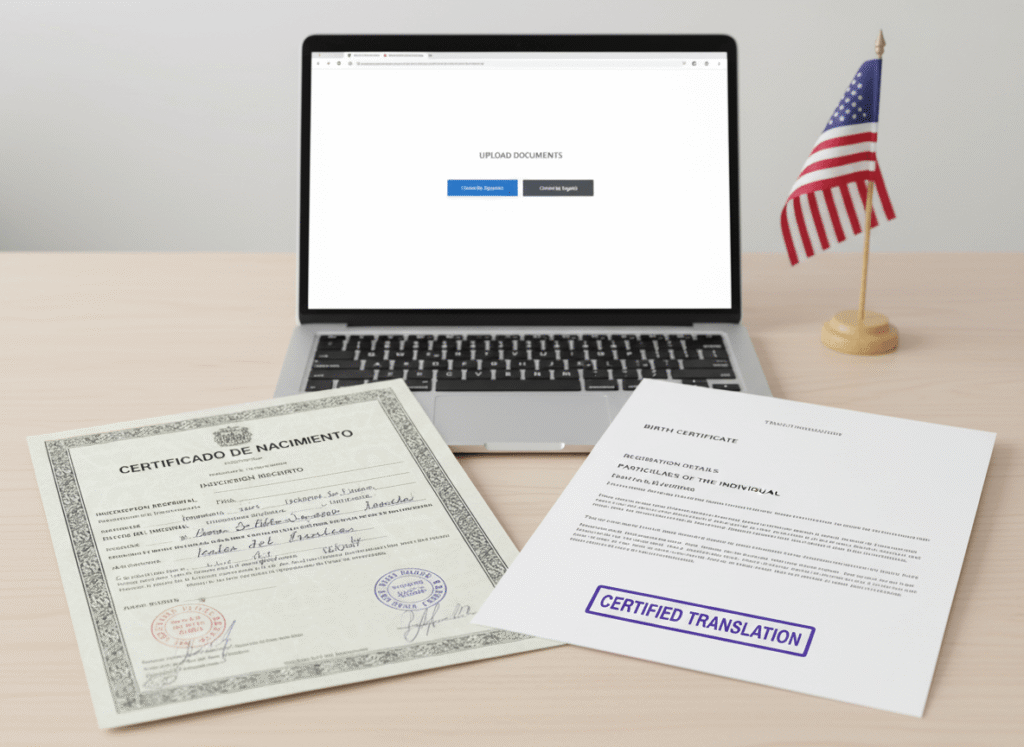
Why you must translate your Spanish birth certificate to English
U.S. immigration rules are very clear:
Any document that is not in English must be submitted with a full English translation and a translator’s certification of accuracy and competence.
That rule applies directly to Spanish birth certificates when used as evidence for applications such as:
- Adjustment of status (e.g. Form I-485 for a green card)
- Consular immigrant visas
- Naturalisation (Form N-400)
- Certain non-immigrant visas and waivers
- Petitions where proof of identity, age, parentage or place of birth is needed
Other U.S. government bodies follow the same principle. For example:
- The Executive Office for Immigration Review (EOIR) requires documents in English or accompanied by a certified English translation for immigration court.
- The U.S. Department of State explains that translators must certify they are competent and that their translation is accurate.
What “certified translation” really means (and what it does not mean)
A lot of confusion starts here, so let’s untangle the terms.
Certified translation
For U.S. immigration, a certified translation is not a special government stamp. It is:
A complete English translation of the document, plus a signed statement from the translator confirming that the translation is complete and accurate, and that the translator is competent to translate from Spanish to English.
The certification statement must include:
- Translator’s full name
- Statement of competence (e.g. “I am competent to translate from Spanish into English…”)
- Statement that the translation is complete and accurate
- Language pair (Spanish ↠ English)
- Title of the document (e.g. “Birth Certificate of [Name]”)
- Translator’s signature and date
- Translator’s contact details (address, and often email/phone)
USCIS does not require the translator to be an officially licensed “sworn translator” or member of a particular association. Any individual or company can certify a translation as long as they can truthfully state competence and accuracy under 8 CFR 103.2(b)(3).
Notarised translation
A notary public can notarise the translator’s signature. This does not make the translation “more official” for USCIS in most cases. USCIS cares about the certification statement, not the notarial stamp. Multiple reputable guides and law-firm resources confirm that USCIS generally requires certified, not notarised, translations.
Some courts or foreign authorities may ask for notarisation, but for typical USCIS filings, a standard certified translation is enough.
Sworn / official translators (Spain & Latin America)
In Spain and several Latin-American countries, “sworn translators” or “traductores jurados” are appointed by the government. Their translations often carry official seals – very useful locally, but not specifically required by USCIS.
For USCIS, the crucial points are:
- Full and faithful translation
- Proper certification wording
- Clear translator identity and contact details
USCIS Official Translation specialises precisely in that.
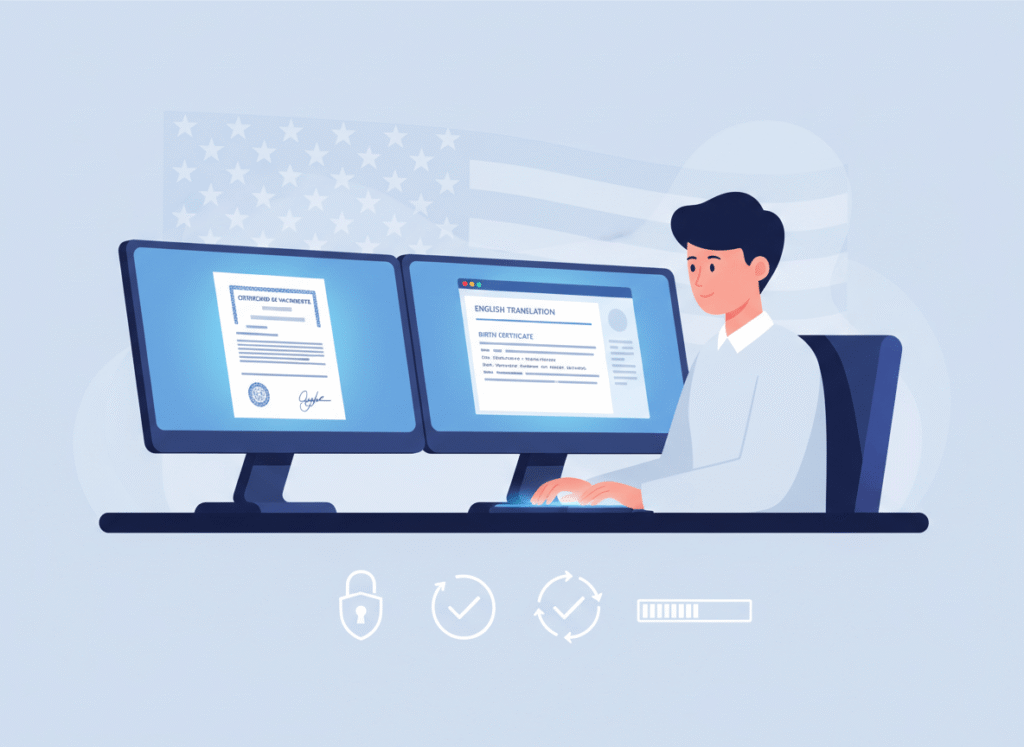
Step-by-step: how to translate a Spanish birth certificate to English
Here is the safest, most straightforward way to handle your Spanish birth certificate for U.S. immigration.
1. Gather the right version of your birth certificate
Make sure you have a recent, legible copy:
- Ideally a long-form birth certificate (with parents’ details), not a short extract
- All stamps, seals, marginal notes and handwritten entries should be visible
- If the document is very old or damaged, request a fresh certified copy from the relevant civil registry
2. Scan or photograph it clearly
Most professional services (including USCIS Official Translation) work from electronic copies:
- Scan at 300 dpi in colour
- Include the full page(s), not just the centre
- Ensure seals and margins are not cropped
- Save as PDF or clear JPEG/PNG
If there are entries on both sides, scan both.
3. Choose a professional USCIS-focused Spanish–English translation service
You technically can ask any competent bilingual person to translate, but multiple expert bodies strongly recommend using professional immigration translators to avoid RFEs or rejections.
When selecting a provider, look for:
- Specialisation in USCIS work, not generic translation only
- Native-level Spanish and English linguists
- Clear examples of certification statements
- Transparent per-page pricing
- Secure online upload and delivery
- Fast but realistic turnaround times
USCIS Official Translation is built around exactly these requirements: dedicated Spanish–English birth certificate teams, compliant certification, and streamlined online ordering.
Ready to move forward? Upload your Spanish birth certificate securely and receive a clear, no-obligation quote from USCIS Official Translation.
4. The translator mirrors the layout and translates every detail
For a birth certificate, layout matters because officers may compare the translation line by line with the Spanish original.
Your translator should:
- Keep similar headings and structure (Registro Civil, Sección, Tomo, Página, etc.)
- Translate all visible content: printed text, handwritten entries, stamps, marginal notes, annotations
- Preserve names, dates and numbers exactly as written
- Use consistent translations for key terms (e.g. “Lugar de nacimiento” → “Place of birth”, “Fecha de nacimiento” → “Date of birth”)
Where something is illegible, it should be marked clearly (e.g. “[illegible]”) rather than guessed.
5. Certification and quality checks
A serious Spanish–English immigration translation will go through at least one internal check before it reaches you. The final package should include:
- English translation, formatted to mirror the original
- Certification statement on a separate page or at the end, signed and dated
- Translator or translation company contact details
At USCIS Official Translation, each Spanish birth certificate translation is reviewed for:
- Completeness (no missing seals, dates or notes)
- Formatting consistency
- Correct names and accents
- Clear certification wording aligned with 8 CFR 103.2(b)(3)
6. Print, assemble and submit with your immigration application
When you are ready to file:
- Print a clear copy of the Spanish original
- Print the English translation and the certification page
- Keep the translation attached directly after the original, using staples or clips
- Add the bundle to the relevant section of your USCIS or consular application
If you are submitting scans/uploads through an online system, combine each original-plus-translation set in a single PDF where possible.
Can you translate your own Spanish birth certificate for USCIS?
Technically, yes – in some cases. U.S. regulations allow any competent individual to provide the translation and certification, including you or a relative, if they can genuinely state they are competent and the translation is accurate.
However, experienced immigration practitioners widely warn against self-translation for crucial documents like birth certificates because:
- You have a clear interest in the outcome, which can raise concerns about bias
- It is easy to miss small but important legal details
- The officer ultimately has discretion to accept or reject the translation
In other words: it might be technically allowed, but it is rarely wise.
If your Spanish birth certificate is central to your case, the safer choice is to use a professional, immigration-focused translation provider. The cost is modest compared to the time and risk involved in a refused or delayed application.
How much does it cost to translate a Spanish birth certificate to English?
In the U.S. market, certified Spanish birth certificate translation typically follows per-page pricing.
Publicly listed examples from established providers suggest approximate ranges of $25–$50 per page for USCIS-compliant birth certificate translations, depending on turnaround time, layout complexity and any extras requested.
Factors that can influence price:
- Number of pages and copies
- Complexity (handwritten notes, marginal annotations, stamps)
- Urgency (same-day vs standard 24–48 hours)
- Additional notarisation or hard copies by post
USCIS Official Translation keeps pricing simple and transparent, with clear per-page rates for Spanish birth certificates and no hidden surcharges.

Typical timelines: how long will it take?
For a standard, legible, one-page Spanish birth certificate:
- Many professional services offer 24- to 48-hour turnaround as standard
- Expedited options may be available for same-day or weekend delivery
- Extra time may be needed if the certificate is very old, damaged or contains hard-to-read handwriting
It is smart to order your translation well before your filing deadline, so you have time to review the document and correct any typos or spelling inconsistencies in names before submission.
Common mistakes that cause problems with Spanish birth certificate translations
Avoid these issues – they are among the most frequent reasons for queries and RFEs:
- Using machine translation (Google Translate) or non-specialists
Automatic tools and casual bilinguals often misread legal terms, dates or abbreviations. Multiple immigration resources warn that inaccurate translations can delay cases or result in evidence being rejected. - Missing stamps, seals or margin notes
Officers expect every visible element to be translated, even if it looks minor. - Incorrect or inconsistent names and dates
A tiny spelling difference between the passport and the translation can trigger questions. For example, “José Luis” vs “Jose Luis”. - No certification statement or incomplete certification
Submitting only the English text without the translator’s signed statement does not meet USCIS requirements. - Over-creative wording
Legal terms like “nacido en” should be rendered as “born in”, not paraphrased loosely, to preserve legal meaning.
What about translations for other authorities – embassies, courts, schools?
The good news: a high-quality Spanish-to-English birth certificate translation prepared for USCIS is usually appropriate for other U.S. institutions that require certified translations, such as:
- Universities and credential evaluators
- State DMVs
- Some state courts
- Employers, insurers or licensing bodies
However, some non-USCIS bodies (especially abroad) may:
- Ask for a notarised translation
- Require a sworn translator registered in their country
- Have specific formatting or seal requirements
If you know you will use the same translation for multiple purposes (for example, USCIS and a foreign consulate), tell the translation provider upfront so they can advise on the most efficient approach.
Why work with USCIS Official Translation for your Spanish birth certificate?
USCIS Official Translation is built around one purpose: making your immigration paperwork easier, safer and less stressful.
When you send us your Spanish birth certificate, you get:
- Specialist Spanish–English immigration translators who work with civil registry documents every day
- Translations formatted to mirror the original certificate, including headings, stamps and annotations
- A clear certification statement aligned with U.S. regulatory language on completeness, accuracy and translator competence
- Secure online upload and encrypted storage for your personal documents
- Fast, predictable turnaround, with urgent options when you are up against a deadline
- Friendly, responsive support if an officer raises a question about the translation
Start now: Upload your Spanish birth certificate and let USCIS Official Translation prepare a compliant English version you can submit with confidence.
Frequently asked questions
1. What is the correct way to translate a Spanish birth certificate to English for USCIS?
The correct way is to obtain a full, accurate English translation that mirrors the Spanish original and includes a signed certification from the translator confirming accuracy and competence in Spanish and English. Attach the translation and certification to a copy of the original Spanish birth certificate when you submit your application.
2. Do I need a notarised translation of my Spanish birth certificate?
For most USCIS applications, no. USCIS requires a certified translation, not a notarised one. A notarisation may only be needed if another authority (for example a foreign consulate or specific court) explicitly requests it.
3. Can I translate my own Spanish birth certificate?
Regulations allow competent individuals – including you or a family member – to certify translations. However, because you have a direct interest in the outcome, and because officers can question biased or inaccurate translations, it is generally safer to use a professional, independent translation provider experienced with USCIS.
4. Do I submit both the Spanish original and the English translation?
Yes. You should always provide:
- A legible copy of the Spanish birth certificate, and
- The English translation plus the certification statement
Keep them together in the same packet or PDF so the officer can easily compare them.
5. Does my child’s Spanish birth certificate also need to be translated?
If your child’s birth certificate is in Spanish and is being used as evidence in a USCIS or consular case, it must also be accompanied by a certified English translation – the same rule applies regardless of whose document it is.
6. How far in advance should I order my translation?
Ideally, order your Spanish-to-English translation several weeks before you plan to file. That gives you time to:
- Review the translation for spelling of names and places
- Request minor corrections if needed
- Assemble your full application package without rushing
