
When a death certificate isn’t in English, a translation mistake can slow down something that’s already emotionally and logistically difficult—immigration filings, probate, pension claims, repatriation, or consular paperwork. The good news: once you know what authorities typically expect, the process is straightforward.
This guide shows you exactly how to translate a death certificate into English in a way that’s clear, complete, and ready for official use—especially USCIS.
If you’d like us to handle it end-to-end, you can upload your file for an instant quote here.
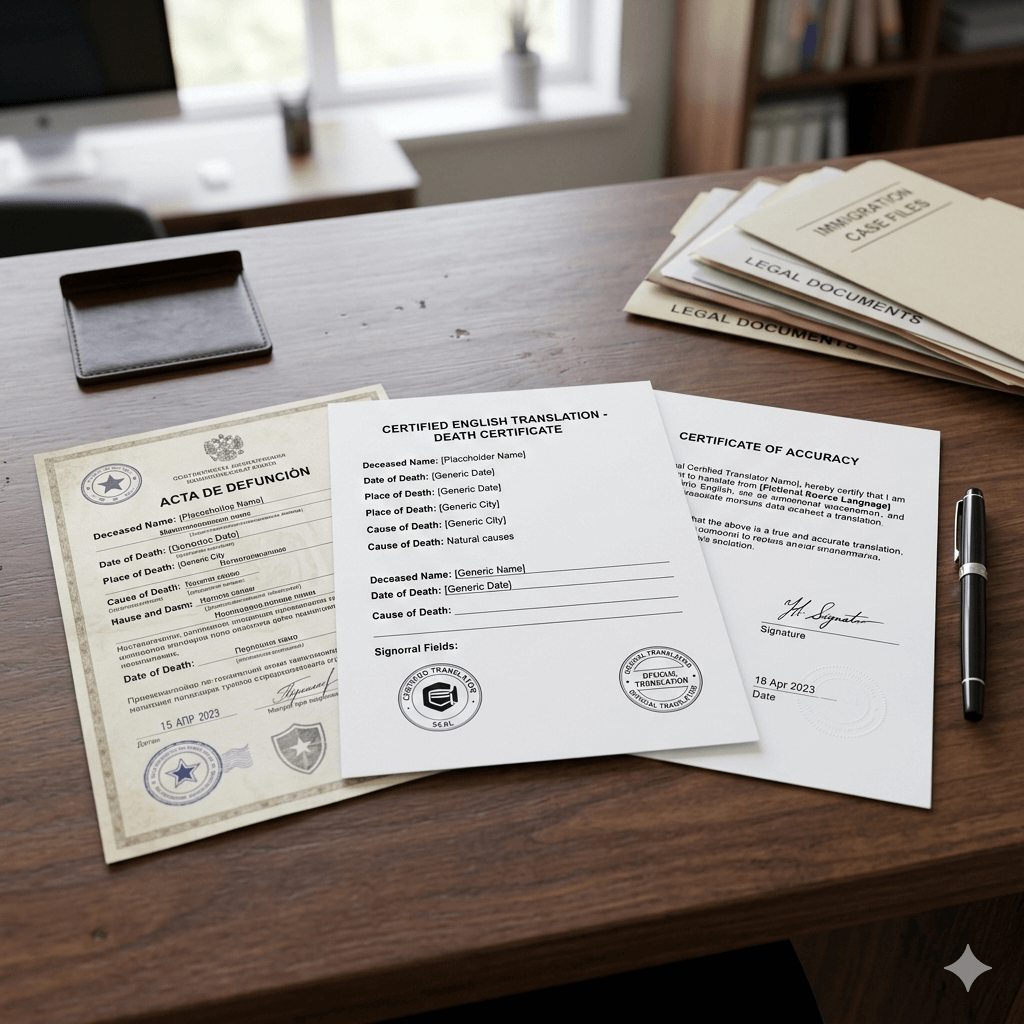
When you need an English translation of a death certificate
You’ll usually need a certified English translation when the death certificate is being submitted to an authority that operates in English, such as:
- USCIS immigration filings (petitions, adjustments, requests to remove conditions, etc.)
- US passport / citizenship supporting evidence
- Probate and estate administration
- Pension, insurance, and benefits claims
- Banking and financial institutions
- Consulates and cross-border legal matters
If you’re filing with USCIS, it also helps to understand the wider requirements that apply to all foreign-language documents: USCIS translation requirements (complete guide).
What a “certified translation” should include
A proper certified translation of a death certificate is more than “just translating the text”. It should include:
- A complete English translation of everything that appears on the document
(including stamps, seals, notes, margin text, and handwritten entries) - A translator certification statement (also called a Certificate of Accuracy)
- Translator details (name, signature, date, and contact information)
- Clear formatting so the document is easy to review and cross-check
If you’re unsure what USCIS means by “certified translation” (it’s often misunderstood), see: Does USCIS require certified translation?.
Step-by-step: How to translate a death certificate into English
1) Confirm what the receiving authority wants
Before paying for any add-ons, check what the end user actually requires:
- Certified translation only?
- Notarised translation?
- Sworn translation (required in some countries/jurisdictions)?
- Printed hard copy or digital PDF is acceptable?
If you suspect notarisation may be needed for your use case, compare with an example format: Translation notary sample (template).
If you need a sworn translation for a jurisdiction that legally requires it, start here: Sworn translator service.
2) Prepare a clean, legible copy
Most rejections and delays come from poor source images, not the translation itself.
Use this quick quality checklist:
- All four corners visible (no cropping)
- No glare, shadows, or blur
- Every page included (front/back if applicable)
- Stamps and seals are readable
- Handwriting is as clear as possible
Tip: If there’s faint handwriting, take two photos—one normal and one with slightly higher contrast—so the translator can verify uncertain characters.
3) Translate everything (including stamps and seals)
A death certificate often includes critical details beyond the obvious fields. Your English translation should cover:
- Full name of the deceased (exact spelling)
- Date and place of death
- Registration numbers / certificate numbers
- Issuing authority and office
- Parent/spouse details (if present)
- Cause of death wording (translate faithfully without “softening” terms)
- Official stamps, seals, signatures, and notes
- Any remarks, corrections, or annotations
Never “tidy up” names, dates, or places—even if they look inconsistent. Your job is to reflect what the document states, not correct it.
4) Keep names and dates consistent across your case
For immigration and legal use, consistency is everything.
Best practice:
- Keep names exactly as written on the death certificate
- If the document uses multiple spellings (common with transliteration), keep the primary spelling and add a short translator note such as:
Translator’s note: The surname appears as “X” in field A and “Y” in stamp B. - Use a clear English date format (e.g., 12 March 2019) while preserving the original meaning
5) Add the translator certification statement (copy-and-use wording)
For USCIS-style compliance, the translator certification statement should be simple, direct, and complete.
Here is safe, widely accepted wording you can use:
Translator Certification (Certificate of Accuracy)
I, [Translator Full Name], certify that I am fluent in English and [Source Language], and that the attached translation of the [Death Certificate] is complete and accurate to the best of my knowledge and ability.
Translator Name: [Full Name]
Signature: ____________________
Date: [DD Month YYYY]
Contact Details: [Email + Phone or Address]
This certification should be attached to the translated document as part of the final PDF.
6) Format it so an officer/reviewer can scan it quickly
Your goal is to make the translation easy to validate:
- Use a clean layout with clear headings (e.g., “Field: Value”)
- Keep the order aligned to the original document structure
- If a seal is present, represent it like:
[Round seal: “Civil Registry Office — City — Country”] - If something is illegible, mark it as:
[illegible] or [partially illegible] (never guess)
If you want an idea of how a professional template is typically presented, you can look at how sample translations are structured (even though the document type differs): Marriage certificate translation sample
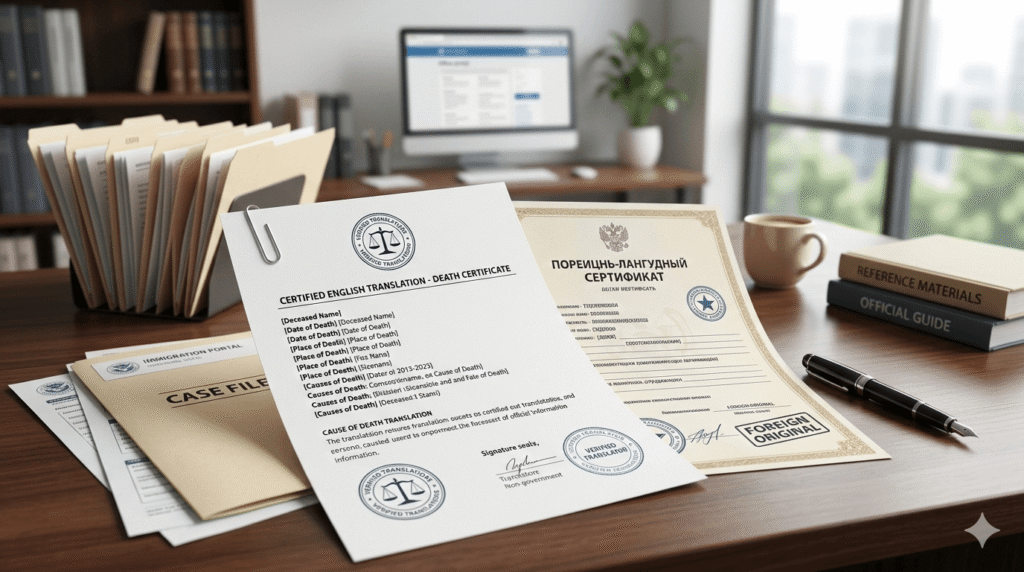
Common mistakes that get death certificate translations questioned
Avoid these, and you remove most risk:
- Skipping stamps, seals, and handwritten notes
- Summarising instead of translating line-by-line
- Correcting inconsistencies (names/dates/places) instead of reflecting them
- Missing certification details (signature, date, contact info)
- Using a “certificate of translation” that doesn’t clearly state complete and accurate
- Illegible source scans that make the translation unverifiable
If you want the fastest, simplest route: upload your death certificate here and we’ll return a certified, ready-to-submit PDF.
Turnaround, pricing, and what you’ll receive
Most death certificates are short (often 1 page). Typical delivery is based on your timeline and any extras you request.
- Clear rates are shown here: view pricing
- If you need help choosing the right option for your situation, contact the team: contact us
What you’ll receive (standard best practice):
- A professionally formatted English translation (PDF)
- A signed Certificate of Accuracy
- Optional notarisation or sworn completion where required
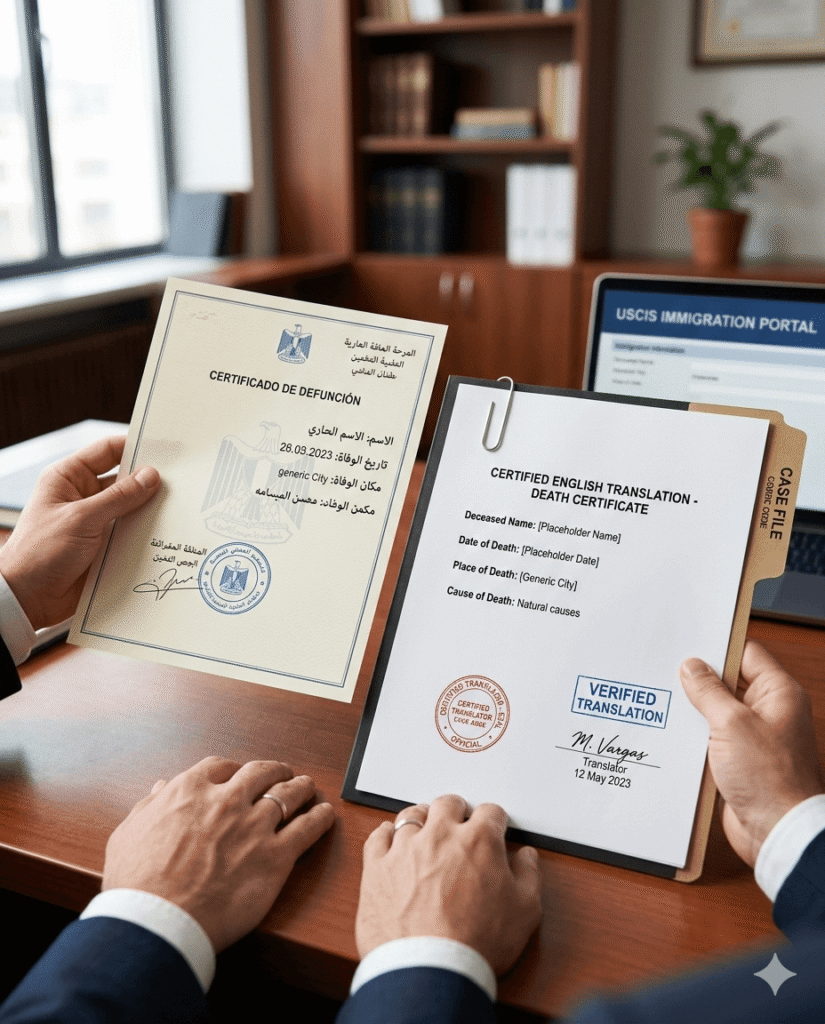
A quick “ready-to-submit” checklist
Before you submit, confirm you have:
- All pages of the original death certificate (copy/scan)
- Full English translation (including stamps/seals/notes)
- Translator certification statement (signed + dated)
- Translator contact details included
- Consistent names/dates across your supporting documents
If any box feels uncertain, it’s worth fixing now—because it’s far easier than responding to a request for missing evidence later.
FAQs
How do I translate a death certificate in English for USCIS?
Use a complete English translation of every element on the document and attach a signed translator certification stating the translation is complete, accurate, and the translator is competent in both languages. For a deeper reference, see https://uscisofficialtranslation.com/uscis-translation-requirements/.
Can I translate a death certificate myself?
Even if you’re fluent, self-translation can create credibility issues in official contexts. For important filings, it’s safer to use an independent translator or agency that will sign a proper Certificate of Accuracy and provide contact details.
Does a death certificate translation need to be notarised?
Often, no—many authorities accept certified translation without notarisation. However, some courts, institutions, or cross-border processes may require notarisation. If you’re unsure, review a typical format here: https://uscisofficialtranslation.com/translation-notary-sample/.
What if a stamp or handwriting is unclear on the death certificate?
Don’t guess. The translation should mark uncertain parts as [illegible] or [partially illegible]. If possible, provide a clearer scan or an additional photo to help the translator verify the characters.
How long does it take to translate a death certificate into English?
Many death certificates can be completed quickly because they are typically short. Turnaround depends on complexity (handwriting, multiple stamps, multi-page certificates) and whether notarisation/sworn completion is needed.
What details must be translated on a death certificate?
Everything: names, dates, registration numbers, issuing authority, stamps, seals, signatures, annotations, and any marginal notes. Missing even a small stamp can cause questions later.
