
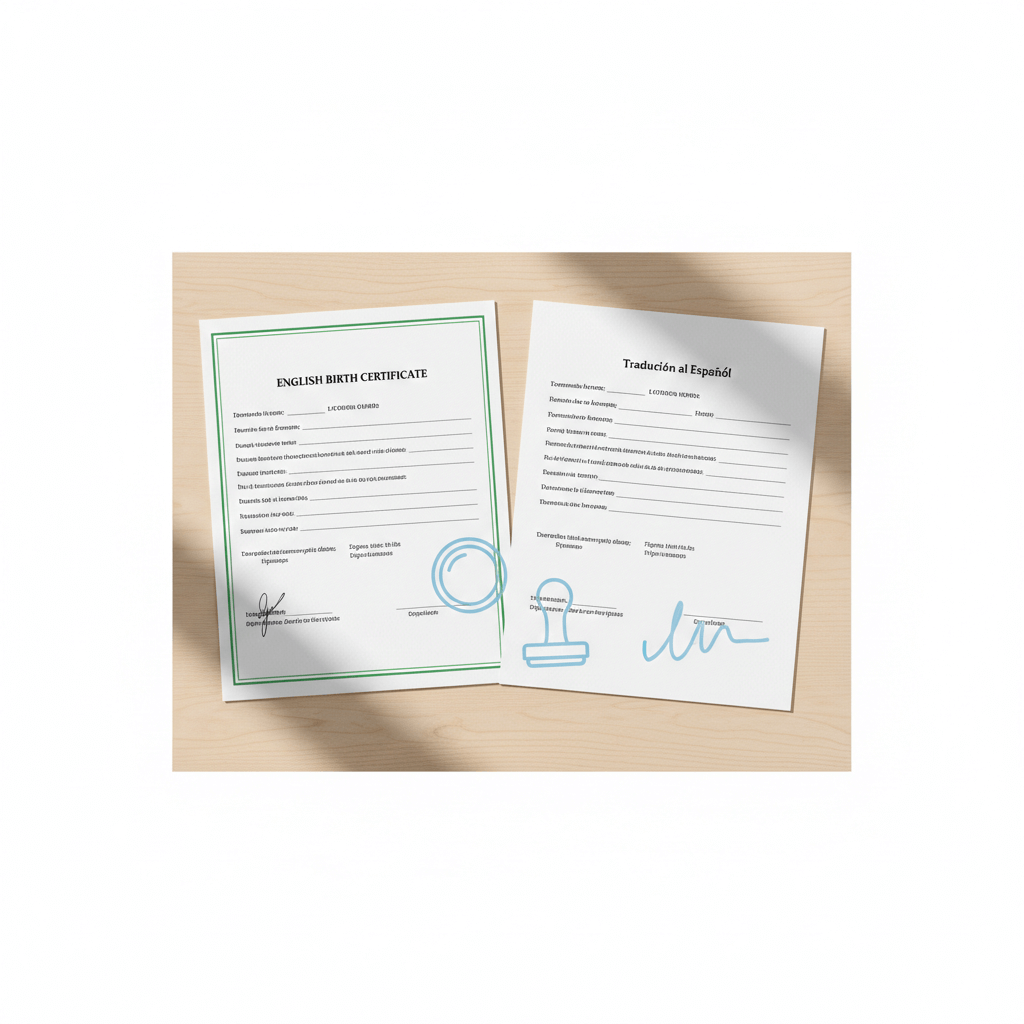
If you need to translate a birth certificate from English to Spanish, the goal isn’t just “Spanish text.” For official use, your translation must match the original document closely, include every stamp and note, and come with the right certification or sworn formalities for the country or office that will receive it.
This guide walks you through the full process step-by-step, including a printable checklist, a mini glossary of common birth certificate terms, and ready-to-copy certification wording (Spanish and English versions) you can adapt based on where you’re submitting.
Before you start: one question that changes everything
Where will you submit the Spanish translation?
Different offices ask for different “levels” of translation. For example:
- Spain (Registro Civil, nationality, many court processes): often requires a sworn translation (“traducción jurada”) completed and stamped by an authorised sworn translator.
- Universities, schools, employers, banks, insurers: often accept a certified translation (translation + signed certification statement).
- Some consulates/embassies: may also request notarisation and/or an apostille/legalisation on the original document (and sometimes on the translator’s statement).
If your receiving office doesn’t clearly say what they want, the safest route is typically:
- a translation that mirrors the original layout, and
- a formal certification statement, and
- sworn/notarised only if explicitly required.
Step 1: Make sure you have the right version of the birth certificate
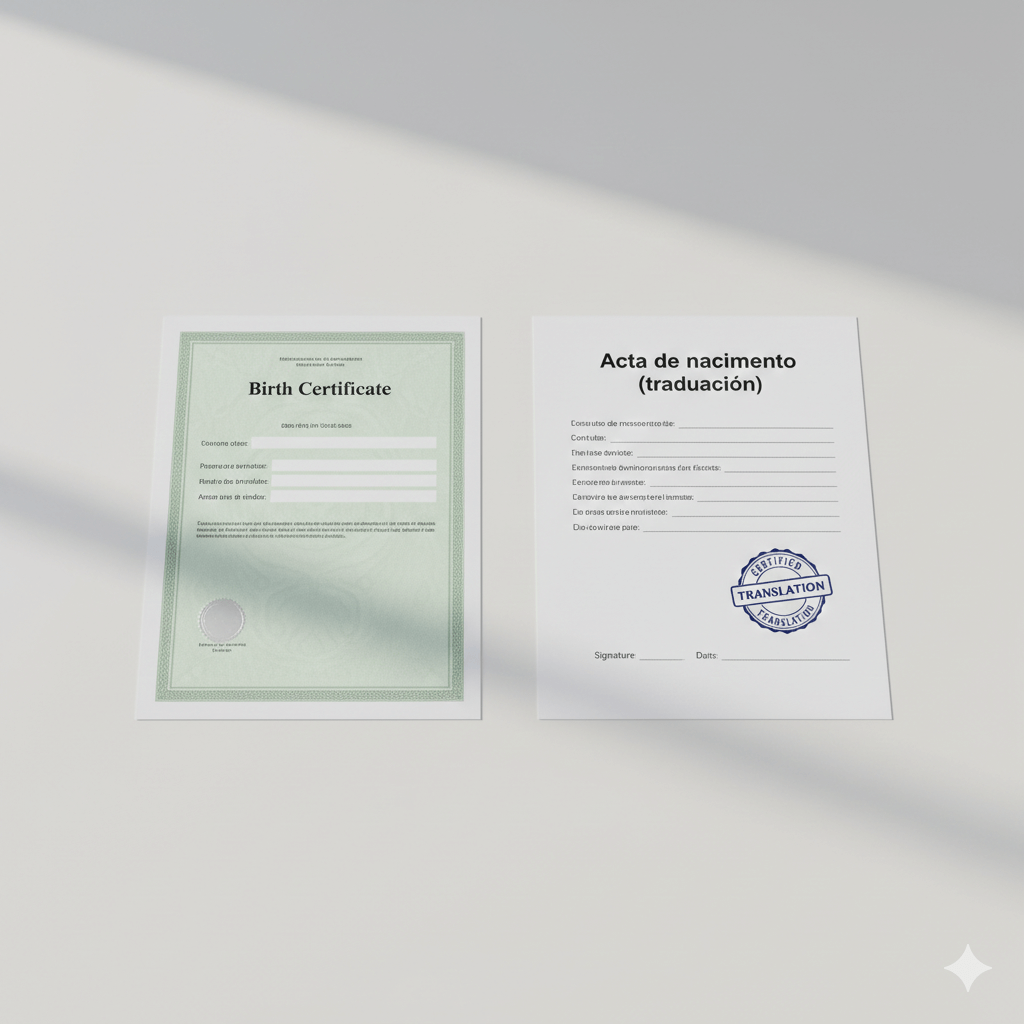
Many authorities won’t accept a short extract if a long-form version exists. Before translating, confirm your document includes:
- Registration/certificate number and issuing authority details
- Full names of child and parents (as shown)
- Dates and places of birth (and sometimes parents’ birthplaces)
- Any marginal notes, amendments, late registrations, or corrections
- Stamps, seals, signatures, registrar notes, and embossed marks
Do not translate from a blurry photo. A perfect translation can still be rejected if the original is unreadable.
Quick tip: If the document has an embossed seal that doesn’t show in photos, take a second photo at an angle with side lighting so the embossing is visible.
Step 2: Decide what “official-ready” means for your case
Certified translation (common for many institutions)
A certified translation usually includes:
- The Spanish translation of the entire document
- A signed certification statement confirming accuracy and translator competence
- Translator/company details (as required by the receiving office)
This is commonly accepted when requirements say things like “certified translation required” without extra instructions.
Sworn translation (common in Spain and some consular processes)
A sworn translation (“traducción jurada”) is produced by a translator authorised under the relevant system, and includes the translator’s stamp/seal and signature in the required format.
If your process involves Spain, confirm whether the receiving office specifically requires “traducción jurada” before you order.
Notarisation (sometimes requested)
Notarisation generally verifies the identity/signature of the person signing the certification statement. It does not verify translation quality.
Apostille/legalisation (often about the original document)
An apostille/legalisation typically applies to the original civil document (birth certificate) for use abroad. Some processes also require notarisation before an apostille can be issued (rules vary by country).
Step 3: Translate every element on the page (not just the typed fields)
An official birth certificate translation must cover:
- Printed headings and field labels
- Typed entries and handwritten additions
- Stamps and seals (translated and/or described)
- Signatures (identified, not “translated”)
- Registration numbers, references, file codes
- Marginal notes and amendments
- Watermarks or embossed seal notes (described)
How to handle stamps, seals, and signatures (the clean way)
A common, accepted approach is:
- Stamp text: translate it (if readable), and optionally note it’s a stamp
- Seal/embossed mark: describe it if text isn’t legible
- Signature: label it as “Signature” and (if name is printed elsewhere) keep consistent
- Illegible text: mark as “[illegible]” rather than guessing
Example formatting inside the translation:
- “Sello: Registro Civil de [lugar]” (if readable)
- “Sello en relieve: [texto ilegible]” (if not readable)
- “Firma: [nombre, si aparece impreso]” or “Firma: [ilegible]”
Step 4: Get names, accents, and formatting right (this is where many DIY translations fail)
Names: keep them consistent and do not “Spanish-ify” them
- Keep names exactly as written on the birth certificate.
- Don’t translate names (e.g., John to Juan) unless the receiving authority explicitly requests it.
- Preserve hyphens, multiple surnames, middle names, and punctuation exactly.
Dates and numbers: match the original, then clarify if helpful
- If the original is “03/04/2010” and the destination country commonly reads dates differently, you can add a clarification like “03/04/2010 (dd/mm/aaaa)” only if the receiving authority allows it.
- Keep registration numbers and codes exactly.
Places and administrative terms
- Proper nouns usually remain as-is (cities, counties), but you can add the Spanish descriptor where helpful (e.g., “County” to “condado”).
Step 5: Use a mini glossary for common birth certificate terms (English to Spanish)
Below is a practical glossary you can use to keep terminology consistent. (Receiving offices sometimes vary by country, so this is a solid “neutral” baseline.)
| English term | Common Spanish rendering |
|---|---|
| Birth Certificate | Certificado de nacimiento / Acta de nacimiento |
| Full name | Nombre completo |
| Date of birth | Fecha de nacimiento |
| Place of birth | Lugar de nacimiento |
| Sex | Sexo |
| Mother | Madre |
| Father | Padre |
| Parents | Padres |
| Mother’s maiden name | Apellido de soltera de la madre |
| Registration number | Número de registro |
| Certificate number | Número de certificado |
| Registrar | Registrador(a) |
| Issuing authority | Autoridad emisora |
| Date of registration | Fecha de registro |
| Seal / stamp | Sello |
| Signature | Firma |
| Amendment / correction | Enmienda / corrección |
| Certified copy | Copia certificada |
Tip: Some countries strongly prefer “Acta de nacimiento”; others prefer “Certificado de nacimiento.” If the receiving office is in Spain, you’ll often see “certificado literal de nacimiento” in certain contexts. Match what the authority uses when possible.
Step 6: Add the certification statement (copy-ready templates)
Different offices prefer different wording. Below are two clean templates: one in Spanish (commonly suitable for Spanish-language submissions) and one in English (commonly suitable when an English certification statement is requested).
Template A: Spanish certification statement (general-purpose)
CERTIFICACIÓN DEL TRADUCTOR
Yo, [Nombre del traductor], certifico que soy competente para traducir del inglés al español y que la presente traducción del documento titulado “[Birth Certificate / Certificado de nacimiento]” es fiel y completa según el documento original.
Nombre: [Nombre del traductor]
Firma: _______________________
Fecha: [dd/mm/aaaa]
Dirección: [Dirección]
Teléfono/Correo electrónico: [Contacto]
Template B: English certification statement (general-purpose)
TRANSLATOR’S CERTIFICATION
I, [Translator name], certify that I am competent to translate from English to Spanish and that the above translation of the document titled “Birth Certificate” is a complete and accurate translation of the original.
Name: [Translator name]
Signature: _______________________
Date: [mm/dd/yyyy or dd/mm/yyyy]
Address: [Address]
Phone/Email: [Contact]
Step 7: Quality check like a professional (a 10-minute review that prevents delays)
Before you submit, run through these checks:
- Completeness: every line, field label, stamp, and marginal note is included
- Numbers: certificate number, registry references, dates match exactly
- Names: spelling and order match the original exactly
- Places: consistent (no accidental “translations” of proper nouns)
- Stamps and seals: translated/described, not ignored
- Legibility notes: anything unclear is marked as illegible (not guessed)
- Certification: signed, dated, includes translator details as required
- Formatting: translation is easy to compare side-by-side with the original
Step 8: Delivery format and what to submit
Most offices accept:
- A clear copy of the original English birth certificate, plus
- The Spanish translation, plus
- The signed certification statement (or sworn translation package, if required)
Some processes require:
- A physical hard copy with signature
- Notarisation of the certification statement
- Apostille/legalisation on the original document (and sometimes additional steps)
If your office is strict, ask them these three questions:
- Do you require certified or sworn translation?
- Do you require notarisation of the translator’s signature?
- Do you require the original birth certificate to be apostilled/legalised?
Common mistakes that cause avoidable delays
- Translating only the typed fields and skipping stamps/seals
- “Correcting” spellings or changing name order
- Guessing unclear stamp text instead of marking it illegible
- Missing marginal notes (very common on amended certificates)
- Using inconsistent date formats without matching the original
- Submitting a translation without a proper certification statement
- Using automatic translation tools for official submissions (high risk for formatting and terminology errors)
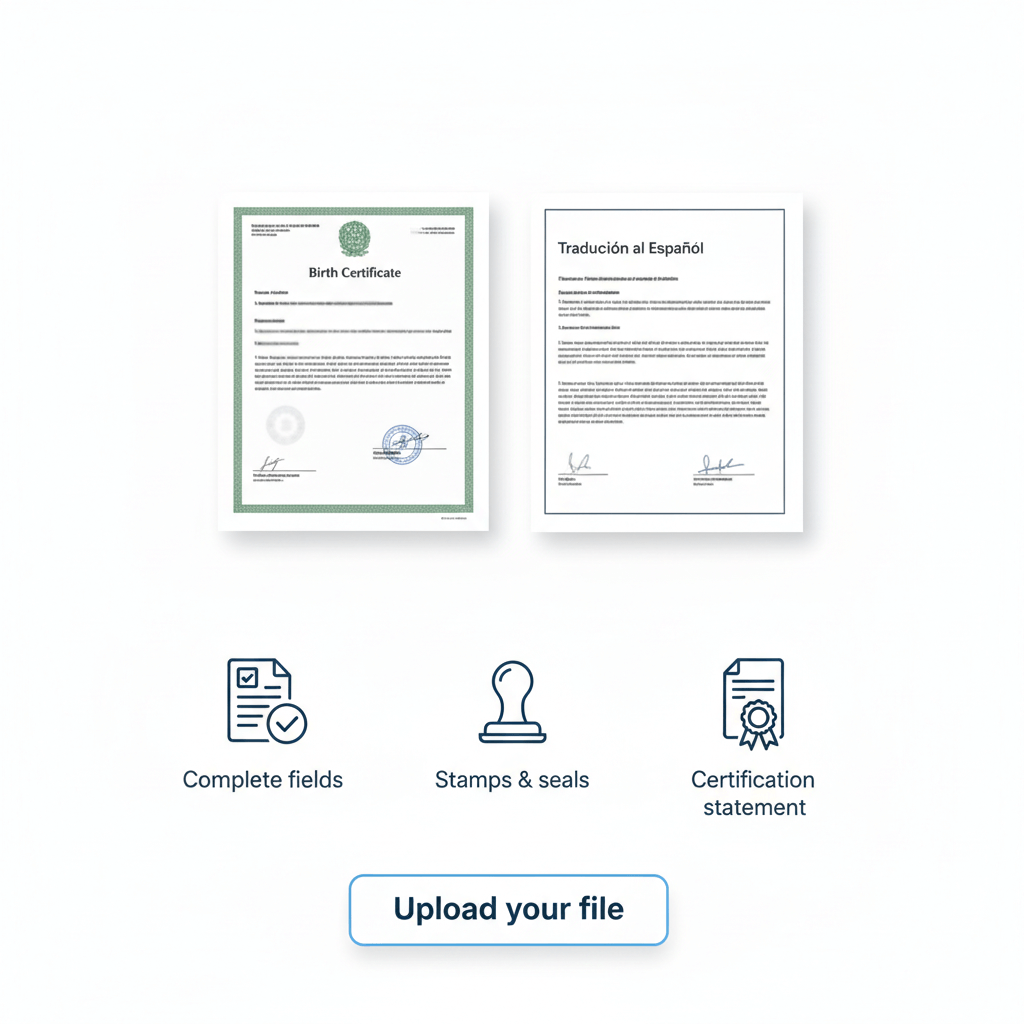
A practical “print and tick” checklist (English to Spanish birth certificate translation)
- I confirmed the receiving office’s translation requirements (certified / sworn / notarised)
- I have the correct version (long-form if required)
- My scan/photo is clear, complete, and shows seals/embossing
- I translated every field label and entry
- I included marginal notes and amendments
- I translated or described stamps and seals
- I preserved names exactly as written
- I matched numbers and dates exactly
- I added a signed, dated certification statement with translator details
- I proofchecked for completeness and consistency
- I prepared the submission bundle (original copy + translation + certification)
FAQ
How do I translate a birth certificate from English to Spanish for official use?
Use a complete, side-by-side comparable translation that includes every field, stamp, seal, and marginal note, then add a signed certification statement (or a sworn translation if your receiving office requires it).
Do I need a sworn translation (“traducción jurada”) for Spain?
Often, yes—especially for Registro Civil, nationality, and some court-related processes. Requirements vary by office, so confirm whether “traducción jurada” is explicitly required before ordering.
What should a certified translation include for a birth certificate?
A full Spanish translation that mirrors the original and a signed certification statement confirming the translator is competent and the translation is complete and accurate, plus translator details as required by the receiving office.
Can I translate my own birth certificate into Spanish?
Some authorities may accept it in low-stakes situations, but many official processes reject self-translations due to perceived bias, missing certification, or formatting issues. For official submissions, a professional certified or sworn translation is the safer option.
Do I need notarisation for an English-to-Spanish birth certificate translation?
Not always. Notarisation may be requested by specific courts, institutions, or consulates. If the receiving office does not explicitly require notarisation, a properly certified translation is often sufficient.
Should the translation match the original layout exactly?
As closely as possible. Matching layout makes review easier and reduces questions. At minimum, preserve the document structure, include all stamps/seals/notes, and keep names and numbers consistent.
