
If you’re applying for a green card, citizenship, a visa, or another U.S. immigration process, you’ll almost always need to translate your Spanish birth certificate into English. And not just “translate the words”—you need an English version that is complete, easy to verify, and packaged correctly so it won’t slow your case down.
This guide walks you through the exact, practical steps to translate a Spanish birth certificate into English, what the translator’s certification must include, and the mistakes that trigger delays.
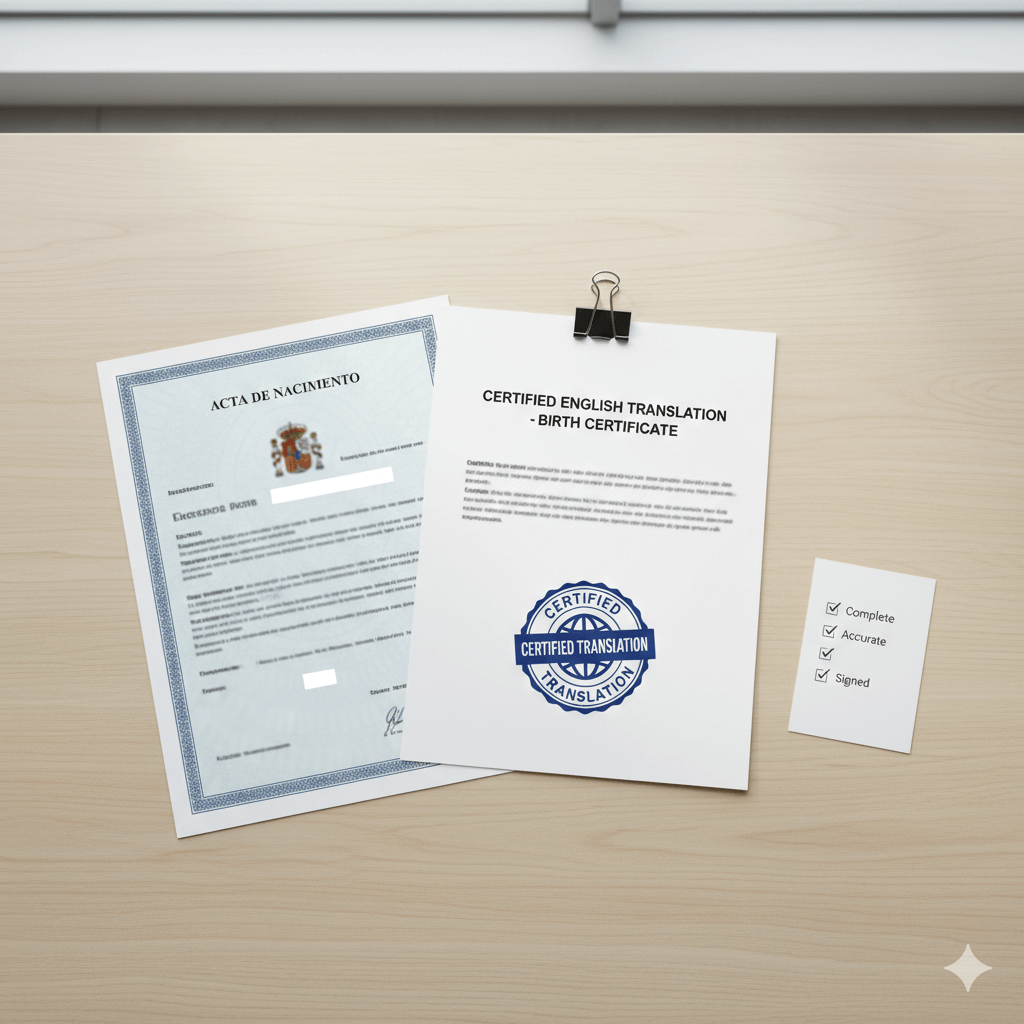
What “USCIS-ready” translation actually means
A Spanish birth certificate translation for USCIS must be:
- Complete (every visible word, stamp, seal, note, and annotation)
- Accurate (no “cleaning up,” guessing, or rewriting)
- Clearly formatted so an officer can compare it to the original
- Accompanied by a signed translator certification (also called a Certificate of Accuracy)
Quick checklist before you translate your Spanish birth certificate
Use this checklist before you pay anyone (or before you attempt it yourself):
- The scan/photo shows full page edges (nothing cut off)
- You have both sides if the back contains stamps, notes, or registry marks
- All text will be translated, including:
- stamps and seals
- handwritten notes
- marginal notes
- registration numbers
- corrections/annotations
- Names will match your immigration forms (spelling, spacing, hyphens, accents—see guidance below)
- Dates will be written clearly to avoid day/month confusion
- Translator certification will include a signature and identification details
Know what you’re looking at: common Spanish birth certificate formats
Spanish birth certificates vary by country and region. You might see:
- Acta de nacimiento
- Partida de nacimiento
- Certificado de nacimiento
- Registro de nacimiento / Inscripción de nacimiento
They can be typed, stamped, handwritten, digital, or multi-page, and may include registry metadata like tomo/libro/folio (book/page references) or civil registry identifiers.
Spanish naming conventions that cause USCIS problems (and how to avoid them)
This is one of the biggest avoidable issues: Spanish names often don’t “fit” neatly into English forms.
1) Two surnames (apellido paterno + materno)
Many Spanish-speaking countries use two last names. Your translation should preserve them exactly as shown on the birth certificate, and your USCIS forms should be consistent with that structure.
2) “De”, “Del”, “De la”, and compound surnames
Examples:
- “María De la Cruz García”
- “Juan Carlos Del Río Pérez”
These should not be shortened or rearranged.
3) Accents and special characters (Á, É, Í, Ó, Ú, Ñ)
If your passport or prior filings already use a specific spelling (with or without accents), stick to one consistent spelling across documents. The translation should reflect the original faithfully, but your submission strategy should aim for consistency.
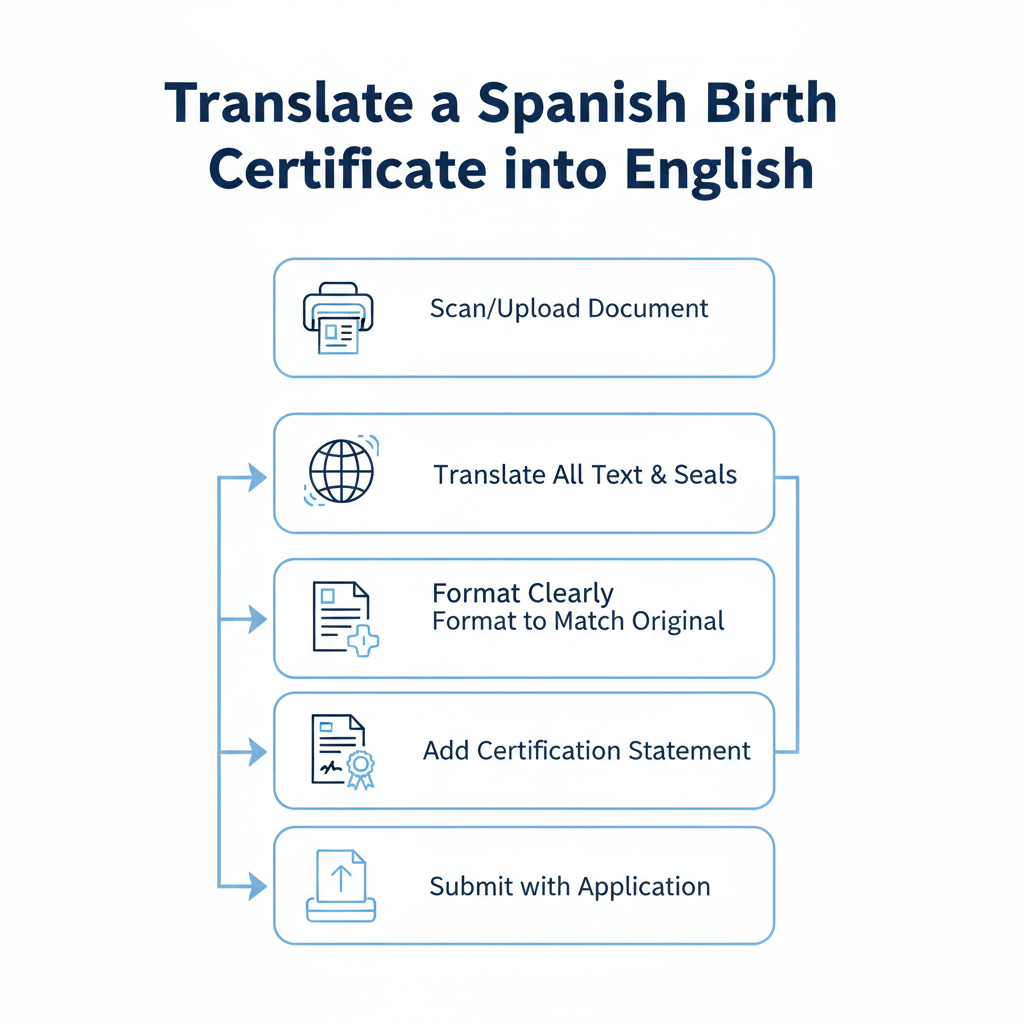
Step-by-step: how to translate a Spanish birth certificate into English
Step 1: Use a clear, complete scan or photo
Take a photo in good light, on a flat surface, with the entire page visible. Avoid shadows and glare. If there are stamps on the back, photograph that too.
Step 2: Identify every element that must be translated
A proper translation includes more than the “main text.” It also includes:
- Registration numbers and codes
- Civil registry office text
- Stamps, seals, signatures (described clearly)
- Marginal notes (even if they’re hard to read)
- Any “corrections” or later annotations
Step 3: Translate field-by-field (not summary-style)
USCIS expects a translation that mirrors the original content, not a paraphrase.
A practical way to do this is to translate each field label and value, for example:
- Child’s full name:
- Date of birth:
- Place of birth:
- Father:
- Mother:
- Registration details:
Step 4: Use a consistent format for stamps, seals, and handwritten text
A strong translation makes comparison easy. A common, readable approach is:
- [STAMP: …] to describe stamp text
- [SEAL: …] to describe seal text if visible
- [SIGNATURE] where a signature appears
- [HANDWRITTEN NOTE: …] for handwritten entries
- [ILLEGIBLE] where text cannot be read (never guess)
Step 5: Add the translator certification (Certificate of Accuracy)
This is not optional for USCIS-style submissions. The certification should confirm two things:
- the translation is complete and accurate
- the translator is competent to translate from Spanish into English
Sample translator certification wording (copy/paste)
Translator Certification
I, [Translator Full Name], certify that I am competent to translate from Spanish into English, and that the attached translation of the Spanish birth certificate is a complete and accurate translation of the original document to the best of my ability.
Signature: _______________________
Name: [Translator Full Name]
Date: ____________________________
Address: _________________________
Email / Phone: ___________________
Step 6: Review the finished translation like a USCIS officer would
Before you submit, check:
- Every item on the original appears somewhere in English
- Names are consistent with your passport and forms
- Dates are unambiguous (spell the month if helpful: “14 March 1996”)
- The certification is signed and dated
- Page order is clear if you have multiple pages
Step 7: Submit the translation with the birth certificate copy
USCIS-style submissions typically include:
- A copy of the original Spanish birth certificate
- The complete English translation
- The translator certification attached to the translation
Some people do—but it’s a high-risk move for a document that proves identity, parentage, and place of birth. Even small issues (missing stamp text, inconsistent names, or unclear dates) can create delays.
If you’re considering doing it yourself, read this first:
Can I translate my own birth certificate? — https://uscisofficialtranslation.com/can-i-translate-my-own-birth-certificate/
If your timeline matters, the safer route is to use a professional, USCIS-focused translator and get it done once, correctly.
Certified vs notarized: what most applicants misunderstand
A certified translation includes the translator’s signed statement of accuracy and competence.
A notarized translation generally means a notary verified the signer’s identity—not the translation quality.
Most USCIS-style filings focus on the certified translation package. Notarization may be requested in other contexts (certain schools, courts, or consulates).
Cost and turnaround: what to expect
Pricing depends on page count, document complexity (stamps, handwriting, marginal notes), and how fast you need it.
Common mistakes that cause delays (and how to avoid them)
Mistake 1: Missing stamps, seals, and marginal notes
If it’s visible on the page, it must be accounted for in English.
Mistake 2: Name mismatches across documents
Two surnames, accent differences, spacing, or hyphenation issues can create confusion. Align your spelling strategy across forms.
Mistake 3: Day/month date confusion
“03/07/1998” can be interpreted two ways. Write the date out clearly in English.
Mistake 4: “Cleaning up” the translation
USCIS-style translations should not rewrite content for style. Keep it literal and complete.
Mistake 5: No certification (or incomplete certification)
A missing signature/date/contact detail is a common rejection point.
Mistake 6: Cropped scans
If page edges are cut off, officers may assume content is missing.
Spanish-to-English birth certificate glossary (quick reference)
These are common terms you may see:
- Acta de nacimiento — Birth certificate / birth record
- Registro Civil — Civil Registry
- Fecha de nacimiento — Date of birth
- Lugar de nacimiento — Place of birth
- Nombre — Given name
- Apellido — Surname / last name
- Primer apellido — First surname
- Segundo apellido — Second surname
- Padre — Father
- Madre — Mother
- Nacionalidad — Nationality
- Número de acta — Certificate/record number
- Libro / Tomo — Book / volume
- Folio — Page / folio
- Oficial del registro — Registry officer
- Sello — Stamp / seal
- Firma — Signature
- Anotación marginal — Marginal note
- Rectificación — Correction / amendment
- Fecha de registro — Registration date
- Municipio — Municipality
Want it done once, correctly, and fast?
If your case has a deadline—or you simply want to avoid rework—get a professional Spanish birth certificate translation with the required certification package.
FAQ Section
1) Do I need a certified translation for a Spanish birth certificate?
If you’re submitting a Spanish birth certificate for a U.S. immigration-style process, you generally need a complete English translation plus a signed translator certification (Certificate of Accuracy).
2) Can I translate my Spanish birth certificate into English myself?
Some applicants do, but it’s risky—especially for identity documents. Missing stamps, unclear dates, or inconsistent name formatting can cause delays. If accuracy matters, use a professional translator.
3) What must be included in a Spanish birth certificate translation to English?
All visible text: names, dates, places, registry details, stamps, seals, signatures, handwritten notes, and marginal annotations—plus a signed translator certification.
4) Do I need notarization for a Spanish birth certificate translation?
Often, no. Notarization is a separate step and is usually only required if the receiving authority specifically asks for it.
5) How long does it take to translate a Spanish birth certificate into English?
Turnaround depends on complexity and service level. Many applicants choose 24-hour or rush options when they’re close to a filing deadline.
6) How much does it cost to translate a Spanish birth certificate to English?
Cost varies by page count and complexity (stamps, handwriting, multiple pages). Pricing is often per page for short civil documents.
