
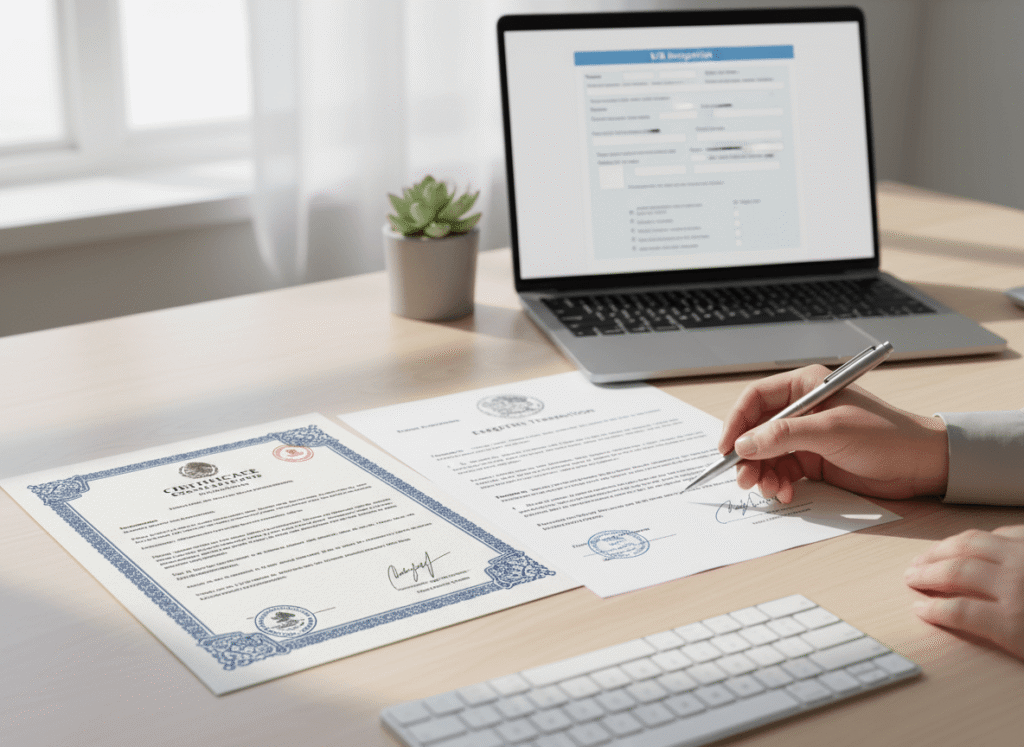
If you were born in Mexico and are now applying for a U.S. visa, green card, citizenship, or another immigration benefit, you will almost certainly be asked for your birth certificate in English. At that point, most people start searching the same thing: how to translate a Mexican birth certificate correctly so that USCIS accepts it without delays or extra questions.
Why You Need to Translate a Mexican Birth Certificate
You typically need an English translation of your Mexican acta de nacimiento when you are:
- Filing a U.S. immigration petition or application (for example, family-based, employment-based or humanitarian cases)
- Applying for a U.S. green card or adjustment of status
- Filing for naturalization (citizenship)
- Proving your age, identity or family relationship in court
- Enrolling in school or university in the U.S.
- Applying for certain professional licences or benefits
U.S. immigration authorities rely heavily on your birth certificate to verify your name, date and place of birth, and family relationships. If the document is in Spanish, they can’t legally rely on it unless it is accompanied by a proper English translation and the required translator’s certification.
What USCIS Actually Requires From Your Translation
Before worrying about how to translate a Mexican birth certificate, it helps to know what the law actually says.
U.S. Citizenship and Immigration Services (USCIS) applies a simple rule: any document in a foreign language must be submitted with a full English translation plus a signed certification from the translator. The certification must confirm that:
- The translation is complete and accurate, and
- The translator is competent to translate from Spanish into English.
There is no requirement in U.S. law that the translator be licensed by a government body; the key point is the signed, written statement attached to the translation. Government and professional guidance explain that this signed statement is what makes the translation “certified” for USCIS purposes.
Does the Translation Need to Be Notarized?
For USCIS alone, the answer is usually no. Notarization is not a standard immigration requirement in the United States. Some applicants still choose notarization for extra peace of mind or because another agency (like a foreign consulate or state office) asks for it—but USCIS itself generally focuses on the content and certification, not a notary stamp.
Who Can Translate a Mexican Birth Certificate?
Authoritative immigration resources explain that a translation for USCIS can, in theory, be done by anyone who is competent in both Spanish and English and who is willing to sign the certification.
However, there are two important warnings:
- Self-translation is risky. While USCIS doesn’t explicitly ban you from translating your own documents, many attorneys and experienced applicants strongly discourage it. A self-translation can create doubts about impartiality and make RFEs more likely.
- Friends or family may also raise questions if they are directly involved in your case.
That’s why most applicants prefer a neutral, professional translator or a specialist service that knows USCIS expectations inside out.
Understanding a Mexican Birth Certificate (Acta de Nacimiento)
Mexican birth certificates follow a structure that is quite different from U.S. documents. Knowing how they’re laid out helps you understand what needs to be translated.
A typical acta de nacimiento includes:
- Header details
- Country name and state (e.g., Estados Unidos Mexicanos, Entidad Federativa)
- Municipality (Municipio or Alcaldía)
- Civil Registry office (Oficialía del Registro Civil)
- Book, act and folio numbers (Libro, Acta, Folio)
- Personal data of the person registered
- Full name (often with two surnames)
- Date and place of birth
- Sex
- Unique population registry code (CURP)
- Parents’ information
- Names (also often with two surnames each)
- Nationality, age, and sometimes occupation or residence
- Registration details
- Date of registration (sometimes different from the birth date)
- Name and title of the civil registrar
- Signatures and official seals
- Margins, stamps and notes
- Marginal annotations (for example, marriage, adoption, corrections)
- Barcodes, QR codes or legends about electronic certification
Professional guides to Mexican birth certificate translation emphasise that all of these elements—headers, seals, marginal notes and even succinct legends—must be carried over into English.
A correct translation should mirror the structure of the original as closely as possible, while still being clear in English.

Step-by-Step: How to Translate a Mexican Birth Certificate
Now, let’s look at the practical side of how to translate a Mexican birth certificate so that USCIS will accept it without trouble.
Step 1: Obtain a Clean, Legible Copy
Start with the best possible copy of your birth certificate:
- If you only have an old, faded copy, consider requesting a newer certified copy from the Registro Civil or the online Mexican government portal.
- Make sure all text, stamps, seals, barcodes and signatures are fully visible.
- Scan the document at a high resolution (ideally 300 dpi or higher) in color.
Poor scans or cropped images are one of the easiest ways to create errors in translation.
Tip: If you’re not sure whether your copy is clear enough, send it to your translation provider and ask for a quick review before payment.
Step 2: Choose the Right Translation Provider
This is the most important decision in the process. Look for:
- Spanish-to-English specialists who regularly handle actas de nacimiento
- Clear mention that they provide USCIS-compliant certified translations
- Transparent pricing and realistic delivery times
- Clear information about how you will receive the translation (PDF, hard copy, or both)
With USCIS Official Translation, your Mexican birth certificate is handled by translators who specialise in immigration cases and understand the nuances of Mexican civil records—such as double surnames, accent marks, and regional terminology.
From your side, the process is simple:
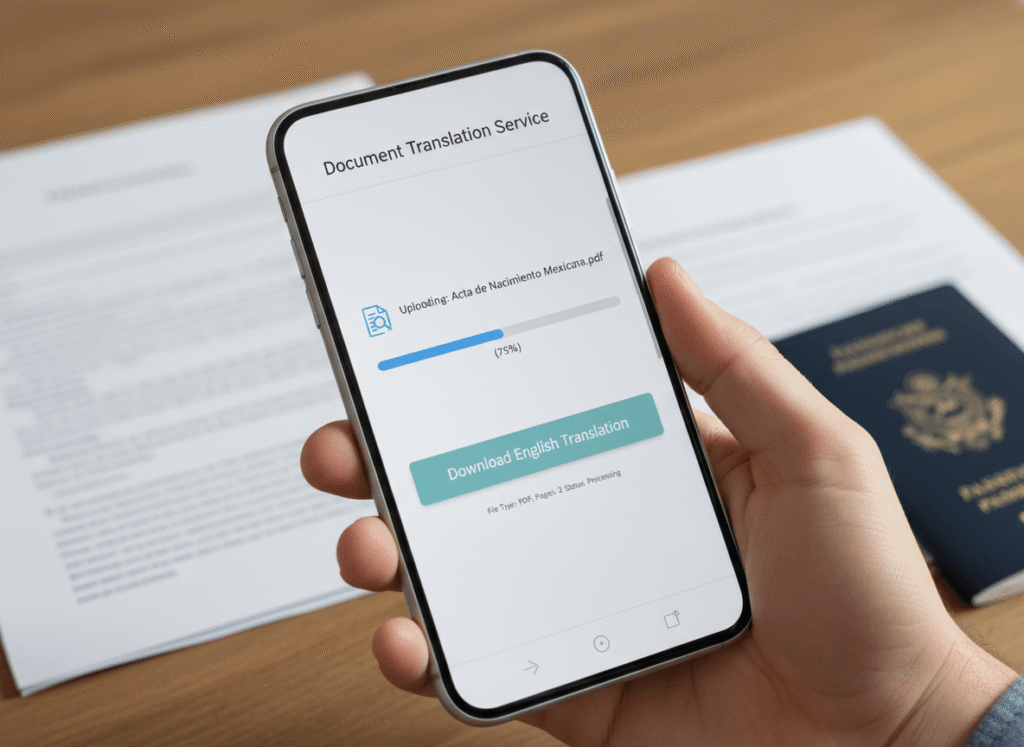
- Upload a clear scan or photo of your acta de nacimiento.
- Provide the spelling of your name exactly as you want it to appear in your immigration forms.
- Confirm your email address and preferred delivery time.
You then receive a ready-to-submit English translation with the translator’s signed certification—and, if needed, printed copies for in-person appointments.
Step 3: Ensure a Full, Word-for-Word Translation
USCIS expects a complete translation, not a summary. That means:
- Every word on the original must be reflected in English, even if it seems unimportant.
- Headers, seals, stamps, side notes and legends must be translated or described (for example, “[Round ink stamp: State of Jalisco Civil Registry]”).
- Names, dates and places must be transcribed carefully, keeping original spellings and diacritics.
A good translator will:
- Mirror the layout of the original as much as possible
- Standardise dates into a clear English format (e.g., “16 de julio de 1998” → “July 16, 1998”) while preserving the original meaning
- Indicate any unreadable text with a neutral note such as “[illegible]” rather than guessing
This level of precision is what immigration officers expect and what protects your case from unnecessary questions.
Step 4: Include the Required Translator’s Certification
Alongside the translated text, there must be a separate translator’s certificate that includes:
- A statement that the translation is complete and accurate
- A statement that the translator is competent in Spanish and English
- The translator’s name, signature and date
- Contact details (address, email, and/or phone)
A typical closing paragraph will look something like:
“I, [Name], certify that I am fluent in the English and Spanish languages and that the foregoing is a complete and accurate translation of the attached Mexican birth certificate.”
Services like USCIS Official Translation use certification wording that is aligned with official guidance and widely used in successful immigration cases.
Step 5: Check for Consistency With Your Forms
Before you submit your application:
- Compare the names and dates on your translation with the information on your USCIS forms (for example, Forms I-130, I-485, N-400).
- Pay special attention to:
- Order of surnames
- Use of accent marks
- Hyphens or spaces in compound surnames
- Make sure the English spelling used in the translation is the same one you use everywhere else.
If there are known discrepancies—for example, your passport uses only one surname, but your birth certificate uses two—talk to your attorney or representative about how best to explain this in your application.
Step 6: Submit the Translation With Your Application
When you file with USCIS, you usually need to include:
- A copy of the original Mexican birth certificate
- The English translation
- The translator’s certification page
If you file online, you’ll upload all pages as PDFs or clear images. If you file by mail, you’ll include printed copies. Keep a digital backup of everything in case USCIS asks you to resend or upload again.
With a properly prepared translation, immigration officers can quickly verify your identity and relationship details—helping your case move more smoothly through the system.
DIY vs Professional Translation: What’s the Risk?
Some applicants wonder whether they should save money by translating their own acta de nacimiento or asking a friend.
Here’s a simple comparison:
DIY or Friend Translation
Pros
- No direct translation fee
- You control the process
Cons
- Risk of subtle mistakes (names, abbreviations, marginal notes)
- No professional template or experience with USCIS wording
- Higher chance of RFEs if the officer doubts the accuracy or neutrality
- Potential discomfort asking a friend to sign a legal certification
Professional USCIS-Focused Translation
Pros
- Translators familiar with Mexican civil registry formats and terminology
- Standard wording for USCIS certifications
- Layout that mirrors the original, making it easy for officers to review
- Fast turnaround and clear, fixed pricing
- Peace of mind that the document is ready to submit
Cons
- You pay a fee—but in practice, this is often far less than the cost of delays, RFEs or refiling.
If your immigration status, work plans or family reunification depend on getting it right first time, a specialised service is usually the safest, most cost-effective choice.
When you work with USCIS Official Translation, you simply upload your Mexican birth certificate, and we return a polished, certified English translation you can submit with your application immediately.
Special Considerations for Mexican Birth Certificates
Mexican records can raise a few additional questions. Here are some points to be aware of.
Double Surnames (Two Last Names)
Most Mexican birth certificates list names as:
Nombre(s) + Primer Apellido + Segundo Apellido
In English-speaking contexts, this can be confusing, especially if one surname is dropped in later documents.
A skilled translator will:
- Preserve all elements of the original name order
- Avoid “re-arranging” names to match later usage
- Use notes or consistent spelling so your lawyer or representative can explain any differences clearly
Marginal Notes (Notas Marginales)
Many actas include short notes in the margins about later events, such as:
- Adoption
- Marriage or divorce
- Late registration corrections
These notes must be translated, even if they seem unimportant to you. An omission could be interpreted as a lack of transparency.
Digital Certificates and QR Codes
Modern Mexican birth certificates often include QR codes, barcodes and legends about electronic verification. The translator doesn’t scan or decode these, but they should describe them briefly, so the officer understands what they are (for example, “[QR code for online verification]”).
How USCIS Official Translation Handles Mexican Birth Certificates
When you trust your acta de nacimiento to USCIS Official Translation, you benefit from a process built specifically for U.S. immigration cases:
- Dedicated Spanish-to-English immigration team
- Templates tailored to Mexican birth certificate formats
- Clear, USCIS-ready translator certification included by default
- Fast digital delivery, with optional printed copies
- Support if you receive follow-up questions from your attorney or the immigration officer
You don’t have to figure out formatting, wording or legal phrasing. You simply send your document, then attach the finished translation to your case file.
If you’re ready to move forward, upload your Mexican birth certificate now and our team will prepare a certified English translation you can submit with confidence.
Frequently Asked Questions: Translating Mexican Birth Certificates
1. Can I translate my own Mexican birth certificate for USCIS?
USCIS rules focus on having a complete, accurate translation and a signed certification from someone competent in both languages. Technically, they do not explicitly forbid self-translation. However, many immigration professionals strongly advise against translating your own documents because it can raise questions about impartiality and increase the risk of an RFE.
In practice, it is much safer to use a neutral, professional translator or a specialist service like USCIS Official Translation.
2. Do I need a notarized translation of my Mexican birth certificate?
For USCIS purposes alone, your translation usually does not need to be notarized. What matters most is that:
- The translation is full and accurate
- A competent translator signs a certification stating this
Notarization may be needed if another body—such as a state office, foreign consulate or court—specifically asks for it. If you’re unsure, ask your attorney or check the instructions for your specific application.
3. How long does it take to translate a Mexican birth certificate?
Most professional services can translate a single-page Mexican birth certificate within 24–48 hours, sometimes faster. Timings depend on:
- How clear your scan or photo is
- Whether there are complex marginal notes
- Whether you also need printed copies shipped to you
If you are on a tight USCIS filing deadline, let your translation provider know so they can prioritise your order.
4. How much does a Mexican birth certificate translation cost?
Pricing varies by provider, but most services charge either per page or per word, with a minimum fee for short documents. Factors that affect the price include:
- Number of pages
- Urgency (standard vs rush)
- Whether you need shipping of hard copies
At USCIS Official Translation, you can upload your acta de nacimiento and receive a clear quote before committing, so there are no surprises.
5. Will USCIS accept a scanned copy of my Mexican birth certificate and translation?
USCIS generally accepts legible copies of civil documents and translations when filing, unless the instructions specifically ask for originals. That means:
- Scanned PDFs or high-quality photos of both the original and the translation are usually fine for online filing
- For in-person interviews, officers may ask to see original civil documents, but copies of translations are normally acceptable
Always follow the instructions in the form’s filing guide and keep your original documents safe in case they are requested later.
6. Can I use one translation for multiple applications?
Yes. Once you have a certified English translation of your Mexican birth certificate, you can usually reuse it for:
- Multiple USCIS applications
- Passport or ID renewals that require an English version
- School or employer verifications
Just keep digital and physical copies in a secure place for future use.
