
If you need to translate a death certificate from Spanish to English, the safest approach is not to do a literal word swap yourself or rely on a free tool. For USCIS, visa cases, probate, insurance claims, estate administration, and other official processes, the translation normally needs to be complete, accurate, and professionally certified so the receiving authority can rely on it without delay.
A death certificate is not just another document. It often affects immigration history, marital status, inheritance rights, next-of-kin records, pension claims, and identity verification. That is why even small errors in names, dates, registry numbers, places of death, or marginal notes can cause unnecessary questions.
Need it done properly the first time? USCIS Official Translation provides certified Spanish-to-English translations starting from $24.99 per page, with rush options, secure handling, and a 100% USCIS acceptance guarantee.
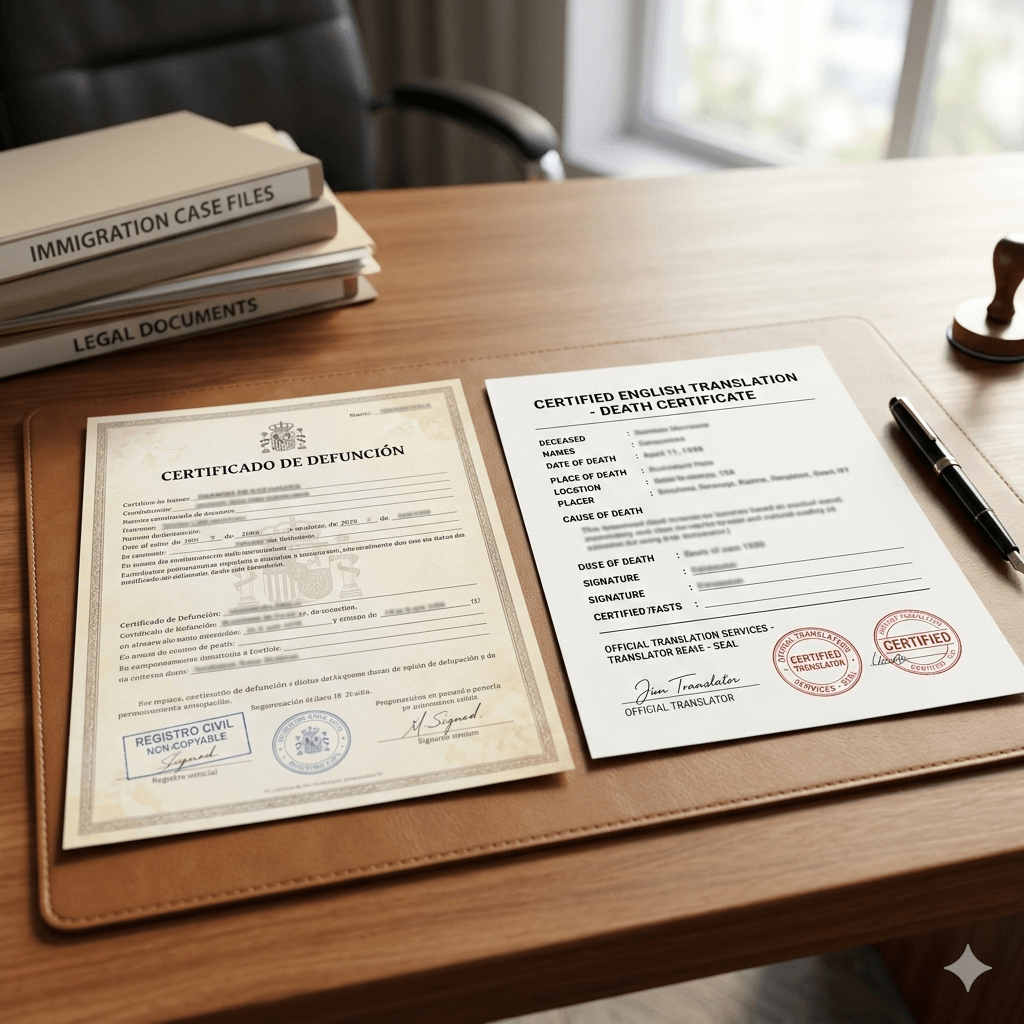
When you may need a Spanish death certificate translated
A Spanish death certificate translation is commonly requested for:
- USCIS petitions and supporting evidence
- National Visa Center and consular processing
- Probate and inheritance matters
- Pension or life insurance claims
- Marriage, remarriage, or civil status updates
- Court filings and legal declarations
- Dual citizenship or nationality applications
- Vital records and family history matters
A common example is when a petitioner must prove that a previous marriage ended because a spouse died. In that situation, a Spanish death certificate often needs to be translated into English before it is filed with immigration paperwork or presented to another authority.
What matters most in an official translation
The biggest mistake people make is assuming this is mainly about converting Spanish words into English. In practice, official acceptance depends on four things:
1. Completeness
Every meaningful element should be accounted for, including:
- typed text
- handwritten notes
- stamps
- seals
- marginal annotations
- registry references
- signatures
- dates
- numbers
- abbreviations
If the original shows it, the English version should reflect it.
2. Accuracy
Names, locations, document numbers, and civil status details must match the source exactly. A death certificate is often cross-checked against other records such as marriage certificates, passports, petitions, and identity documents.
3. Certification
For many official uses, especially USCIS-related filings, the translation should include a signed certification confirming that the translation is complete and accurate and that the translator is competent in both languages.
4. Format clarity
A good certified translation should be easy to compare against the original. It does not need to copy every visual detail perfectly, but it should clearly mirror the structure and show what each field means.
Step by step: how to translate a death certificate from Spanish to English
Step 1: Get a clear copy of the original document
Start with the best version of the Spanish death certificate you have. Ideally this will be:
- the original certificate
- a certified copy
- a high-resolution scan
- a full photo with all corners visible
Do not crop seals, side notes, or handwritten parts. Even a small marginal note can matter.
Step 2: Confirm where the translation will be used
Before ordering, identify the receiving authority. Requirements can vary depending on whether the translation is for:
- USCIS
- a U.S. consulate
- probate court
- an insurer
- a bank
- a state agency
- a foreign authority
This is where people lose time. They assume “certified” and “notarised” mean the same thing everywhere. They do not.
Step 3: Use a professional Spanish-to-English translator
For official documents, especially sensitive civil records, use a human translator or specialist translation company experienced with legal and immigration paperwork. This reduces the risk of:
- mistranslating registry terms
- normalising names incorrectly
- omitting seals or handwritten notes
- submitting a translation without the right certification wording
If your deadline is close, upload the file and ask for a same-day or 24-hour option rather than rushing a poor translation.
Step 4: Make sure the whole document is translated
A proper death certificate translation should cover all visible content, not just the “main details”.
That includes items such as:
- title of the document
- issuing authority
- full name of the deceased
- date and place of death
- date and place of registration
- cause of death, where shown
- age, sex, marital status, nationality
- informant or declarant details
- book, folio, act, volume, or registry number
- remarks, amendments, and marginal notes
- seals, stamps, and signatures
Step 5: Attach a certification statement
For USCIS and many other official uses, the English translation should include a translator’s certification. That certification normally identifies:
- the source language
- the target language
- the translator’s competence
- confirmation that the translation is complete and accurate
- the translator’s name
- signature
- date
- contact details
Step 6: Review the identity details before submission
Before you file or present the translation, compare it against the source and your other paperwork.
Check carefully:
- full name spellings
- double surnames
- maiden names
- date format
- place names
- passport-style name order
- registry numbers
- handwritten corrections
- whether accent marks or abbreviations could cause confusion
This is the step that saves people from avoidable follow-up questions.
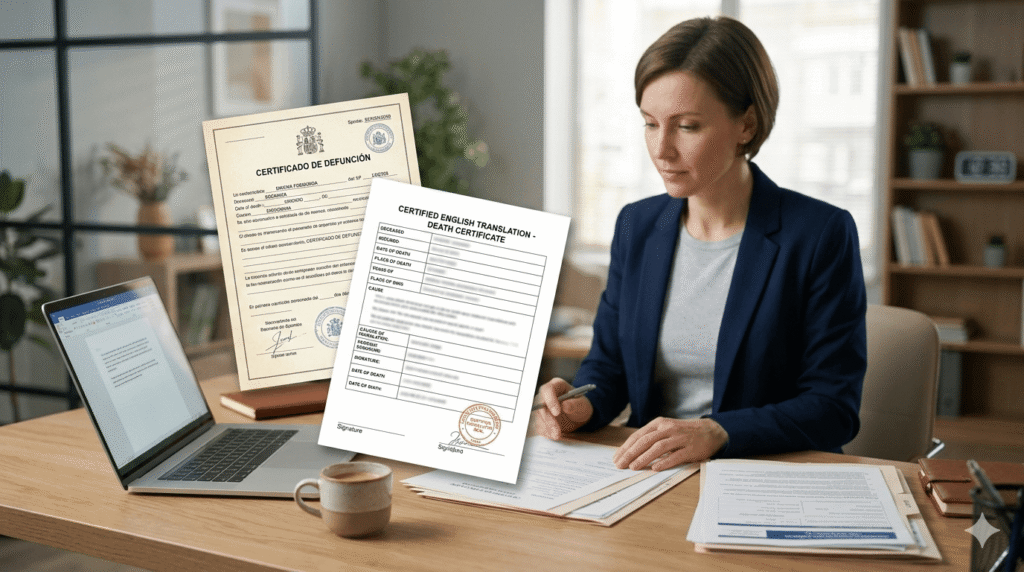
What must be translated on a Spanish death certificate
Spanish death certificates vary by country, region, and issuing office. Some are modern digital extracts. Others are handwritten civil registry records. Many include terms that look simple but carry legal meaning.
Here are common Spanish terms you may see:
| Spanish term | Usual English rendering |
|---|---|
| Acta de Defunción | Death Certificate / Death Record |
| Certificado de Defunción | Death Certificate |
| Registro Civil | Civil Registry |
| Nombre completo | Full Name |
| Fecha de defunción | Date of Death |
| Lugar de fallecimiento | Place of Death |
| Estado civil | Marital Status |
| Nacionalidad | Nationality |
| Sexo | Sex |
| Edad | Age |
| Causa de muerte | Cause of Death |
| Declarante | Informant / Declarant |
| Libro / Tomo | Book / Volume |
| Folio | Folio / Page |
| Acta / Partida | Record / Certificate Entry |
| Sello | Seal |
| Firma | Signature |
The correct English rendering can depend on context and country. For example, the same field label may be translated slightly differently in Spain, Mexico, Colombia, Argentina, or another Spanish-speaking jurisdiction. A strong translation keeps the meaning legally clear without over-interpreting the source.
The hidden issue: names and civil status must match your case
This is where many translations fail.
A death certificate may be used to prove that a prior marriage ended, to support a petition, or to explain a family relationship. If the translated name on the death certificate does not line up neatly with the name on a passport, marriage certificate, or petition form, the document may still be technically translated but still cause questions.
Pay special attention to:
- paternal and maternal surnames
- married and unmarried names
- initials versus full names
- abbreviated middle names
- different date formats
- places with multiple accepted English spellings
A professional translator will usually preserve the document faithfully and, where needed, use translator notes instead of guessing.
Certified, notarised, and apostilled: what is the difference?
These three are often confused.
Certified translation
This is the standard requirement for many immigration and official uses. It means the translation is accompanied by a signed statement from the translator confirming accuracy and competence.
Notarised translation
This usually adds a notary step to verify the identity of the signer of the certification. It may be requested by a court, foreign authority, university, or registry, but it is not the same thing as the translation itself.
Apostilled document
An apostille is a separate authentication step for use in countries that recognise apostilles under the Hague Convention. It usually relates to the original document or notarisation, not the act of translating alone.
If you are filing with USCIS, the usual concern is whether the translation is fully certified and complete. If you are dealing with probate abroad, dual citizenship, or foreign civil authorities, ask whether notarisation or apostille is also needed before you order.
Not sure which version you need? Send your death certificate and the destination requirement to USCIS Official Translation and get a clear answer before you pay for the wrong service.
Why machine translation is risky for death certificates
A death certificate is one of the worst documents to run through a free online translator and submit as if it were final.
Machine translation can struggle with:
- handwritten civil registry entries
- abbreviations
- registry terminology
- old-style legal phrasing
- faint stamps and seals
- country-specific administrative language
- name order and formatting
- partial bilingual layouts
The real problem is not only wording. It is accountability. A free tool does not certify the translation, does not explain unclear text, and does not take responsibility for omissions.
For official submissions, especially immigration-related ones, human review matters.
Common mistakes that cause delays
If you want to avoid rework, avoid these seven mistakes:
- Submitting only part of the document
Leaving out stamps, notes, or the reverse side can create problems. - Using a summary instead of a full translation
Official bodies often expect the entire document, not a shortened version. - Guessing at handwritten text
Unclear writing should be marked appropriately, not invented. - Changing name formats to “sound more English”
Legal documents should reflect the source accurately. - Using the wrong date format
Day/month/year and month/day/year confusion is common. - Ordering a translation without certification
A plain translation may not be enough for USCIS or formal legal use. - Assuming notarisation is always required
Sometimes it is needed, sometimes it is not. Ordering extra steps blindly wastes time and money.
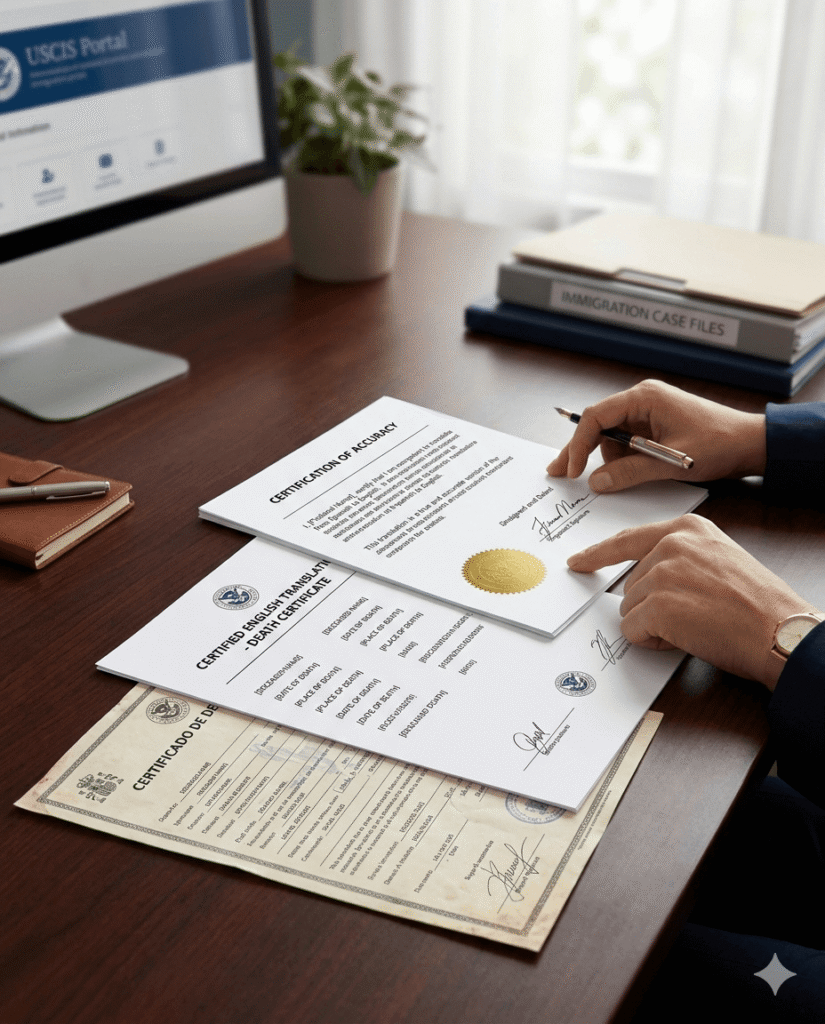
How long does it take and how much does it cost?
For most standard Spanish death certificates, turnaround depends on:
- image quality
- document length
- whether handwritten text needs careful review
- whether you need certification only or added services
- how quickly you need delivery
At USCIS Official Translation, certified translations start at $24.99 per page, with 12-hour rush service available for an additional $10 per page. For many families, that means the document can be translated, certified, and delivered quickly without the delay of chasing a local provider.
If you are on a tight filing deadline, it is better to order the correct certified version immediately than to submit something incomplete and deal with a rejection or request for more evidence later.
What a strong Spanish-to-English death certificate translation should include
A strong final package usually includes:
- the full English translation
- clear identification of the source document
- a signed certificate of accuracy
- consistent formatting
- accurate handling of stamps, notes, and unclear text
- PDF delivery suitable for upload or printing
- optional notarisation or hard copies when required
That is the standard most people actually need, even if they begin by searching for “how to translate a death certificate from Spanish to English”.
A practical checklist before you submit
Use this quick checklist before you file your case or send documents to another authority:
- Is every visible part of the death certificate accounted for?
- Does the English version match all names, dates, numbers, and places exactly?
- Are seals, signatures, and notes included or described?
- Is there a signed certification statement?
- Have you checked whether the receiving authority also wants notarisation?
- Is the scan clear enough to avoid misreading handwritten text?
- Do the translated details match your passport, petition, and supporting documents?
If you cannot confidently answer yes to all seven, do not submit it yet.
Why families choose USCIS Official Translation
When a death certificate is part of an immigration or legal matter, speed matters, but accuracy matters more.
USCIS Official Translation is built for high-stakes official documents and offers:
- certified translations suitable for USCIS and other formal uses
- native-level Spanish-to-English translators
- accurate handling of civil registry wording
- clear certification statements
- secure document handling
- straightforward pricing
- rush options for urgent filings
Most importantly, you get a translation package prepared for real-world submission, not just a text conversion.
Ready to move forward? Upload your file now and get a certified Spanish-to-English death certificate translation prepared for official use.
Final word
If you need to translate a death certificate from Spanish to English, think beyond literal translation. The document must be complete, consistent, and properly certified for the authority receiving it. That is what turns a translated page into a document that can actually be used.
Whether you are preparing a USCIS filing, dealing with probate, updating civil records, or handling an insurance matter, the safest route is a professional certified translation that reflects every important detail of the original.
When the document is sensitive and the deadline matters, get it done once, get it done properly, and submit it with confidence.
FAQs
Does USCIS accept a death certificate in Spanish without an English translation?
If the death certificate is in Spanish, USCIS generally expects a full English translation with a signed certification from the translator. Sending the Spanish document alone can create delays or requests for more evidence.
Can I translate a death certificate from Spanish to English myself?
For an official filing, self-translation is risky. Even if you speak both languages, authorities care about completeness, certification, and credibility. Most applicants use an independent professional translator so the document is ready for formal review.
Does a Spanish death certificate translation need to be notarised?
Not always. A certified translation and a notarised translation are not the same thing. For many USCIS-related uses, certification is the key requirement. Some courts, consulates, and foreign authorities may also ask for notarisation or apostille.
How long does a certified Spanish-to-English death certificate translation take?
A standard death certificate can often be translated quickly if the scan is clear. Turnaround depends on length, image quality, and whether you need rush delivery. USCIS Official Translation offers standard and 12-hour rush options.
What if the death certificate has stamps, handwritten notes, or unclear text?
Those elements should still be addressed in the translation. A professional translator will translate or describe stamps, signatures, seals, and handwritten notes, and will mark any unreadable text properly instead of guessing.
Is a Mexican death certificate translated differently from a Spanish death certificate from Spain?
The core process is the same, but document layout, legal terms, registry references, and wording can differ by country. A translator familiar with Spanish civil records should adapt the English rendering to the source document’s jurisdiction and context.
