
If you were born outside the United States, your birth certificate is one of the most important documents you’ll ever handle. It proves your identity, age, place of birth, and family relationships—all the things immigration officers, embassies, universities, and courts care about.
But if that birth certificate isn’t in English, you can’t simply upload it or pop it in the post and hope for the best.
U.S. immigration rules are clear: any foreign-language document submitted to U.S. Citizenship and Immigration Services (USCIS) must come with a full English translation and a certification from the translator that it’s complete, accurate, and that they are competent to translate it.
This guide walks you through exactly how to translate a birth certificate so it’s accepted the first time—whether you’re applying for a green card, a U.S. passport for your child, a student visa, or a professional licence. You’ll learn what USCIS actually requires, who can translate your document, how the process works step by step, how much it usually costs, and how to avoid delays and Requests for Evidence (RFEs).
Throughout, you’ll also see how USCIS Official Translation can take the stress off your shoulders with fast, fully compliant certified translations.
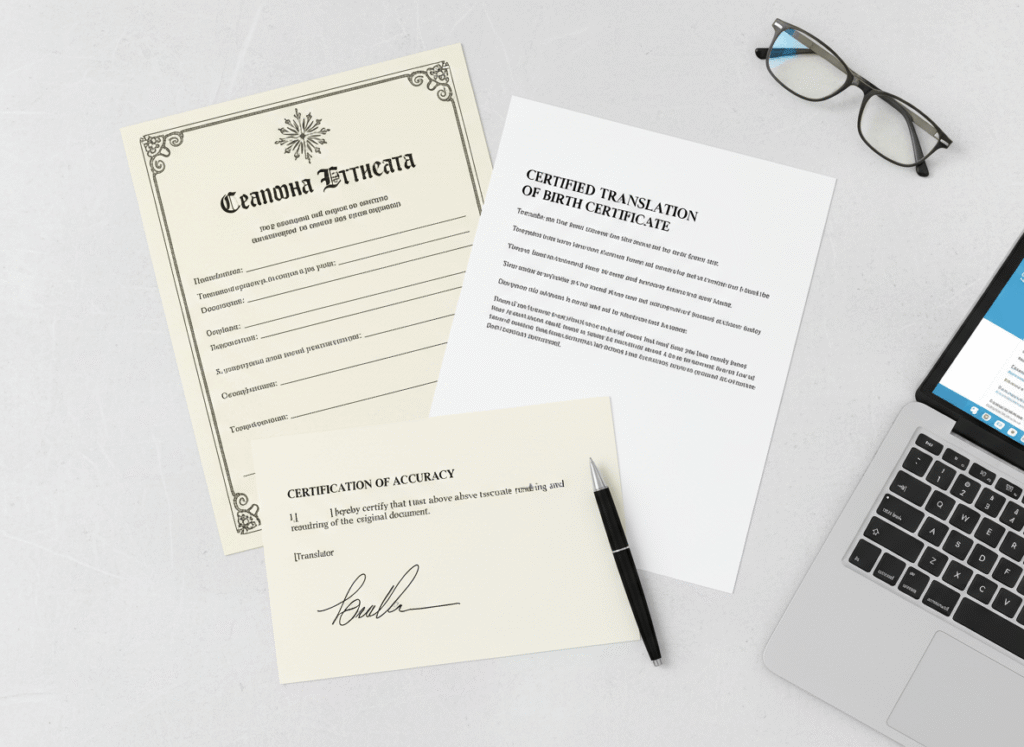
Why You Need to Translate a Birth Certificate in the First Place
You’re usually asked to translate a birth certificate when you need to prove:
- Identity and age – for immigration, visas, and passports
- Family relationships – for spouse, child, or parent petitions
- Civil status – for marriage licences and name changes
- Eligibility for study or work – for schools, licensing boards, or employers
USCIS and other U.S. authorities use your birth certificate to confirm that the details in your forms are correct. If they can’t read the document because it’s in Spanish, Arabic, Portuguese, Hindi, or any other language, they can’t verify those details—and your case stalls.
USCIS regulations require that any foreign-language document must be accompanied by a complete English translation, certified as accurate by a competent translator.
The same translated birth certificate is often reused for:
- Family-based green card applications
- Naturalisation (citizenship)
- K-1 fiancé(e) visas
- U.S. passport applications
- Visa appointments at U.S. embassies
- University and college admissions
What “Certified Translation” of a Birth Certificate Really Means
A lot of confusion comes from the word certified. People often think they need:
- a “USCIS-approved” translator, or
- a translator with a special government licence, or
- a translation done at the embassy or by a notary only.
For USCIS, none of that is strictly required.
According to federal regulations (8 CFR 103.2(b)(3)), a compliant translation must:
- Include a full English translation of the birth certificate (no missing sections, stamps, or notes).
- Be accompanied by a signed certification from the translator confirming:
- They are fluent in English and the original language.
- The translation is complete and accurate.
- Include the translator’s name, signature, and date, and usually their contact details.
Professional bodies such as the American Translators Association (ATA) describe a certified translation in similar terms: the translation plus a signed statement from the translator, attesting to its accuracy and their competence.
Can You Translate Your Own Birth Certificate?
Technically, in the United States, almost any competent bilingual person can certify a translation, and some guides say you could even translate your own documents.
However, this is where theory and reality part ways.
In practice:
- Self-translation is risky. USCIS officers can view self-translated vital records as biased or unreliable.
- Family translations may be questioned. Even if your relative is fluent, there’s still a conflict of interes
- If the officer doubts the translation, they may issue an RFE (Request for Evidence) or even deny the application.
Because your birth certificate is such a critical document, most immigration attorneys and professional bodies recommend using a specialist translation service for USCIS documents rather than doing it yourself.

How to Translate a Birth Certificate: Step-by-Step
Here is the straightforward, practical process most applicants follow. This is exactly how to translate a birth certificate so it’s ready for USCIS, embassies, and other authorities.
1. Gather the right version of your birth certificate
Before you translate anything, make sure you have the correct and complete version of your birth certificate:
- Ideally the long-form certificate that shows:
- Full name
- Date of birth
- Place of birth
- Parents’ full names
- Official stamp or seal
- Registration details where applicable
- Check that the document is legible—stamps, handwritten notes, and seals must be visible.
- If your certificate is damaged, missing information, or impossible to read, contact the issuing authority for a replacement before ordering a translation.
If you’re unsure which version USCIS will accept, you can also check the U.S. Department of State’s country-specific reciprocity tables, which outline what kind of civil documents are usually available from each country.
Quick win: Take clear, flat photos or scans of the front and back of the certificate at a high resolution. That’s what you’ll upload for translation.
2. Choose a specialist in immigration and USCIS translations
Not all translators are familiar with immigration. For birth certificates, look for:
- Documented experience with USCIS and consular cases
- A clear promise that translations come with a signed certification that meets USCIS rules
- Transparent pricing, usually:
- per page (for standard one-page certificates), or
- per word (for longer or more complex records)
- Turnaround options (standard, urgent, same-day)
- Secure online ordering and payment
- Good reviews and success stories from immigration clients
USCIS Official Translation specialises in immigration cases, so our workflows, terminology, and formatting are designed specifically around USCIS expectations.
Ready to move forward?
Upload a scan of your birth certificate to USCIS Official Translation and receive a firm quote and delivery date before you pay.
3. Submit your birth certificate securely
Once you’ve chosen a provider, you’ll usually:
- Upload a copy of your birth certificate (scan or photo).
- Provide:
- Your full name as it appears on the document.
- The language pair (for example, Arabic to English, Portuguese to English).
- The purpose of translation (USCIS, embassy, university, etc.).
- Select your delivery time (standard or expedited).
- Confirm your contact details and submit payment.
Good providers will not ask you to post your original document unless specifically required for another process (for example, legalisation). For translation itself, a high-quality copy is enough.
At USCIS Official Translation, uploads are encrypted, documents are stored securely, and you can track progress online.
4. The actual translation of your birth certificate
Behind the scenes, a professional translator will:
- Recreate the layout and structure of your birth certificate as closely as possible.
- Translate every element, including:
- typed text
- handwritten notes
- margins, stamps, seals, registration numbers, and footnotes
- Use standard English terminology for civil status terms that vary by country.
- Clarify illegible elements or abbreviations in translator’s notes where appropriate.
The aim is a faithful, word-for-word translation, not a summary. USCIS expects the English document to mirror the original so officers can compare them easily.
For complex cases—such as birth certificates with multiple amendments, marginal notes, or old handwriting—specialist translators will apply extra checks to avoid misreading names or dates.
5. Certification and quality checks
Once the translation is complete, the provider will:
- Attach a certificate of accuracy, signed and dated by the translator or an authorised representative.
- Confirm that:
- The translation is complete and accurate.
- The translator is competent in both languages.
- Review the document for:
- Spelling consistency (especially names and places)
- Matching dates and registration numbers
- Complete coverage of every visible element on the original
At USCIS Official Translation, birth certificate translations go through a dedicated quality check for:
- Formatting that matches USCIS and consular expectations
- Consistent spelling across your documents
- Clearly presented certification and contact details
6. Delivery: digital and hard-copy options
Most immigration cases now accept PDF copies of certified translations uploaded to online portals or included in your application packet. Depending on your provider, you may receive:
- A PDF of the translation plus certification, ready to print or upload
- Optionally, a hard-copy original posted to you with:
- wet ink signature
- company letterhead
- seal or stamp (if used by that provider)
Check your specific form instructions and any embassy guidance to see whether a printed copy is recommended or required.
Practical tip:
Save the PDF of your birth certificate translation in a secure folder (for example, “Immigration documents – translations”) and back it up. You’re likely to need it again for future applications.
7. Submitting your translated birth certificate to USCIS
When you file your application package:
- Include a copy of the original foreign-language birth certificate.
- Attach the certified English translation immediately after it.
- Keep the original certificate and the translation together for interviews or future requests.
Common Mistakes That Cause Delays (and How to Avoid Them)
Even small issues can lead to an RFE or denial. Here are the most frequent problems—and how to avoid them.
1. Incomplete translations
- Missing back pages, notes, or stamps
- Ignoring handwritten amendments
- Translating only the “main” information, not the full document
Fix: Always insist on a full, word-for-word translation of everything visible on the certificate. USCIS expects a complete translation, not a summary.
2. No proper certification statement
Some applicants submit a translation without a signed certification or with a very vague statement.
Fix: Check that the translation includes a clear certificate of accuracy that:
- Names the translator
- Confirms fluency in both languages
- States that the translation is accurate and complete
- Is dated and signed
This is specifically required by USCIS and related guidance.
3. Self-translation or family translation
Even if allowed in theory, self-translation can trigger extra scrutiny.
Fix: Use an independent third-party translator or professional service for important vital records like birth certificates, especially when USCIS is involved.
4. Using machine translation
Copy-pasting your birth certificate into a free online tool is risky:
- Names, dates, places, and legal terms can be mistranslated.
- Tools won’t add the required certification statement.
- Obvious machine translation can damage credibility with USCIS.
Fix: Use machine tools only, if at all, to understand the gist for yourself—not for official submissions. For your case, rely on a professional human translation.
5. Confusing certified vs notarised translations
USCIS does not usually require a birth certificate translation to be notarised—it requires a certified translation.
- A certified translation = accurate translation + signed certification statement.
- A notarised translation = certified translation + notary witnessing the translator’s signature.

How Much Does It Cost to Translate a Birth Certificate?
Costs vary by:
- Language pair (rarer languages can be more expensive)
- Complexity (multiple pages, amendments, difficult handwriting)
- Urgency (same-day vs standard turnaround)
In the U.S., many professional services charge roughly $25–$150 per birth certificate depending on these factors.
At USCIS Official Translation, pricing is:
- Clear and upfront—you see your price before confirming
- Fixed per document for standard one-page certificates
- Available with rush options for time-sensitive filings
How Long Does Birth Certificate Translation Take?
Typical timelines:
- Standard one-page birth certificate: 24–48 hours
- Complex or multi-page certificates: 2–4 working days
- Emergency or same-day service: available with rush fees at many providers
Building in extra time is wise. If USCIS issues an RFE for any reason, you’ll want to be able to respond quickly without rushing around for last-minute translations.
Why Choose USCIS Official Translation for Your Birth Certificate?
When your immigration status, family petition, or study plans depend on a single document, “good enough” isn’t really good enough.
USCIS Official Translation is built around exactly this type of case:
- Specialisation in immigration and USCIS
- Certified translations with wording and formatting aligned with current regulations and guidance
- Secure online ordering and document upload
- Fast turnaround, including rush options
- Translations handled by professional, vetted linguists, not random freelancers
- Friendly support if you receive an RFE and need clarification or re-issuing
Frequently Asked Questions About Translating a Birth Certificate
Can I translate my own birth certificate for USCIS?
It’s strongly discouraged. While U.S. rules are flexible about who can certify a translation, USCIS officers may question self-translated or family-translated vital records. That can lead to RFEs, delays, or even refusals. Using an independent, professional service is the safest way to ensure your birth certificate translation is accepted.
Does my translated birth certificate need to be notarised?
For most USCIS applications, no. USCIS requires a certified translation, meaning a full translation plus a signed statement from the translator confirming accuracy and competence. Notarisation is an extra step where a notary witnesses the translator’s signature; it is usually only required if a court, embassy, or other specific authority asks for it.
How do I know if my birth certificate translation meets USCIS requirements?
Check that:
- Every word, stamp, and note on the original appears in English.
- A certificate of accuracy is attached, with the translator’s name, signature, date, and certification statement.
- Names, dates, and places match the original and your forms exactly.
If you order from USCIS Official Translation, all of these elements are included by design.
Can I use the same translation for my embassy appointment and USCIS?
In many cases, yes. A certified translation that meets USCIS standards will also satisfy many embassies, consulates, universities, and other institutions. However, some authorities have extra rules (for example, notarisation or consular legalisation), so always check their specific instructions.
What happens if I send an untranslated or poorly translated birth certificate?
USCIS may issue a Request for Evidence asking you to provide a compliant certified translation, which delays your case. In more serious situations, incorrect or incomplete translations can contribute to a denial.
Using a professional service from the start is far cheaper and less stressful than fixing problems later.
How early should I arrange my birth certificate translation?
Ideally, as soon as you know which application you’re planning. Having a certified translation ready means you can:
- File sooner
- Respond quickly to any RFE
- Reuse the translation for future needs (for example, a naturalisation application after a green card)
If you’re under time pressure, USCIS Official Translation offers rush options, but building in a buffer is always wise.
