
If you’ve been told to “provide a legal translation” of your birth certificate, what they usually mean is simple: an English translation that’s complete, accurate, properly formatted, and accompanied by the right certification statement.
This guide walks you through exactly how to legally translate a birth certificate for official use—especially for U.S. Citizenship and Immigration Services filings—so you can avoid delays, rejections, or last-minute rework.

What “legal translation” actually means
A “legal translation” isn’t a special dialect of English. It’s a translation that meets the acceptance rules of the authority you’re submitting to (immigration, courts, consulates, universities, employers).
For most U.S. immigration cases, the key requirement is a certified translation—a full English translation plus a signed statement from the translator confirming:
- the translation is complete and accurate, and
- the translator is competent to translate into English.
If you’re submitting to a different authority (for example, an overseas civil registry), you may be asked for notarisation, an apostille, or a sworn translation. We’ll cover how to tell the difference (and when each one applies).
First: confirm where the translation will be used
Before translating anything, identify the destination requirement. Ask yourself:
- Is this for USCIS, a visa interview, or a U.S. consulate?
- Is it for a court, a school, a credential evaluator, or an employer?
- Is it for a non-U.S. authority that specifically requires a sworn/official translator?
If your request letter says “certified translation” (most common), you’re aiming for a certified translation package.
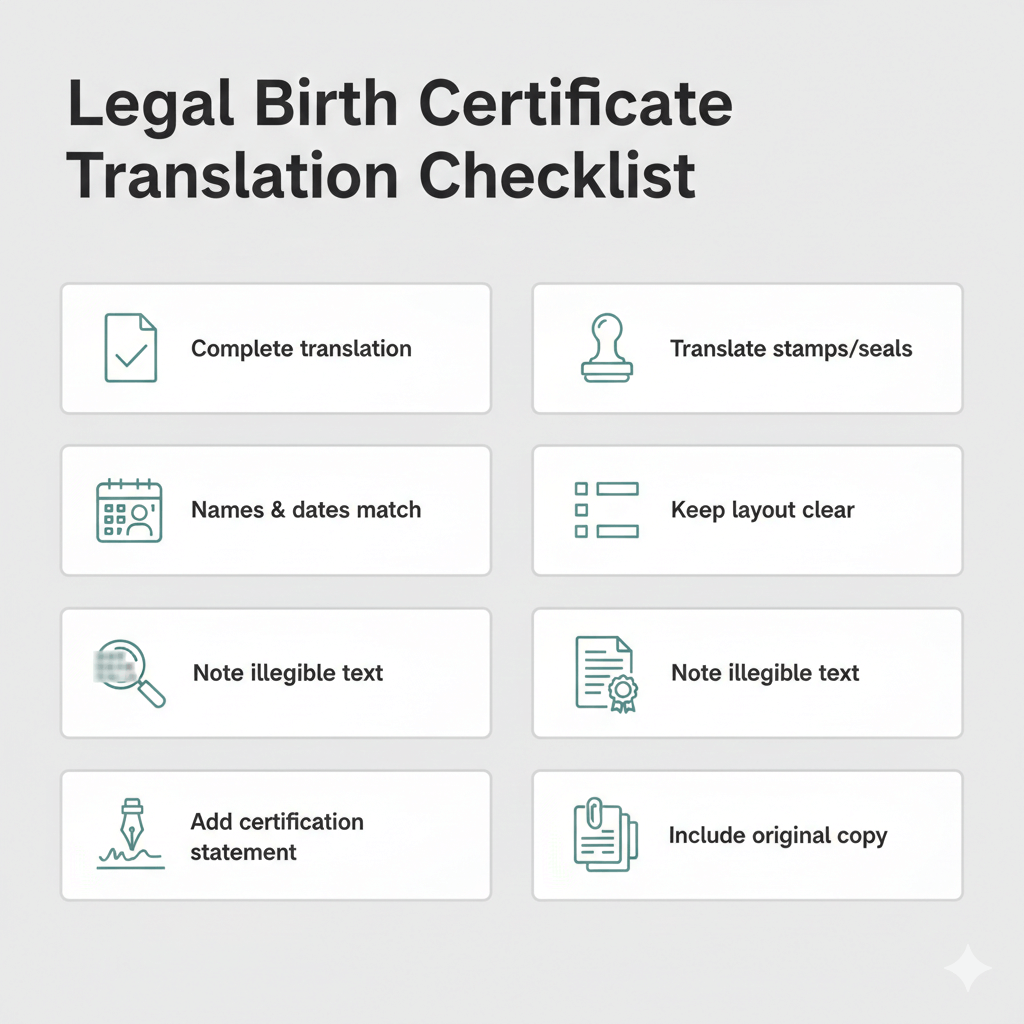
The legal-acceptance checklist for birth certificate translations
A birth certificate translation is typically rejected (or questioned) for predictable reasons. A legally acceptable translation should include:
- A complete translation (no missing stamps, seals, notes, or handwritten items)
- Accurate names and dates that match your immigration forms exactly
- Consistent spelling (including transliteration choices for non-Latin scripts)
- All official markings translated (stamps, seals, registry notes, marginal text)
- Clear formatting that mirrors the original layout as closely as practical
- A signed certification statement from the translator (not just a company header)
- Translator identification (name + signature + date; contact details recommended)
- A clean scan/photo of the original attached with the translation in your filing pack
Step-by-step: how to legally translate a birth certificate
Step 1: Get a clean, readable copy of the original
Legal acceptance starts with legibility. Use a scan or a well-lit photo:
- Capture all corners of the document
- Include every page (front/back, annex pages, registry extracts)
- Avoid glare over stamps and embossed seals
- Don’t crop out margins—marginal notes often contain legal updates
If anything is unclear (faded stamps, handwriting, torn edges), fix that now. A perfect translation can still fail if the source image is unreadable.
Step 2: Decide how you’ll handle names (and stick to it)
Birth certificates often contain names in formats that don’t match passports or USCIS forms. Legal translation is about consistency, not creativity.
Use these rules:
- Keep names exactly as shown on the birth certificate (including accent marks)
- If the original uses a non-Latin script, use the spelling that matches the passport/USCIS forms
- Don’t “correct” spelling or reorder names unless the document clearly indicates it
- If the certificate shows multiple spellings, the translator can add a short bracket note like:
- [Also spelled: ____] (only when necessary to avoid confusion)
This one step prevents the most common problem: name mismatches across filings.
Step 3: Translate everything—yes, everything
A legally acceptable birth certificate translation is a full translation. That includes:
- Headings and field labels
- Registration numbers and registry office details
- Stamps and seals (even if partially illegible)
- Marginal notes (corrections, legitimisation notes, adoption notes, re-registrations)
- Handwritten additions
- Watermarks or security text where it contains meaningful words
If something is truly unreadable, don’t guess. Use a translator notation such as:
- [Illegible stamp]
- [Handwritten note — partially illegible]
- [Signature]
Guessing is riskier than transparently noting what can’t be read.
Step 4: Match the layout so an officer can scan it quickly
For acceptance, clarity matters as much as accuracy. A strong legal translation:
- Keeps the same field order as the original
- Uses a simple table layout where the original is structured
- Preserves stamps as labelled elements (e.g., “Round stamp: …”)
- Keeps dates in a readable format (and clarifies ambiguous formats)
Pro tip: If the original uses multiple calendars or formats, translate faithfully and add clarification like:
- “Date of birth: 03/04/1992 (format as shown on original)”
Step 5: Add a proper certification statement (copy-ready wording)
For USCIS and many official uses, the translation must include a certification signed by the translator.
Use wording like this (adapt the bracket fields):
Translator Certification
I, [Translator Full Name], certify that I am competent to translate from [Source Language] into English, and that the attached translation of [Document Title: Birth Certificate] is complete and accurate to the best of my knowledge and ability.
Translator name: [Full Name]
Signature: _______________________
Date: [DD Month YYYY]
Contact details: [Email / Phone]
Address: [City, State/Province, Country]
If you’d rather not manage these details yourself, you can order a certified package that includes the certificate automatically: <a href=”https://uscisofficialtranslation.com/order-form/”>Upload your file for certified translation</a>.
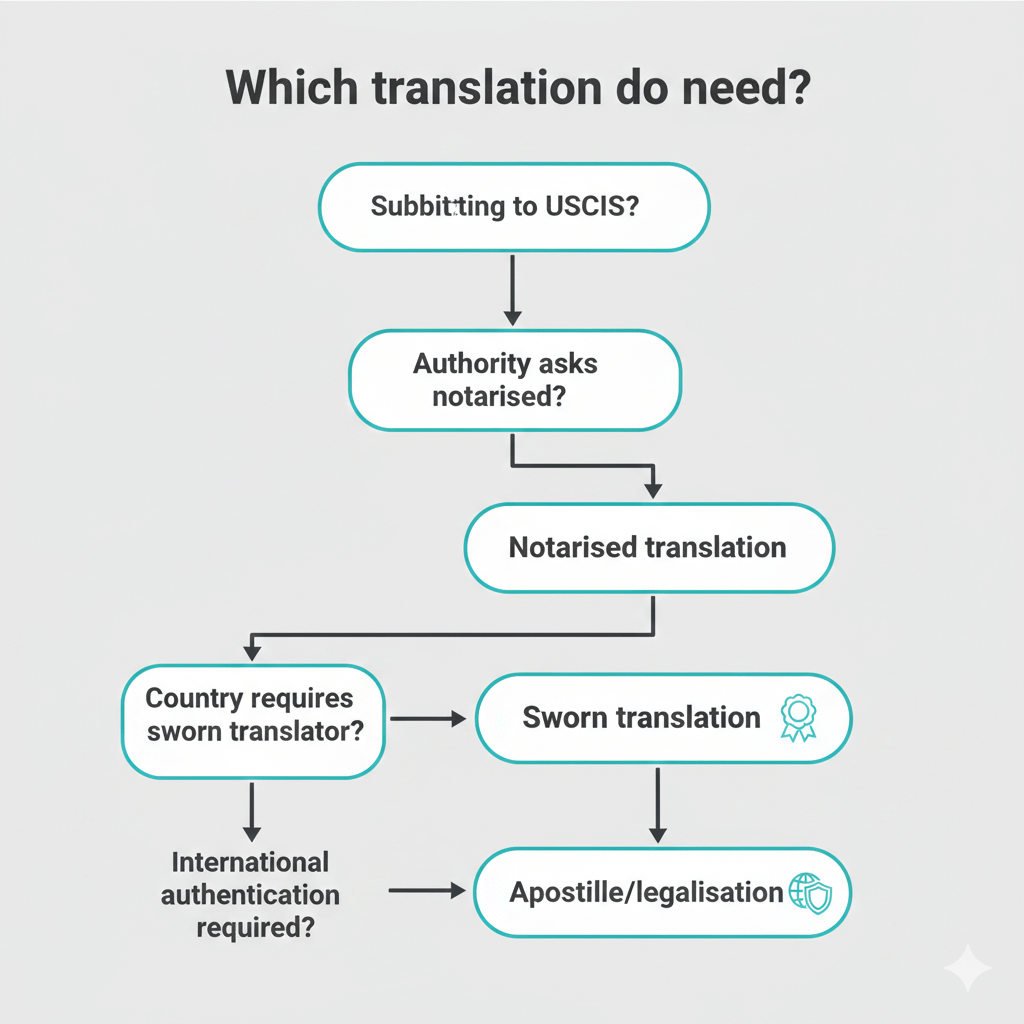
Step 6: Decide whether you need notarisation, apostille, or sworn translation
This is where people overpay—or get the wrong thing.
Certified translation (most common)
- What it is: translation + signed translator certification statement
- Typical use: USCIS, many schools, many employers, many courts (depending on case)
Notarised translation (sometimes requested)
- What it is: a notary witnesses the translator’s signature
- What it is not: proof the translation is correct
- When it helps: when an authority explicitly asks for “notarised translation”
If you want a clear explanation of the difference, use: <a href=”https://uscisofficialtranslation.com/certified-vs-notarized-translation/”>certified vs notarised translation</a>.
Apostille / legalisation (country-specific)
- What it is: authentication of a public document for international use
- When it applies: usually when a receiving country requires an apostille/legalisation chain
- Important: apostille rules depend on where the document was issued and where it’s being used
Sworn translation (only when explicitly required)
Some countries require a sworn/official translator who is authorised by a court or ministry. U.S. immigration generally does not require this, but foreign authorities sometimes do.
If your request letter mentions “sworn translator” or “official translation”, start here: <a href=”https://uscisofficialtranslation.com/translator-sworn/”>sworn translator vs certified translation</a>.
Step 7: Do a final “error-proof” review (5 minutes that saves weeks)
Before submitting, check these items line by line:
- Names match the birth certificate and match your forms (spelling + order)
- Date formats are consistent and not accidentally swapped (day/month confusion)
- Places (city/region/country) are translated consistently
- Registry numbers and stamp dates are not missing
- Any marginal notes are included
- The translator certification is present, signed, and dated
If you want to reduce risk further, add a second-person review (proofread) before filing.
Can you legally translate your own birth certificate?
People ask this because they’re bilingual and want to move faster.
Here’s the practical reality: even when rules don’t explicitly forbid self-translation, self-translation increases scrutiny because the reviewer can’t treat it as independent. The safer route is a third-party translator who can sign the certification.
How long does a certified birth certificate translation take?
Turnaround depends on clarity, formatting, and language pair—but birth certificates are usually fast because they’re short.
How much does it cost to legally translate a birth certificate?
Costs vary by provider and what’s included (certification page, formatting, revisions, rush options).
Common mistakes that cause rejections or delays
Avoid these, and you avoid most problems:
- Partial translations (ignoring stamps or marginal notes)
- Name mismatches vs forms (especially accents, spacing, surname order)
- “Cleaned-up” translations that change meaning (adding or removing details)
- Missing translator certification statement
- Unclear scans or cropped edges
- Invented guesses for illegible text
- Using machine translation without a competent human review and certification
A simple “ready to submit” checklist
Use this before you file:
- Original birth certificate is fully visible and readable
- Full English translation includes all markings and notes
- Names/dates match your forms and IDs
- Certification statement is included, signed, and dated
- Translator details are present (name + contact details)
- You’re submitting the original-language copy alongside the translation
FAQ Section
1) How do I legally translate a birth certificate for USCIS?
You need a full English translation of the entire document and a signed translator certification stating the translation is complete, accurate, and the translator is competent.
2) Does a birth certificate translation have to be notarised?
Usually no. Many cases only require a certified translation. Notarisation is only needed if the authority explicitly requests it.
3) What must a certified translation include for a birth certificate?
A complete English translation of all text (including stamps/seals/notes) plus a signed certification statement with translator name, signature, and date (contact details recommended).
4) Can I translate my own birth certificate for immigration?
It’s risky. Even if you’re bilingual, self-translation can increase scrutiny because it isn’t independent. A third-party translator is safer.
5) How long does it take to translate a birth certificate legally?
Often 24–72 hours depending on clarity, language pair, and formatting. Rush options may be available.
6) How much does a certified birth certificate translation cost?
It varies by provider and options (rush, notarisation, formatting). Check live pricing before you order to avoid surprises.
