
Losing a loved one is hard enough without being slowed down by paperwork. If you need to use a death certificate in the United States or with any English-speaking authority, the document usually needs more than a simple translation. It needs to be complete, accurate, and prepared in a format the receiving authority can actually accept.
Whether you are filing immigration paperwork, settling an estate, closing accounts, making an insurance claim, or proving the end of a prior marriage, here is how to get a death certificate translated properly the first time.
When you may need a death certificate translated
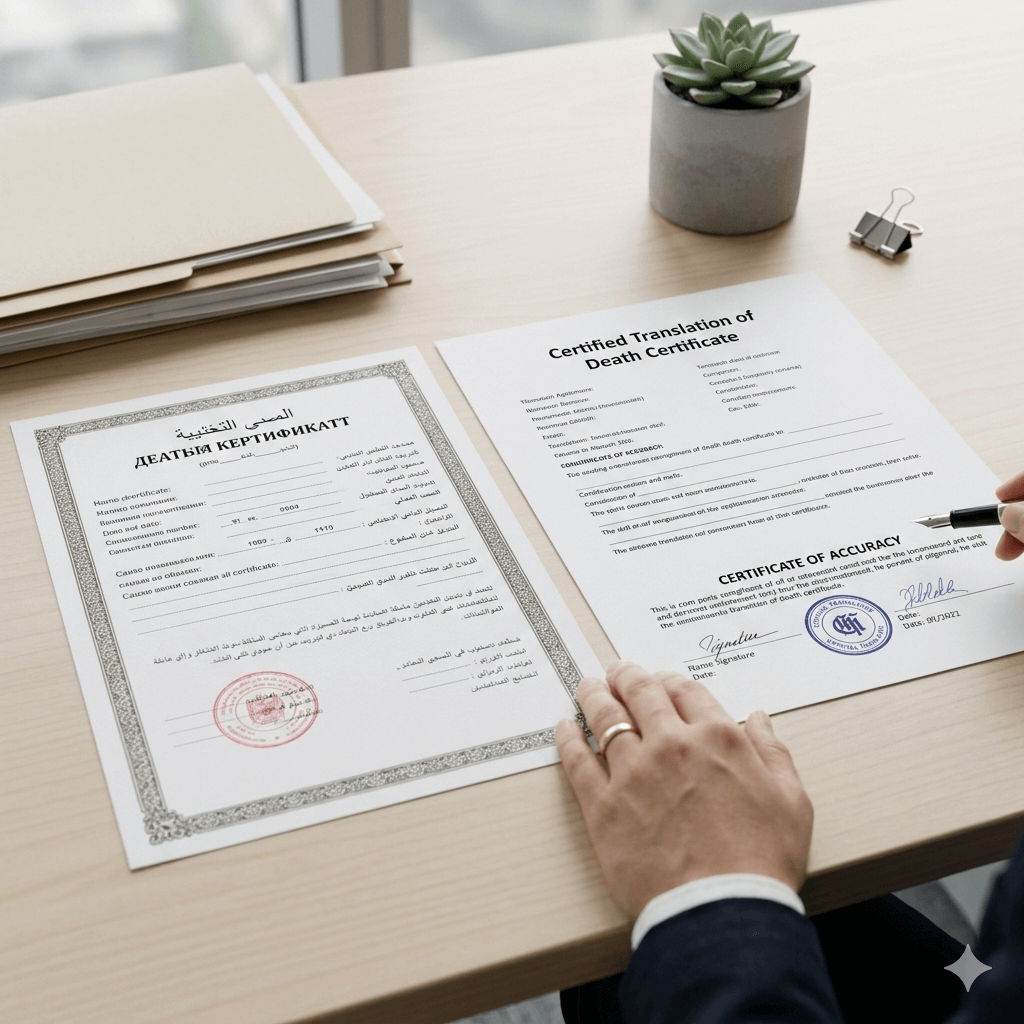
A death certificate translation is commonly requested when the original record was issued in another language and must be submitted to an English-speaking authority.
Typical situations include:
- Immigration applications and supporting evidence
- National Visa Center document uploads
- Consular interview preparation
- Probate and inheritance matters
- Insurance and pension claims
- Bank account closure and estate administration
- Court proceedings
- Official family record updates
In immigration matters, a translated death certificate may be needed to show the end of a prior marriage, support a family-based filing, or complete a civil-document package. In legal and financial matters, it may be used to unlock processes that cannot move forward until the death is formally documented in English.
What a valid translation should include
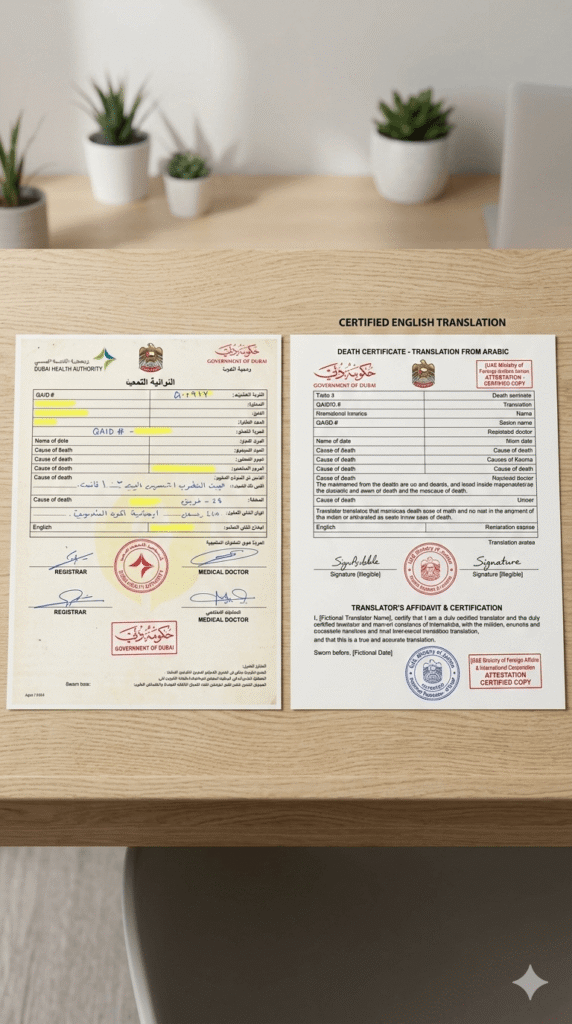
A proper death certificate translation is not just the main text. It should reflect the original document fully and clearly.
That usually means including:
- All visible text on the document
- Names, dates, places, registration details, and issuing authority details
- Seals, stamps, annotations, marginal notes, and handwritten entries
- Signatures or signature notes
- A signed certification statement from the translator
- A clear connection between the translated document and the certification page
If the original includes something unclear or unreadable, that should still be noted rather than ignored. For example:
- [Round seal]
- [Signature]
- [Handwritten note]
- [Illegible stamp]
That level of completeness matters. Authorities do not want a summary. They want a faithful English version of what appears on the original.
The difference between certified, notarised, and sworn translation
Many people mix these up, especially when they are dealing with both immigration and foreign authorities.
Certified translation
This is the standard most people need for USCIS and many official submissions in the United States. It includes:
- A full English translation
- A signed statement confirming the translation is complete and accurate
- Confirmation that the translator is competent in both languages
Notarised translation
This adds a notary step. It is not always necessary. Some courts, consulates, banks, or foreign institutions ask for it, but many immigration filings do not.
Sworn translation
This is used in countries where translators are legally authorised by the state or court system. It may be required for use abroad, depending on the country receiving the document.
The key point is simple: the right format depends on where the translation will be submitted. For many U.S. immigration filings, certified translation is the main requirement. For some non-US authorities, notarisation or sworn translation may be required as an additional layer.
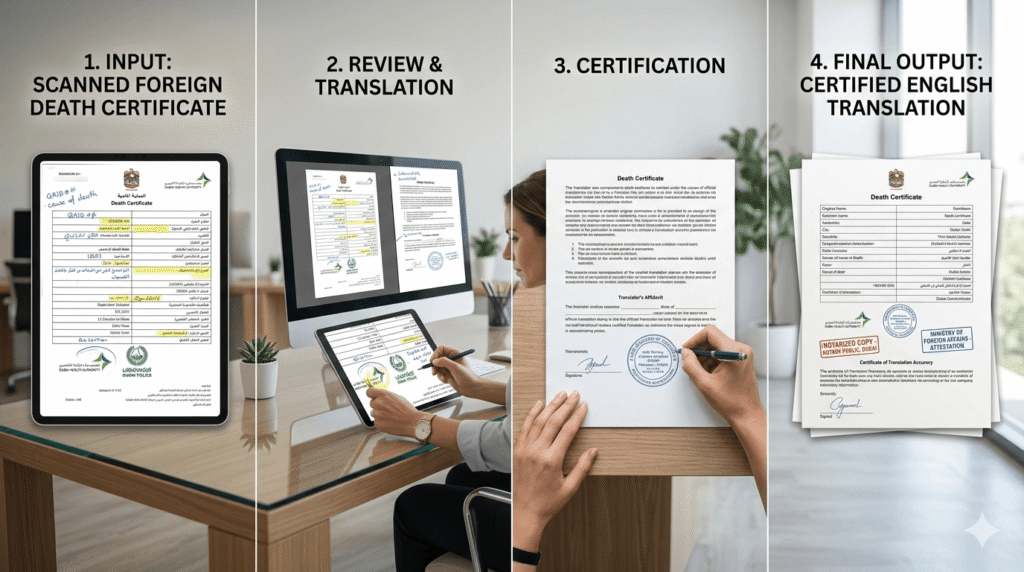
How to get a death certificate translated step by step
1. Confirm where the translation will be used
Before you order anything, identify the receiving authority.
Examples:
- USCIS
- National Visa Center
- A U.S. embassy or consulate
- Probate solicitor or court
- Insurance provider
- Bank
- Foreign registry office
This tells you whether you need:
- Certified translation only
- Certified translation plus notarisation
- Sworn translation
- Hard copy delivery
- PDF only
- Combined file packaging with original + translation
This first step prevents the most common mistake: ordering the wrong type of translation.
2. Get a clear copy of the original death certificate
Use the best version available.
Your file should be:
- Flat and fully visible
- High resolution
- Easy to read
- Uncropped
- Free from shadows and glare
If the certificate has a reverse side, additional notes, registry stamps, or later amendments, include those too. A translation should match the exact version you plan to submit.
3. Choose a provider experienced with official documents
This is not the place for guesswork. A death certificate is a vital record, which means formatting, terminology, and accuracy matter.
Look for a provider that can handle:
- Official civil records
- USCIS-style certification wording
- Stamps and seal descriptions
- Name consistency across document sets
- Fast turnaround for urgent filings
- Secure document handling
A reliable service should also be able to tell you quickly whether you need certification only or something more.
4. Ask for a complete, document-matching translation
A proper order instruction is simple:
Please translate every visible element on this death certificate, including seals, stamps, handwritten notes, signatures, and registration details. Include a signed certification page.
That one instruction avoids partial translations and missing stamp notes, both of which create unnecessary risk.
5. Make sure the certification page is included
The translator’s certification is one of the most important parts of the package.
It should confirm that:
- The translator is competent in the source language and English
- The translation is complete
- The translation is accurate
It should also include:
- Translator name
- Signature
- Date
- Contact details
Without that certification page, many official uses become risky even if the translation itself looks correct.
6. Review names, dates, and document details before submission
Before filing, compare the translation against the original and against your other documents.
Check:
- Spelling of the deceased person’s name
- Spelling of parents’ or spouse’s names
- Date format
- Place names
- Registration number
- Cause-of-death wording, if shown
- Consistency with passports, marriage certificates, or court papers in the same case
This matters more than people think. A minor inconsistency across documents can trigger questions later, especially in immigration and probate matters.
7. Submit the translation in the right format
For many digital filing systems and document portals, the cleanest approach is:
- Original-language document first
- English translation second
- Certification page attached
- One clear PDF per document set
That format keeps everything together and makes review easier for the receiving officer.
Common mistakes that cause delays
Most problems come from a short list of avoidable errors.
Using a summary instead of a full translation
Authorities generally want the full document, not just the key fields.
Leaving stamps or seals untranslated
Even when the seal text is minimal or partly unreadable, it should still be described.
Ordering the wrong type of certification
Some people pay for notarisation they do not need. Others skip it when a court or foreign institution actually requires it.
Submitting a poor-quality scan
A perfect translation can still fail if the original file is blurry, cropped, or unreadable.
Reusing an old translation that no longer matches
If the certificate was re-issued, amended, or supplemented with new notes, the translation should be updated too.
Letting names vary across documents
If one document says a surname one way and another uses a different spelling, the issue should be handled consistently and clearly.
Can you translate a death certificate yourself?
Technically, the real question is not whether you can type the words into English. The real question is whether the receiving authority will trust the result.
For official use, self-translation is a risky move. A neutral third-party translator is usually the safer choice because the translation needs to look objective, complete, and professionally certified.
If the document matters to an immigration filing, legal claim, estate matter, or benefits process, using a specialist service is the more dependable route.
How long does it take to translate a death certificate?
For a standard one-page civil record, turnaround is often fast, especially when the document is clear and the language is common.
Timing can vary based on:
- Language pair
- Document quality
- Whether the certificate has handwritten notes or marginal entries
- Whether you need notarisation or sworn translation
- Whether you need hard-copy shipping
If your deadline is close, order before you assemble the rest of your package. Waiting until the final day creates pressure and increases the chance of avoidable mistakes.
How much does death certificate translation cost?
Cost usually depends on:
- Number of pages
- Language pair
- Turnaround speed
- Certification type
- Any extras such as notarisation, apostille support, or hard-copy delivery
For official document translation, the cheapest option is rarely the safest option. What matters is whether the package is complete, clear, and acceptable for the authority reviewing it.
A better question than “What is the lowest price?” is:
Will this translation be ready to submit without causing follow-up issues?
What to look for in a death certificate translation service
Choose a provider that offers:
- Human translation, not machine-only output
- Experience with official records
- Signed certification included
- Clear formatting
- Descriptions for seals, stamps, and signatures
- Fast delivery options
- Confidential handling
- Clear pricing
- Support if you are unsure whether you need certified, notarised, or sworn translation
That combination saves time and reduces risk.
What families often overlook
The biggest hidden issue is not the translation itself. It is the packaging.
A well-prepared death certificate translation should do three things at once:
- Reflect the original document fully
- Read clearly in English
- Fit the submission method of the receiving authority
That means the best translation is not only linguistically accurate. It is also practical, review-ready, and easy for an officer, clerk, or caseworker to follow.
A simple checklist before you order
Use this quick checklist:
- I know where the translation will be submitted
- I have a clear copy of the full document
- I included all pages, stamps, and notes
- I know whether I need certified, notarised, or sworn translation
- I chose a provider familiar with official records
- I asked for a signed certification page
- I will review names and dates before filing
- I will submit the original and translation together where needed
Why many clients choose USCIS Official Translation
When the document is important, people want a service that is built for official use rather than casual translation.
USCIS Official Translation is designed for that kind of paperwork, with:
- Certified translations prepared for official submission
- A signed Certificate of Accuracy
- Clear formatting that matches document-based filing needs
- Standard and rush turnaround options
- Secure handling of personal records
- Straightforward pricing
- Support for related document needs across immigration and legal matters
If your death certificate needs to be translated for USCIS, a visa case, probate, insurance, or another official process, the safest next step is to upload your file and get it checked before you submit anything.
Start your order today and get a translation package that is ready to move with your case, not hold it back.
Frequently asked questions
Do I need a certified translation for a death certificate?
If the original death certificate is not in English and you are submitting it to an English-speaking authority, a certified translation is often the right option. The translation should be complete and include a signed certification statement.
How do I translate a foreign death certificate to English?
The safest route is to send a clear copy of the original to a professional document translation service, request a full English translation of every visible element, and make sure the final package includes the translator’s signed certification.
Does USCIS require notarisation for a death certificate translation?
In many cases, certified translation is the key requirement for USCIS-related filings. Notarisation may still be needed if another authority in your process asks for it separately.
Can I use Google Translate for a death certificate?
Free machine translation tools are not a reliable choice for official civil records. They can miss registry terms, stamp text, handwritten notes, and formatting details that matter in real submissions.
How long is a certified death certificate translation valid?
A certified translation is generally still usable as long as it accurately matches the exact version of the original document you are submitting and the certification remains complete and clear.
What if my death certificate has stamps, signatures, or handwriting?
Those elements should still be included in the English version, either as translated text or as clear translator notes such as [signature], [round seal], or [handwritten note].
