
If you’re preparing an immigration filing, your birth certificate is one of the most important identity documents in your packet. So it’s completely normal to ask: can you translate your own birth certificate—especially if you’re bilingual.
Here’s the honest answer:
- USCIS requires a complete English translation plus a signed translator certification.
- USCIS does not require a “licensed” translator.
- But translating your own birth certificate is a high-risk move because it can look self-serving and invite delays—especially when the document proves identity, parentage, and place of birth.
If you want the safest route, you’ll want an independent translator (or a certified translation service) who can provide a properly formatted translation with a compliant certification statement.
What USCIS Actually Needs With a Birth Certificate Translation
For USCIS, “certified translation” doesn’t mean the translator must hold a particular credential. It means the translation must be:
1) Complete
Every piece of text must be translated, including:
- stamps, seals, and watermarks (described in brackets)
- marginal notes
- handwritten entries
- reverse-side text (if anything appears there)
- registration numbers, codes, or official remarks
2) Accurate
Not “close enough.” Not summarised. Not “cleaned up.” It must reflect what the document says—line by line—without adding or removing meaning.
3) Easy to compare to the original
Immigration officers often compare your translation against the original visually. The best translations:
- follow the same order as the source
- keep headings and sections aligned
- use consistent formatting
- label stamps/seals/illegible portions clearly
4) Attached to a signed translator certification
This is the part that trips people up most. A compliant certification identifies the translator and includes statements confirming:
- the translator is competent in both languages
- the translation is complete and accurate
- the translator’s name, signature, date (and best practice: contact details)
So… Can You Translate Your Own Birth Certificate?
You can physically translate it yourself, but the real question is whether doing so is the smartest way to submit a document that can affect case timing.
Why self-translation is risky for a birth certificate
A birth certificate is different from a casual supporting letter or a simple record. It’s a core identity document that impacts:
- name consistency
- parent/guardian details
- place of birth and registration authority
- date formats and civil registry references
- spelling and transliteration choices (especially from Arabic, Cyrillic, Chinese, etc.)
When the applicant is also the translator, it can raise concerns like:
- conflict of interest
- “interpretive” translations rather than literal ones
- missing stamps/notations that seem unimportant to the applicant but matter to an officer
Even when your translation is correct, a questionable translation can trigger an RFE (Request for Evidence)—which means delays, rework, and stress.
The Safer Alternative: Independent Translator + Proper Certification
If cost is the reason you’re considering self-translation, here’s the reality:
- Fixing a rejected translation under deadline often costs more than doing it properly once.
- A compliant translation is not just language—it’s formatting, completeness, and certification.
A reliable solution is:
- an independent qualified translator (not the applicant)
- or a service that produces a ready-to-submit translation on letterhead with a signed certification
A Practical Decision Guide
Use this quick guide to decide whether you should self-translate:
Consider an independent translator if:
- this is for USCIS, NVC, consular processing, or any government filing
- the document includes stamps, handwritten notes, or multiple sections
- your name includes diacritics or multiple spellings across documents
- the document is older, damaged, faint, or partially illegible
- your case is time-sensitive (you want to avoid an RFE)
Self-translation is most likely to backfire if:
- you’re translating a birth certificate, marriage certificate, divorce decree, or court document
- you’re using machine translation and “editing it”
- you plan to skip stamps/seals because “they’re not important”
- your document contains regional terms or legal civil registry language
What a USCIS-Compliant Birth Certificate Translation Should Look Like
A strong birth certificate translation usually includes:
A) A clean, typed English translation
- All fields translated (names, places, dates, titles)
- Bracketed notes for stamps/seals, for example:
- [Round seal: Civil Registry Office]
- [Stamp: Registration confirmed]
- Clear handling of handwriting/illegible text:
- [Illegible handwritten note] or [Handwritten: “Approved”]
B) A translator certification statement (signed)
It should include:
- translator’s full name
- language pair
- certification statements (competence + accuracy)
- signature + date
- contact details (recommended)
Copy-and-Paste Translator Certification (Template)
Use this as a formatting reference (it must be signed by the translator):
Translator Certification
I, ________________________________, certify that I am competent to translate from [Language] into English, and that the attached translation of [Document name: Birth Certificate] is complete and accurate to the best of my ability.
Translator Name: ________________________________
Signature: ________________________________
Date: ________________________________
Address: ________________________________
Phone / Email: ________________________________
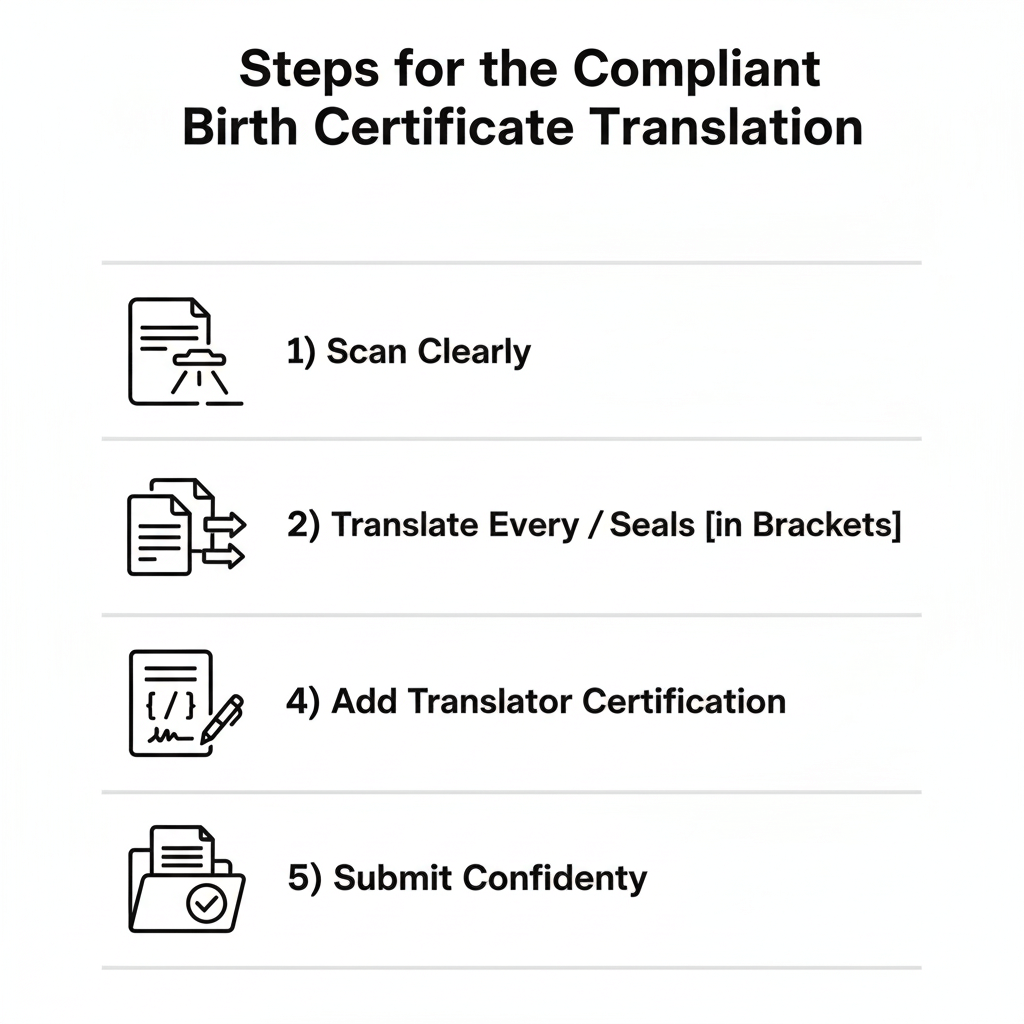
Step-by-Step: How to Get Your Birth Certificate Translated the Right Way
Step 1: Use the best version of your birth certificate
If you have options, choose the most complete version (often “long form”) that includes:
- parents’ details
- registry references
- full location names
- official stamps and remarks
Step 2: Scan it properly
A perfect translation can still be delayed if the scan is poor. Make sure:
- all corners are visible
- no glare or shadows
- high resolution (phone scan apps work well)
- front and back included if there’s any content
Step 3: Keep your names consistent across your case
Before submitting, double-check:
- spelling matches your passport
- hyphens, spaces, and diacritics are consistent
- date formats are unambiguous (e.g., write 12 Jan 2026, not 01/12/26)
Step 4: Make sure every stamp and note is accounted for
This is one of the most common reasons a translation gets questioned. If it’s on the page, it should be translated—or described.
Step 5: Ensure the certification is complete and signed
Missing signature and date is an easy way to invite an RFE.
Common Mistakes That Cause Delays (and How to Avoid Them)
Mistake 1: “I translated it but forgot the certification”
A translation without a signed certification is often treated as incomplete.
Mistake 2: Omitting stamps, seals, marginal notes, or back-side text
These are not decorative. Officers may treat missing elements as missing information.
Mistake 3: Using machine translation
Even when edited, machine output tends to:
- mistranslate civil registry terminology
- mishandle names and places
- miss contextual meaning (especially legal phrases)
Mistake 4: “Cleaned up” translations that change meaning
Do not interpret. Do not “correct” errors. Translate what’s written.
Mistake 5: Inconsistent names across documents
If your birth certificate translation spells your name differently than your passport, you can create avoidable complications.
Do You Need Notarisation for a Birth Certificate Translation?
Most USCIS filings require a certified translation, not notarisation. Notarisation generally verifies the identity of the signer—it does not verify translation accuracy.
If you’re filing somewhere that specifically asks for notarisation (certain courts, institutions, or overseas authorities), you may need an extra step.
How Long Does It Take (and How Much Does It Cost)?
Most birth certificates are 1–2 pages. Pricing is typically set per page, with rush options available when needed.
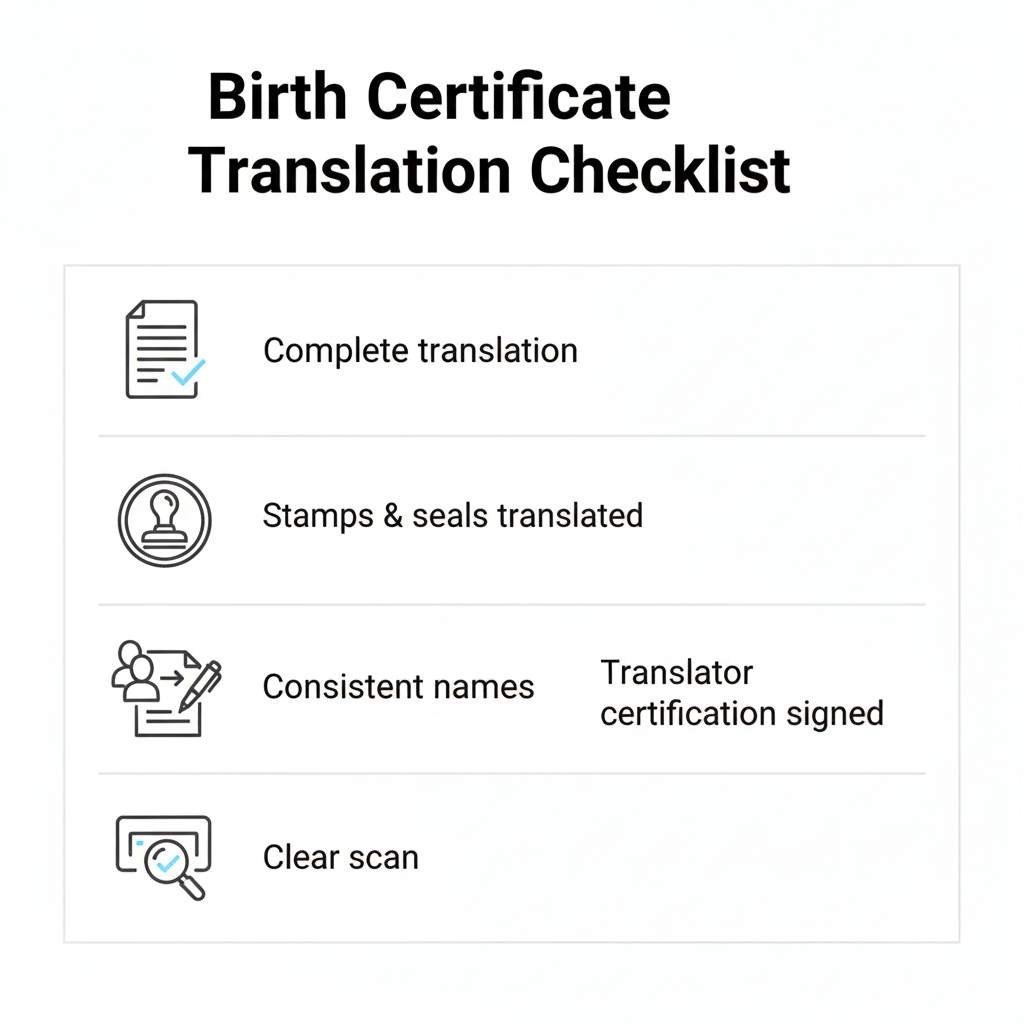
A Simple “Ready to Submit” Checklist
Before you upload or file, confirm you have:
- A clear scan (all corners visible)
- Full English translation of every element
- Stamps/seals/handwriting translated or described in brackets
- Consistent spelling of names and places
- A signed translator certification attached to the translation
- One certification per document
FAQs
Can you translate your own birth certificate for USCIS?
USCIS requires a complete English translation plus a signed certification from the translator confirming competence and accuracy. Self-translation is widely considered risky for a core identity document like a birth certificate, so an independent translator is the safer choice.
Can a family member translate my birth certificate?
A family member can translate if they are competent and provide a proper certification, but it may still be viewed as biased. For high-stakes documents, an independent translator reduces risk of delays.
Does USCIS require a certified translator for birth certificate translation?
USCIS requires a certified translation (meaning a translation with a signed certification statement). It does not require the translator to hold a particular licence or credential, but competence and proper certification are essential.
Do I need a notarized translation for USCIS?
Usually, no. USCIS generally requires certified translations with a signed certification statement. Notarisation is typically optional unless another authority specifically requires it.
What happens if my birth certificate translation is missing a stamp or note?
Missing stamps, seals, or marginal notes can trigger questions or an RFE, because USCIS may treat the translation as incomplete. Everything visible on the document should be translated or described.
What’s the fastest way to get a compliant birth certificate translation?
Use a service that delivers a ready-to-submit translation with a signed certification and clear formatting.
