
If you’re getting ready to file a U.S. immigration application, you’ve probably asked yourself a very specific question:
“Can I translate my own birth certificate for USCIS?”
The short answer:
- The law doesn’t explicitly forbid you from translating your own document, but
- In real life, self-translations are high-risk and often lead to Requests for Evidence (RFEs) or even rejections.
USCIS has strict rules for any document in a foreign language: it must come with a full English translation and a signed certification from the translator confirming the translation is complete, accurate and that they’re competent to translate from the original language into English.
This guide will walk you through:
- What USCIS actually says (and doesn’t say) about who can translate
- Why translating your own birth certificate is such a bad idea in practice
- Who should translate your birth certificate
- How to get a USCIS-ready certified translation with minimal stress
Throughout, we’ll use plain language and practical examples so you can confidently decide what to do next.

The Quick Answer: Can I Translate My Own Birth Certificate for USCIS?
Let’s separate law, practice and best strategy.
What the official USCIS rules say
USCIS policy and regulations require three things for any foreign-language document:
“Any document containing foreign language submitted to USCIS shall be accompanied by a full English language translation which the translator has certified as complete and accurate, and by the translator’s certification that he or she is competent to translate from the foreign language into English.”
In other words, you need:
- Full English translation (not a summary)
- Certification statement from the translator
- Translator’s claim of competence in both languages
Notice what’s missing: USCIS does not explicitly say “you cannot translate your own documents”.
What immigration guidance and practice say
Trusted immigration resources confirm that anyone who is competent in both languages can technically act as the translator, including individuals who are not “officially certified”.
However, many experienced immigration services and law firms warn that in practice:
- Self-translations and family translations are often treated as conflicts of interest
- Officers may question impartiality and reject or RFE the case
- Some providers and experts explicitly state that the translation must be done by a neutral third party, not the applicant
At the same time, some legal information sites still say that you or a relative can do it, as long as you’re truly competent and there’s no conflict of interest—but they immediately add that it’s safer to use a professional translator.
So what’s the safest answer?
Putting law and real-world practice together, here’s the practical conclusion:
You should not translate your own birth certificate for USCIS.
The safest, lowest-risk route is to use an independent, competent translator or professional translation service.
If your timeline, visa, job or family status depends on this application, gambling on a self-translation to save a small fee is rarely worth the risk.
What USCIS Requires from a Birth Certificate Translation
Whether you use a professional service like USCIS Official Translation or a trusted translator you personally know, the requirements are the same.
Full, word-for-word English translation
USCIS expects a complete, line-by-line translation, not a summary. That includes:
- All printed text (front and back)
- Names, places, and titles exactly as they appear
- Handwritten notes, stamps, seals and marginal comments
- Dates, registration numbers and references
If the officer can’t match the translation to the original document easily, you risk an RFE or rejection.
A proper translator’s certification
Every USCIS-ready translation must include a signed certificate of translation that states, in substance, that:
- The translator is competent in English and the original language
- The translation is complete and accurate
A typical certification will show:
- Translator’s full name
- Statement of language competence
- Statement that the translation is complete and accurate
- Signature and date
- Optionally, the translator’s contact details and company name
Long-form, civil birth certificate
USCIS generally expects a long-form birth certificate showing:
- Full name
- Date and place of birth
- Parent(s)’ names
- Issuing authority and official seals
Short-form or “extract” versions, or religious certificates alone, often trigger RFEs.
Clear, consistent formatting
The translation should mirror the structure of the original as much as reasonably possible:
- Use similar headings and table layout
- Keep sections in the same order
- Mark illegible text clearly as “illegible” (not guessed or “fixed”)
This makes it easy for the officer to compare both versions and trust what they’re reading.
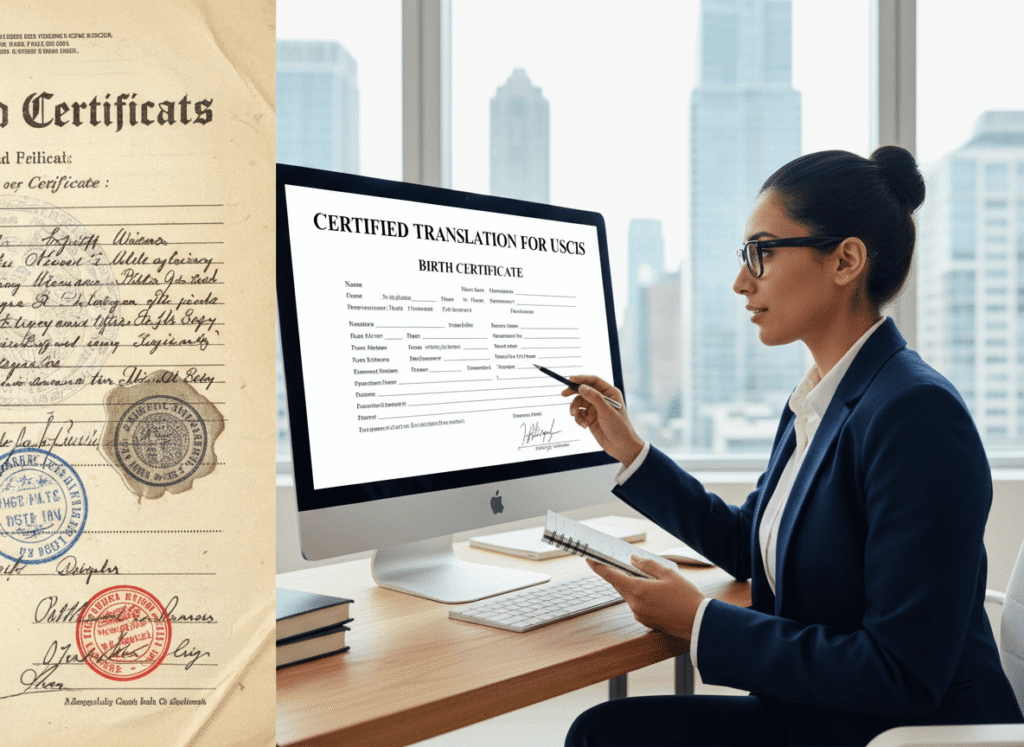
Why Translating Your Own Birth Certificate Is a Bad Idea
Even if you are perfectly bilingual, self-translation is risky. Here’s why.
Conflict of interest and credibility
Your birth certificate is directly tied to your case: identity, age, family relationship and eligibility. When you translate it yourself, an officer might reasonably ask:
- “Is this really word-for-word?”
- “Have they ‘cleaned up’ spelling or dates?”
- “Did they omit anything awkward?”
Because translations are not usually compared line-by-line with the original, USCIS often assumes the translation is either fully right or not trustworthy at all.
A neutral third party is simply far easier for an officer to accept.
Tiny errors can cause delays or denials
Immigration experts repeatedly highlight that minor translation errors can lead to RFEs, rejections or even outright denials:
Common problems include:
- Misspelt names or inconsistent spellings
- Wrong date formats (e.g. confusing 06/07/1990 with 7 June vs 6 July)
- Missing stamps, seals or handwritten annotations
- Mis-translated titles or official terms
A professional translator specialising in USCIS cases is trained to avoid these traps.
You might miss mandatory elements
Applicants who translate their own documents often forget to:
- Add a separate certification statement
- Include all pages, including the back or margins
- Translate every stamp and note
- Provide the translator’s contact details
Any one of these issues can be a reason for USCIS to push back.
Emotional load and time pressure
Most people submit immigration applications while juggling:
- Work and family
- Tight filing deadlines
- Visa expiries, job offers, study plans, weddings or relocations
Trying to teach yourself how to properly format and certify a translation on top of everything else is a heavy burden. Outsourcing this piece to a professional is usually a small cost compared to the overall value of your case.
Who Can Translate a Birth Certificate for USCIS?
If you shouldn’t translate your own document, who can?
USCIS requirements for the translator
USCIS requires that the translator be:
- Competent in both languages (original language and English)
- Able to provide a full translation
- Willing to sign a certification of accuracy and competence
USCIS does not require:
- A government licence
- A specific “certified translator” badge
- A notary stamp (for USCIS itself, although other authorities sometimes want notarisation)
Best options in practice
From a practical and risk-management perspective, the safest options are:
- Professional translation company specialising in USCIS
- Dedicated templates that meet USCIS expectations
- Quality control and proofreading
- Clear, predictable turnaround times
- Independent professional translator experienced with immigration cases
- Ideally a member of a recognised professional body (e.g. ATA in the U.S.)
- In very limited cases, a trusted third party
- Someone non-related, fluent in both languages, who understands the requirements and is happy to sign a formal certification
Even where sources suggest you may translate your own document or ask a family member to do so, they still recommend against it because acceptance is always at the discretion of the officer
Sample Certification Statement for USCIS Translations
To understand what a professional translation looks like, here’s a typical certification (for illustration only):
I, [Full Name], certify that I am fluent in [Language] and English and that I am competent to translate from [Language] into English. I further certify that the attached translation of the [name of document] is a complete and accurate translation of the original document.
Signature: ________________________
Name: ____________________________
Date: ____________________________
Contact details: __________________
This structure aligns with standard templates used by law-related organisations and universities when certifying translations.
With USCIS Official Translation, this type of certification is automatically included with every birth certificate translation we deliver
Step-by-Step: How to Get a USCIS-Ready Birth Certificate Translation
Here’s a clear, practical process you can follow.
Step 1 – Confirm that translation is required
You need a translation if:
- Your birth certificate is not in English, or
- It’s bilingual but the English portion is incomplete or unclear
If your birth certificate is already fully in English and clearly issued by the official civil authority, you usually don’t need a translation.
Step 2 – Gather the right version of your birth certificate
Aim to provide:
- The long-form birth certificate, showing full details and parentage
- A clear scan or photo, with all corners visible
- If possible, both front and back pages
If the original is damaged, incomplete or unavailable, you may need a “certificate of non-availability” and alternative evidence such as school or religious records.
Step 3 – Choose a USCIS-savvy translator or translation service
When selecting a provider, look for:
- Experience with USCIS and immigration documents
- A guarantee that translations meet USCIS certified translation standards
- Transparent pricing (usually per page) – many services treat around 250 words as one page
- Clear turnaround options (standard vs urgent)
At USCIS Official Translation, we specialise exclusively in immigration-ready translations, so every system and template is built around USCIS expectations.
You can simply upload a clear scan of your birth certificate and request a quote in a few clicks.
Step 4 – Submit your document securely
Send:
- A high-resolution scan or photo
- Any existing translations (if you’ve tried before and got an RFE)
- The spelling of names exactly as you want them to appear on your forms
Make sure the service you use has strong data protection measures in place, as you’re sharing highly personal information.
Step 5 – Receive and review your certified translation
Your translated birth certificate package should include:
- A typed English translation
- A separate certification statement signed by the translator or the translation company
- Clear references between the translation and the original document
Carefully check:
- Names and dates match your forms
- Place of birth and parent details are correct
- No obvious spelling or typographical errors
If anything looks off, ask for a correction before filing.
Step 6 – Assemble your USCIS submission
When you send your application, include:
- A copy of the original birth certificate in the original language
- The certified English translation
- The translator’s certification (often part of the same PDF or on a separate page)
Always follow the instructions for your specific form (e.g. I-130, I-485, N-400), as some may ask for originals or photocopies in particular situations.
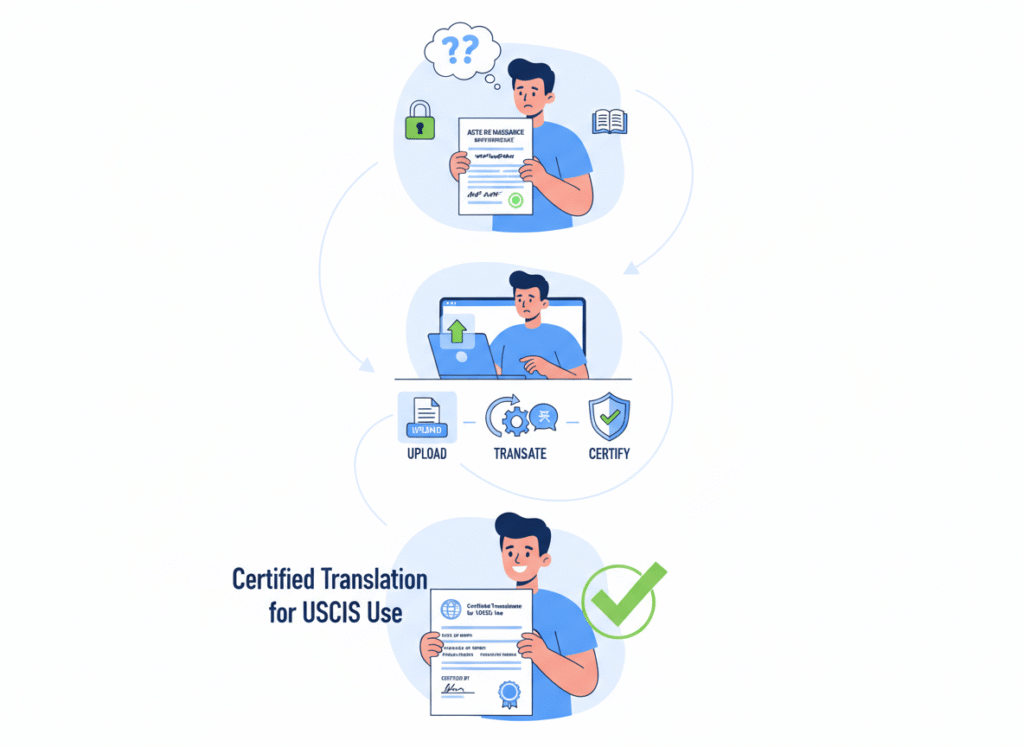
How USCIS Official Translation Makes This Simple
USCIS Official Translation is built specifically for people in your situation: you just want this done properly, the first time.
When you order a birth certificate translation with us, you get:
- Word-for-word, USCIS-ready translation by a specialist human translator
- Signed certification of accuracy and competence with every order
- Clear formatting that mirrors your original document
- Fast, reliable delivery in digital format (and hard copies on request)
- Support if USCIS ever raises a translation-related query on our work
You simply upload your birth certificate, confirm your details and proceed with your order. Our team takes care of the rest.
If you’re already facing an RFE due to a problematic translation, we can also re-translate your document properly and help you avoid the same issue again.
Visual Ideas to Make This Topic Easier to Digest
On your live page, you can make the process feel much less intimidating by adding:
- A simple flowchart showing: “Upload → Translation → Certification → Submit to USCIS”
- A visual checklist (ticks next to: long-form certificate, full translation, certification, copy of original)
- A short explainer video or animation outlining the risks of self-translation vs using a professional service
These visual touches help readers quickly understand what to do next, especially when they’re anxious about their immigration case.
Frequently Asked Questions
1. Can I translate my own birth certificate for USCIS?
You should not translate your own birth certificate for USCIS. While the regulations focus on having a full, certified translation from a competent translator and do not explicitly ban self-translation, immigration practice strongly favours a neutral third-party translator.
Using a professional, independent translator massively reduces the risk of RFEs, delays and credibility issues.
2. Can my spouse, relative or friend translate my birth certificate for USCIS?
Some legal resources indicate that any fluent person can technically act as the translator, including a friend or relative, as long as they certify the translation and there is no conflict of interest.
However, many immigration-focused translation providers and practitioners warn that family translations are often not accepted in practice, and can be viewed as self-interested.
To stay on the safest possible ground, it’s far better to use a professional third-party service.
3. Do USCIS birth certificate translations need to be notarised?
For USCIS purposes, no—a notarised translation is generally not required. USCIS requires a certified translation, which means a signed statement by the translator confirming completeness, accuracy and competence.
Other authorities (courts, foreign embassies, universities) may sometimes ask for notarisation on top of certification, but that is separate from USCIS’s own rules.
4. Do I need to send the original birth certificate with the translation?
Typically, you submit:
- A copy of the original birth certificate in the foreign language
- The certified English translation
- The translator’s certification
Always follow the specific form instructions. In some cases, USCIS may request an original document or a certified copy from the issuing authority.
5. What if my birth certificate is old, damaged or missing?
If your birth certificate:
- Is damaged, the translation should still reflect it faithfully, including any “illegible” sections.
- Is unavailable, many applicants obtain a “certificate of non-availability” from the issuing authority and provide secondary evidence (school records, religious certificates, affidavits).
Translation is still required for any non-English evidence you provide.
6. Which languages can you translate for USCIS birth certificate submissions?
USCIS accepts translations from any language, as long as the translator can competently translate into English and provides a proper certification.
USCIS Official Translation works with a wide network of professional linguists covering major and less common languages used in immigration cases. You can simply upload your file, and we’ll match it with a suitable specialist.
