
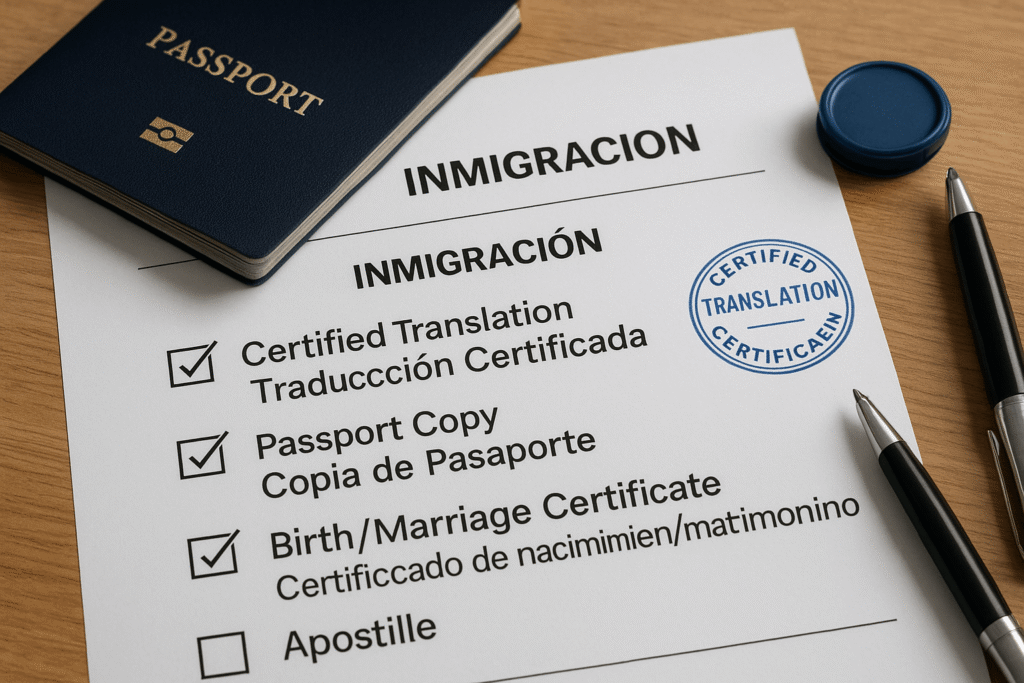
Short answer:
“Immigration” in Spanish is inmigración (feminine noun). Common collocations include política de inmigración (“immigration policy”) and control de inmigración (“immigration control”).
What “immigration” means in Spanish (quick definitions & nuances)
- Inmigración = the movement of people into a country to live there. It’s a feminine noun: la inmigración. The Royal Spanish Academy (RAE) lists it as “acción y efecto de inmigrar.”
- Related terms you’ll see in Spanish:
- emigración = moving out of a country.
- migración = the broader phenomenon of population movement (covers both immigration and emigration). FundéuRAE clarifies the contrast between inmigrante and emigrante, and the umbrella term migrante.
Usage tip: In travel contexts, “immigration” can also mean the passport control area. In Spanish, that’s control de inmigración (also control de extranjería).
How do you say “immigration” in Spanish? (with examples)
- Base translation: immigration → inmigración
- Policy & law:
- immigration policy → política de inmigración
- immigration law → ley de inmigración / derecho de inmigración
- Government & agencies:
- U.S. Citizenship and Immigration Services (USCIS) in Spanish is Servicio de Ciudadanía e Inmigración de los Estados Unidos.
- Airports & borders:
- Immigration (passport control) → control de inmigración / control de extranjería
Examples in sentences
- La inmigración ha contribuido al crecimiento económico del país.
- Debes pasar por el control de inmigración antes de recoger tu equipaje.

“Immigration” vs “emigration” vs “migration” (clear comparison)
| English term | Spanish | Focus | Example |
|---|---|---|---|
| Immigration | inmigración | People entering a country | Políticas de inmigración |
| Emigration | emigración | People leaving a country | Aumentó la emigración juvenil |
| Migration | migración | Any movement (in/out) | La migración interna crece |
FundéuRAE notes inmigrante is the person who arrives, emigrante the one who leaves, and migrante a broader label for either.
“Immigration” for U.S. contexts in Spanish
If you’re writing for a U.S. audience in Spanish:
- USCIS: Servicio de Ciudadanía e Inmigración de los Estados Unidos. See the official Spanish site for wording style.
- Spanish-language resources: USCIS maintains Spanish pages for news, forms and services (e.g., Formularios / forms; Noticias / news; Estatus de caso / case status).
Compliance note (for document submissions): When you submit documents in a foreign language to USCIS, you must include a full English translation with a translator’s certification stating completeness, accuracy, and translator competence (8 CFR 103.2(b)(3)). Our certified translations include this statement.
Style guide: writing about “immigration” in Spanish (H3)
1) Choose the precise term (H4)
- Legal/policy context → inmigración (and política de inmigración)
- Airport/border context → control de inmigración (or extranjería)
2) Grammar & agreement (H4)
- Inmigración is feminine singular: la inmigración; adjectives agree: la inmigración legal / irregular.
3) Synonyms & near-synonyms (H4)
- Depending on tone and context: migración (broader), movilidad (broader, often policy-speak). For precision in public information, prefer inmigración when you mean entry to a country.
Quick Q&A (rich-result friendly)
Q: How do you say “immigration” in Spanish?
A: Inmigración. It’s a feminine noun used for the process of entering a country to live there.
Q: Is it inmigración or emigración?
A: Use inmigración for entering a country; emigración for leaving your country.
Q: How do you write “immigration control” in Spanish?
A: control de inmigración (also control de extranjería in some contexts).
Q: What is USCIS called in Spanish?
A: Servicio de Ciudadanía e Inmigración de los Estados Unidos.
Q: Do translations for USCIS need certification?
A: Yes. USCIS requires a complete English translation with a signed translator’s certification per 8 CFR 103.2(b)(3).
Why choose USCIS Official Translation (trust & conversions)
- ✅ USCIS-ready: Every Spanish↔English translation includes a translator’s certification that meets 8 CFR 103.2(b)(3) requirements.
- 🔐 Secure & private: Encrypted file upload and GDPR-aligned handling.
- 🕒 Fast turnaround: Same-day and 24–48h options.
- 🎯 Specialists in immigration documents: Birth, marriage, police, court, academic and civil records.
“Clear pricing, fast delivery and accepted without issues.” — Client review (immigration case, 2025)
How to order a certified translation (step-by-step)
- Upload your document(s) (scan or photo).
- Receive an instant quote and turnaround options.
- We translate & certify (Spanish ↔ English).
- Quality check by a second linguist.
- Delivery: PDF by email; optional hard copy by post.
- Support: We help with any formatting or reprints needed for submission.
FAQs
1) Is “immigration” always translated as inmigración?
Yes, for the legal/policy concept. In travel contexts (airports), “immigration” also refers to passport control, translated as control de inmigración.
2) Which is correct: inmigración or migración?
Use inmigración for entering a country; migración is broader and may include internal moves.
3) What is USCIS in Spanish?
Servicio de Ciudadanía e Inmigración de los Estados Unidos, the federal agency overseeing lawful immigration.
4) Do I need a certified translation for USCIS?
Yes. Per 8 CFR 103.2(b)(3), any foreign-language document submitted to USCIS must include a complete English translation with a translator’s certification of accuracy and competence.
5) How fast can I get my translation?
Most single-page documents are delivered within 24–48 hours, with same-day options available (ask us when you upload your file).
