
If you’re applying for a US immigration benefit, a visa, a passport, school admissions, or anything official, one small detail can quietly slow everything down: a birth certificate that isn’t in English (or isn’t fully in English).
The good news is that getting your birth certificate translated into English is straightforward once you know what “acceptable” really means — and what common mistakes trigger delays.
This guide walks you through the exact process from start to finish, including a ready-to-use certification statement, a practical checklist, and real-world formatting tips that make your translation easy to review.
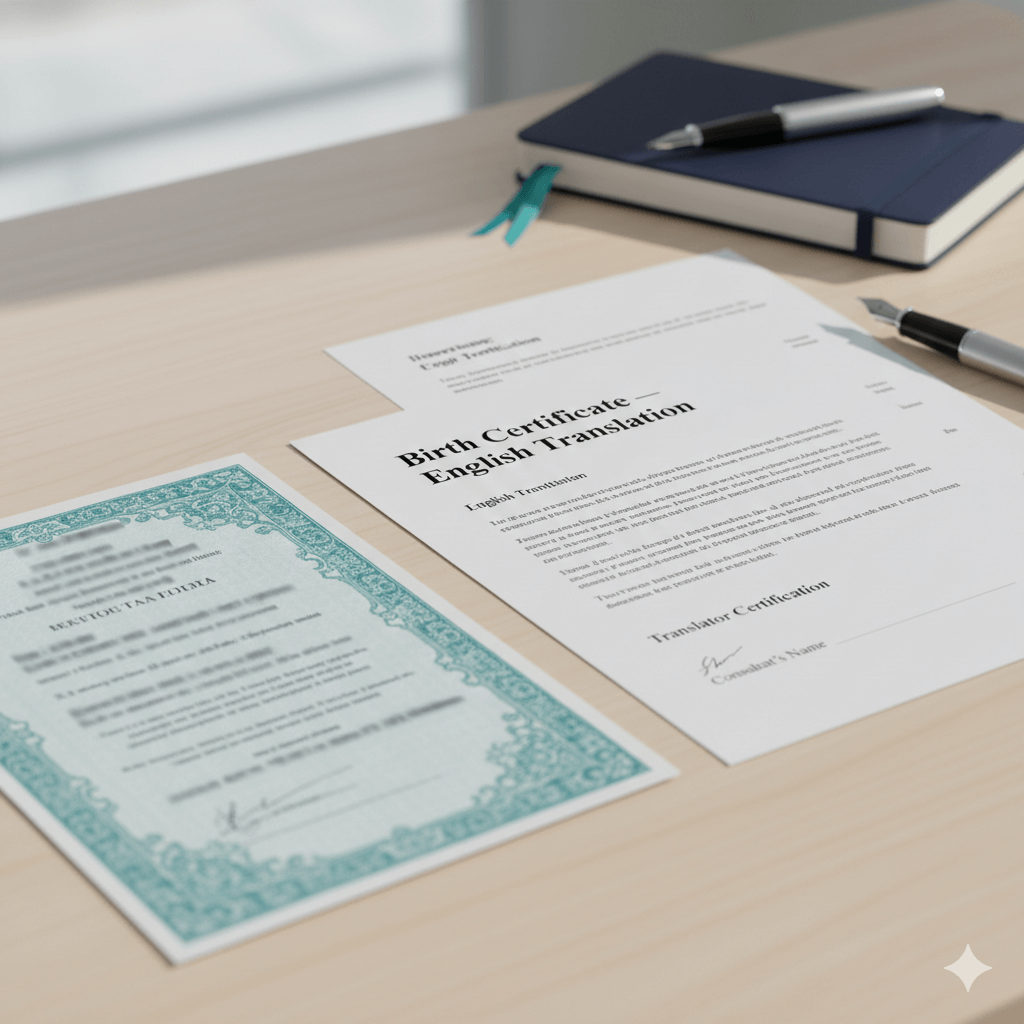
What “translated into English” actually means for official use
A usable English translation is not just “the text in English”.
For official purposes, your translation should be:
- Complete (every visible element is covered)
- Accurate (names, dates, places, and labels are faithfully rendered)
- Readable (typed, clearly structured, and easy to compare)
- Certified (includes a signed translator certification statement)
That last point — certification — is what separates an official-ready translation from an informal one.
Step 1: Confirm what you’re using the translation for
Before you translate anything, get clear on where you’re submitting it. Requirements can differ slightly depending on the destination.
Most common scenarios:
- US immigration filings (USCIS): typically requires a certified English translation
- National Visa Center (NVC) / consular processing: often accepts certified translations, but some embassies have specific rules
- Courts, state agencies, universities, licensing boards: may sometimes request notarisation
- Foreign authorities (outside the US): may ask for sworn translation and/or legalisation
Step 2: Make sure you have the right version of your birth certificate
Not all birth certificates are equally usable.
Before you translate, check whether your document is:
- Long-form vs extract: some countries issue short “extracts” that don’t list parents or registration details. That can be a problem depending on your application.
- Stamped / registered version: official stamps, seals, and registry references matter and must be included.
- Double-sided: if there’s text on the back (notes, endorsements, registry remarks), it should be translated too.
If you’re not sure whether your document is the “right” one for a US process, you can also look up how your country’s civil documents are typically issued (more on this in the external resources section at the end).
Step 3: Prepare a clean scan or photo (this prevents 80% of problems)
Even a perfect translator can’t fix unreadable text.
Use this quick scan/photo checklist:
- Place the document on a flat surface in good light (no shadows)
- Capture all four corners and any border text
- Avoid glare over stamps, seals, and signatures
- If it’s a booklet-style document, photograph each page
- If handwriting is faint, take a second close-up photo of that area
Step 4: Decide whether to DIY or use a professional service
Some people try to translate their birth certificate themselves using a template or machine translation. Sometimes that works — and sometimes it creates delays that cost far more than the translation.
Here’s the risk-based way to decide.
DIY can be reasonable if:
- The certificate is short, fully legible, and clearly structured
- There are no stamps, marginal notes, handwritten entries, or multi-page sections
- You’re confident you can produce a typed, complete translation and attach a proper certification
Hiring a professional is strongly recommended if:
- There are stamps, seals, signatures, handwritten notes, or registry remarks
- Your name contains accents/diacritics or a non-Latin script (Arabic, Cyrillic, Chinese, etc.)
- The layout is complex (tables, columns, multiple languages)
- You’re already on a deadline (or responding to a request for more evidence)
- You need the translation to look “review-ready” for an officer or clerk
Step 5: Translate every visible element (yes, even stamps and seals)
A birth certificate translation should cover everything visible, not just the main fields.
That includes:
- Registration numbers and record references
- Parent names, maiden names, and “also known as” fields
- Places of birth (district, province, country)
- Authority names and issuing office titles
- Stamps, seals, signatures, handwritten notes
- Marginal notes (corrections, late registration, amendments)
A simple rule that prevents rework:
If you can see it, include it in the translation.
How to handle stamps, seals, and signatures
You don’t “translate” a seal’s artwork — you label it clearly.
Examples of acceptable rendering:
- [Round stamp: Civil Registry Office, City Name]
- [Embossed seal]
- [Signature]
- [Illegible handwriting] (only if genuinely unreadable)
This makes it obvious to a reviewer that nothing was omitted — and it avoids the appearance of missing content.
Step 6: Keep names and dates consistent across your entire application
This is one of the most overlooked issues, and it causes unnecessary questions.
Names: create a simple “name map” before translating
Write down exactly how names appear in:
- Your passport
- Your birth certificate
- Any marriage/divorce documents
- Any prior immigration paperwork
Then choose the spellings you will use consistently in English.
If the original document is in a non-Latin script (e.g., Arabic), your translator should transliterate names into English in a consistent way — ideally matching your passport spelling whenever possible.
Dates: prevent day/month confusion
Many birth certificates use formats that can be interpreted two ways (e.g., 03/04/1996).
A clean way to avoid confusion is to write dates in an unambiguous format in the translation, such as:
- 04 March 1996 (spelled month)
or - 1996-03-04 (ISO style)
Your translation should not “correct” dates — it should render the date as shown, but in a clear English format.
Step 7: Add a proper translator certification statement
This is the part people forget — and it’s a common reason documents get challenged.
Your certification should confirm three things:
- The translator is competent in both languages
- The translation is complete and accurate
- The translator signs and dates the statement (and includes contact details)
Copy-and-paste certification wording (official-ready format)
Translator Certification
I, [Translator Full Name], certify that I am competent to translate from [Source Language] into English, and that the attached translation of [Document Name: Birth Certificate] is a complete and accurate translation of the original document.
Signature: _______________________
Name: [Translator Full Name]
Date: [DD Month YYYY]
Contact details: [Email / Phone / Address]
Step 8: Format the translation so it’s easy to compare
Reviewers don’t want to “solve a puzzle”. They want to match fields quickly.
Strong formatting looks like this:
- Clear title at the top: Birth Certificate — English Translation
- A clean structure that mirrors the original order (top-to-bottom, left-to-right)
- Tables remain tables (not converted into messy paragraphs)
- Labels are translated consistently (e.g., “Date of Birth”, “Place of Birth”, “Father”, “Mother”)
- Stamps and seals are listed in the area where they appear (or grouped at the end, clearly labelled)
Step 9: Final check before you submit (the “no surprises” checklist)
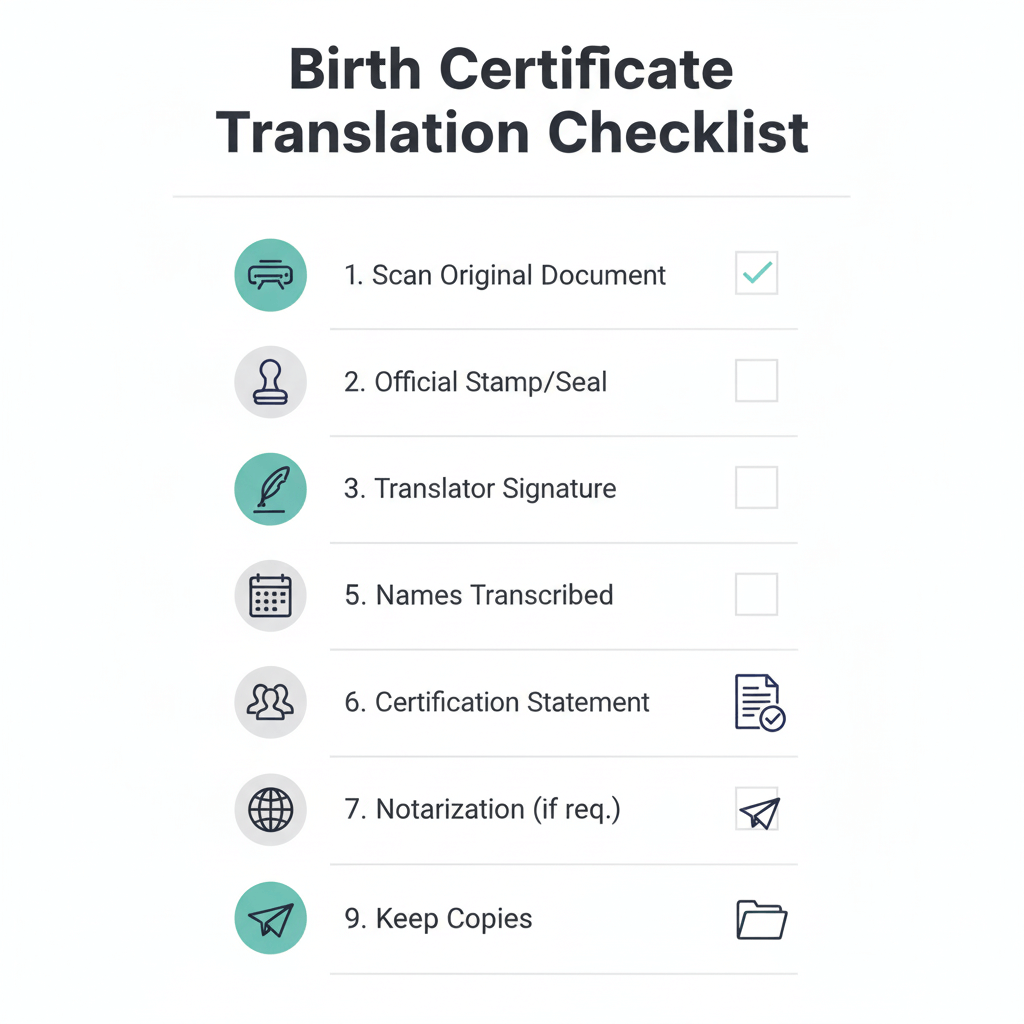
Use this checklist before sending anything to an agency or attaching it to your application:
- Every word and field on the original appears in English (including stamps/notes)
- Names match passport spelling (or differences are clearly explainable)
- Dates are unambiguous in English
- The translation is typed and legible
- The translator certification statement is attached
- The certification is signed and dated
- The translator can be contacted if needed
- You’re submitting both the original and the English translation together

Common mistakes that trigger delays (and how to avoid them)
Mistake 1: Partial translations
Birth certificates often contain important notes in margins, registration boxes, or stamps. If those aren’t translated, it can look incomplete.
Fix: translate everything visible — and label stamps/seals clearly.
Mistake 2: Missing certification statement
A translation without a signed certification is often treated as not usable for official review.
Fix: attach a signed certification that includes competence + completeness/accuracy.
Mistake 3: “Looks translated” but not review-friendly
Messy formatting, missing headings, or inconsistent labels slow down verification.
Fix: structure the translation so it’s easy to compare line-by-line.
Mistake 4: Relying on machine translation for official submission
Even when the output looks decent, machine translation commonly misses registry terms, abbreviations, and stamp text — and it can create credibility issues.
Fix: use a human translator for any official-purpose submission.
What to do if your birth certificate is bilingual (partly English, partly not)
Some certificates are issued in two languages (e.g., French/English, Arabic/English).
You may still need a translation if:
- Not all fields are in English
- Important remarks, stamps, or endorsements are not in English
- The issuing authority uses English headings but non-English handwritten entries
When in doubt, translate everything that is not clearly English — it’s safer than leaving mixed-language sections unaddressed.
If you need the translation quickly
Urgency is common — especially when you’re close to a filing deadline or responding to a request for more documents.
The fastest path is:
- Upload a clear scan/photo
- Confirm your preferred name spelling (passport spelling is best)
- Request certified delivery format
FAQ Section
How do I get my birth certificate translated into English for USCIS?
Get a complete English translation of every visible element (including stamps/notes) and attach a signed translator certification stating the translation is complete, accurate, and done by a competent translator.
What should a translator certification statement say?
It should confirm the translator is competent in both languages, the translation is complete and accurate, and include the translator’s name, signature, date, and contact details.
Do I need a notarised translation for a birth certificate translated into English?
Often no for USCIS-style submissions; notarisation is typically only needed when a court, university, or other authority specifically requests it.
Can I translate my own birth certificate into English?
Self-translation can create credibility issues in official processes. It’s safer to use an independent translator who can sign the certification statement.
How long does a certified birth certificate translation take?
Turnaround depends on the service level, document complexity, and how clear your scan is.
Is a “sworn translation” required to translate a birth certificate into English?
In many US processes, the key requirement is a certified translation with a signed certification statement. Sworn translations are usually tied to specific countries and authorities that explicitly require them.


