
If your marriage certificate isn’t fully in English, a certified translation is one of those “small” details that can make a big difference. Done properly, it’s straightforward: you submit a complete English translation plus a signed certification statement from the translator confirming accuracy and competency.
Done poorly, it can trigger delays, follow-up requests, or last-minute panic when you’re trying to file on time.
This guide gives you a clear, safe process you can follow today—whether you’re ordering online, using a local translator, or double-checking a translation you already have.
First: do you actually need to translate your marriage certificate?
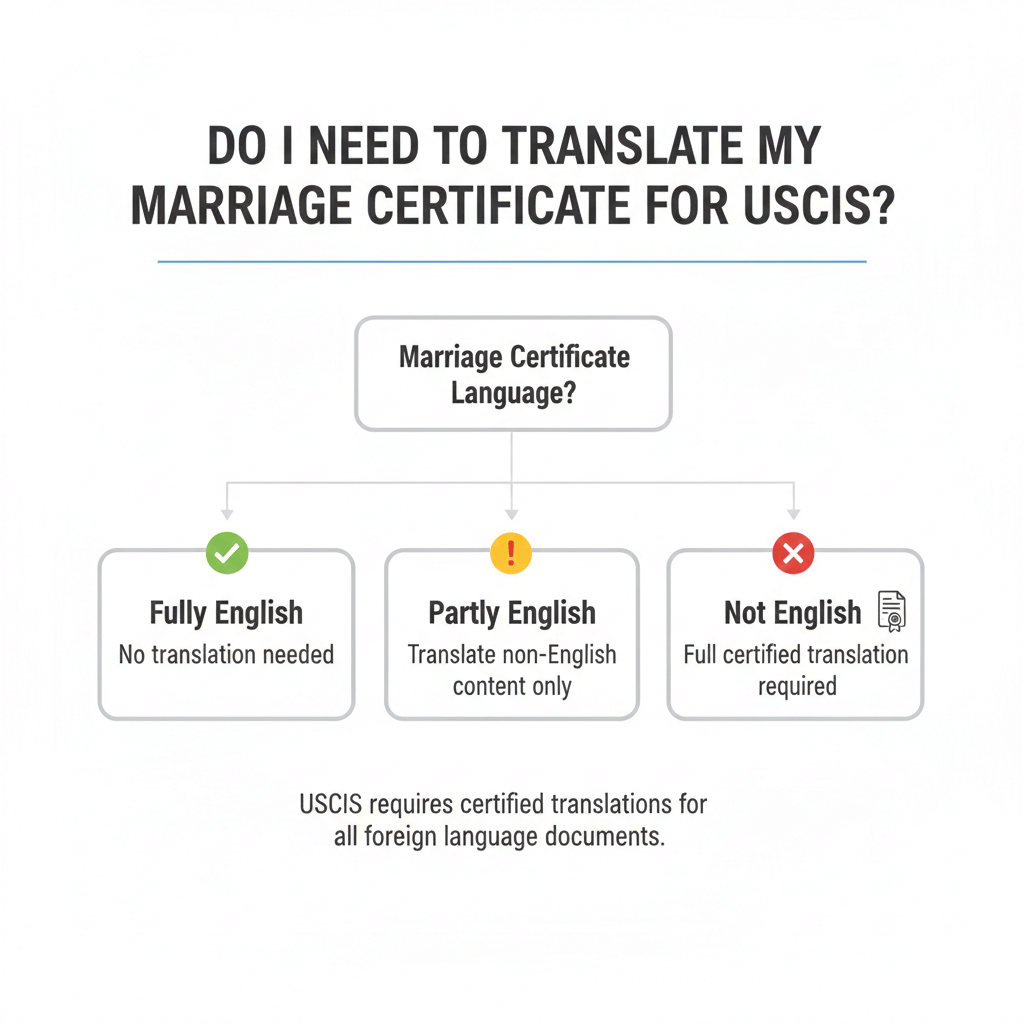
Use this quick decision test:
- Your marriage certificate is entirely in English: You typically don’t need a translation.
- Your marriage certificate is partly in English (bilingual/mixed): You may still need a complete English translation if any stamps, notes, fields, or back-page notations are not in English.
- Your marriage certificate is not in English: You’ll need a full English translation with a translator’s certification.
What “certified translation” means for USCIS (plain English)
For USCIS purposes, “certified” doesn’t usually mean a government stamp or a special licence. It means:
- A complete English translation of the marriage certificate (not a summary).
- A signed certification statement from the translator confirming:
- the translation is complete and accurate, and
- the translator is competent to translate into English.
The USCIS-ready checklist for a marriage certificate translation
A marriage certificate is simple on paper—but often messy in reality (stamps, handwritten notes, marginal text, reverse-side entries). Use this checklist to keep yours “officer-friendly”:
Your translation should include (without exception)
- Every word, stamp, seal, notation, and header on the document
- Handwritten items (translated as best as possible, marked if unclear)
- Numbers and dates rendered clearly and consistently
- Names exactly as shown (including accents, hyphens, multiple surnames)
- All pages, including the back side if there’s any text, stamps, or endorsements
- A certification statement with signature and translator details
Your formatting should make it easy to compare
- Keep the same field order as the original where possible
- Use clear labels like [Stamp], [Seal], [Signature], [Illegible] where needed
- Keep it typed, clean, and readable (avoid clutter)
Step-by-step: how to get a certified translation (without delays)
Step 1 — Prepare a clean copy of your marriage certificate
Before you send anything to a translator, do a 2-minute quality check:
- Take a flat, well-lit photo or a 300 dpi scan (phone scans are fine if sharp)
- Capture full edges (don’t crop out seals, borders, or page numbers)
- Include every page and the back side if it contains marks or text
- If there’s faint text or embossed seals, take two photos at different angles
A clean file reduces cost, speeds up turnaround, and prevents “guessing” on names and numbers.
Step 2 — Choose the right translator (and avoid the risky options)
There are three common routes:
Option A: Online certified translation service (fast + consistent)
Best when you want:
- predictable formatting
- quick turnaround
- a built-in certification statement
- easy PDF delivery
Option B: Independent professional translator (good, but varies)
This can work well, especially if the translator routinely handles immigration documents. The key is that they must provide a proper certification statement (with full details and signature).
Option C: “Friend/family translation” (high risk)
Even if someone is bilingual, the common problems are:
- missing stamps or side notes
- inconsistent spelling of names
- incomplete certification details
- formatting that looks like a summary rather than a full translation
Step 3 — Make sure the certification statement is complete
This is where many “almost correct” translations fall apart.
A safe certification statement typically includes:
- translator’s full name
- statement of competency in both languages
- statement that the translation is complete and accurate
- signature
- date
- contact details (at minimum email, often address/phone)
Sample certification statement (template-style)
You can use this as a reference for what “complete” looks like:
Translator’s Certification
I, [Full Name], certify that I am fluent in [Source Language] and English, and that the above translation is a complete and accurate translation of the attached document to the best of my knowledge and ability.Signature: ____________________
Name: [Full Name]
Date: [Date]
Contact: [Email / Phone / Address]
Step 4 — Do the 60-second “acceptance” self-check before you file
Before you submit, verify these five items:
- Everything is translated (including seals, stamps, margins, back page)
- Names match the original exactly (same order, same spelling, same diacritics)
- Dates and locations are unambiguous (no confusing formats)
- Certification is signed and dated with translator details included
- Your translated PDF is clean and readable (not blurry, not skewed, not cropped)
If any part looks “thin” (summary-style, missing stamp text, no translator contact details), fix it now—before USCIS has to ask.
Common marriage certificate translation mistakes (and how to avoid them)
Mistake 1: Translating only the “main text”
USCIS-style review expects the “small marks” too:
- registrar stamps
- seals
- side notes
- handwritten annotations
- file references and registration numbers
Fix: Insist on a full translation, not highlights.
Mistake 2: Name mismatches caused by formatting differences
This happens a lot with:
- double surnames
- patronymics
- accent marks
- swapped first/last name order
Fix: Keep names exactly as shown on the certificate. If the certificate uses multiple spellings, add a brief translator note.
Mistake 3: Unclear handwriting handled as “best guess”
Guessing is where trouble starts.
Fix: If a word is not fully readable, it should be marked as [Illegible] or [Unclear]—and the translation should still be as complete as possible.
Mistake 4: Missing certification details
The translation may be accurate, but the certification is incomplete (no contact, no signature, no competence statement).
Mistake 5: “Certified”, “notarised”, and “sworn” mixed up
These words mean different things depending on the authority and country.
Fix: If you’re filing with USCIS, you generally need a certified translation (translation + certification statement). For other authorities, notarisation or sworn translation might be requested.
Cost and turnaround: what to expect (and what drives the price)
For most marriage certificates, pricing is usually straightforward because they’re often one page (sometimes two), but final cost depends on:
- How many pages your provider counts (some count “one sheet = one page”; others count each side)
- Language pair (rarer languages can cost more)
- Complexity (dense stamps, handwriting, multi-part registers)
- Speed (same-day or rush delivery adds cost)
If you’re under a deadline, choose the route that gives you a clean PDF and certification quickly—then you can move on with your filing.
Do you need notarisation or a sworn translation for a marriage certificate?
For USCIS filings
Most applicants only need a certified translation (complete translation + signed certification statement).
You may need notarisation if…
- a court or separate authority specifically asks for it, or
- you’re using the translation outside the USCIS context (certain institutions or foreign authorities)
You may need a sworn translation if…
A foreign authority (not USCIS) requires a sworn/court-appointed translator format.
A simple, reliable way to get it done online
If your goal is: “USCIS-ready translation, delivered fast, with the certification handled correctly,” the simplest approach is:
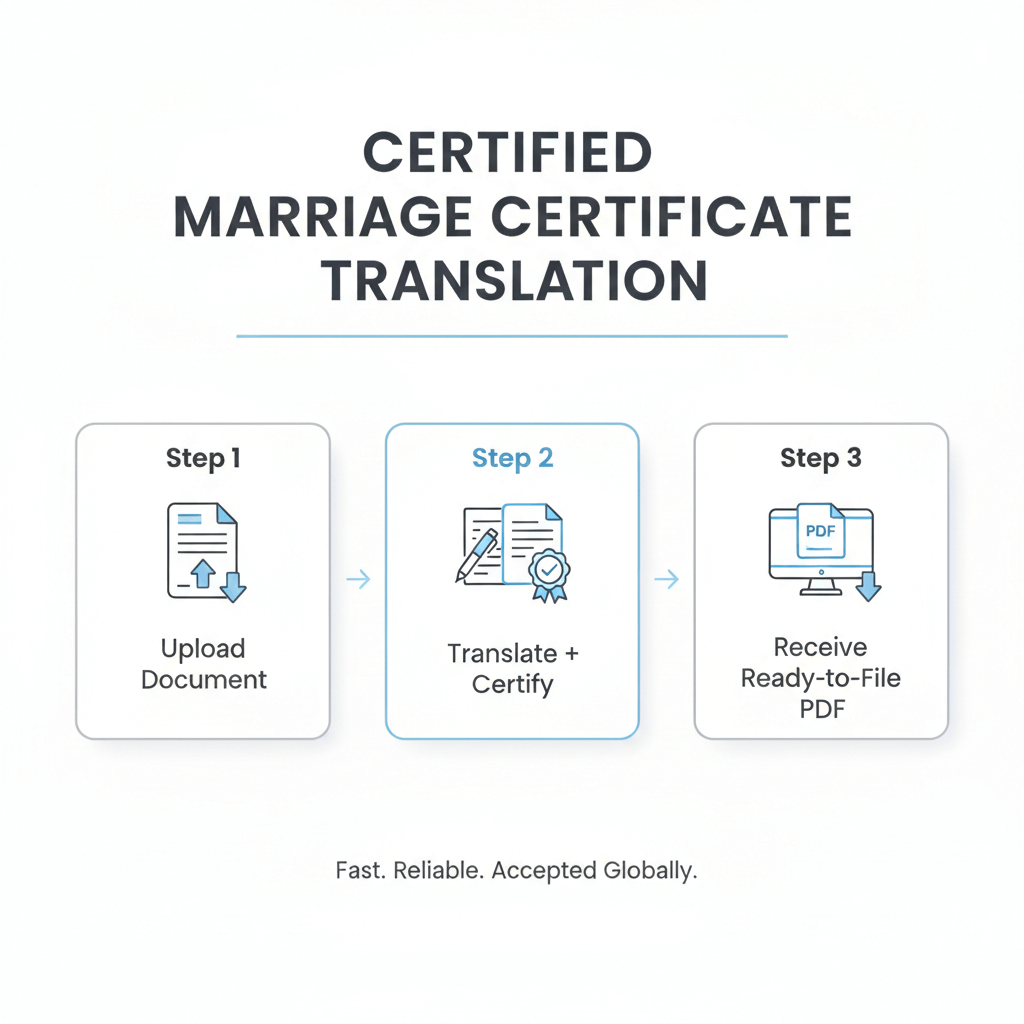
- Upload your marriage certificate
- Confirm turnaround and any add-ons (rush, notarisation only if needed)
- Receive a clean, certified PDF ready to submit
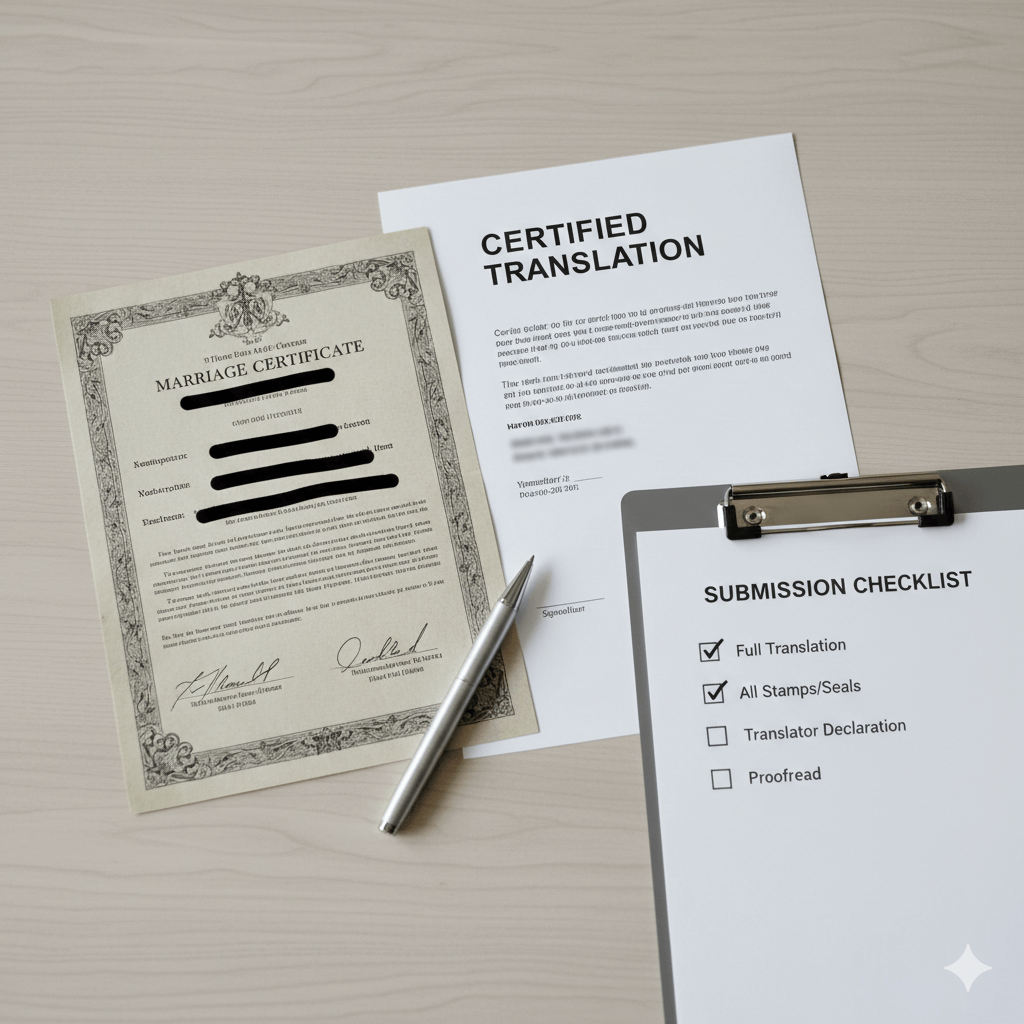
Quick submission checklist (save this)
Before you file, make sure you have:
- Copy of the original marriage certificate (all pages/sides)
- Full English translation (no omissions)
- Translated stamps/seals/notes included
- Translator’s certification statement (competence + accuracy)
- Signed and dated certification with translator contact details
- Clean PDF that’s readable and not cropped
If you can tick every box, you’re in good shape.
FAQs
1) Can I translate my own marriage certificate for USCIS?
It’s strongly discouraged because USCIS expects an independent translator’s certification statement and clean compliance. For the safest approach, use an independent third party.
2) Does USCIS require a notarised translation of a marriage certificate?
USCIS typically requires a certified translation (translation + signed certification statement), not notarisation—unless another authority or special circumstance specifically requests it.
3) What must be included in the translator certification statement?
At minimum: translator identity, competence statement, accuracy/completeness statement, signature, date, and contact details.
4) How long does a certified marriage certificate translation take?
Many single-page certificates can be completed quickly, but timelines depend on language, complexity, and whether you select rush delivery.
5) Do I need to translate a bilingual marriage certificate?
If any part of the document (including stamps or notes) isn’t in English, you may still need a complete English translation for a clean submission.
6) Can I use a marriage certificate translation template?
Templates can help you understand structure, but the risk is missing stamps/notes or producing a summary-style document. A professional translation is safer when stakes and deadlines are real.
