
If you’re filing an immigration application, your birth certificate often becomes one of the most important documents in your packet. And if it isn’t in English, the translation needs to be done in a very specific way.
This guide walks you through the full process—exactly what to translate, what the certification must say, how to avoid delays, and how to get a USCIS-ready translation quickly.
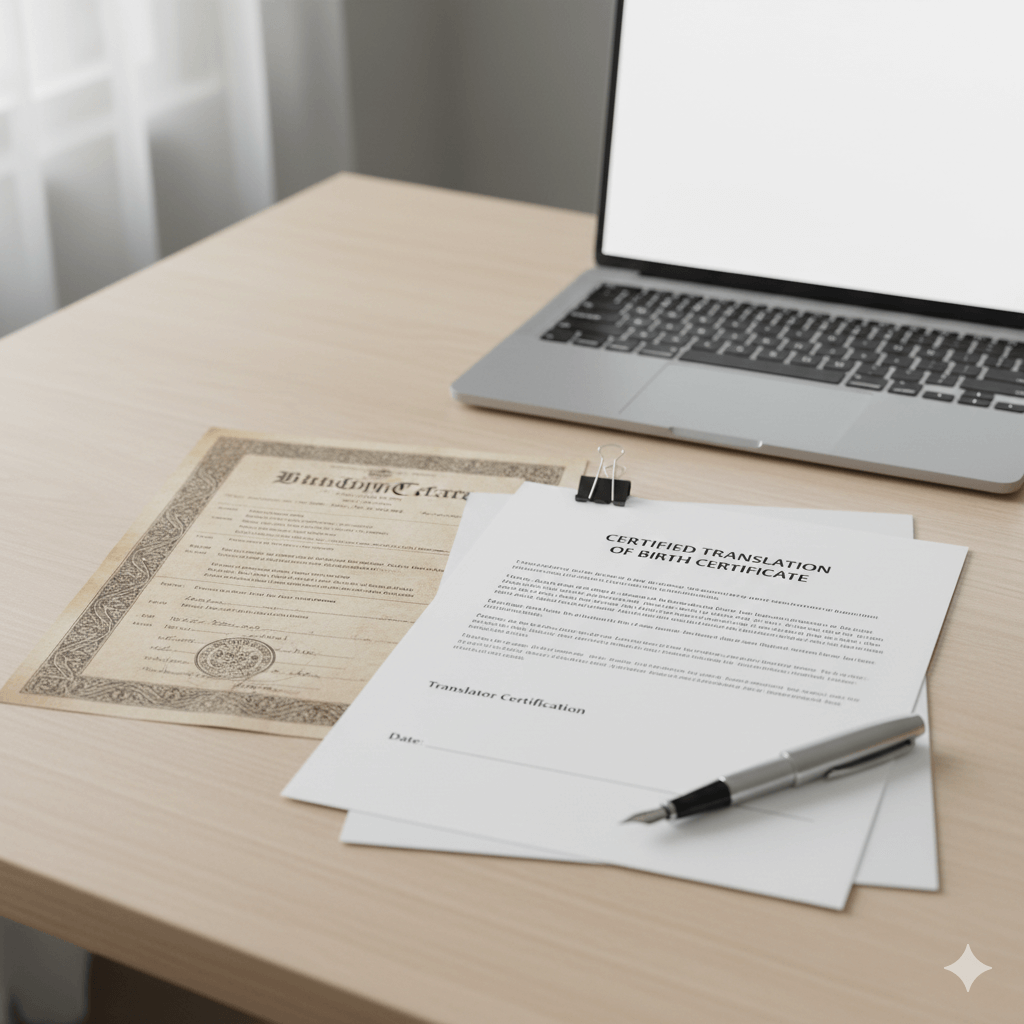
What USCIS actually wants (in plain English)
When USCIS receives a document that’s not in English, they’re looking for three things:
- A complete English translation (not a summary)
- A translator’s signed certification confirming the translation is complete and accurate
- A statement that the translator is competent to translate into English
That’s it. There’s no special “USCIS licence” for translators—and there’s no magic stamp that fixes an incomplete translation. The most common problems are missing parts and weak certification.
Step-by-step: how to get a birth certificate translated
1) Make sure you have the right birth certificate version
Before you translate anything, confirm you have the version you actually need for your case.
In many situations, USCIS prefers (or effectively expects) the long-form birth certificate because it includes parents’ details and registration information. If your document is a short extract that’s missing key fields, fix that first—otherwise you may pay for a translation and still get asked for a better record later.
2) Create a clean scan (this matters more than people think)
A good scan prevents mistakes and prevents “illegible” notes on critical fields.
Quick scan checklist
- Use a flat scan or a well-lit phone photo (no shadows)
- Capture every page and every side
- Include the margins (stamps and handwritten notes often live there)
- Don’t crop seals, embossed areas, or registry numbers
If your birth certificate has a back page with stamps, endorsements, or handwritten notes, translate that too.
3) Decide whether you’re using a template or a professional translator
Some people start with a template. It can be helpful for understanding structure, but it becomes risky when the document is complex.
A template may be workable if your birth certificate is:
- clearly printed
- short
- has minimal stamps/annotations
- has no handwritten sections
A professional is usually safer if your birth certificate is:
- handwritten or partly illegible
- heavily stamped or annotated
- amended or re-registered (multiple entries)
- bilingual with inconsistent field labels
- urgently needed (you can’t afford a redo)
4) Translate everything on the document (not just the “main text”)
This is where many applicants go wrong.
A USCIS-ready birth certificate translation should include:
- Full name exactly as shown
- Date of birth (careful with date formats)
- Place of birth
- Parents’ names (including maiden name if listed)
- Registration number / entry / book / folio
- Issuing authority and location
- Every stamp, seal, endorsement, marginal note, and handwritten entry
- Any abbreviations or acronyms (expand them in brackets if helpful)
- Notes for illegible text (mark as [illegible]—don’t guess)
Practical formatting tip: You don’t need to recreate the document artistically, but the translation should be easy for an officer to compare line-by-line with the original. Clear headings and structured fields help.
5) Add a proper certification statement (this is non-negotiable)
Your translation must be accompanied by a signed certification from the translator.
Here’s a reliable, USCIS-friendly certification template you can use:
CERTIFICATION OF TRANSLATION ACCURACY AND COMPETENCE
I, [Translator’s Full Name], certify that I am competent to translate from [Language] into English, and that the attached translation of the [Birth Certificate] is a complete and accurate translation of the document in [Language].
Signature: _______________________
Printed Name: ____________________
Date: ___________________________
Email/Phone: ____________________
Address: ________________________
6) Review it like an officer would (two-minute “RFE prevention” check)
Before you submit, do this quick verification:
- Names match across your immigration forms and supporting documents
(Watch spacing, hyphens, diacritics, and multiple surnames.) - Dates are unambiguous
(Spell out months where possible: “12 January 2001,” not “12/01/01”.) - All stamps/seals are addressed
(Even if the stamp is just a registry seal, translate its visible text or note it.) - Nothing is skipped
(If it’s on the page, it belongs in the translation—unless clearly blank.)
7) Submit the correct set in your application
Commonly, you include:
- a copy of the original birth certificate (foreign language)
- the full English translation
- the translator’s signed certification
If you’re mailing a packet, keep these items together in your evidence section so they’re not separated during intake.

Can you translate your own birth certificate for USCIS?
People ask this constantly—and it’s where “technically possible” and “smart to do” diverge.
USCIS rules focus on competence and certification. In practice, self-translation can:
- create credibility issues
- trigger questions at interview
- become a problem if the officer suspects bias, omissions, or selective translation
For a core identity document like a birth certificate, an independent translator is the safer route.
Do you need notarisation?
For USCIS filings, notarisation is usually not required. What USCIS needs is the translator’s signed certification.
Notarisation may be useful if:
- another authority (court, university, consulate) asks for it
- you want the same translation to work for multiple uses
- your attorney requests it for extra formality (even if USCIS doesn’t)
What if your birth certificate is bilingual?
Bilingual birth certificates are common—and they still cause problems when:
- the English portion is incomplete
- key fields appear only in the non-English section
- stamps and marginal notes are only in the non-English language
- the formatting makes it unclear what text belongs to what field
What if you don’t have a birth certificate (or it isn’t available)?
Some countries have limited availability for historical records, late registrations, or regional formats. If you truly can’t obtain a standard birth certificate, the solution is usually not “skip the document”—it’s to provide acceptable alternatives.
Common substitutes (depending on your case) may include:
- government-issued birth record extracts
- civil registry letters confirming non-availability
- family registry documents
- religious records (where accepted)
- secondary evidence paired with sworn statements/affidavits
If you’re in this situation, don’t guess—handle it intentionally, because the strategy can vary by country and filing type.

How long does it take and how much does it cost?
Turnaround and pricing depend on:
- the number of pages
- handwriting/complexity
- how many stamps/annotations need translation
- whether you need rush delivery
- whether you need notarisation or hard copies
Common mistakes that delay cases (and how to avoid them)
Mistake 1: Translating only the “main fields”
Fix: translate stamps, seals, handwritten notes, and marginal entries.
Mistake 2: Weak certification (or no certification)
Fix: include both required statements (accuracy/completeness + competence) and a real signature.
Mistake 3: Name inconsistencies across documents
Fix: match spelling and order to your identity documents and immigration forms. If your language uses multiple surnames, keep the structure consistent.
Mistake 4: Date format confusion
Fix: use month spelled out in English.
Mistake 5: Using machine translation for a legal record
Fix: don’t rely on automated output for documents that carry identity and parentage—small errors can create big delays.
A simple “done-right” checklist you can save
Before you submit your birth certificate translation, confirm:
- Every visible word is translated (including stamps/seals/notes)
- Names, dates, and places match your other evidence
- Illegible text is marked as [illegible] (not guessed)
- Certification is signed and includes competence + accuracy
- The translation is easy to compare to the original
- You’re submitting the original copy + translation + certification together
Frequently asked questions
How do you get a birth certificate translated for USCIS?
You get a complete English translation of the entire document and attach a signed translator certification stating the translation is complete/accurate and the translator is competent to translate into English.
Does USCIS require notarised birth certificate translations?
USCIS generally does not require notarisation. USCIS requires a certified translation with the translator’s signed certification. Notarisation may be needed for other authorities.
Can a family member translate my birth certificate?
A family member may be competent in both languages, but using a close relative can raise credibility concerns. For a key identity document, an independent professional translator is safer.
What should be included in a birth certificate translation?
Everything: names, dates, parents’ details, registry numbers, issuing authority, stamps, seals, endorsements, handwritten notes, and marginal annotations.
Does the translation need to match the document layout?
It doesn’t need graphic design, but it should be structured clearly so an officer can compare it quickly. Field-by-field formatting is strongly recommended.
What if the birth certificate has handwriting or unclear stamps?
Mark unclear sections as [illegible] rather than guessing, and use a professional translator experienced with civil registry formats.
