
If you need to know how to translate a death certificate, the safest approach is simple: get a complete English translation prepared by a professional translator and make sure it includes a signed certification statement. For USCIS and many other official uses, a death certificate translation cannot be partial, simplified, or missing stamps, notes, or handwritten entries. It must be complete, accurate, and ready to submit with confidence.
A death certificate is one of those documents where small details matter more than people expect. A missing registry number, a mistranslated place name, or an omitted handwritten note can create delays at exactly the wrong time. Whether you need the translation for immigration, inheritance, a consulate, a pension claim, or another formal process, the goal is the same: produce an English version that clearly reflects the original document and is supported by the right certification.
At USCIS Official Translation, certified translations start from $24.99 per page, include a signed certificate of accuracy, and are available with 24-hour turnaround for many common civil documents. If your deadline is close, you can upload your file and move the process forward straight away.
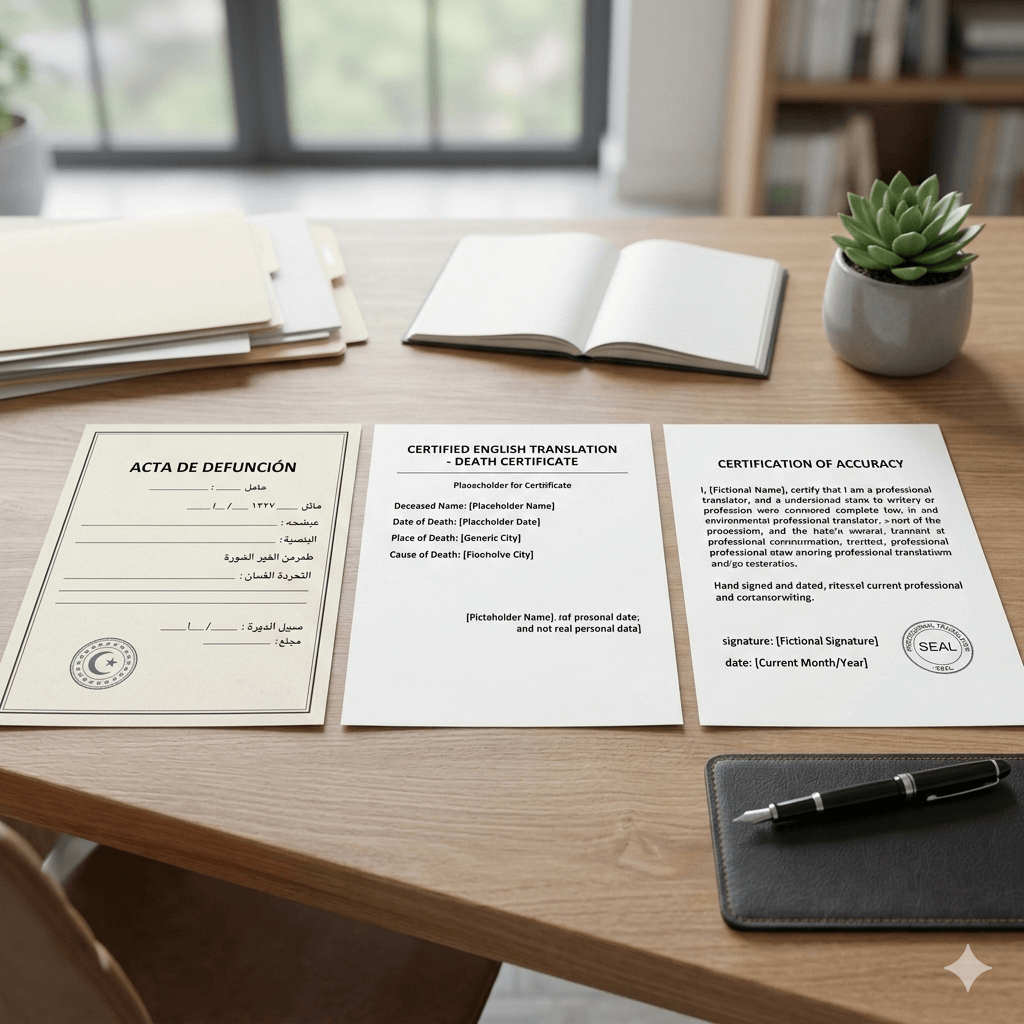
What a death certificate translation actually means
A proper death certificate translation is not just a loose English summary of the document. It is a full rendering of the original record into English, with the translator confirming that the translation is complete and accurate.
That means the English version should cover all relevant content appearing on the certificate, including:
- the deceased person’s full name
- date and place of death
- date and place of registration
- certificate or registry number
- issuing authority
- cause of death, where shown
- declarant details, where shown
- marginal notes or later annotations
- stamps, seals, and handwritten remarks
- signatures, where relevant
- any printed headings, labels, or administrative notes
This is where many low-quality translations fail. Some providers translate only the obvious text in the middle and ignore the material around the edges. On official documents, that “extra” text is often exactly what an officer, caseworker, or clerk is checking.
When you may need to translate a death certificate
A death certificate often needs translation when it was issued in a language other than English and must be submitted to an English-speaking authority or institution.
Common situations include:
- USCIS filings and supporting immigration evidence
- petitions involving the death of a petitioner or relative
- surviving relative cases
- humanitarian requests
- probate or inheritance matters
- pension or insurance claims
- family law or civil court matters
- consular or embassy procedures
- estate administration involving overseas records
For immigration-related cases in particular, a translated death certificate may be needed to show family relationships, explain changes in petition status, or provide proof of death in a formal submission.
Need a USCIS-ready translation now? Upload a clear scan of the certificate and request a certified translation prepared for official submission.
What USCIS expects from a translated death certificate
For USCIS purposes, the key rule is not complicated, but it is strict: if the document is not in English, it must be accompanied by a full English translation and a signed certification from the translator.
In practice, that means your death certificate translation should include:
- a full English translation of the original
- no summaries or omitted sections
- a certification statement signed by the translator
- confirmation that the translator is competent in both languages
- confirmation that the translation is complete and accurate
That is why a casual translation, self-typed summary, or machine-generated version is a bad risk for this kind of document. Even if the main facts seem obvious, USCIS expects a formal translation package, not a rough explanation of what the certificate says.
Step by step: how to translate a death certificate properly
1. Check who will receive the translation
Before ordering anything, confirm the destination of the document.
Ask:
- Is this for USCIS?
- Is it also being used for a consulate, court, university, or pension provider?
- Do they require only certified translation, or do they also ask for notarization or legalization?
This matters because USCIS normally requires certified translation, while some other institutions may ask for a notarized translator statement or a different format.
If the same death certificate will be used in more than one process, it is worth deciding that upfront so you do not need to reorder the translation later.
2. Prepare a clear copy of the death certificate
The final translation is only as good as the image you provide.
Your file should be:
- flat and fully visible
- uncropped at the edges
- high resolution
- free from glare and shadows
- easy to read, including stamps and handwriting
A scan is usually best. If you only have a phone photo, make sure every corner is visible and the text is sharp.
If the certificate has multiple pages, backs, side notes, or attached annotations, send all of them. A surprising number of official problems come from page two being forgotten.
3. Use a professional translator or specialist service
For a death certificate, this is not the moment to rely on guesswork.
A professional service should understand:
- civil registry terminology
- official naming conventions
- how to handle seals, signatures, and stamps
- how to describe illegible text properly
- how to format the English version so it is easy to compare with the original
The best providers also know when to keep a literal rendering and when to translate an administrative term in a way that makes sense to an English-speaking reviewer.
For example, an issuing office title may need a faithful English equivalent rather than a word-for-word rendering that sounds awkward or unclear. Good document translation is not about sounding fancy. It is about being accurate, consistent, and useful to the authority reviewing it.
4. Make sure the certification statement is included
This is one of the most important parts of the package.
A proper certified translation should include a statement confirming that:
- the translator is competent to translate from the source language into English
- the translation is complete
- the translation is accurate
It should also normally include:
- translator name
- signature
- date
- contact details or company details
Without that certification, the translation may not meet the standard expected for USCIS or other official uses.
5. Review the English version before submission
Even when you use a professional provider, do one careful final check.
Look at:
- spelling of names
- order of names
- dates
- places
- registration numbers
- labels for stamps and signatures
- whether all visible content has been accounted for
Pay special attention if the certificate includes handwritten corrections, alternate spellings, or side notes added after the original issue date. These are exactly the details that can create confusion if missed.
6. Submit the original copy and the translation together
In most official scenarios, you should keep the original-language document copy with the certified English translation as one clear submission set.
A clean submission packet usually includes:
- copy of the original death certificate
- full English translation
- signed certificate of translation accuracy
That structure makes it easier for the receiving authority to review the evidence quickly.
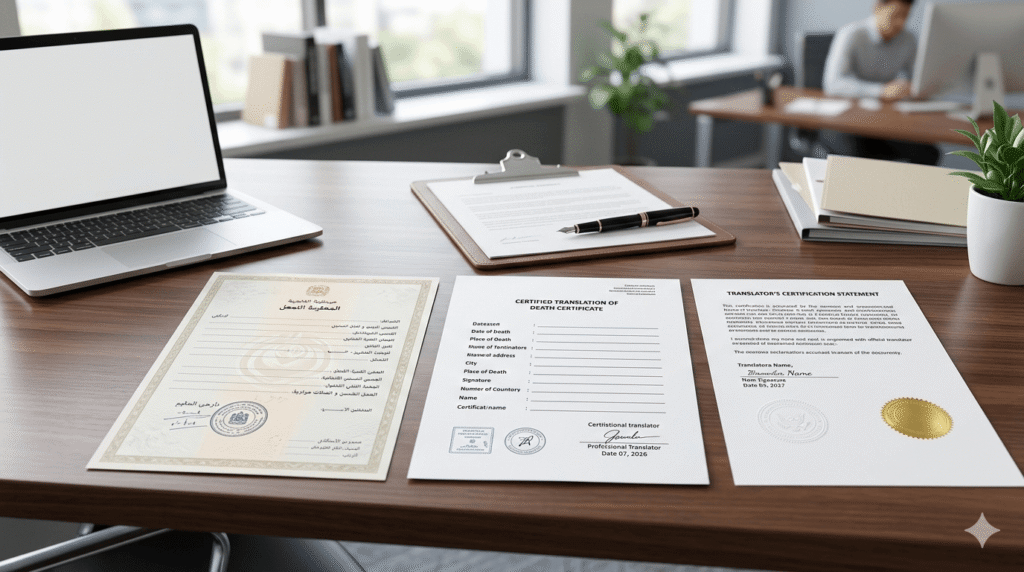
What must never be left out of a death certificate translation
One of the biggest reasons people search for how to translate a death certificate is that they assume the process is just about the main facts. It is not.
A proper translation should not leave out:
- seals
- stamps
- embossed marks
- handwritten notes
- issue dates
- registration references
- margin entries
- cause-of-death wording, where shown
- corrections, amendments, or later annotations
If something is unclear or partly unreadable, the translator should indicate that appropriately rather than silently skipping it.
That is a major difference between a submission-ready translation and an informal one.
Certified, notarized, or sworn: which one do you need?
This is where many applicants get confused.
Certified translation
This is usually the correct choice for USCIS. It includes the full translation plus the translator’s signed certification statement.
Notarized translation
This adds notarial witnessing to the translator’s signature. The notary does not verify the language accuracy. They verify the identity/signature process.
Sworn translation
This applies in certain countries and legal systems where a sworn translator has a specific official appointment. It is not the default requirement for USCIS.
For most USCIS cases involving a foreign-language death certificate, certified translation is the core requirement. Notarization may be useful only if another organisation handling the same document asks for it as well.
If you are unsure, it is better to check the destination before ordering extras that may not be needed.
Can you translate a death certificate yourself?
Technically, what matters is whether the translation meets the formal requirement and includes a proper certification. In practice, self-translation is risky.
Why?
Because death certificates are sensitive records, and official reviewers may look closely at credibility, completeness, and neutrality. Using an independent professional translator reduces the chance of questions about omissions, bias, formatting, or unclear terminology.
A family member or friend who “knows both languages” is rarely the strongest choice for an official record of this type. When the document supports an immigration or legal matter, using a professional service is the safer route.
Common mistakes that cause delays
Here are the errors that most often turn a straightforward translation into a follow-up problem:
1. Using Google Translate or AI alone
Automated tools can produce readable English, but readable is not the same as submission-ready. Official documents need full coverage, consistent terminology, and a valid certification statement.
2. Translating only the main text
A death certificate is not just the central paragraph. Officers may look at seals, margins, notes, and administrative labels too.
3. “Fixing” names to make them look better in English
Names should match the source record and the wider case file. The translation should not invent a cleaner spelling unless the document itself supports it.
4. Leaving dates ambiguous
International certificates may use date formats that can be read more than one way. The translation must present dates clearly and consistently.
5. Forgetting the certification page
Even an accurate translation may fall short if the required certification is missing.
6. Sending a poor-quality scan
Blurry documents make good translation harder and can leave avoidable gaps in the final file.
What a strong death certificate translation looks like
A professional translation is usually easy to recognize. It feels clear, orderly, and complete.
A strong final file will normally:
- mirror the structure of the original where practical
- use clear English labels for each field
- describe seals, stamps, and signatures in brackets where appropriate
- preserve important numbers and dates accurately
- include the translator’s certification at the end
- look clean enough for legal, immigration, or administrative review
If the original document is very visual or irregularly laid out, the English version does not need to copy the design perfectly. It does need to make the content easy to follow and easy to compare.
A practical field-by-field checklist
If you want to judge whether a death certificate translation is complete, use this quick checklist before submission:
- Deceased person’s full name
- Sex, if shown
- Date of birth, if shown
- Date of death
- Time of death, if shown
- Place of death
- Cause of death, if shown
- Registration number
- Registration district or civil registry office
- Date of registration
- Informant/declarant details, if shown
- Issuing authority
- Official stamp or seal
- Signature line
- Margin notes, amendments, or remarks
- Translator’s certification statement
That checklist is especially useful when the original certificate comes from a registry format that includes side columns, handwritten amendments, or multiple authority stamps.
How long does it take to translate a death certificate?
Turnaround depends on the language pair, readability of the document, and whether the certificate includes handwritten material or multiple pages.
For many standard civil certificates, professional services can often complete the work within 24 to 48 hours, with faster options available for urgent cases.
At USCIS Official Translation, many certified document translations are available with 24-hour service, and rush handling may also be possible where timing is critical.
If your filing deadline is close, do not wait until the whole case is ready. Upload the certificate early so the translation can move in parallel with the rest of your paperwork.
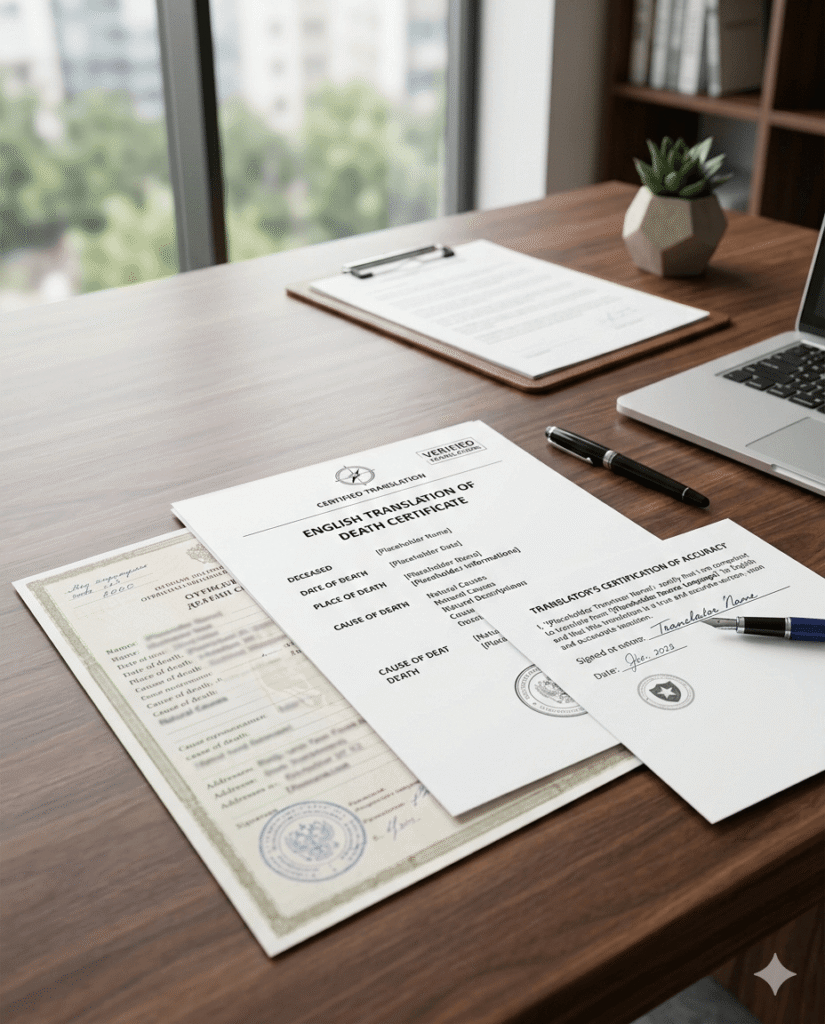
How much does it cost?
For a single civil certificate, pricing is often simple.
At USCIS Official Translation, certified translations start from $24.99 per page, with clear pricing and a signed certificate of accuracy included. That is usually the most practical option for applicants who need a clean, official English version without unnecessary extras.
Cost can vary based on:
- number of pages
- document complexity
- handwriting or marginal notes
- urgency
- whether notarization is added
The cheapest option is not always the lowest-cost option in real life. A rejected or questioned translation costs more once delay, rework, and stress are added in.
Why people use USCIS Official Translation for death certificate translation
When the document is part of a high-stakes case, applicants usually want four things: clarity, speed, compliance, and peace of mind.
USCIS Official Translation is built around exactly that.
What clients get:
- certified translations prepared for USCIS and official use
- signed certificate of accuracy
- pricing from $24.99 per page
- 24-hour turnaround available for many documents
- secure upload process
- clear formatting designed for official review
- optional support if notarization is needed for another institution
- 100% USCIS acceptance guarantee
- 12,874+ documents translated worldwide
That combination matters because death certificates are often requested during already stressful situations. A smooth ordering process and a clean final file remove one more problem from the list.
If you need your death certificate translated now, upload your file and request a certified translation prepared for USCIS or other official submission.
Final takeaway
If you are wondering how to translate a death certificate, do not overcomplicate it and do not cut corners.
Start with a clear copy of the original. Use a professional translator or specialist service. Make sure the translation is complete, not partial. Confirm that the certification statement is attached. Review names, dates, registry details, and stamps before you submit.
That is the difference between an English version that merely “reads okay” and one that is actually ready for USCIS or another official authority.
When the document matters, completeness matters. And with death certificates, completeness is where acceptance usually begins.
FAQ
Do I need a certified translation for a death certificate?
Yes, if the death certificate is in a language other than English and you are submitting it to USCIS or many other official bodies, you will usually need a certified English translation with a signed certification statement.
Can I translate a death certificate myself for USCIS?
It is better not to. Even if you know both languages, self-translation can create credibility and completeness concerns. A professional, independent translator is the safer option for an official filing.
Does a death certificate translation need to be notarized?
Not usually for USCIS. Certified translation is generally the main requirement. Notarization may only be needed if another authority, such as a court, consulate, or institution, specifically asks for it.
What should be included in a death certificate translation?
The translation should include all visible content on the document, including names, dates, places, registration details, stamps, seals, handwritten notes, and any other annotations, plus the translator’s certification statement.
How fast can a death certificate translation be done?
Many standard death certificate translations can be completed within 24 to 48 hours, and urgent options may be available for shorter documents and common language pairs.
What happens if the translation is incomplete?
An incomplete translation can cause delays, requests for further evidence, or rejection by the receiving authority. Missing stamps, notes, side text, or certification wording are common reasons for problems.
