
If you’re filing an immigration application and your marriage certificate isn’t fully in English, you’ll usually need a complete English translation plus a signed translator certification. The good news: once you know what USCIS expects, the process is straightforward.
The quick answer (what to do in the next 10 minutes)
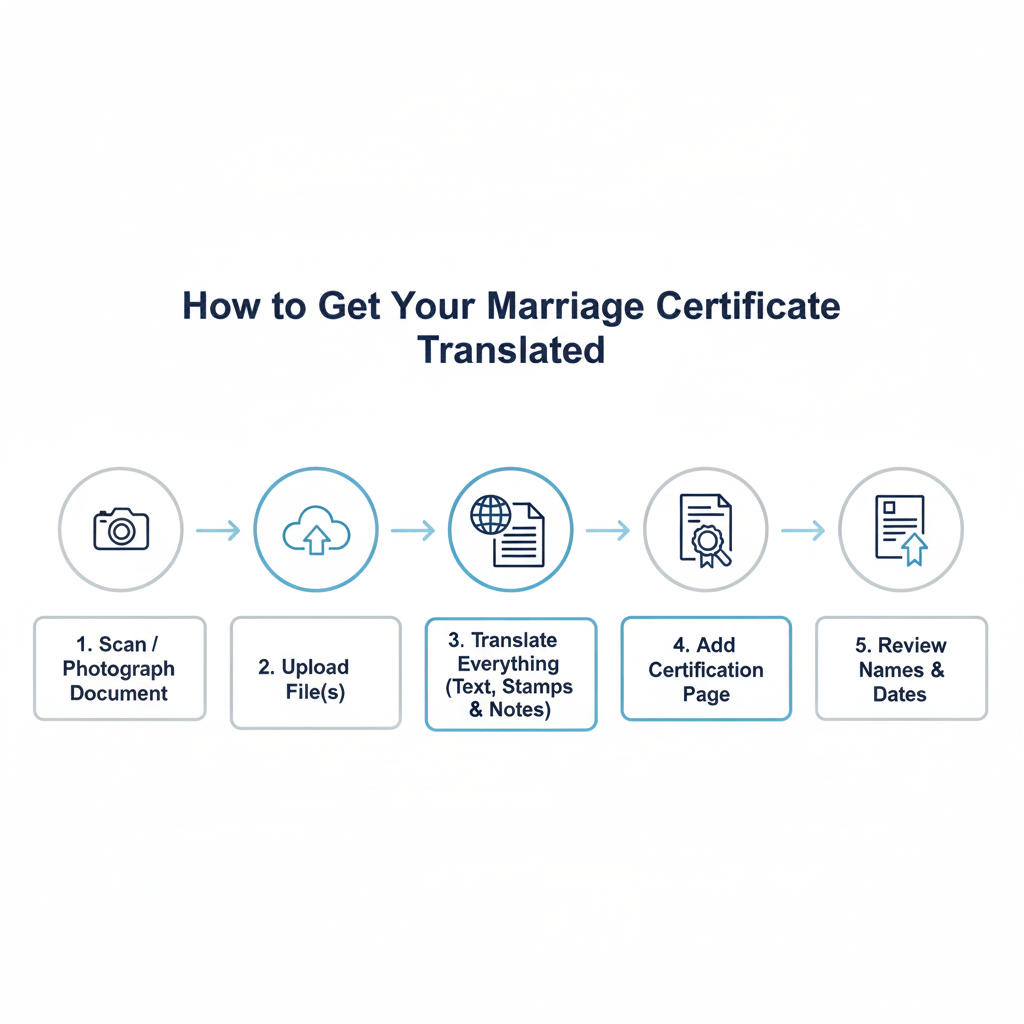
- Scan or photograph your marriage certificate clearly (include front/back and any extra pages).
- Choose a translator or service that provides a certified translation (translation + signed certification page).
- Confirm they will translate everything: stamps, seals, handwritten notes, marginal remarks.
- Review the draft for names, dates, and completeness (not wording/style).
- Submit to USCIS as a package: copy of the original + English translation + certification page.
Do you actually need to translate your marriage certificate?
You likely need a translation if:
- Any part of the certificate is not in English (including stamps or handwritten remarks).
- The certificate is “bilingual” but not fully bilingual (some fields are still in another language).
- The certificate includes annotations, registry notes, or an apostille page that isn’t in English.
If your certificate is truly 100% English (every field and note), you usually don’t need an additional translation—but many applicants still translate if there’s any doubt
What USCIS means by “certified translation”
For USCIS, “certified translation” is not about fancy seals or a government stamp. It means:
- A full English translation of the foreign-language document, and
- A signed certification statement from the translator confirming the translation is complete, accurate, and that the translator is competent in both languages.
In practice, a clean USCIS-ready package usually includes:
- A typed English translation that mirrors the original’s structure as closely as practical
- A certification page (signed and dated)
- Translator name and contact details (commonly included)
Step-by-step: how to get your marriage certificate translated correctly
Step 1: Get the clearest copy you can (this affects everything)
USCIS problems often start with a poor scan—especially when certificates have faint ink, embossed seals, or handwritten notes.
Use this mini checklist:
- Bright lighting, no glare, no shadows
- Entire page visible (edges included)
- High resolution (avoid WhatsApp-compressed images if possible)
- Include the reverse side if it has stamps/notes
- Include registry “extract” pages if your country issues multi-page certificates
If text is genuinely unreadable, a proper translation should label it as unreadable—not guess.
Step 2: Choose the right translation route (and avoid rework)
You generally have four options:
- Immigration-focused online translation service (fast, consistent formatting, built for USCIS-style certification)
- Local translation agency (good if you prefer in-person, but confirm they do immigration certifications correctly)
- Qualified freelance translator (often excellent, but confirm availability and certification format)
- Friend/relative (possible in theory, but higher risk in practice)
If you’re trying to reduce the chance of delays, the safest choice is an independent professional.
Step 3: Provide “consistency notes” before translation starts
This is where many avoidable issues come from—especially with names and places.
Send your translator:
- The exact spelling of names as used on passports and USCIS forms
- Any preferred transliteration (Arabic/Cyrillic/Chinese, etc.)
- Whether to keep diacritics (accents) exactly as shown
- Any prior translations you’ve used (birth certificate translations, divorce decrees, etc.) so everything matches
Step 4: Make sure everything gets translated (not just the “main text”)
A marriage certificate isn’t only names and dates. USCIS-ready translations typically include:
- Stamps and seals (e.g., “[Stamp: Civil Registry, City]”)
- Signatures (e.g., “[Signature]”)
- Handwritten notes and marginal remarks
- Registration numbers, book/page references, file numbers
- Any apostille/legalization notes if present on the document pages you’re submitting
A common reason for scrutiny is a translation that looks “clean” because it silently omitted messy elements.
Step 5: Confirm the certification page is included and properly worded
A correct certification is short, direct, and signed.
Copy-ready sample certification wording (general USCIS use):
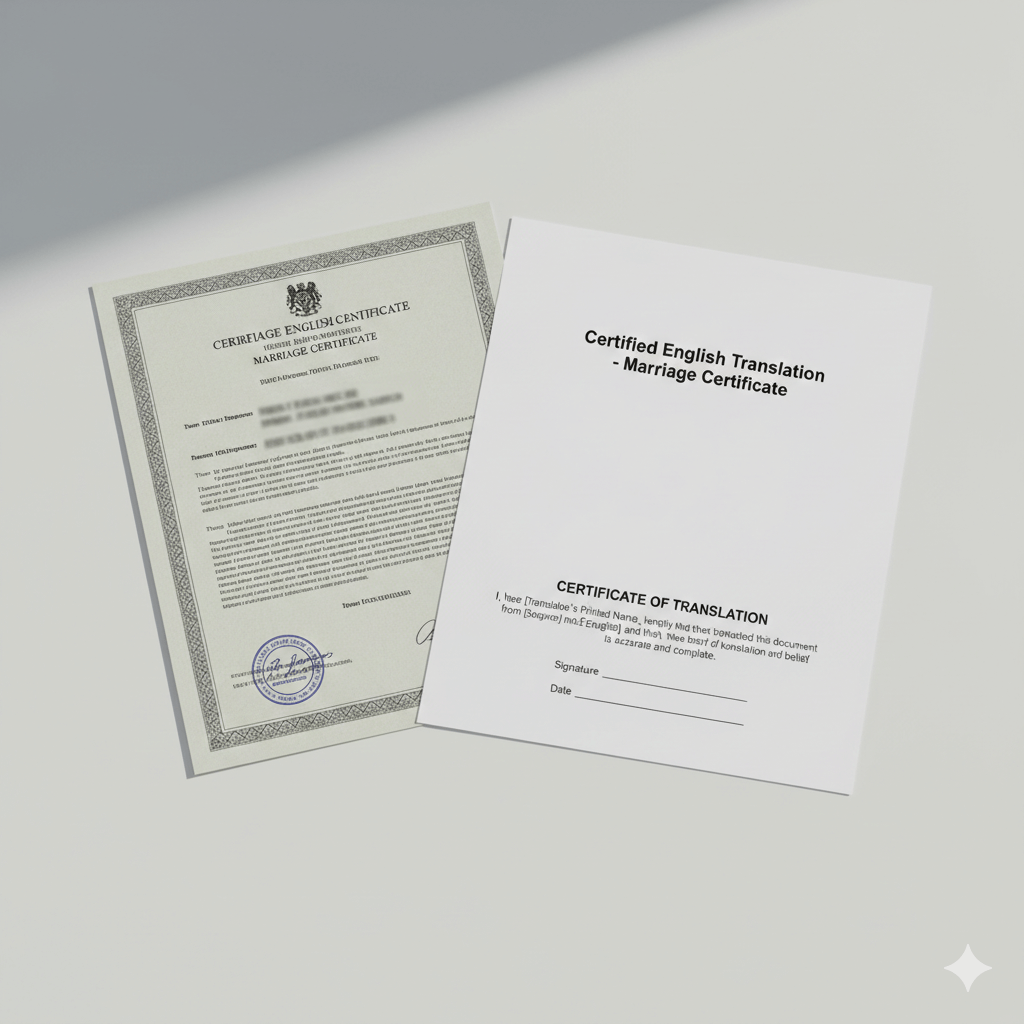
CERTIFICATE OF TRANSLATION
I, [Translator Full Name], certify that I am competent to translate from [Source Language] into English, and that the attached translation of the marriage certificate is a complete and accurate translation of the original document.
Translator Name: [Full Name]
Signature: ___________________
Date: [Month Day, Year]
Contact: [Email / Phone]
Your provider may format this differently, but it should clearly communicate the same core statements.
Step 6: Review the draft the right way (what to check—and what not to)
You’re not proofreading “English style.” You’re checking factual consistency:
- Names (including hyphens, accents, spacing)
- Dates (watch for day/month swaps)
- Places (city/region names)
- Registration numbers and IDs
- Completeness (stamps/notes included)
If something is unclear on the original, the translation should flag it—not invent it.
Step 7: Submit the correct package to USCIS
Typically, you submit:
- A copy of the original marriage certificate (foreign language), plus
- The English translation, plus
- The signed certification page
Keep the order clean so an officer can compare line-by-line easily.
Common mistakes that cause delays (and how to avoid them)
Missing certification page
A translation without a signed certification is one of the easiest ways to trigger problems.
Partial translation
Skipping stamps, seals, marginal notes, or back-page notes is a common issue.
Name mismatches across documents
One letter difference can ripple through the entire filing (passport, birth certificate, marriage certificate, forms).
Low-quality scan = low-confidence translation
If the translator can’t read the document, the translation becomes guesswork—or must be marked illegible in places.
Relying on machine translation
USCIS is not asking for “rough meaning.” They need a complete, reliable English version of what the document says.
Do you need notarization for a marriage certificate translation?
Most USCIS submissions rely on the translator’s signed certification (not notarization). Notarization can be helpful when a specific authority asks for it, or for certain non-USCIS uses.
How long does it take?
Turnaround depends on:
- Language pair availability
- Legibility (handwritten notes take longer)
- Whether there are multiple pages / registry extracts
- Whether you need expedited delivery
Many standard marriage certificates can be completed quickly, but always confirm timeline before ordering—especially if you’re filing with a deadline.
What should a USCIS-ready marriage certificate translation include?
A strong, USCIS-ready package is:
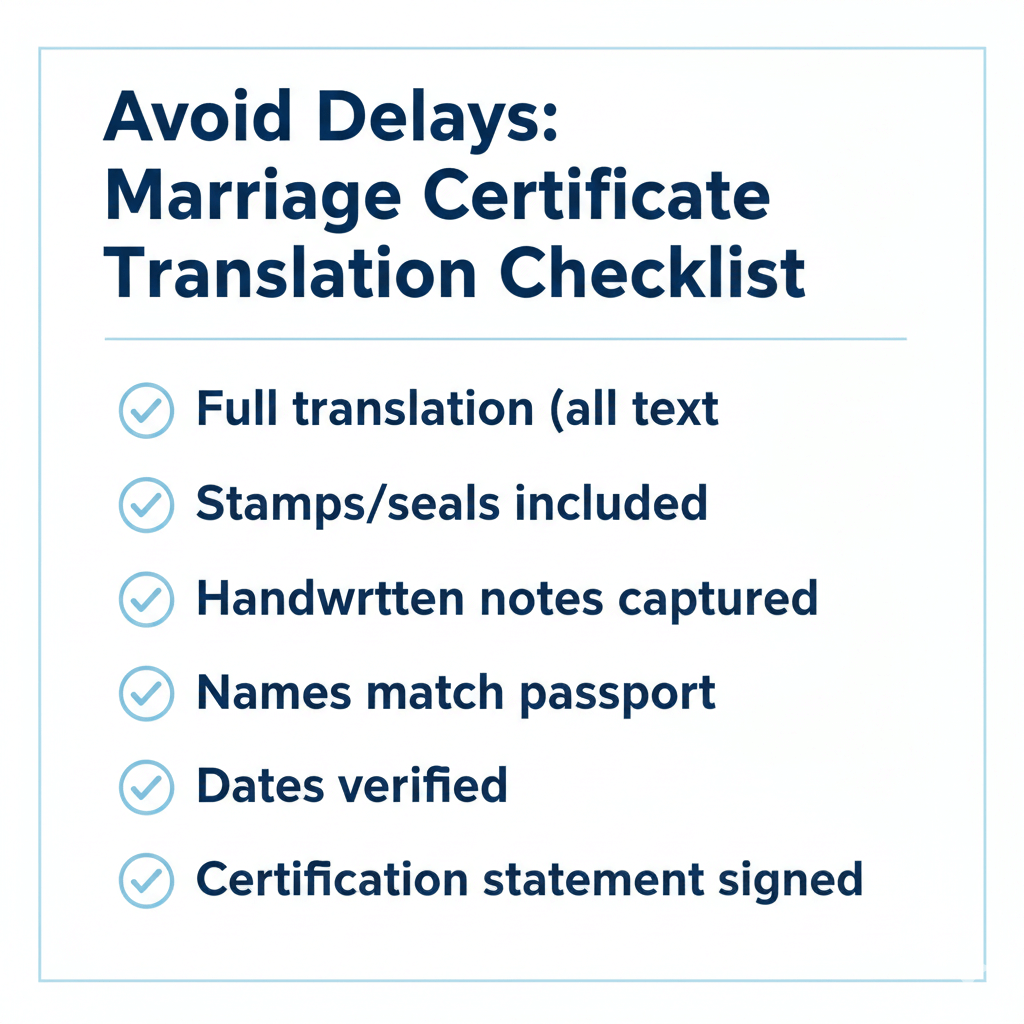
- Complete (no omissions)
- Typed and readable
- Easy to compare to the original
- Includes a signed certification page
- Uses consistent spelling across your immigration documents
A simple way to get it done (lowest friction)
If you want a clear, USCIS-ready translation without guessing:
- Upload your marriage certificate
- Choose your turnaround option
- Receive a clean PDF translation with certification included
- Submit with confidence
FAQs
Can I translate my own marriage certificate for USCIS?
It may be possible in some cases, but it’s risky. The most common issues are missing stamps/notes, inconsistent spelling of names, and incorrect certification wording. An independent professional is usually the safer choice.
Do I need to send the original marriage certificate?
Usually no. A clear scan or photo is typically enough to produce a certified translation. Keep your originals safe unless a specific authority requests physical inspection.
My marriage certificate is bilingual—do I still need a translation?
If every field, stamp, and remark is fully in English already, you may not need an additional translation. If any portion remains in another language (even a stamp), a complete English translation is usually the safer move.
Does USCIS require notarization of the translation?
Not usually. USCIS focuses on the translator’s signed certification. Notarization is separate and only needed if a specific requirement asks for it.
What if my certificate has handwritten notes or stamps I can’t read?
A proper translation should still include them and label unclear parts as illegible rather than guessing.
Will USCIS accept a PDF translation?
A clean, readable PDF is commonly used. The key is that the translation is complete and includes the signed certification.
