
If you’re filing with USCIS and your marriage certificate isn’t fully in English, you’re right to pause and ask: can I translate my own marriage certificate to save time and money?
Here’s the practical answer most applicants need:
Yes, USCIS requires a complete English translation with a signed translator certification.
But translating your own marriage certificate is usually the highest-risk option—because the translator must certify accuracy and competence, and USCIS (or an officer reviewing your file) may question credibility if the translator is also the applicant or an interested party.
And if you want to understand the rules (and what “certified” actually means), read on.
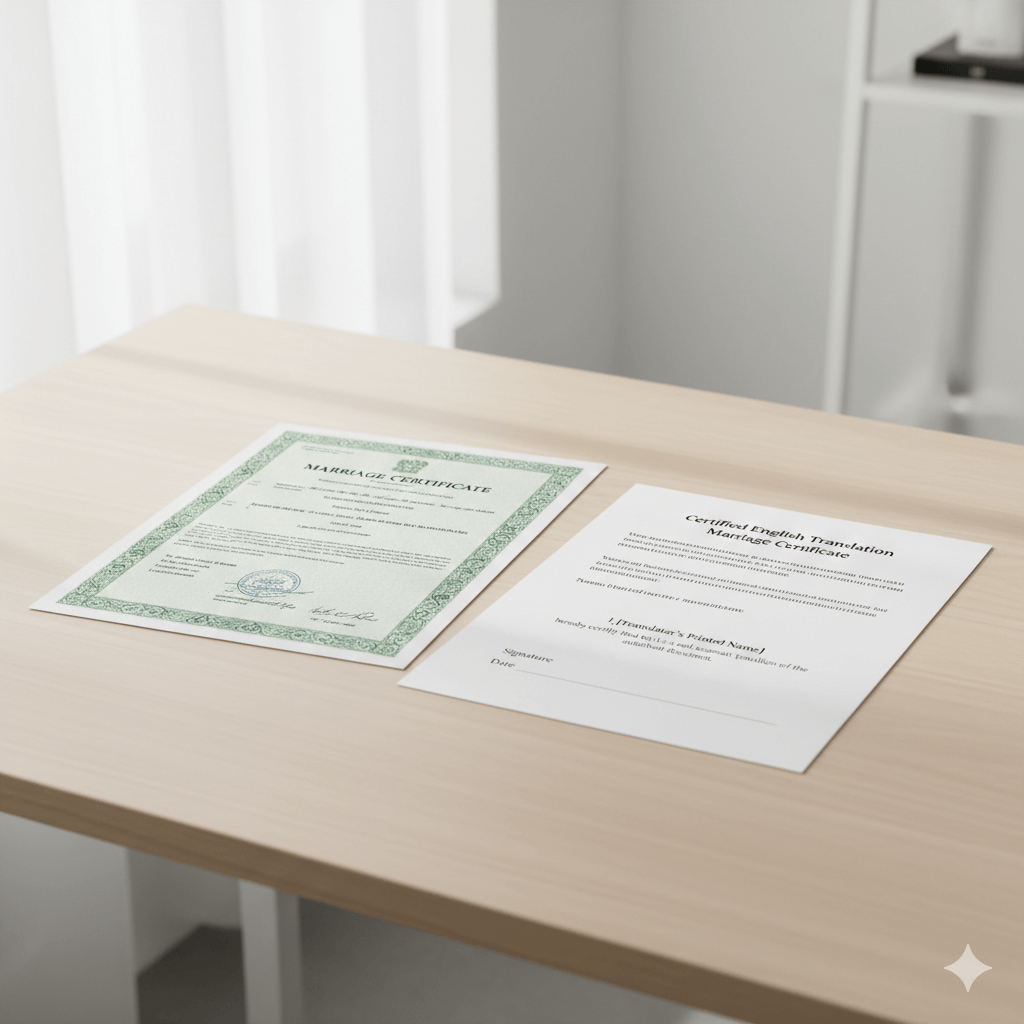
The one rule USCIS cares about most: the translator certification
A marriage certificate translation for USCIS is not “certified” because it has a fancy stamp.
It’s certified because it includes two things:
- A full, typed English translation of everything on the document
- A signed certification statement from the translator confirming:
- the translation is complete and accurate, and
- the translator is competent to translate into English
That certification statement is what turns a translation into a USCIS-ready submission.
So… can you translate your own marriage certificate?
What’s technically possible
USCIS does not “license” translators for your case. Instead, USCIS looks for:
- a complete translation, and
- a proper certification statement
That means a bilingual person can produce a translation—but they must still provide a certification statement and accept responsibility for accuracy.
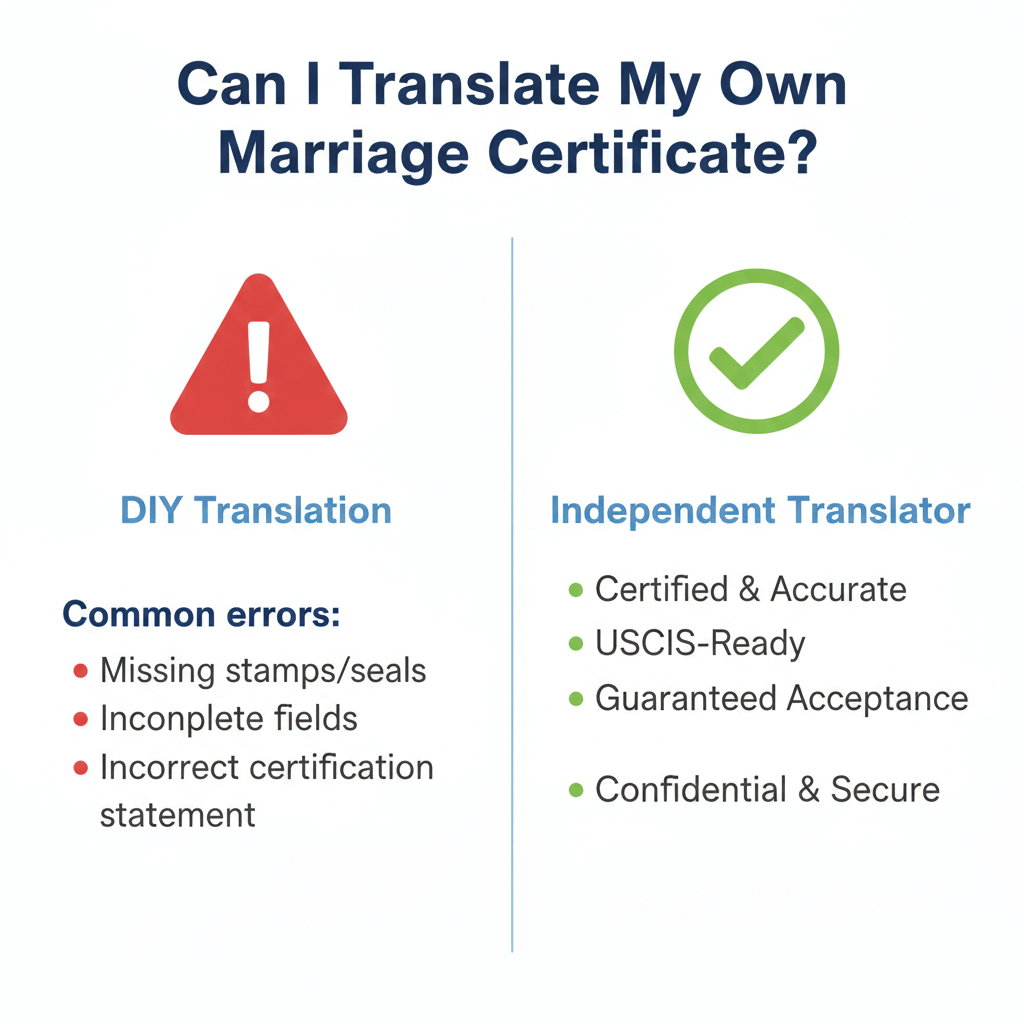
Why it’s usually a bad idea
Even when self-translation isn’t explicitly forbidden, it’s often a mistake because:
- Conflict of interest: If you’re the petitioner/beneficiary, you’re not neutral.
- Small errors trigger big delays: Names, dates, places, stamps, marginal notes—one mismatch can cause rework or follow-ups.
- Certification wording is often wrong: Many DIY certifications are missing required elements or read like a notary statement (which is not the same thing).
- Formatting problems: USCIS doesn’t require perfect formatting, but officers must be able to match your English text to the original without confusion.
Bottom line: If you want maximum acceptance confidence, use an independent translator (professional or otherwise neutral).
When self-translation tends to go wrong (real-world pain points)
Marriage certificates are deceptively “simple,” but these are the parts that trip people up:
1) Stamps, seals, and handwritten notes
Officers want everything translated—including:
- registrar stamps
- official seals (describe them if needed)
- handwritten remarks
- marginal notes
- back-page text (if present)
2) Name consistency across your case
Marriage-based filings often include:
- passports
- birth certificates
- marriage certificate
- divorce decrees / name change orders (if applicable)
A one-letter difference can cause confusion:
- accents removed/added
- spacing changes
- hyphenation differences
- transliteration variations (Arabic, Cyrillic, Chinese, etc.)
3) “Bilingual” certificates that aren’t fully bilingual
Many certificates show some English—but not all:
- field labels might be English, but values aren’t
- stamps remain in another language
- remarks section is not English
- reverse side contains additional registry text
When in doubt, translate it.
4) DIY templates that omit essential details
The certification page often fails because it’s missing:
- translator full name
- signature and date
- language pair
- statement of competence
- statement of completeness/accuracy
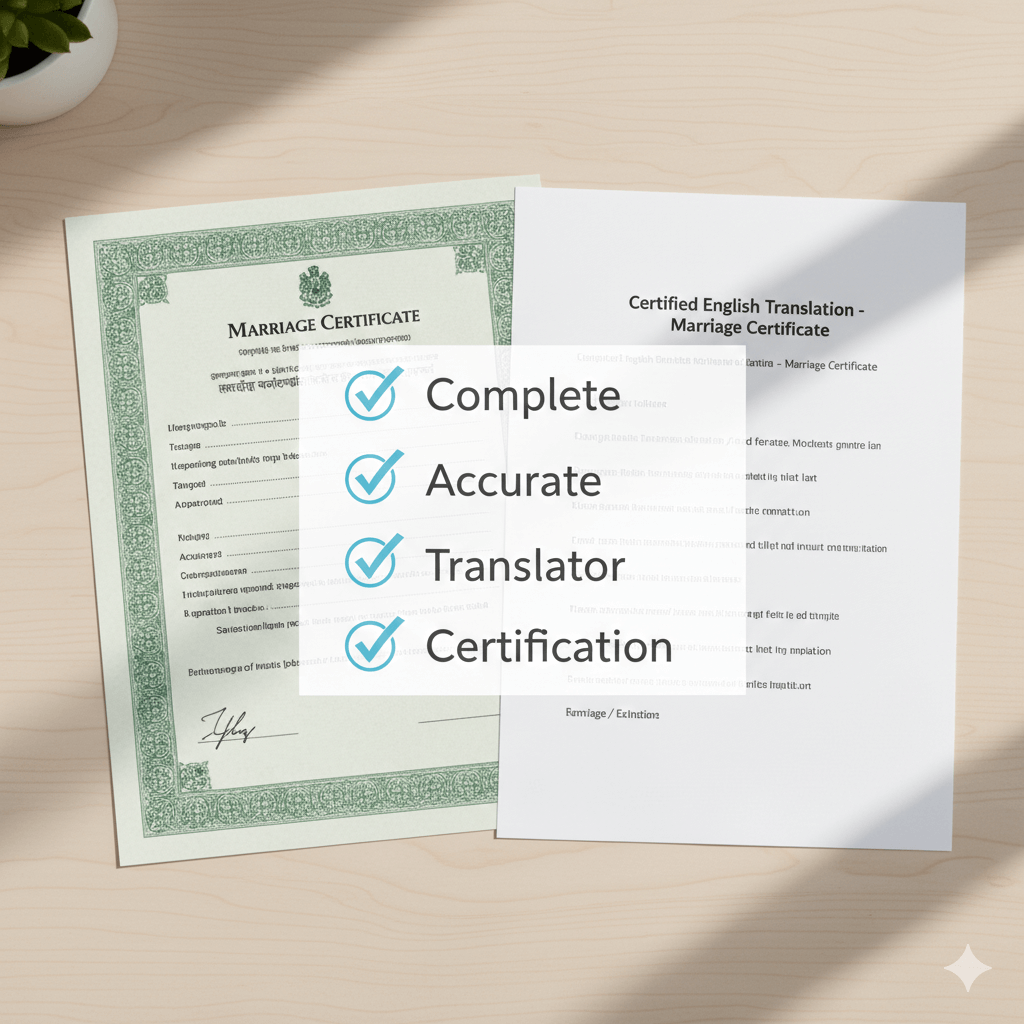
What a USCIS-ready translation should include (your checklist)
Use this as a quick quality check before submitting:
- Typed English translation (not handwritten)
- Everything translated (including stamps/seals/handwriting)
- Clear labels for seals, stamps, signatures, and illegible text
- Consistent spelling of names and places (matching your other USCIS documents)
- Translator certification page (signed and dated)
- Logical layout that lets an officer compare the translation to the original easily
Copy-and-paste translator certification statement (USCIS-ready format)
You can use this wording as a baseline. The key is that it states accuracy, completeness, and competence.
Translator Certification
I, [Translator Full Name], certify that I am fluent in English and [Source Language], and that this translation is a complete and accurate translation of the attached document.
Translator’s Full Name: [Name]
Signature: ____________________
Date: _________________________
Contact Details: [Email / Phone / Address]
Tip: Keep it simple. USCIS wants clarity, not legal theatre.
If you still want to translate your own marriage certificate: do it the safest possible way
If you’re determined to self-translate, reduce risk with this approach:
Step 1: Confirm the document is fully legible
- Use a clean scan (preferred) or a sharp photo with no glare
- Include front and back (and any multi-page registry extract)
Step 2: Translate literally (no summarising)
Translate what is written, not what you think it means.
- Keep names exactly as shown
- Keep formatting readable
- Translate stamps and seals as text descriptions where necessary
- If text is unreadable, mark it as [illegible] instead of guessing
Step 3: Add bracketed document notes (only when needed)
Examples:
- [Round stamp: Civil Registry Office, City, Country]
- [Signature]
- [Embossed seal present]
- [Handwritten note: …]
Step 4: Attach a proper certification page
Use the copy-and-paste certification above and sign it.
Step 5: Do a “submission stress test” (60 seconds)
Before you file, check:
- Do all names match your passport and forms?
- Did you translate every stamp and note?
- Did you include the certification page?
- Could a stranger match each translated field to the original quickly?
If any answer is “not sure,” it’s usually faster (and cheaper) to get a proper certified translation than to deal with rework later.
The safer alternatives (ranked by lowest stress)
1) A specialist USCIS translation service (fastest, most consistent)
Best when you want:
- predictable formatting
- correct certification wording
- quick turnaround
- less back-and-forth
2) A qualified professional translator (freelance)
Good if you want a named translator and direct communication.
Make sure they will provide a signed certification statement.
3) A bilingual friend (only if truly neutral and meticulous)
If you use a friend:
- they must be competent
- they must sign the certification
- they should not be the petitioner/beneficiary
- they must translate everything, including stamps
This is where most mistakes happen—so only choose this if they’re genuinely detail-oriented.
Certified vs notarized: don’t mix these up
A lot of applicants lose time here:
- Certified translation = translation + signed certificate of accuracy (what USCIS expects)
- Notarized translation = a notary verifies the signer’s identity/signature (not the translation’s accuracy)
Notarization may be useful if another institution requires it, but it doesn’t replace a proper certification statement.
What to send your translator (so it’s done right the first time)
Whether you hire a service or an individual, send:
- clear scan/photo of the certificate (front + back)
- any attached registry pages (if multi-page)
- your preferred spelling for names/places (matching passport/forms)
- a note if the certificate includes stamps, handwritten remarks, or faded sections
- your deadline (standard vs urgent)
A simple, reliable process that works for most applicants
If your goal is “submit it once and move on,” this is the clean path:
- Upload a clear copy (front/back)
- Receive a quote and turnaround
- Get a complete translation + signed certificate of accuracy
- Submit the translation with your USCIS packet
FAQ
Can I translate my own marriage certificate for USCIS?
USCIS requires a complete English translation plus a signed translator certification. Self-translation can be risky if you’re the applicant or an interested party, because credibility and small errors can cause delays.
Does USCIS require notarized marriage certificate translations?
Not usually. USCIS focuses on the translator’s signed certification of accuracy and competence. Notarization verifies a signature, not the translation quality.
What must be included in a certified marriage certificate translation?
A full typed English translation of all text (including stamps/seals/handwriting) plus a signed certification statement confirming completeness, accuracy, and translator competence.
If my marriage certificate is bilingual, do I still need a translation?
If every part of the certificate is fully in English—including stamps and remarks—you may not need a separate translation. If any part is not in English, a full English translation is the safer choice.
Who should translate a marriage certificate for immigration?
A competent, independent translator who can certify the translation is complete and accurate. Many applicants choose a professional service to reduce risk and avoid rework.
How fast can I get my marriage certificate translated?
Turnaround depends on language, document clarity, and provider capacity. If you have a deadline, use a service that offers standard and rush options and confirms delivery before you order.
