
If you’re preparing a USCIS filing, a consular packet, or a green card application, you’re probably asking the same question as everyone else:
How long does it take to translate a birth certificate?
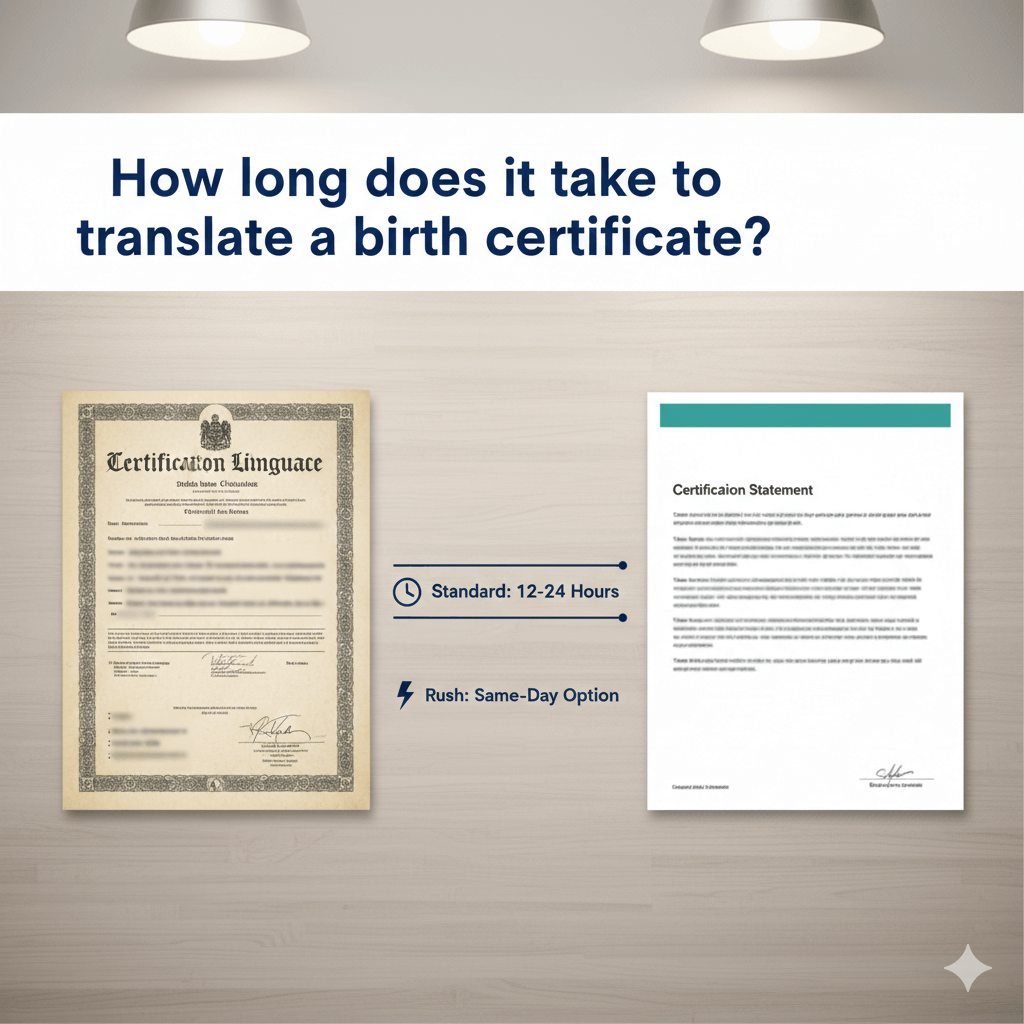
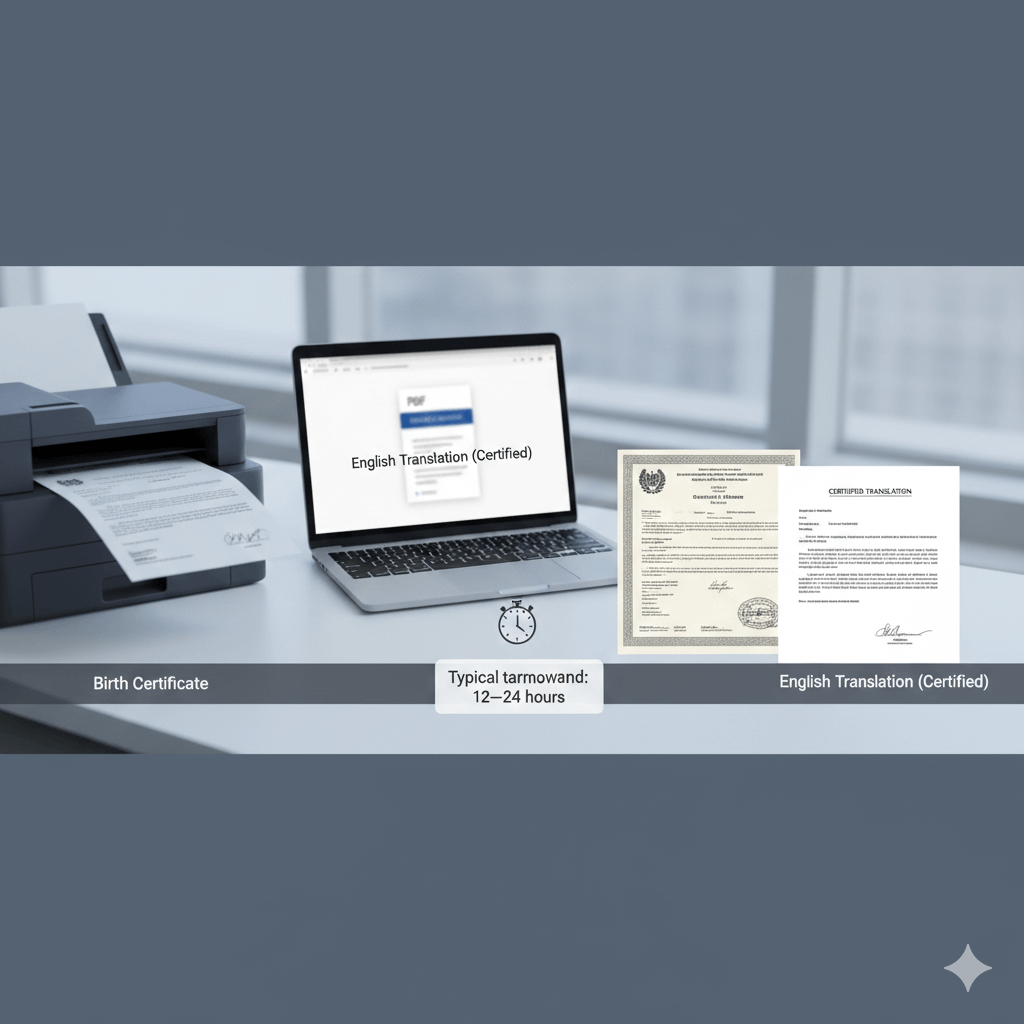
The honest answer: it depends—but for most people with a standard, one-page certificate and a clear scan, you can usually get a certified English translation within 12–24 hours, with same-day options available when the document is straightforward and you’re on a deadline.
This guide breaks down what affects birth certificate translation time, what slows it down, and how to get it done quickly without risking rejection or delays.
The quick answer: typical turnaround times
Most birth certificates fall into the “fastest” category because they’re short, structured, and repeatable. Here’s what you can generally expect:
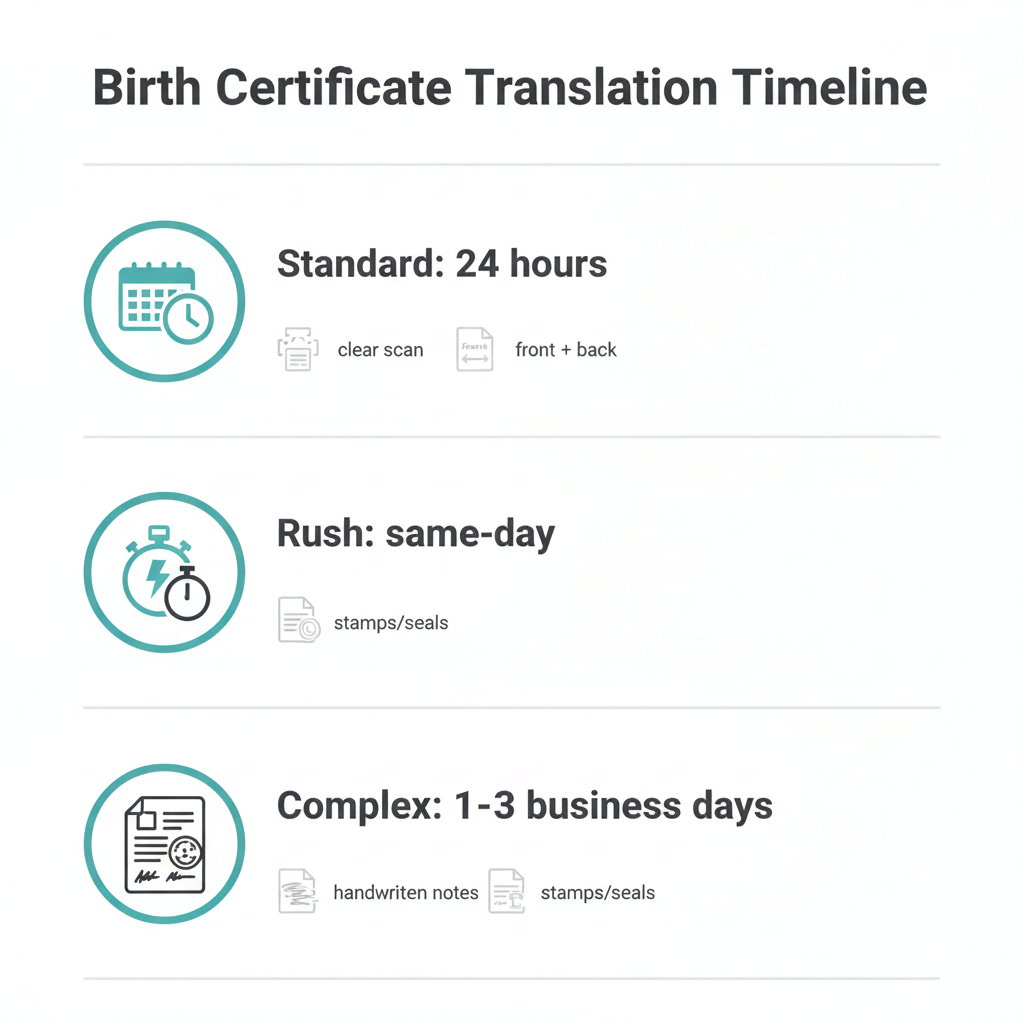
- Standard (most cases): 24 hours for a clear, one-page birth certificate
- Rush / priority: 12 hours (sometimes faster for simple certificates)
- Complex certificates: 1–3 business days (handwritten text, multiple stamps, long notes, or poor-quality scans)
- Add-ons like notarisation and hard-copy shipping: may add extra processing or delivery time
What actually affects how long birth certificate translation takes
Translation speed isn’t just “how fast someone can translate.” For official documents, time is spent on accuracy, formatting, and verification checks that prevent RFEs and resubmissions.
1) Document length (pages and word count)
Most birth certificates are 1 page, but some include:
- a reverse side with stamps or notes
- a registry extract page
- amendments or marginal annotations
More content = more time.
2) Legibility and scan quality
A clean scan is the biggest speed multiplier.
Fastest: clear photo/scan, sharp text, both sides included
Slowest: blurry mobile photos, shadows, glare, low resolution, cropped seals
3) Handwritten or mixed-format text
Handwriting, older certificates, or mixed-script documents often require:
- interpretation checks
- careful “illegible” marking where appropriate
- extra review time
4) Language pair and script
Common pairs (e.g., Spanish → English) are typically faster due to specialist availability. Less common languages may take longer purely due to scheduling and specialist matching.
5) Stamps, seals, marginal notes, and back-page content
For immigration use, missing “small” details can cause big delays:
- seals and stamps
- registry references
- legal annotations
- corrections and amendments
If it’s on the document, it usually needs to be translated.
6) Certification requirements (and whether you need notarisation)
For USCIS, certified translations typically rely on a translator’s certification statement—not notarisation.
Timeline table: what most applicants can expect
| Scenario | Typical turnaround | Why it takes that long |
|---|---|---|
| 1-page certificate, clear scan | 12–24 hours | Straightforward fields + quick QA |
| 1–2 pages, stamps/notes | 24–48 hours | More completeness checks |
| Multiple pages / registry extract | 1–3 business days | Formatting + cross-page consistency |
| Old or handwritten certificate | 1–3 business days | Legibility review + verification |
| Notarisation requested | Adds time | Identity/statement verification step |
| Physical shipping needed | Adds delivery time | Courier time depends on destination |
How to get your birth certificate translated faster (without risking issues)
If you need speed, the goal is to remove anything that forces back-and-forth.
Send this (to avoid delays)
- A clear scan or photo (no glare, no shadow)
- Front and back, even if the back “looks blank”
- Any supporting notes (e.g., name spelling differences across documents)
- Your preferred spelling of names exactly as used in your USCIS forms
Avoid these common slowdowns
- Cropped edges that cut off seals or registry numbers
- Blurry photos that turn stamps into unreadable blobs
- Submitting only one side
- Inconsistent spelling between the certificate and your petition packet
What “complete” translation really means for a birth certificate
A birth certificate translation isn’t just the main text fields. A complete translation usually includes:
- Full name (as shown)
- Parents’ names (including maiden names if listed)
- Date and place of birth
- Registration details (book, folio, entry number)
- Issuing authority
- Stamps, seals, signatures (and any text within them)
- Marginal notes and annotations
- Any reverse-side content
If something is truly unreadable, it should be marked appropriately rather than guessed.
A simple 3-step way to get it done quickly
If you want an efficient, upload-and-done process:
- Upload your document and get your quote
- Translation + quality review (completeness, names, formatting, stamps)
- Certified delivery as a PDF you can submit
Can you translate your own birth certificate to save time?
It’s tempting—especially when you’re in a rush. But with immigration filings, the “fastest” route isn’t always the safest route.
Real-world timing examples (what happens in practice)
Example 1: Standard USCIS packet
A client uploads a clean, one-page birth certificate (front + back). The translation is completed, reviewed, and delivered in under 24 hours, giving them time to check names and submit without stress.
Example 2: Old certificate with handwritten notes
A certificate includes handwritten marginal annotations and multiple stamps. The first pass is quick, but the review step takes longer to ensure nothing is missed. Delivery: 1–2 business days—still fast, but safer than rushing.
Example 3: “Urgent deadline tomorrow”
A client needs the translation today. A rush workflow prioritises their file, but success still depends on scan quality. With a clear upload, same-day delivery is realistic; with a blurry image, delays happen.
FAQs
How long does it take to translate a birth certificate for USCIS?
For a clear, one-page certificate, many applicants receive a certified translation within 12–24 hours. Complex documents may take 1–3 business days.
Can I get a same-day birth certificate translation?
Often yes—especially if the certificate is short, typed, and clearly scanned. Same-day timelines depend on language pair, legibility, and whether you need add-ons.
Does notarisation change the birth certificate translation turnaround time?
It can. Notarisation adds an extra verification step, which may extend turnaround time depending on processing and delivery method.
What slows down certified birth certificate translations the most?
The most common delays are blurry scans, missing the back side, and hard-to-read stamps or handwritten notes.
Do I need to translate stamps and seals on my birth certificate?
In most official contexts, you should translate all visible text, including stamps, seals, marginal notes, and reverse-side markings.
How can I make sure my birth certificate translation is accepted the first time?
Use a service that follows official requirements, includes a proper certification statement, and translates the entire document—front, back, stamps, and notes.
