
If you were born in a Spanish-speaking country and now need your birth certificate in English for immigration, university, work, or a passport application, getting the translation wrong can delay or even derail your plans. For US immigration in particular, USCIS requires every non-English document to be submitted with a complete English translation and a signed certification from the translator.
This guide walks you through exactly how to translate a birth certificate from Spanish to English safely – what the rules really say, who can translate it, when a DIY approach is too risky, how much it costs, and how to avoid the mistakes that trigger RFEs (Requests for Evidence) and refusals.
Throughout this article, “birth certificate” covers Mexican, Colombian, Peruvian, Venezuelan, Spanish, and other Spanish-language certificates, whether they are modern printed forms or older handwritten registry entries.
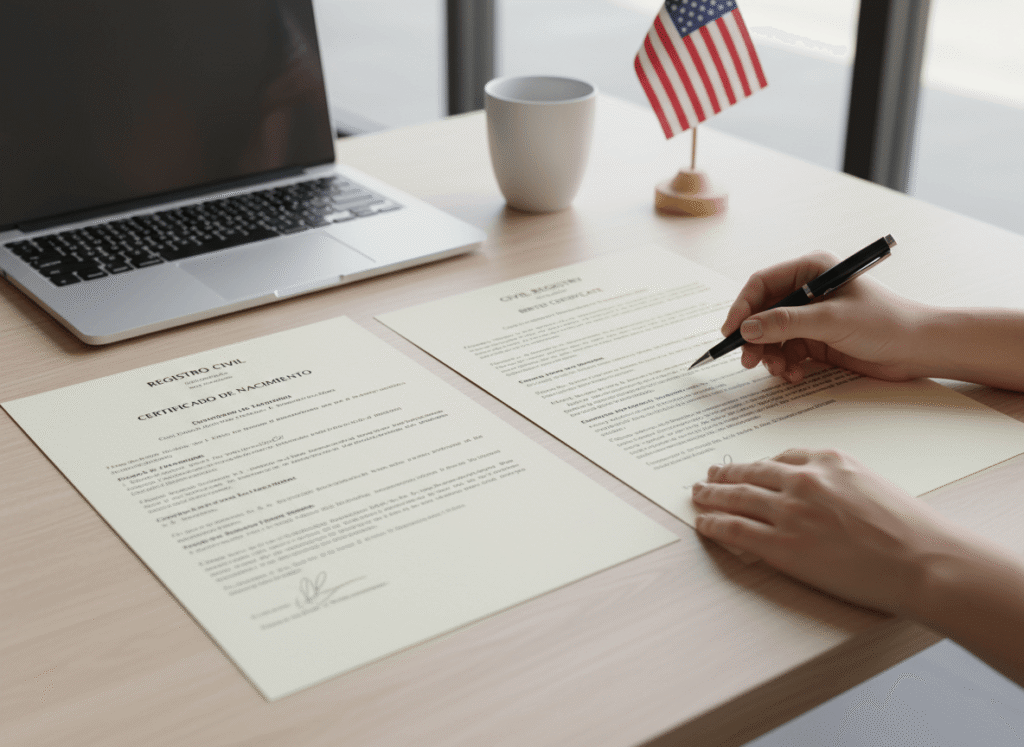
Why you need your Spanish birth certificate translated into English
You’re most likely to need a certified English translation of your birth certificate in situations such as:
- USCIS immigration applications (family-based petitions, green cards, naturalisation, work visas, humanitarian programmes)
- Consular processing at a US embassy or consulate
- Passport applications and proof of citizenship
- University or college enrolment, especially when proving identity and prior education
- Marriage licences, family court matters, or inheritance cases
- Employment checks with larger employers or government bodies
What the rules actually say about translating a birth certificate
USCIS and official requirements in plain language
USCIS policy states that any document in a foreign language must be accompanied by a complete English translation and a certification from the translator affirming that the translation is accurate and that they are competent in both languages.
Other official guidance (for example from the US Department of State and immigration resources) consistently describes a similar standard: a full translation plus a signed statement confirming the translator’s competence and accuracy.
In practice, a compliant certified translation of a Spanish birth certificate will typically include:
- A full English translation of every legible word, number, stamp, and note on the certificate
- The original Spanish document (scan or photo) attached or referenced
- A signed certificate of accuracy from the translator or translation company, including:
- Translator’s full name
- A statement that they are fluent in Spanish and English
- A statement that the translation is complete and accurate
- Date and place of certification
- Contact details (address, sometimes email/phone)
Who can translate a Spanish birth certificate into English?
Official rules focus on competence and certification, not on a specific licence or membership. For USCIS:
- The translator must be competent in both Spanish and English
- They must provide a written certification of accuracy with their name, signature, and date
USCIS does not require the translator to be sworn in court or approved by a particular government body. That’s why many reputable agencies and qualified freelancers successfully provide USCIS-ready birth certificate translations.
However, many immigration lawyers and professional services strongly advise against translating your own documents for your own immigration case. While some older commentary suggests self-translation may be technically possible, more recent practitioner guidance stresses that USCIS expects an independent, third-party translator, and self-translations are often flagged or questioned.

Step-by-step: how to translate a birth certificate from Spanish to English (the safe way)
Step 1: Gather and check your birth certificate
Before you think about translation:
- Obtain a clear copy
- Ask the civil registry or local authority for a recent certified copy if possible.
- If you only have an older original, scan it in high resolution (300 dpi or higher).
- Check legibility
- Make sure names, dates, registry numbers, and stamps are readable.
- If anything is damaged or illegible, the translation should mark it as such (e.g. “[illegible]”) rather than guessing.
- Check personal data
- Confirm that your name, parents’ names, and dates match your passport and other documents.
- If there’s any discrepancy (e.g. accent marks, double surnames, spelling), note it; your lawyer or advisor may want a short explanation alongside the translation.
Step 2: Decide on the right translation route
There are several options for translating a Spanish birth certificate into English. They are not all equal.
Option A: Professional certified translation service (recommended for USCIS)
Most trusted services follow a similar process:
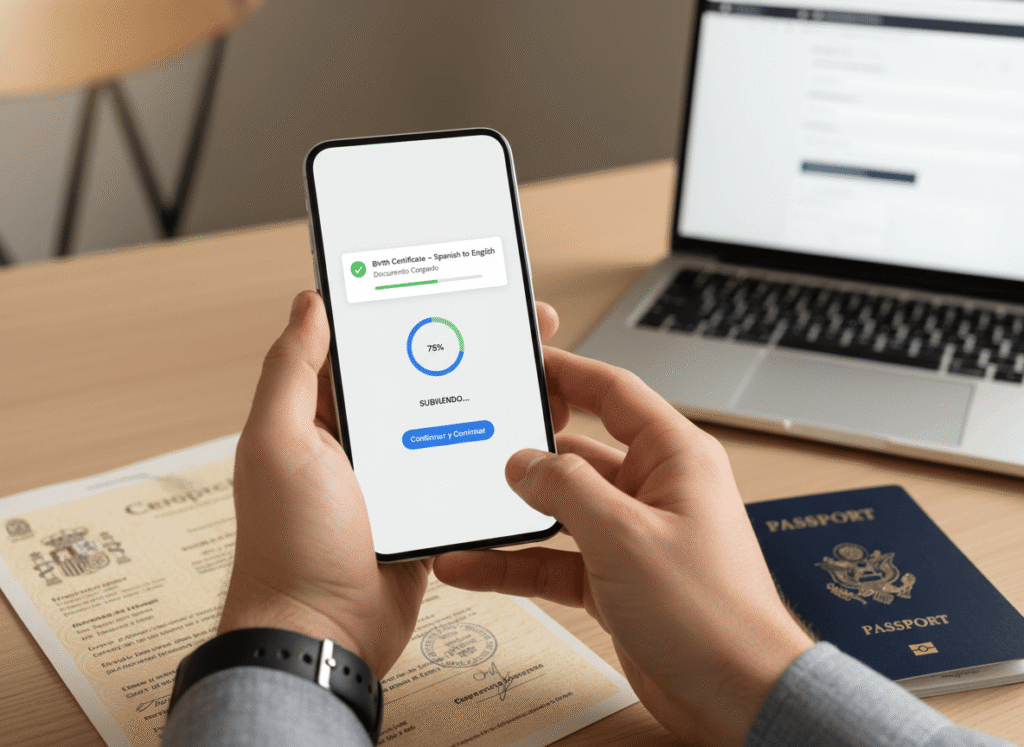
- You upload a scan or photo of the birth certificate.
- You select Spanish → English certified translation and specify whether it’s for USCIS, a consulate, or another authority.
- The provider gives you a clear per-page or per-document quote and turnaround time (often 24–48 hours for one certificate).
- A vetted translator specialising in legal/immigration documents completes the translation.
- A second linguist or project manager conducts a quality check.
- You receive:
- A PDF of the English translation
- A signed certification letter
- Optionally, a hard copy by post, sometimes with notarisation if required by your destination authority
This route is the safest for USCIS and other government processes, because it reduces the risk of errors, omissions, and format issues that could trigger an RFE.
Option B: Human translator you know (non-agency)
You might know a qualified translator, language professional, or lawyer who can translate Spanish into English and provide a certification letter. This can work if:
- They are genuinely fluent in both languages
- They are comfortable signing a certification that includes their full name, address, and date
- They are not the applicant or a direct party to your immigration case
This is often acceptable but you sacrifice the additional quality checks, secure portal, and clear service guarantees that a specialist agency offers.
Option C: Free or very low-cost options
In some countries, consulates or non-profit organisations offer low-cost or free translation services for vulnerable applicants. Some online services also advertise “free” birth certificate translation, usually limited to automated formatting or basic output.
While these options can be attractive, be cautious:
- Check whether they provide a formal certification that meets USCIS standards.
- Confirm that the translator’s name, signature, and date are included.
- Ensure the English is native-level; a poorly translated certificate is worse than no translation.
Option D: Machine translation (what not to do)
Using tools like Google Translate or other automatic translators is not acceptable for an official birth certificate. They:
- Do not provide a certification letter
- Often mishandle names, abbreviations, and legal terminology
- Can produce format errors that make the document look unprofessional
Even if you use machine translation as a rough guide, the final version must be reviewed, corrected, and certified by a competent human translator.
Step 3: How a professional actually translates your Spanish birth certificate
To understand what “good” looks like, here’s what a careful professional will do:
- Mirror the original layout sensibly
- Headings such as “Acta de Nacimiento” become “Birth Certificate”.
- Sections like registry details, parents’ details, and marginal notes are kept in a logical order.
- Translate every visible element
- Names of the civil registry office, municipality, and state
- Stamps, seals, and marginal notes (for example, later marriage annotations)
- Handwritten additions, where legible, with “[illegible]” where they are not.
- Handle names and accents correctly
- Surnames with accents (e.g. “José Pérez García”) are normally reproduced exactly as in the original, even if your passport drops the accents.
- Double surnames are kept in full; the translator does not decide which surname to drop.
- Standardise dates and numbers
- Dates written as “10/03/1989” in Spanish-speaking countries can be ambiguous. A good translator writes them as “10 March 1989” to avoid confusion.
- Registry numbers, book/folio references, and certificate IDs are copied exactly.
- Add a clear certification statement A typical closing statement might say, in essence, that the translator is fluent in Spanish and English and that the translation is complete and accurate, followed by their name, signature, date, and contact details.
Step 4: Review before you submit
Before you upload or mail your translated birth certificate:
- Check that your full name, date and place of birth, and parents’ names match your other documents.
- Confirm that the certificate of accuracy is included and signed.
- Make sure the translation includes every page and every marginal note.
- Save a digital copy and, if possible, print a clean hard copy to keep with your records.
Common mistakes that cause RFEs or delays
From immigration forums, law firm articles, and translation providers’ case studies, the same issues appear again and again as causes of USCIS Requests for Evidence or slowdowns:
- Missing certification letter
- Submitting only the English translation with no signed certificate.
- Partial translation
- Only translating the main block of text and ignoring marginal notes, stamps, or the reverse side.
- Wrong or inconsistent names
- Dropping one of the double surnames, changing the order, or “normalising” a spelling that doesn’t match the original.
- Incorrect dates
- Translators mixing up day and month, or mistranslating Spanish date formats.
- Using a friend or relative without a proper statement
- Even if they speak both languages, if their translation is casual and uncertified, it’s a problem.
- Machine-translated certificates
- USCIS officers can usually spot these at a glance.
- Illegible scans
- If the officer can’t read what’s on the page, they can’t rely on the translation.
How much does it cost to translate a birth certificate from Spanish to English?
Pricing varies by provider, country, and turnaround time, but publicly listed pricing and guides from Spanish–English translation companies suggest the following ballpark:
- Standard certified translation (1–2 pages)
- Roughly US$20–US$50 per page for a typical Spanish birth certificate
- Rush or same-day service
- Often more expensive (for example, an extra 25–100% surcharge for urgent processing)
- Extras
- Hard-copy postage
- Notarisation (if required by a specific authority)
How long does a Spanish birth certificate translation take?
For a single birth certificate, many providers publicly advertise delivery within 24–48 hours, with faster turnarounds available for an extra fee.
As a rough guide:
- Standard service: 1–3 business days
- Rush service: Same day or within 24 hours
- Complex or handwritten certificates: May take longer, especially if the handwriting is difficult to decipher.
Why work with USCIS Official Translation for Spanish birth certificate translations?
When your immigration status or your family’s future is on the line, you want specialists who handle these documents every single day.
At USCIS Official Translation, your Spanish birth certificate is handled by trained human linguists and a specialist support team:
- Spanish–English legal specialists who understand civil registry formats across Latin America and Spain
- Certified translations designed to meet USCIS requirements, including a complete certificate of accuracy
- Secure online upload of your documents, with encrypted handling at every step
- Fast delivery, with options for urgent turnarounds when you’re facing an RFE deadline
- Transparent, per-document pricing so you know the total cost up front
- Friendly support who can clarify requirements and coordinate with your lawyer or adviser where needed
Frequently asked questions: translating a birth certificate from Spanish to English
1. Can I translate my own Spanish birth certificate into English for USCIS?
For an immigration case, this is strongly discouraged. While the core rule focuses on having a complete and accurate translation plus a certification letter, recent guidance from immigration-focused resources and professional services clearly states that USCIS expects an independent translator, not the applicant, to certify the translation. Submitting a self-translated certificate can lead to extra questions or RFEs.
To avoid risk, use a third-party professional such as USCIS Official Translation to prepare and certify your Spanish-to-English translation.
2. Do I need a notarised translation, or is a standard certified translation enough?
For most USCIS applications, a standard certified translation is enough: a complete English translation with a signed certificate of accuracy from the translator or translation agency. USCIS guidance does not generally require notarisation.
However, some courts, universities, or foreign authorities may insist on a notarised translation or a translation by a sworn translator. Always check the specific instructions for the authority you’re dealing with. If in doubt, ask your lawyer or the institution directly.
3. Does USCIS accept online translation companies?
Yes. USCIS does not distinguish between walk-in and online providers. What matters is that:
- The translation is complete and accurate
- The translator or agency certifies their work with a proper statement
- The certification includes the translator’s name, signature, and date
Reputable online providers clearly state that they specialise in USCIS-ready certified translations and show example certifications or templates. If a website is vague about certification, think twice.
4. What if my Spanish birth certificate is old, handwritten, or damaged?
Older or handwritten certificates are common, especially from smaller municipalities. A good translator will:
- Spend extra time deciphering the handwriting
- Clearly mark any parts that are completely illegible as “[illegible]” rather than guessing
- Keep all registry numbers and references even if the design looks outdated
If your certificate is extremely damaged or partially missing, you may need to obtain a new certified copy from the civil registry before translating it.
5. My birth certificate is already bilingual (Spanish and English). Do I still need a translation?
Some modern certificates are issued in both Spanish and English. In those cases, a separate translation might not be necessary if the English text is complete and clear. However:
- If any part is only in Spanish (e.g. marginal notes), those parts may still need translation.
- Some lawyers still recommend attaching a brief certification confirming that the English version is an official bilingual document, just to avoid questions.
When in doubt, have a professional review the document. USCIS Official Translation can look at a scanned copy and confirm whether a separate translation is advisable.
6. Can I use the same Spanish-to-English birth certificate translation for multiple applications?
Yes. Once you have a good certified translation, you can usually reuse it for:
- Different USCIS filings involving the same person
- Consular processing
- University or job applications
