
If you are applying for a green card, a visa, dual citizenship, or any other immigration benefit, one key question often appears at the very last minute:
Who can actually translate my birth certificate so it will be accepted?
You may have a bilingual friend, a helpful colleague, or even feel confident enough to translate it yourself. But immigration authorities like USCIS and foreign consulates treat birth certificates as high-risk documents. A small mistake in the translation can lead to delays, Requests for Evidence (RFEs), or even refusals.
Why Birth Certificate Translations Matter So Much
A birth certificate isn’t just a piece of paper. For immigration and legal processes it is often the foundation document used to:
- Prove identity
- Confirm date and place of birth
- Show parentage and marital status
- Link you to other records (passports, national IDs, family documents)
Because of this, authorities scrutinise both the original document and its translation very carefully. Any inconsistency – a spelling error, missing stamp, or omitted note – can raise questions and trigger extra checks.
When you submit a birth certificate that is not in English to USCIS, the law requires that it is accompanied by a full English translation plus a specific certification from the translator.
What a “Certified Birth Certificate Translation” Really Is
Many people think “certified translation” means it must be done by a government body or an accredited organisation. That’s not exactly how it works in the United States.
For USCIS purposes, a certified translation is:
- A complete and accurate translation of every part of the document (names, numbers, seals, notes, stamps, margins).
- Accompanied by a signed statement from the translator confirming:
- They are competent in both English and the source language
- The translation is complete and accurate to the best of their ability
What the Law Says: USCIS Rules on Who Can Translate
The key rule lives in 8 CFR §103.2(b)(3), part of the U.S. immigration regulations. It states that any foreign-language document submitted to USCIS must be accompanied by:
- A full English translation
- A certification by the translator that:
- The translation is complete and accurate
- The translator is competent to translate from the foreign language into English
Notice what this rule does not say:
- It does not require the translator to be “sworn” or “court-appointed.”
- It does not require notarisation for USCIS purposes.
- It does not say the translator must be ATA-certified or registered on any particular list.
So, Who Can Translate a Birth Certificate for USCIS?
Let’s break it down by type of translator.
1. Professional Translator or Translation Agency
A professional translator or specialised translation agency is almost always the safest and most efficient choice, especially for immigration and consular work.
Why?
- They work with official documents every day (birth, marriage, divorce, court orders).
- They know how to reproduce stamps, seals, margin notes, and handwritten elements properly.
- They provide a formal certificate of accuracy that clearly matches USCIS expectations.
- They usually store your translation securely, in case USCIS asks for a re-issue or you need another copy later.
At USCIS Official Translation, every birth certificate translation designed for USCIS includes:
- A full, line-by-line English translation
- A signed translator’s certificate with the required statements
- Clear contact details so an officer could follow up if needed
- Formatting aligned with immigration-law best practice
If you want the low-risk path, this is the category you should be in.
2. Bilingual Individuals (Non-Professionals)
Legally, a bilingual individual who is competent in both languages can provide a translation and sign a certification, as long as they are honest about their competence and follow the format described above.
However, there are real downsides:
- They may miss legal nuances (e.g., abbreviations, civil status, archaic phrasing).
- They may not know how to handle illegible handwriting or partial seals.
- If they are a friend or family member, USCIS officers may question impartiality and request a fresh translation from a third party.
If your immigration future depends on a document, relying on a casual favour is rarely recommended.
3. You (Self-Translation)
This is one of the most common questions:
Can I translate my own birth certificate?
USCIS regulations do not explicitly forbid you from translating your own documents. The rule is that the translator must certify their competence and the accuracy of the translation.
However, several immigration law firms and professional guidance sources strongly discourage self-translation for vital records like birth certificates, because:
- It creates a clear conflict of interest – you’re both the applicant and the translator.
- Officers may treat it as less reliable and request an independent translation.
- If there is a mistake, you personally are responsible, and fixing it later can be costly and stressful.
For that reason, if your document is important for your case, self-translation is almost never the best strategy.
4. Notaries and Lawyers
Another frequent question:
Can a notary public translate my birth certificate?
A notary’s main role is to verify identity and witness signatures, not to translate. Some notaries are bilingual and may offer translation, but their notarial seal does not automatically make the translation compliant with USCIS.
Similarly, lawyers may translate documents, but unless they are truly fluent in the language and experienced with civil-status documents, they are not automatically a better choice than a professional translator.
If you are asked to provide a “notarised translation”, what usually happens is:
- A translator completes the certified translation.
- The translator then signs the certification statement in front of a notary.
- The notary notarises the translator’s signature – not the translation itself.
For USCIS, this notarisation is generally optional, not mandatory.
5. Court-Sworn or Government-Authorised Translators (Outside the US)
If your birth certificate is being used in countries like the UK, EU states, or the UAE, you may face additional rules:
- The UK Home Office expects official documents to be translated and certified by a qualified translator or translation company, not by the applicant or a friend.
- In some jurisdictions, only sworn or government-licensed translators can produce translations that ministries and courts will accept.
If you are using the same birth certificate both for USCIS and for a foreign authority, it is essential to verify the requirements of each institution separately.
Who Should Not Translate Your Birth Certificate
To stay on the safe side, your birth certificate translation should not be handled by:
- You, if you are the applicant or a close family member
- Friends or relatives, especially if they are part of your application
- Automated tools (Google Translate or similar) – these cannot sign certifications and are explicitly rejected by many authorities
- Unlicensed or unregulated translators in countries where the law requires officially recognised professionals
If your document is central to your case, always move away from “free” translation solutions and towards documented professional competence.
How to Choose the Right Translator or Service: A Checklist
When you evaluate who should translate your birth certificate, use this simple checklist.
1. Do they understand USCIS (and other authority) requirements?
Look for providers that clearly:
- Refer to 8 CFR §103.2(b)(3) or the USCIS Policy Manual in their guidance.
- Explain the difference between certified, notarised, and sworn translations.
- Provide document-specific guidance for birth certificates, not just generic marketing language.
2. Will they include a proper translator’s certification?
The certification should:
- Name the translator or translation company
- Confirm competence in both languages
- Affirm that the translation is complete and accurate
- Include signature, date, and contact details for follow-up
3. Are they used to dealing with vital records?
Ask if they regularly translate:
- Birth certificates
- Marriage and divorce certificates
- Adoption papers and court orders
- Police and court records
Teams that specialise in these documents know how to consistently avoid errors that cause RFEs.
4. Do they protect your data?
Immigration documents are highly sensitive. A professional provider should follow secure handling practices (secure upload, limited access, and controlled retention periods).
Step-by-Step: How Birth Certificate Translation Works with USCIS Official Translation
Here’s how a typical birth certificate translation project works when you use a specialised service like USCIS Official Translation:
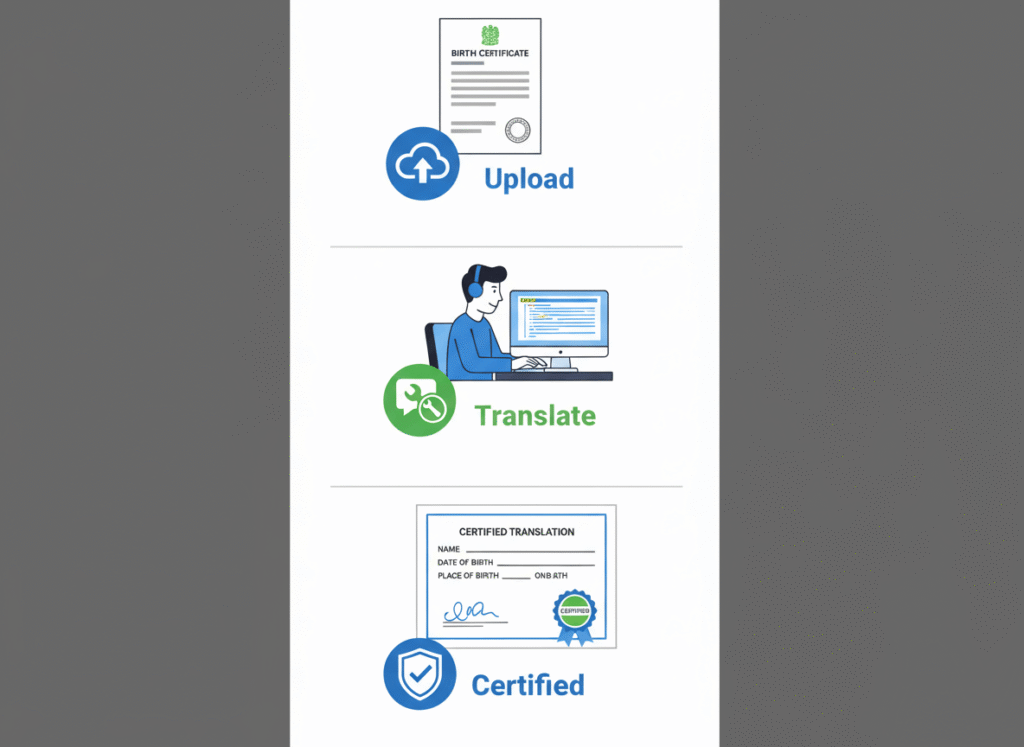
Step 1 – Secure Upload
You upload a clear scan or photo of your birth certificate through a secure online portal. If any part is blurred or cut off, the team will let you know before work begins.
Action step: Upload your birth certificate now and receive a clear, written quote before you commit.
Step 2 – Specialist Assignment
Your document is assigned to a translator who:
- Is fluent in the source language and English
- Has experience with civil-status and immigration documents for that language pair
- Follows USCIS-specific formatting conventions
Step 3 – Translation and Internal Check
The translator produces a full English version, including:
- Names, dates, and places
- Stamps, seals, margins, and handwritten notes
- Any additional annotations or marginal remarks
A second linguist or reviewer verifies spellings, consistency and formatting against the original.
Step 4 – Certification
The final translation is accompanied by a signed certificate of accuracy that meets USCIS requirements and references the specific document (e.g., “Birth Certificate of [Name]”).
Step 5 – Delivery
You receive:
- A PDF suitable for online filing or printing
- Instructions on how to submit it with your USCIS or consular application
- The option to request extra copies if needed later
Costs, Turnaround Times and Rush Options
Actual prices vary by language pair, length, and complexity, but you can usually expect:
- Per-page pricing for standard birth certificates
- Fast standard turnaround, often within 24–48 hours for common languages
- Rush or same-day options for urgent filings
When comparing providers, pay attention not just to price, but to:
- Whether review and certification are included
- Any extra fees for rush or physical copies
- The clarity of their guarantee – do they commit to meeting USCIS translation requirements?
Frequently Asked Questions
1. Who can translate a birth certificate for USCIS?
USCIS requires that any foreign-language document, including birth certificates, be accompanied by a full English translation certified by a translator who confirms the translation is complete and accurate and that they are competent in both languages. This is typically done by professional translators or specialist agencies that work regularly with USCIS documents.
2. Can I translate my own birth certificate?
The regulations do not explicitly forbid self-translation, but it is strongly discouraged. Self-translation creates a conflict of interest and increases the risk of mistakes or RFEs. Many immigration lawyers recommend using an independent, professional translator instead of translating your own vital records.
3. Can a friend or family member translate my birth certificate?
A friend or family member who is competent in both languages can, in theory, translate and certify your birth certificate. However, USCIS may question their impartiality and request a new translation if they suspect a conflict of interest. In practice, using an independent translation service is much safer, especially for key documents like birth certificates.
4. Does USCIS require notarised birth certificate translations?
USCIS requires certified translations, not necessarily notarised ones. Notarisation may be requested by other institutions (courts, foreign consulates, universities), but for USCIS alone, a properly certified translation that meets 8 CFR §103.2(b)(3) is usually sufficient.
5. Does the translator have to be ATA-certified or on a specific list?
No. USCIS does not demand that translators be ATA-certified or included on any specific register. The crucial requirement is that the translator certifies their competence and the completeness and accuracy of the translation in writing. Many reputable agencies employ ATA-certified translators, but the certification requirement is about responsibility, not membership.
6. How long does a birth certificate translation take?
For standard birth certificates in common languages, professional services can often deliver within 24–48 hours, with same-day options for urgent cases. Less common languages or poor-quality scans may add time, but providers will tell you upfront before you place your order.
