
If you’re applying for a visa, green card, citizenship, a U.S. passport, or dealing with a court or vital records office, you’ll almost always be asked for your birth certificate – and often in English, even if it was issued abroad. That’s when the question hits:
“Where can I get my birth certificate translated and notarized near me – and how do I know it will actually be accepted?”
The good news: you don’t have to spend days calling random notaries or translation shops. In this guide, you’ll learn:
- When you need notarization and when a simple certified translation is enough
- The best places online and locally to get your birth certificate translated and notarized
- How to avoid costly mistakes that lead to USCIS delays or rejections
- How USCIS Official Translation can handle the entire process for you, end-to-end
By the end, you’ll know exactly what to do next – and you can get your document on its way today

Do You Really Need a Notarized Translation – or Just a Certified One?
Before you start searching “translation and notarization near me,” it’s worth clarifying what you actually need. Many people are surprised to learn that:
- USCIS requires a certified English translation, not notarization.
- Some other authorities do require notarized translations, especially for passports, vital records offices, and certain courts.
What a certified translation is
For U.S. immigration, the rule is simple:
Any document in a foreign language submitted to USCIS must be accompanied by a full English translation plus a signed statement from the translator certifying that the translation is complete, accurate, and that they are competent to translate from that language into English.
A proper certified translation of your birth certificate will therefore include:
- A full, line-by-line English translation of the entire document (including stamps and seals)
- A certificate of translation accuracy signed by the translator or translation company representative
- The translator’s name, signature, and contact details
This is what USCIS looks for when reviewing your file.
What notarized translation means
A notarized translation adds one extra step:
- A notary public does not check the linguistic accuracy.
- Instead, the notary verifies the identity of the person signing the translator’s certification and witnesses their signature.
In other words, notarization confirms who signed the certification, not whether the translation is good.
When you need which
Use this quick rule of thumb:
- USCIS applications (green card, citizenship, many visas)
- Usually: Certified translation only – notarization is not required.
- U.S. Department of State / passport office, some state courts, some vital records offices, and certain overseas consulates
- Often: Certified + notarized translation
- Schools, universities, and employers
- Depends on their policy – many accept certified translations without notarization, but always check their instructions.
The Main Places to Get Birth Certificate Translation and Notarization “Near Me”
When you search online, you’ll see everything from freelance translators on social networks to large translation companies. Not all options are equal – especially when immigration status is on the line.
Here are the main routes you can take.
1. Online immigration-focused translation providers (fastest and most flexible)
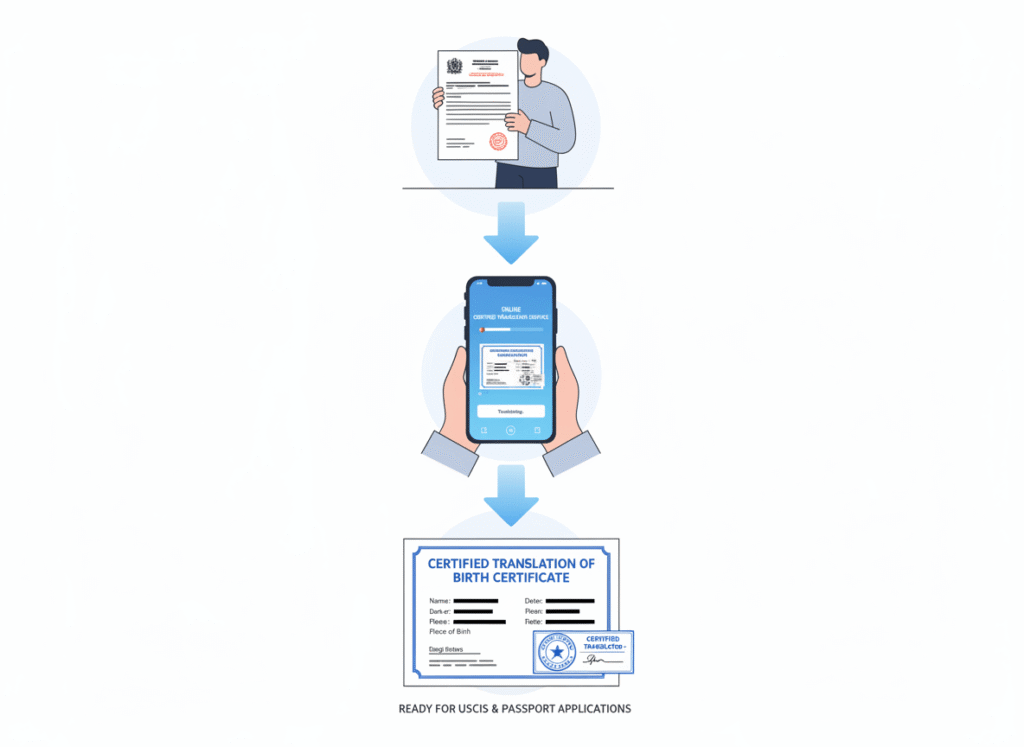
Modern “near me” solutions are often fully online – which means you can upload your birth certificate from anywhere in the world and receive a certified (and, if needed, notarized) translation by email, plus optional hard copies.
Look for providers that:
- Specialize in immigration documents, especially birth certificates for USCIS
- Provide a clear acceptance guarantee for U.S. government agencies
- Offer an option to add notarization for authorities that require it
- Deliver PDF copies by email, plus courier or mail if you need originals
This approach is ideal if:
- You need your translation in 24–72 hours
- You don’t have easy access to local translators for your language pair
- You want everything documented, traceable, and handled by professionals used to immigration work
How USCIS Official Translation fits here
USCIS Official Translation focuses on immigration-ready translations:
- Certified translations formatted to match your original birth certificate
- Translator certification that follows U.S. requirements for accuracy and competence
- Optional notarization add-on when your passport office, court, or agency asks for it
- Secure online upload, clear pricing per page, and responsive support for applicants and attorneys
You simply upload your birth certificate, choose whether you need notarization, and we take care of the rest – no hunting for a separate notary or chasing multiple vendors.
2. Local translation agencies or language service providers
If you really want a physical office “near me,” you can look for:
- Translation agencies in your city
- Community interpretation centers
- Legal translation offices (especially in larger metro areas)
Pros:
- Face-to-face explanations if you’re more comfortable talking in person
- Possibility of combining translation + notarization through one provider, if they work with local notaries
Cons:
- Limited language coverage in smaller towns
- Often higher pricing and longer turnaround times
- Shorter opening hours and the need to travel and wait in person
If you go this route, check that they know USCIS requirements and not just general translation.
3. Independent translator + local notary
You can also separate the process into two steps:
- Hire a qualified translator (via local recommendations or directories such as the American Translators Association’s online directory).
- Take the signed translation certificate to a notary public, who will witness the translator’s signature.
Where to find the notary:
- Banks and credit unions
- Law offices
- Shipping chains (e.g., many UPS Stores and similar)
- City hall, county clerk’s office, or some libraries
- The National Notary Association’s public notary directory
This can work well if you already know a translator and a local notary you trust. It’s less convenient if you’re starting from zero.
4. Law firms and immigration service providers
Some immigration lawyers:
- Maintain relationships with trusted translation and notarization providers
- Bundle translation costs into their legal fees

Step-by-Step: How to Get a Translated and Notarized Birth Certificate in Days, Not Weeks
Whether you use USCIS Official Translation or another provider, this simple roadmap will help you move fast without mistakes.
Step 1: Confirm exactly what is required
Take five minutes to read the instructions from the authority asking for your birth certificate:
- For USCIS, look at the instructions for the specific form (for example, I-485 or N-400) and the Policy Manual section on evidence and translations.
- For passports or consular services, check the U.S. Department of State or embassy / consulate website.
- For courts or vital records offices, check their official site or ask the clerk.
Note down:
- Do they say “certified translation” only, or mention “notarized translation”?
- Do they require original paper copies, or are PDFs enough?
- Is there a specific deadline?
If anything is unclear, send them a quick email asking for written confirmation.
Step 2: Prepare your birth certificate
To avoid back-and-forth and delays:
- Make sure you have an official, legible copy of your birth certificate.
- If the document is worn or smudged, request a fresh certified copy from the issuing authority.
- Scan it at high resolution or take a clear, flat photo in good light, including stamps, seals, and both sides if there is printing on the back.
Most providers (including USCIS Official Translation) can work from good-quality scans or photos, so you rarely need to mail the original.
Step 3: Choose a provider that understands immigration and notarization
When you check providers, ask yourself:
- Do they talk specifically about USCIS, passports, or courts – or just “general translation”?
- Do they clearly explain the difference between certified and notarized translation?
- Is there sample wording for the translator’s certification that matches U.S. expectations (competence, completeness, accuracy)?
- Do they offer notarization as an option, instead of forcing it when you don’t need it?
With USCIS Official Translation, immigration is the entire focus, so all internal processes – from templates to quality checks – are built around these requirements.
Step 4: Place your order and specify your needs
When you submit your document:
- Indicate the source language (the language on your birth certificate) and English as the target language
- Confirm the purpose (USCIS, passport office, court, university, etc.)
- Select whether you need certified only or certified + notarized
- Choose how many physical copies you want, if any
- Share your deadline and any file-naming or formatting preferences your lawyer or agency has requested
At USCIS Official Translation, your order form can reflect all of this, so your translation and (if needed) notarization are delivered exactly in line with your next step.
Step 5: Receive, review, and store your translation
When your translation is ready, you’ll typically receive:
- A PDF of the translated birth certificate
- A PDF of the translator’s certification, and if applicable,
- A PDF of the notarized certification page
- Optional paper copies shipped to your address
Review the translation carefully:
- Check that names, dates, and places are correct and consistently spelled.
- Confirm that every visible element on the original is reflected: stamps, seals, marginal notes, signatures.
What to Look For in a Trustworthy Translation & Notarization Provider
Because birth certificate errors can lead to delays or extra requests for evidence, your choice of provider matters more than saving a small amount on fees.
Here’s a checklist you can use:
- Immigration specialization
- They clearly mention USCIS, consular processing, and government agencies.
- Clear certification wording
- Their translator’s certificate states that the translation is complete, accurate, and that the translator is competent in both languages.
- Option, not obligation, to notarize
- They can add notarization when required, but don’t insist on it for plain USCIS use (where it isn’t needed).
- Transparent pricing
- Clear per-page pricing for vital records like birth certificates and a small, clearly stated fee for notarization if you need it.
- Data security
- Encrypted upload, limited access to your documents, and a clear document retention policy.
- Real reviews and credentials
- Independent reviews and, ideally, memberships of professional bodies such as the American Translators Association.
Common Mistakes That Delay Applications – and How to Avoid Them
Even well-prepared applicants and law firms fall into these traps. Avoid them and you’ll save weeks of stress.
1. Translating the birth certificate yourself
USCIS wants a translation by a disinterested, competent party with a signed statement – not by the applicant. Many authorities also frown on translations done by close family members.
2. Using generic translation instead of immigration-focused work
A translator who doesn’t regularly handle immigration cases might:
- Miss details such as stamps, hand-written notes, or abbreviations
- Use unusual date formats
- Translate names in ways that don’t match your passport or previous filings
These small errors can trigger requests for evidence or even doubts about identity.
3. Paying for notarization you don’t need
For pure USCIS use, notarization is usually unnecessary; it adds cost and complexity without improving acceptance chances.
If you know you’ll later use the same translation for a passport, court, or vital records office, ask in advance whether they’ll require notarization – then decide.
4. Not checking the final translation
Even with good providers, always:
- Compare names, dates, and places to your passport and other documents
- Confirm that your parents’ names and place of birth match previous filings
- Ensure there are no missing sections (front and back of the certificate, where applicable)
Treat this review as a final safety check before you file.
5. Leaving translation until the last minute
Translation and, especially, notarization can take time during busy seasons. Starting a few days earlier gives you:
- Room for corrections
- Time to order additional hard copies if you need them
- Less pressure when you’re assembling the rest of your package
Frequently Asked Questions
1. Do I need my translated birth certificate notarized for USCIS?
For most applications, no. USCIS requires a certified translation with a translator’s signed statement, not notarization of that statement. Notarization is usually optional for USCIS, though other agencies (like the U.S. Department of State or some courts) may require it.
2. What’s the difference between a certified and a notarized translation?
- A certified translation includes a statement from the translator or translation company confirming that the translation is complete and accurate and that they are competent to translate between the two languages.
- A notarized translation adds a notary public who verifies the identity of the person signing the certification and witnesses their signature. The notary does not check the translation itself.
3. Can I translate my own birth certificate?
For U.S. immigration, you should not translate your own birth certificate. USCIS expects a translation by someone other than the applicant, who signs a certification of competence and accuracy.
4. Where can I find someone near me who can notarize the translation?
Common places to find a notary public include:
- Banks and credit unions
- Law firms
- Shipping and mailbox stores
- City or county offices
- Public directories run by organizations like the National Notary Association
5. How long does birth certificate translation and notarization take?
For a single birth certificate:
- Certified translation alone is often completed in 24–72 hours, depending on language and provider capacity.
- Adding notarization can add a little time for scheduling and processing, but this can often still be completed within a few days.
6. Can I use the same translated and notarized birth certificate for multiple applications?
In most cases, yes. Once you have a proper certified translation, and if required a notarized translation certificate, you can use copies for:
- USCIS filings
- Passport or consular applications
- University or employer records
- Some court or vital records procedures
