
If you’re exploring how to become a translator, this guide gives you a clear, practical path—whether you hold a linguistics degree or want to become a translator without a degree. We’ll cover translator qualifications, certification options (ATA, CIOL, ITI), how to build experience fast, and how to specialise in high-trust niches like translation for visa applications (birth certificates, police clearances, marriage certificates and more).
What does a translator actually do?
A translator converts written text from one language into another with accuracy, clarity and cultural appropriateness. Unlike interpreters (spoken), translators work with documents, websites, research, contracts, and official records. Excellence hinges on top-tier writing in your target language (the language you translate into), subject-matter knowledge, and a meticulous eye for detail.

Core responsibilities
- Analyse source texts and clarify ambiguities
- Research terminology and style conventions
- Produce fluent, reader-ready translations and back them with a QA process
- Use appropriate tooling (glossaries, QA checkers, style guides)
- Provide certified translations for official use when required (e.g., immigration, academic, legal)
Do you need a degree to be a translator?
No. A degree helps but isn’t mandatory. In practice, clients and agencies look for a mix of competence, portfolio samples, professional references, and (optionally) certifications. In the U.S., translators are not state-licensed; for immigration submissions, USCIS requires a certification statement affirming the translation is complete and accurate and that the translator is competent in both languages.
Qualification for translator”: what actually counts
- Language mastery: native-level writing in your target language and advanced comprehension of your source language(s)
- Domain knowledge: legal, medical, technical, financial, or visa/immigration documents
- Process competence: glossary building, versioning, QA, and deadline reliability
- Professional signals: ATA certification (U.S.), CIOL/ITI membership (UK), robust portfolio, testimonials
How to specialise in translation for visa applications
Visa and immigration cases demand precision and compliance. For USCIS and many consulates, any non-English document must be accompanied by an English translation plus a translator’s certification statement confirming completeness, accuracy, and translator competence. Typical documents: birth/marriage certificates, police clearances, degrees, transcripts.

What to master for this niche
- Exact matches of names, dates, seals, and stamps
- Standard certification statements with your name, signature, and contact details
- Consulate/agency nuances and formatting that mirrors the original
- Turnaround and confidentiality expectations for time-sensitive immigration filings
10 Steps: How to Become a Translator
- Choose your language pair(s) and target language. Commit to native-quality writing in your target language.
- Pick a specialisation. Legal/immigration (translation for visa applications), medical, technical, financial, or marketing.
- Build a starter portfolio (5–10 samples) with short, realistic texts: a birth certificate template, an academic transcript, a bank letter, a police certificate summary, a marriage certificate.
- Create your certification statement template for immigration documents and learn to mirror layout and stamps precisely.
- Master tooling: terminology management (glossaries), QA checkers, and secure file-handling for PII.
- Get references and micro-credentials: short courses, CPD certificates, and where relevant ATA practice tests or CIOL/ITI membership paths.
- Start earning experience: pro-bono for NGOs (with NDAs), small paid jobs, or subcontracting with reputable agencies.
- Publish a professional profile (website + directory listings). State your pairs, niche, rates policy, turnaround, and confidentiality practices.
- Systematise quality: checklists for dates/names, bilingual glossary upkeep, second-pair review when available.
- Scale carefully: raise rates as your portfolio, testimonials, and certifications grow.
How to Become a Translator Without a Degree
If your route is non-academic, focus on demonstrable competence and trust signals:
- Language mastery via proficiency tests and published samples
- Documented experience: client testimonials, verified projects, or platform reviews
- Micro-credentials and memberships: short courses, CPD, ATA/CIOL/ITI tracks you can begin now
- Niche authority: show depth in visa-application translation by publishing brief guides, sample certifications, and redacted examples
You don’t need a degree to deliver compliant, accurate translations—but you do need process, proof, and professionalism. For immigration documents, USCIS accepts translations from any competent translator who provides the required certification statement.
Translator Qualifications: a practical checklist
- Language: native-level target language; C1+ source language
- Writing quality: style control, consistency, and terminology accuracy
- Compliance: correct USCIS certification statement and mirrored formatting for visa files
- Professionalism: on-time delivery, secure PII handling, version control
- Recognition (optional): ATA certification (U.S.), CIOL/ITI membership (UK)
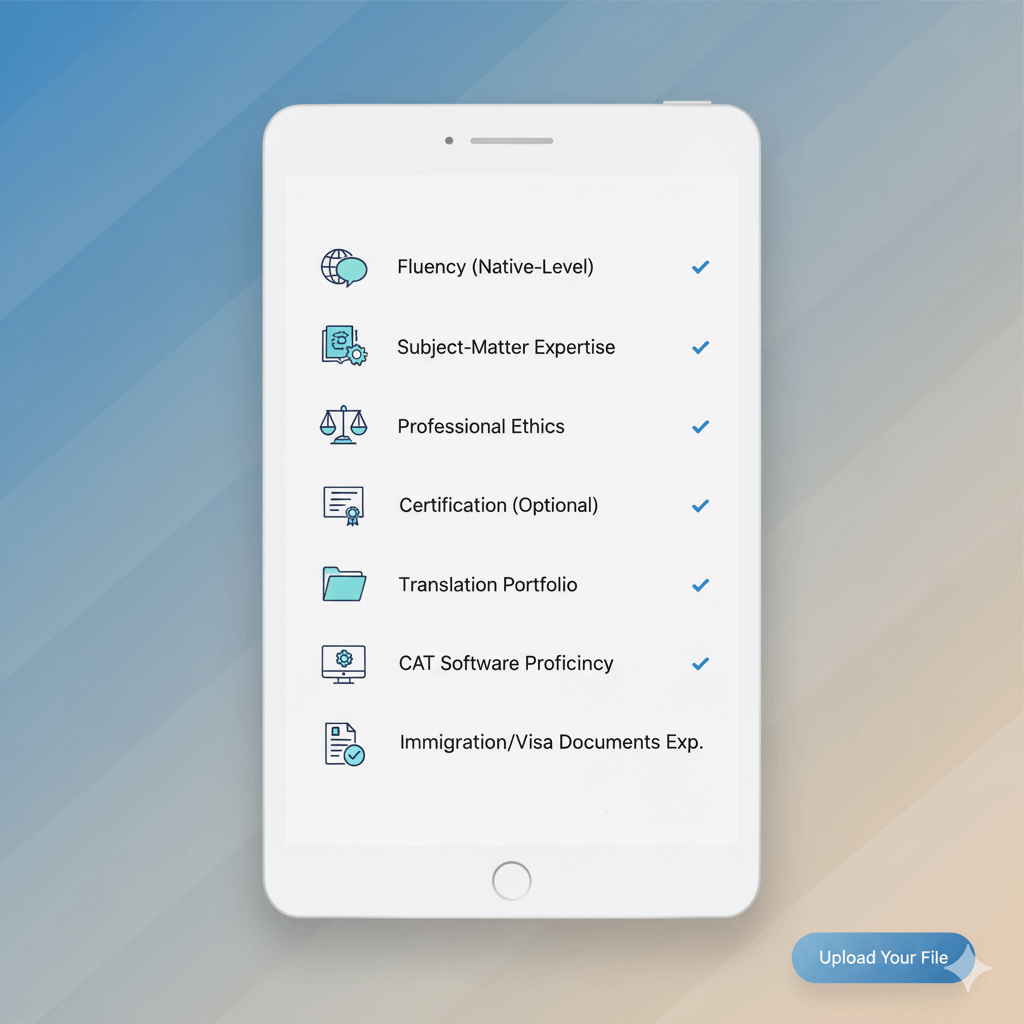
Certification & Membership Pathways (Optional but Valuable)
ATA (U.S.)
- What it proves: respected evidence of professional competence
- How to prepare: ATA exam overview, study resources, and practice tests available online
- Good for: U.S. clients who recognise the brand and value third-party validation
CIOL & ITI (UK)
- What it proves: skills, ethics, and experience aligned with UK standards
- Examples: CIOL Associate/Full Member criteria; ITI Qualified Translator assessment route
- Good for: UK/Europe-facing projects and institutional buyers
Building your portfolio (that clients actually trust)
- Include before/after snippets (redacted) demonstrating clarity, consistency, and correct handling of names/dates.
- Add visa-application samples (e.g., birth certificate translation with certification statement).
- Present turnaround options (standard/express) and a simple pricing policy (per page for vital records; per word for longer texts).
- Share client testimonials and case highlights (e.g., “1,200+ certified translations delivered for family and work visas last year”).
Pricing: where to start
- Visa/immigration documents: often priced per page (clear, predictable for clients)
- General/technical: priced per word or fixed-fee packages
- Factor in complexity, urgency, and certification. Offer transparent bundles (e.g., translation + certification + tracked postage).
Quality & compliance for visa documents: your 7-point checklist
- Translate everything on the page (including stamps/seals).
- Keep names and dates consistent; add translator notes only where essential.
- Mirror layout to aid officer review.
- Use your standard certification statement on company letterhead.
- Run terminology and QA checks (spelling, diacritics, number formats).
- Ensure secure storage and redaction for samples.
- Provide PDF delivery (and printed copies if needed).
Internal resources you’ll find helpful
- Translation for Visa Application (Pillar) — how document translation supports successful submissions
- Certified Translation Services — what’s included in certification and delivery
- Birth Certificate Translation — accepted formats and turnaround
- Police Certificate Translation — country-specific nuances
- Academic Transcript Translation — grades, scales, and notes handling
FAQs
How do I become a translator with no degree?
Build evidence of competence: publish strong samples, collect testimonials, complete short professional courses, and (optionally) pursue ATA/CIOL/ITI credentials. For immigration work, ensure you can issue a compliant certification statement.
What is the required qualification for translator roles?
Clients look for native-quality writing in the target language, proven experience, domain knowledge, and reliable processes. Certifications (ATA/CIOL/ITI) help but are optional signals of quality.
Do USCIS translations need to be notarised?
No. USCIS requires certified translations, not notarisation. The translator must certify completeness, accuracy, and competence in both languages.
Which niche should I choose first?
Start with a focused area like translation for visa applications. It builds trust quickly because your work is high-stakes and process-driven (accuracy, formatting, certification).
Is ATA certification required to translate for USCIS?
No. It’s respected but not required. USCIS cares that your translation is accurate and properly certified.
