
esta en english
If you’re searching for “esta en english”, here’s the quick answer:
esta (without accent) usually means “this” when it modifies a feminine noun (e.g., esta casa → this house).
está (with accent) is the verb “is” (3rd-person singular of estar), used for states/locations (e.g., Ella está en casa → She is at home).
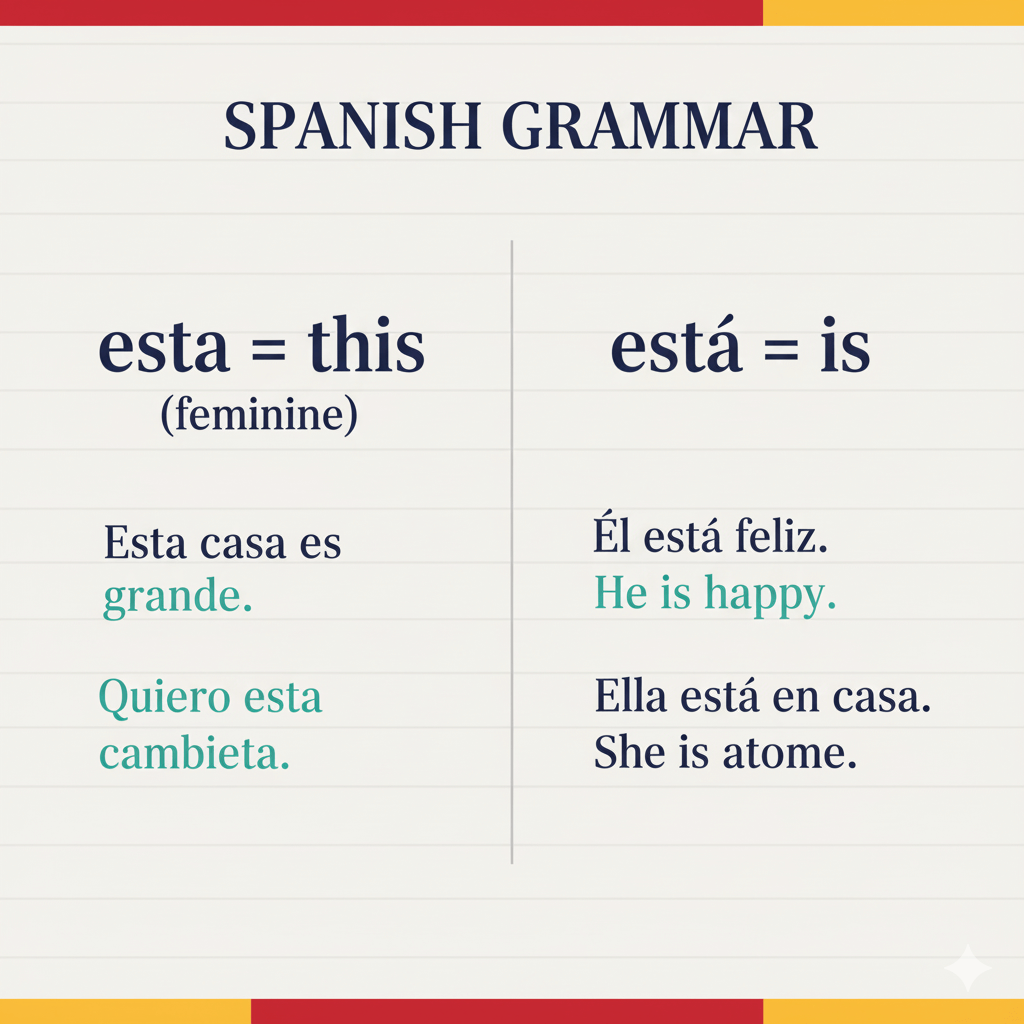
Definition at a glance (for featured snippets)
esta (determinant/adjective): this (feminine, singular) → esta mesa = this table.
esta (pronoun; accent optional in edge cases): this one (fem.) → ¿Quieres esta o aquella? Esta. Current guidance: demonstratives do not need an accent; using it is optional only to avoid genuine ambiguity.
está (verb): is → El museo está abierto = The museum is open.
“esta” (no accent) — how it works
Part of speech: demonstrative that marks proximity and agrees with a feminine singular noun: esta casa, esta idea, esta persona.
As a pronoun: You may see ésta in older texts, but today the RAE recommends no accent on demonstratives (write esta), with optional accent only in rare ambiguous cases.
Examples (Spanish → English):
Esta foto es reciente. → This photo is recent.
Me quedo con esta. → I’ll keep this one.
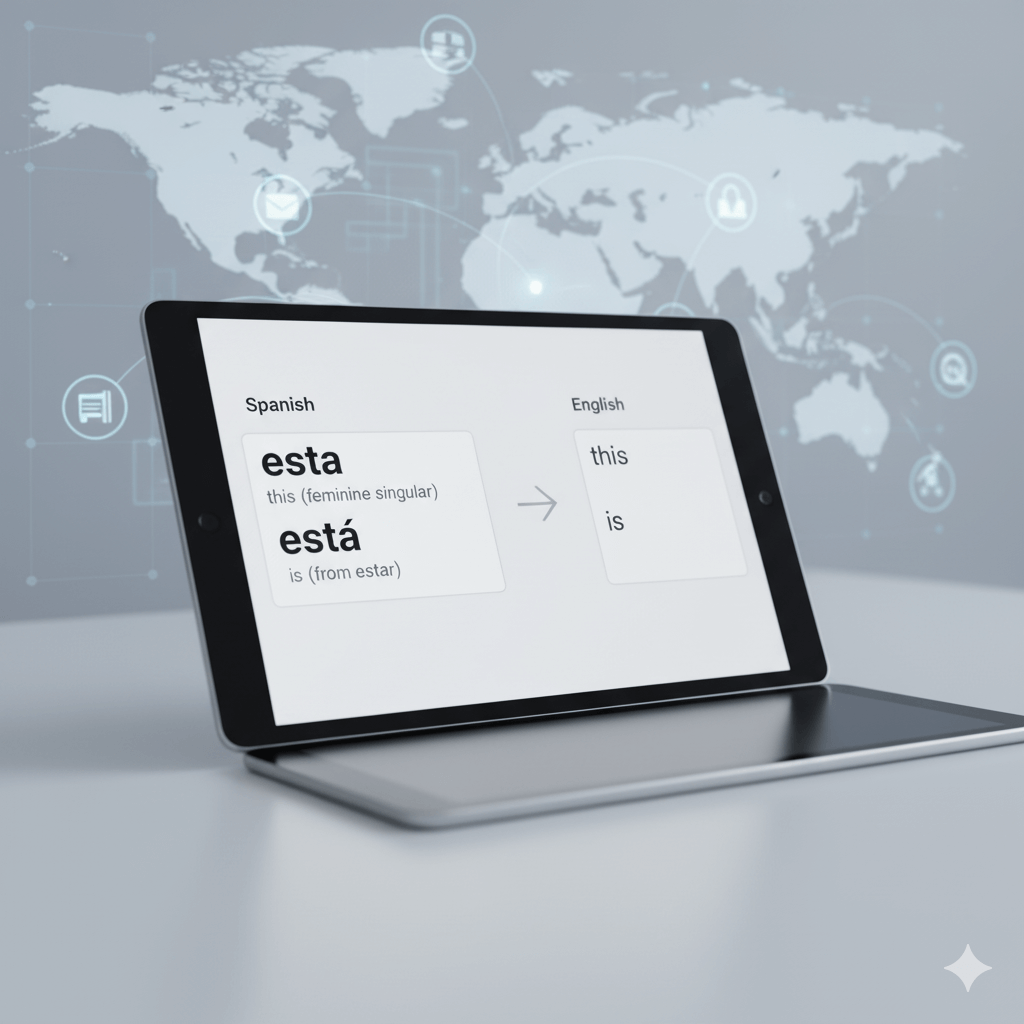
“está” (with accent) — the verb estar
Meaning: 3rd person singular of estar → is (temporary state, location, ongoing action with gerund).
Core uses:
Location: La tienda está aquí. → The shop is here.
Temporary state/condition: El café está frío. → The coffee is cold.
Present progressive: Está lloviendo. → It is raining.
Impersonal/weather idioms: Está nublado. → It is cloudy.
Mini chart (present indicative): estoy, estás, está, estamos, estáis, están.
Common mix-ups (and how to fix them)
esta vs. está → esta = this; está = is. Check if a noun follows (esta casa), or if you can replace with is.
estas vs. estás → estas (these, fem. pl.) vs. estás (you are).
ésta vs. esta → Accent generally not required today; optional only to avoid ambiguity.
ESTA (travel) vs. esta/está (grammar) → Different altogether; ESTA is U.S. travel authorisation
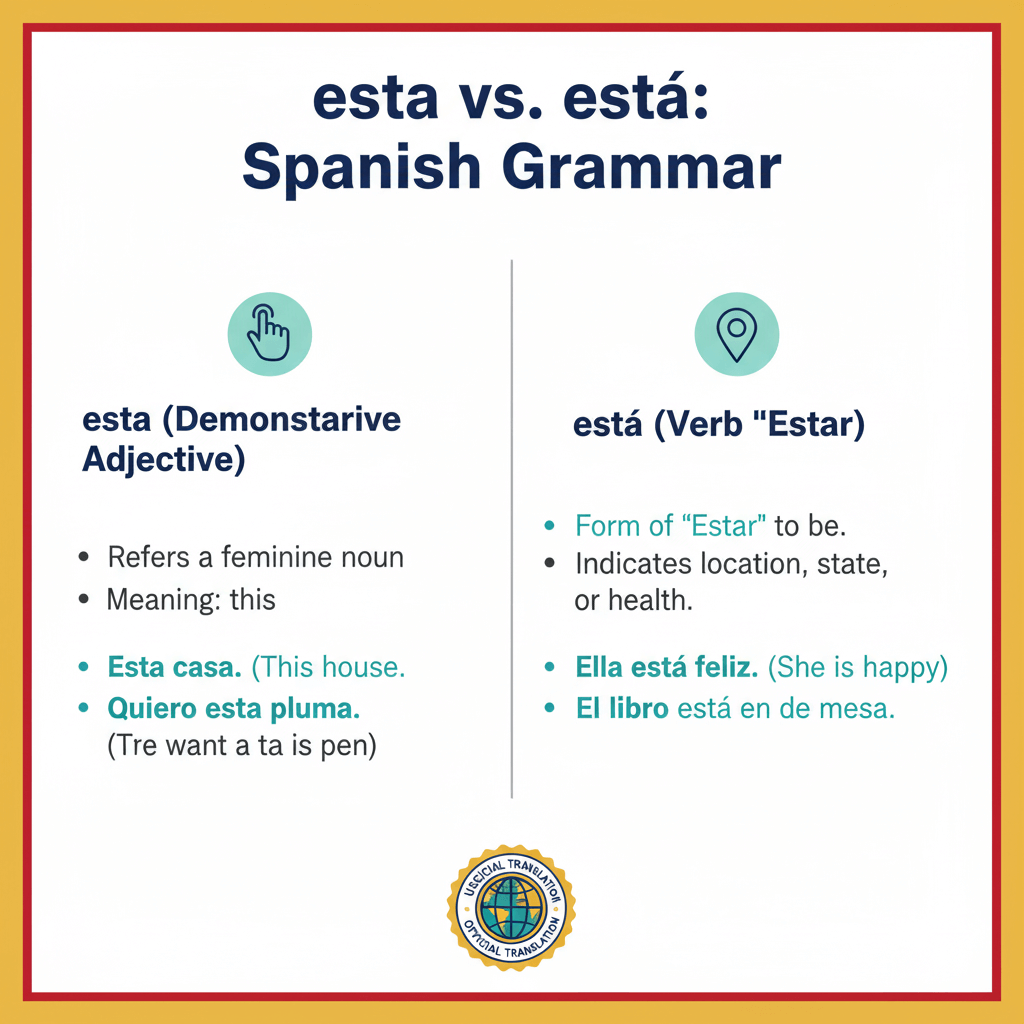
Translate “esta” to English — step-by-step
Identify the noun. If feminine singular (la mesa, la zona, la noche), esta → this.
If no noun follows, translate as “this one” (fem.).
If you really mean “is,” you need está (with accent).
Plural forms: estas → these (fem.); están → are (they are).
Quick examples:
Esta zona es tranquila. → This area is quiet.
¿Dónde está María? → Where is María?
¿Quieres estas? → Do you want these (ones)?
Los niños están listos. → The kids are ready.
Why this guide beats the dictionary results
Most top results are single-entry dictionaries or generic translators. We give:
Grammar + usage beyond one-word glosses (vs. dictionary stubs).
Up-to-date accent guidance from the RAE (not just forum lore).
Human examples and translation pitfalls you actually face when writing.
Need it translated now? Fast, human-checked Spanish→English
As part of our fast translation services offering, we deliver same-day Spanish→English translations with bilingual QA for accuracy and tone. Ideal for business email, marketing copy, or immigration paperwork.
Certified translators for official use (upon request)
Speed options: same day / 24-hour / 48-hour
Data security: NDA on request, secure upload
FAQs — “esta en english”
What does “esta” mean in English?
“This” (feminine, singular) when it modifies a noun; as a pronoun, “this one (fem.)”
What does “está” mean in English?
“Is” (3rd person of estar), used for states, locations, and progressives.
Do I need an accent on esta?
No in normal use; the RAE says demonstratives don’t take an accent; it’s optional only to avoid real ambiguity.
How do I translate “esta en casa”?
If written “está en casa”, it’s “(She/He) is at home.” If “esta casa,” that’s “this house.” Context and accent mark change the meaning.
Is ESTA the U.S. travel authorisation?
Yes. Our on demand translation services cover customs forms, invoices, return instructions, and claims documentation—so the call outcome is implemented quickly.