
If you’re preparing an immigration, visa, citizenship, or passport application, you’ll almost certainly be asked for a translated birth certificate. Somewhere in that process, a common question pops up:
“Can a notary translate my birth certificate?”
The short answer for most situations, especially USCIS cases, is:
No – a notary public should not be the one translating your birth certificate.
Notaries and translators play different roles. A notary’s job is to verify identities and witness signatures, not to perform the translation itself.
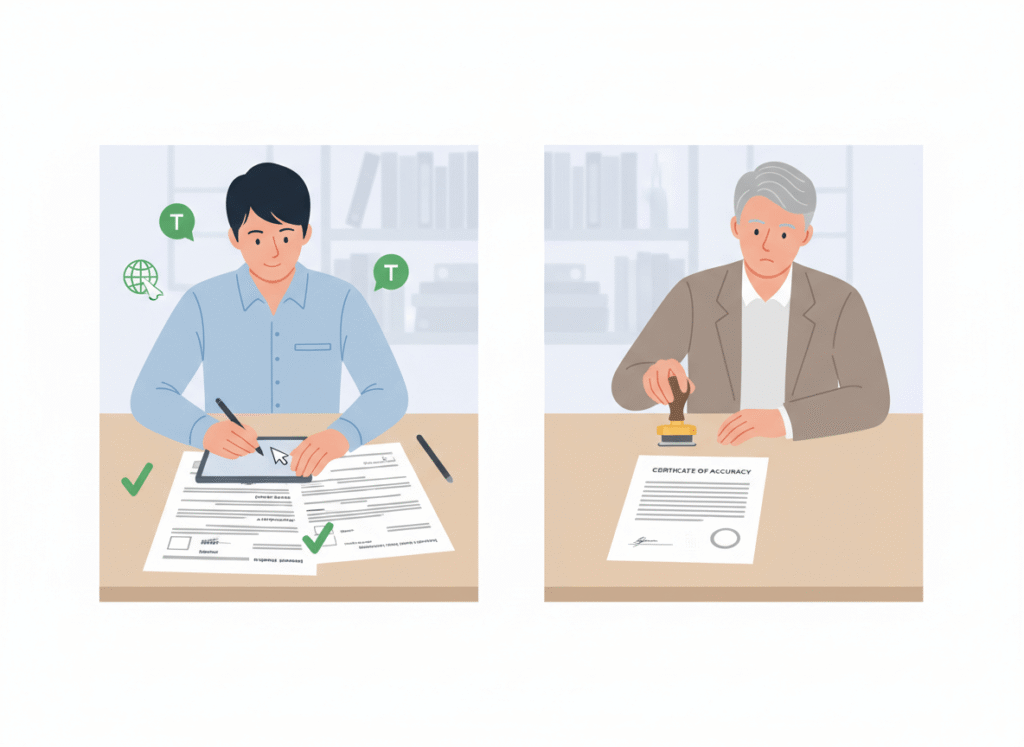
The Short Answer: Can a Notary Translate a Birth Certificate?
For most immigration and legal uses, especially in the United States:
A notary public cannot “replace” a qualified translator.
What usually is allowed is one of the following:
- A qualified translator translates the birth certificate, and
- A notary notarises the translator’s signature on a certificate of accuracy, if requested.
So the notary is validating who signed, not how well they translated.
There is one exception:
- If a notary also happens to be a professional translator and is allowed by law or institutional rules to provide translation, they could do the translation in their capacity as a translator – but it’s their translator role that matters, not their notary commission.
However, relying on a random notary who speaks another language is risky. They may not understand immigration requirements, formatting, or terminology, and that can easily lead to Requests for Evidence (RFEs) or outright rejection.
Who Is Legally Allowed to Translate a Birth Certificate?
For USCIS and most US immigration situations, the key standard comes from 8 CFR 103.2(b)(3):
Any foreign-language document submitted to USCIS must be accompanied by a full English translation, which the translator has certified as complete and accurate, and by the translator’s certification that they are competent to translate from that foreign language into English.
That means:
- The translator must be fluent in both languages
- The translation must be complete and accurate (including stamps, seals, and notes)
- The translator must sign a certification statement confirming both of the above
USCIS does not say that:
- The translator must be a notary
- The translator must be “sworn” by a court
- The translation must be notarised
In theory, any competent person (even a friend) could translate, but in practice:
- USCIS officers are strict about accuracy, consistency of names and dates, and proper formatting
- Amateur translations are a common cause of RFEs and delays
This is why most applicants choose a professional translation agency like USCIS Official Translation that:
- Specialises in birth certificate translation for immigration
- Provides USCIS-compliant certification wording
- Understands how to mirror the layout and handle stamps, seals, and handwritten notes correctly
What USCIS Actually Requires from Your Birth Certificate Translation
For a typical birth certificate used in a USCIS application, you need:
- Full English translation
- Nothing omitted: names, places, margins, seals, stamps, notes, handwritten annotations – everything.
- Certificate of accuracy signed by the translator
- Stating they are competent in both languages
- Confirming the translation is complete and accurate
- Translator’s details
- Full name
- Signature and date
- Contact information (address or email)
- Original-language document copy
- A clear copy of the original birth certificate attached to the translation
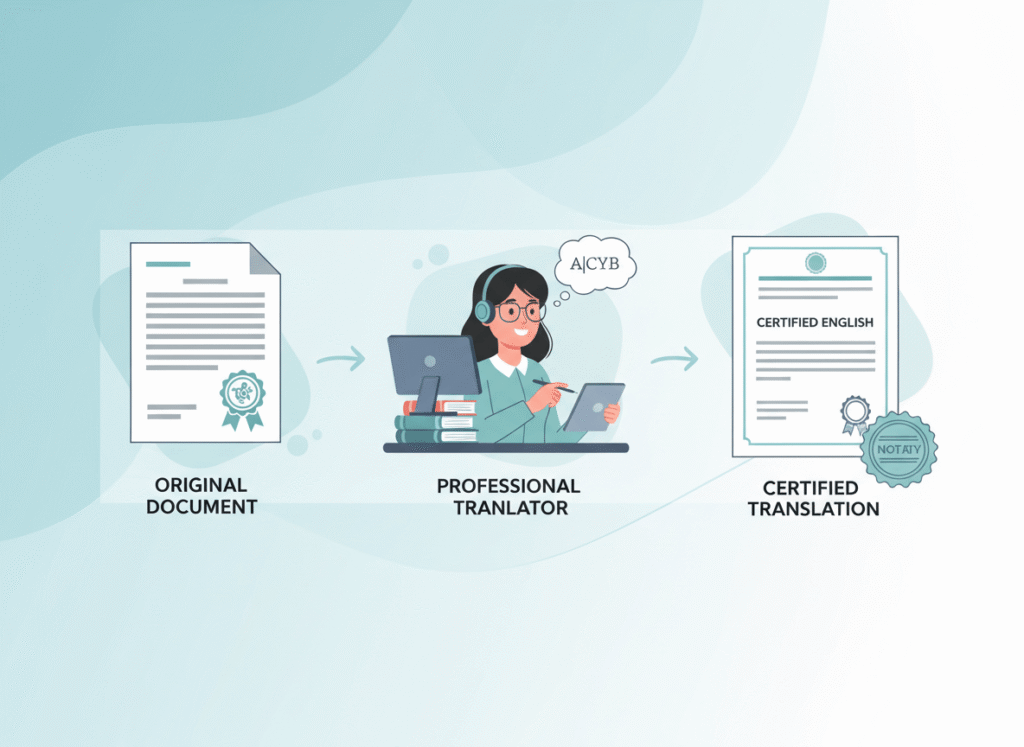
What a Notary Public Can and Cannot Do
It helps to clearly separate the roles.
What a notary can do
A notary public can:
- Verify the identity of the person signing the translator’s certificate
- Witness the translator’s signature
- Attach a notarial certificate and stamp/seal
- Sometimes, provide remote or e-notarisation where allowed
So a notary is confirming:
“This person signed this statement in front of me and proved their identity.”
They are not confirming:
“This translation is linguistically correct.”
What a notary cannot do
A notary cannot, by virtue of being a notary alone:
- Automatically become a qualified translator
- Guarantee the accuracy of the translation
- Replace the requirement for a translator’s certification
Many reputable sources are explicit: a notary’s role is to verify identity and signatures, not to perform or certify the translation itself.
Certified vs Notarised Translation: What’s the Difference?
These two terms are often confused, but they mean different things.
Certified translation
A certified translation is:
- A full translation of your document
- Accompanied by a signed certificate of accuracy from the translator or translation company
- Required for USCIS and most immigration authorities
This is exactly what USCIS asks for.
Notarised translation
A notarised translation is:
- A certified translation where the translator’s signature is notarised by a notary public
- Often requested for some court cases, state-level procedures, or foreign consulates
- Not primarily about language quality – it’s about identity verification of the signer
The translation itself is still done by a translator, not by the notary.
Which do you need?
- For USCIS: Certified translation is usually enough. Notarisation is optional unless your lawyer or a specific agency tells you otherwise.
- For some courts / universities / foreign authorities: They may explicitly ask for “notarised translation” or “sworn translation.” In that case, you’ll need both a certified translation and a notarised certificate.
USCIS Official Translation can provide certified translations for USCIS and notarised translations where extra formality is requested, so you don’t have to decide blindly.
When Might You Actually Need a Notarised Translation of a Birth Certificate?
There are situations where notarisation adds value or is requested, for example:
- Consular processing where a consulate or embassy specifies “notarised translation” in their instructions
- Court proceedings involving family law, inheritance, or identity disputes
- Certain foreign universities or professional bodies that routinely ask for notarised or sworn translations
- Local authorities abroad (civil registries, town halls) that rely on notarised translations to validate foreign documents
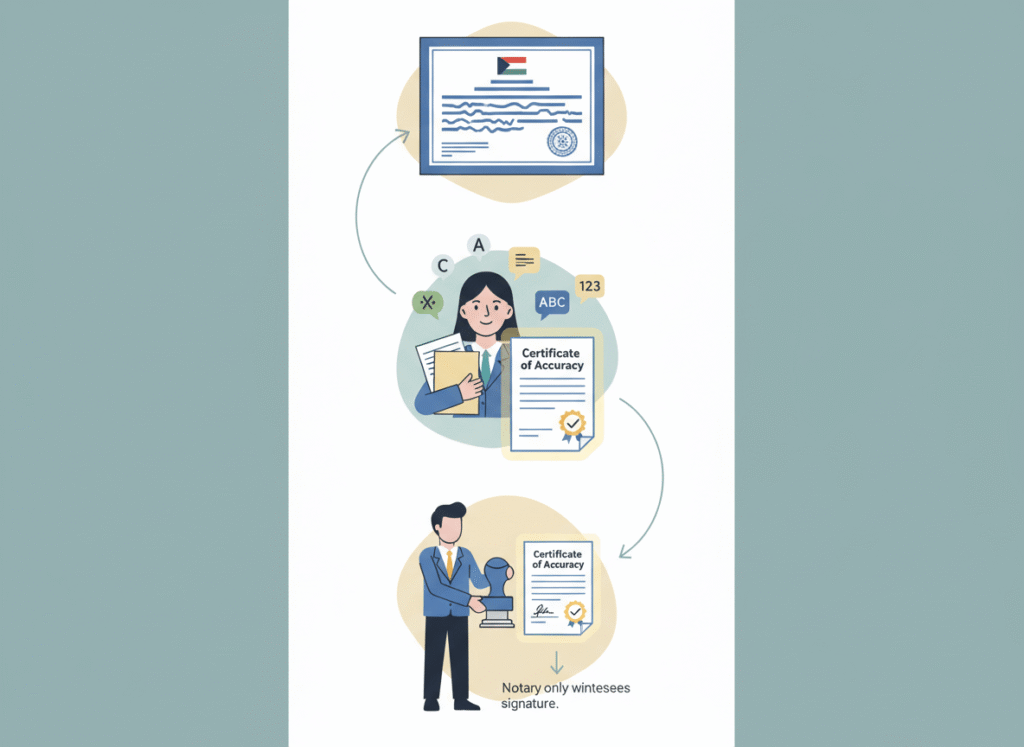
In these cases, a notary still does not translate your birth certificate. Instead:
- USCIS Official Translation prepares a certified birth certificate translation.
- Our translator signs the certificate of accuracy.
- A notary public notarises that signature, producing a notarised translation package ready for your specific authority’s requirements.
Common Myths About Notaries and Birth Certificate Translation
Let’s clear up a few misconceptions that cause headaches:
Myth 1: “If a notary speaks both languages, they can just translate it.”
Reality: Unless that notary is also acting as a professional translator, their notary status alone doesn’t make the translation acceptable. Immigration authorities care about the translator’s competence and certification, not their notary commission.
Myth 2: “USCIS needs everything notarised.”
Reality: USCIS primarily requires certified translations, not notarised ones. Notarisation is optional in most immigration cases.
Myth 3: “A notarised translation is always better than a certified one.”
Reality: Notarisation doesn’t magically improve translation accuracy. It only proves who signed the certificate. A sloppy translation with a notary stamp can still cause RFEs or rejections.
Myth 4: “I can save money by asking any bilingual acquaintance to translate.”
Reality: DIY translations are a major cause of RFEs, delays, and added legal fees. Professional translators understand terminology, formatting, and what officers look for.
Choosing a specialist service once is usually cheaper than fixing mistakes later.
How to Get Your Birth Certificate Translated Correctly (Step by Step)
Here is a straightforward, low-stress path to a compliant translation.
Step 1: Gather clear copies
- Scan or photograph your birth certificate at high resolution.
- Ensure names, dates, seals, and margins are all clearly visible.
Step 2: Confirm where you’ll use it
Ask yourself:
- Is this for USCIS only?
- Also for a foreign consulate, court, or university?
- Does any instruction specifically say “notarised translation” or “sworn translation”?
If it’s unclear, you can send the instructions to USCIS Official Translation and we’ll interpret them with you.
Step 3: Order a certified translation from a specialist
With USCIS Official Translation, you can:
- Upload your birth certificate securely
- Select whether you need certified or certified + notarised translation
- Choose digital delivery, and if needed, a posted hard copy
Every translation comes with:
- A Certificate of Translation Accuracy that matches USCIS and immigration expectations
- Professional layout mirroring the original document
- Translation of seals, stamps, and marginal notes
Step 4: Review the details
Before you submit your application, double-check:
- Spelling of all names (including accents)
- Dates and places of birth
- Document numbers, registration numbers, and passport details if shown
If you spot anything at all, ask for an adjustment. Professional services like USCIS Official Translation can issue corrected versions promptly.
Step 5: Attach both original and translation to your file
Finally:
- Attach the original-language copy of your birth certificate
- Attach the certified (and notarised, if applicable) translation
- Keep a digital copy for your records and any future applications
Real-World Scenarios: Do You Need a Notary Here?
To make it concrete, consider a few examples.
Scenario A: Green card application inside the US
- You’re filing an adjustment of status with USCIS inside the US.
- You need your birth certificate translated.
What you need:
- Certified birth certificate translation for USCIS
- No notarisation required in most cases
USCIS Official Translation provides a ready-to-submit translation with a certificate of accuracy.
Scenario B: Consular immigrant visa at a US embassy
- You’re applying for an immigrant visa abroad.
- The National Visa Center or embassy instructions mention “certified translation”.
What you need:
- Certified translation as described above
- Notarisation usually not required unless specifically mentioned
If the embassy uses confusing language like “notarised translation,” we can review the exact wording and provide a compliant package.
Scenario C: Dual-citizenship or foreign registration abroad
- You’re registering a birth in another country or applying for that country’s passport.
- The foreign authority demands a “notarised” or “sworn” translation.
What you need:
- Certified translation of the birth certificate
- Translator’s certificate notarised by a notary public
- Possibly additional apostille/legalisation steps depending on the country
USCIS Official Translation can coordinate the translation and notarisation steps so you receive a single, coherent set of documents instead of juggling multiple offices.
Why Choose USCIS Official Translation for Birth Certificate Translation?
When your immigration status or legal rights depend on a single document, the safest choice is a specialist service that lives and breathes this process.
With USCIS Official Translation, you benefit from:
- USCIS-ready translations of birth certificates and other civil documents
- Translators experienced in immigration and legal terminology
- Clear, compliant certificate of accuracy with every translation
- Optional notarisation when embassies, courts, or universities require it
- Fast, predictable turnaround times with clear pricing
FAQ: Notaries and Birth Certificate Translation
1. Can a notary translate a birth certificate for USCIS?
A notary can witness and notarise the translator’s signature, but they don’t replace a professional translator. For USCIS, what matters is a complete, accurate translation and a proper certificate of accuracy, not the notary stamp.
2. Do I need a notarised translation of my birth certificate for USCIS?
In most cases, no. USCIS requires a certified translation, not a notarised one. Some people choose notarisation as an extra layer of formality, but it is usually optional unless your attorney or a specific agency insists on it in writing.
3. Who can translate my birth certificate for immigration?
Any competent translator who is fluent in both languages and willing to sign a certificate of accuracy can do it. In practice, it’s strongly recommended to use a professional translation service experienced with USCIS to avoid mistakes, RFEs, or refusals.
4. Can I translate my own birth certificate?
You should not translate your own documents for USCIS. Even if you are fluent, self-translation can raise concerns about impartiality and increase the risk of errors. It is far safer to use a neutral, professional translator or agency.
5. When is a notarised translation actually necessary?
You may need notarisation if:
- A court, university, or foreign authority explicitly requests “notarised” or “sworn” translations; or
- Your attorney advises notarisation for a sensitive or complex case.
USCIS Official Translation can supply both certified and notarised translations, so you have the right type of document for each authority.
