
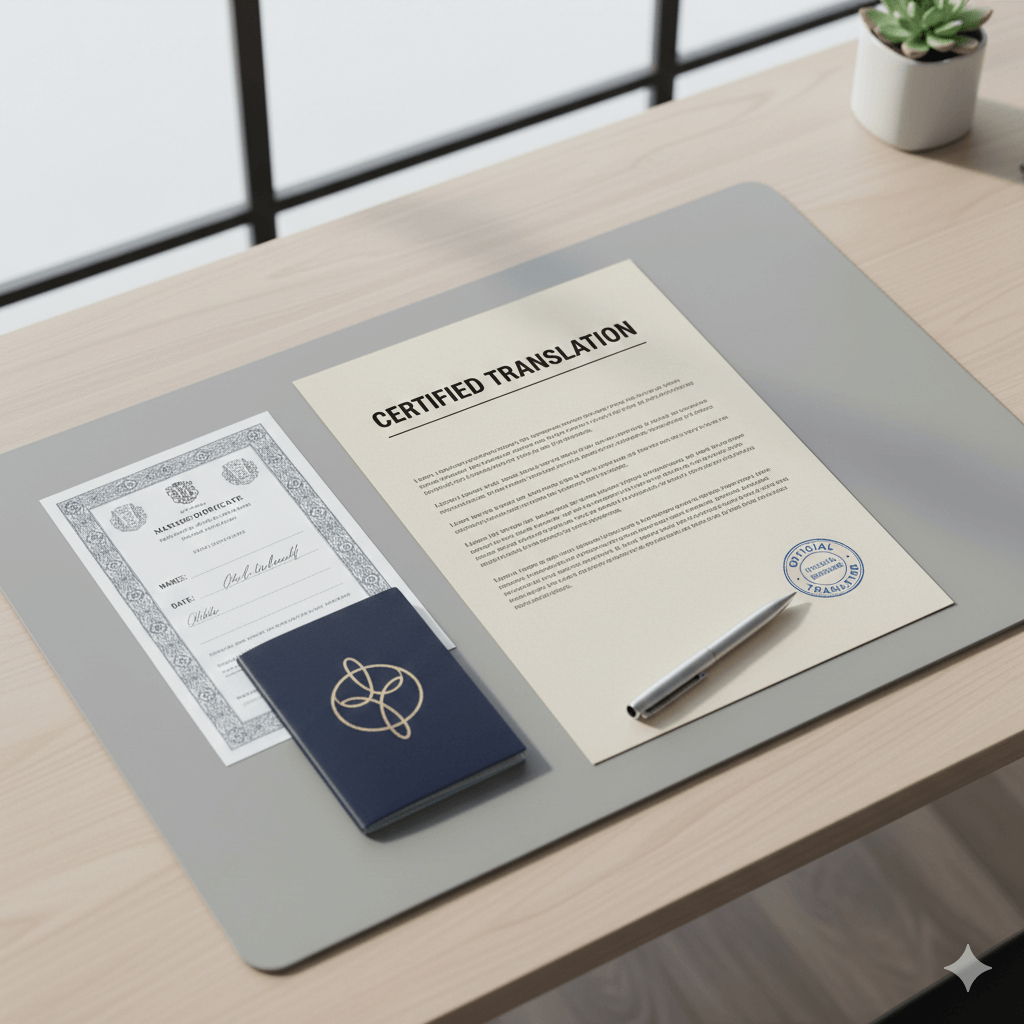
If your marriage certificate isn’t fully in English, you’ll usually need an English translation to submit with a U.S. immigration filing. The good news: it doesn’t have to be complicated — but it does have to be complete, readable, and properly certified.
This guide shows you exactly how to translate a marriage certificate in English in a way that’s easy for an immigration officer to review: what must be included, how to format it, what to do with stamps and handwritten notes, and the certification wording that makes the translation acceptable.
If you’d rather not risk delays, you can upload a clear scan and get a same-day quote for a USCIS-ready certified translation.
When you need an English translation (and when you don’t)
You typically need an English translation if:
- Any part of the marriage certificate is in a language other than English
- The certificate includes stamps, annotations, marginal notes, or back-page text in another language
- The document is bilingual but not fully English (for example, English headings with non-English entries)
You may not need a translation if:
- Every piece of text on the document is already in English
- Any stamps/notations are also in English and clearly legible
Quick rule: If an officer can’t read every word, they can’t evaluate the document. Translate everything that isn’t English.
What “USCIS-ready” really means (simple checklist)
A USCIS-ready marriage certificate translation has three parts working together:
1) Complete content (nothing missing)
You translate every element that contains meaning, including:
- Names, dates, places, registration numbers
- Headings and labels (even if repetitive)
- Notes like “amended”, “corrected”, “late registration”
- Stamps, seals, signatures, handwritten remarks
- Back-page text (often overlooked)
2) Officer-friendly formatting (easy to compare)
Your English version should allow a line-by-line or field-by-field comparison with the original.
3) A proper translator’s certification
A signed statement confirming the translator is competent and the translation is complete and accurate.
Miss any one of these and you increase the chance of a request for evidence or delays. and that the translation is accurate to the original document.
Step-by-step: How to translate a marriage certificate in English
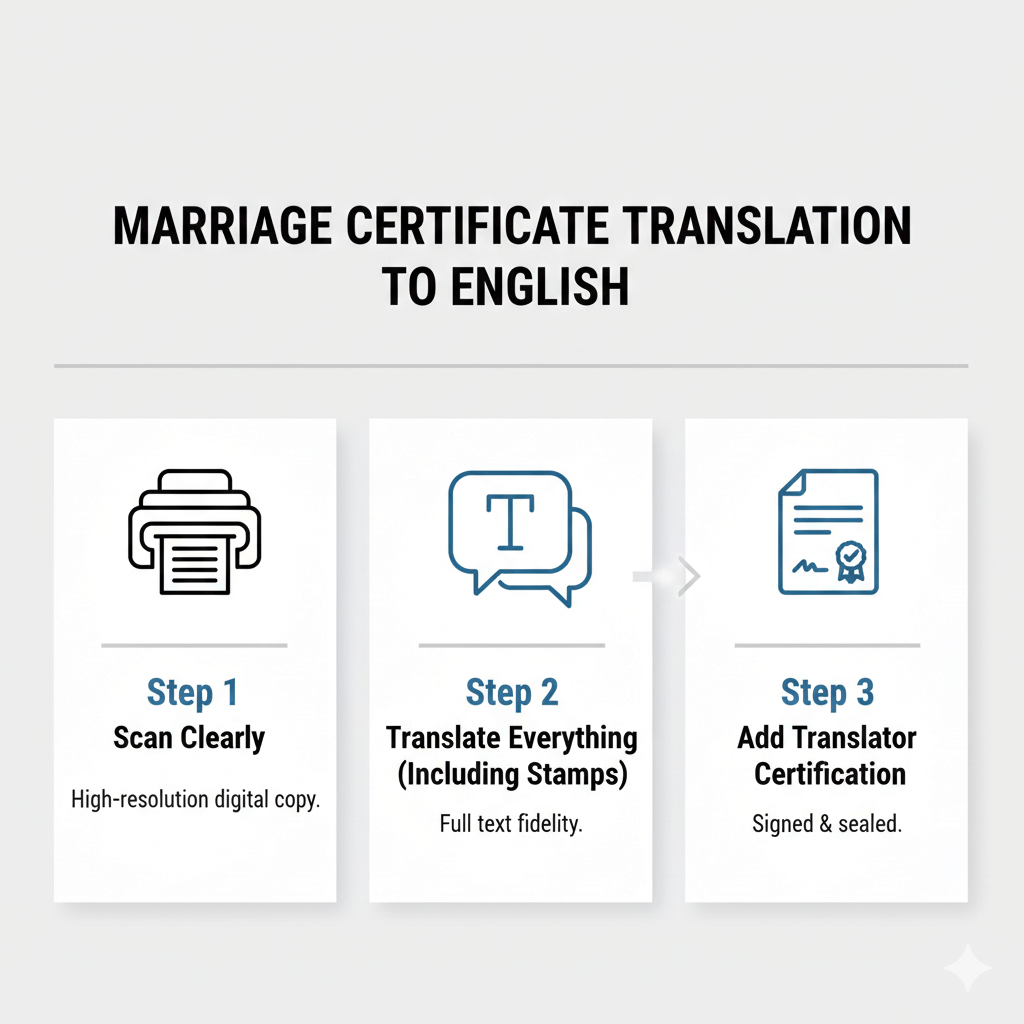
Step 1: Get a clean scan (this matters more than people think)
Before translation even starts:
- Scan in colour if possible
- Ensure all edges and corners are visible
- Include both sides of the document (even if one side “looks blank”)
- Make sure stamps and faint text are readable
- Avoid phone photos with shadows, glare, or perspective distortion
If the scan is unclear, the translation will have to include “illegible” notes, and that can raise questions.
Step 2: Recreate the structure (don’t rewrite it like a story)
Marriage certificates are structured records. Treat them like structured records.
Use a layout that mirrors the original:
- Keep the same order of sections and fields
- Use the same sequence of entries (Spouse 1 then Spouse 2, etc.)
- Preserve tables where possible
- Keep dates and numbers exactly as shown, then clarify format if needed
Example (format style):
- “Date of marriage: 03/07/2019”
- If the country uses day/month/year, keep the original and optionally add clarification in brackets:
- “03/07/2019 (03 July 2019)”
Step 3: Translate everything — including stamps, seals, and handwritten notes
This is where most DIY translations fail.
Include translations for:
- Round seals, embossed stamps, ink stamps
- Registrar notes (often in small print)
- Handwritten marginal corrections
- Watermark text if it contains words (when readable)
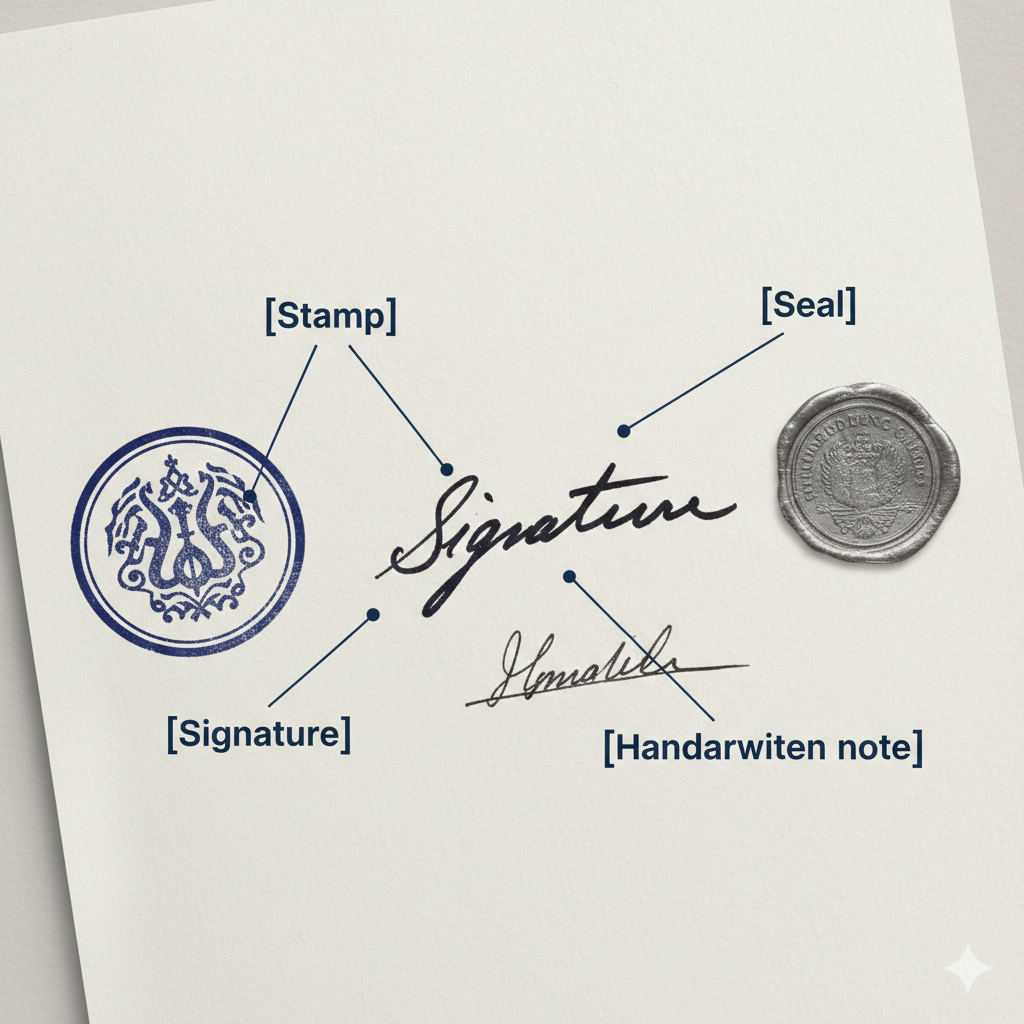
How to write stamps/seals cleanly:
- Use bracketed labels such as:
- [Stamp: Civil Registry Office, City, Country]
- [Embossed Seal: Ministry of Interior]
- [Signature: Registrar]
- [Handwritten note: Corrected on 12/09/2021]
- [Illegible stamp] (only if truly unreadable)
Step 4: Handle names the right way (spelling consistency is crucial)
Names cause avoidable problems when they don’t match across documents.
Use this approach:
- Copy names exactly as they appear on the marriage certificate
- If the certificate uses a non-Latin script (Arabic, Cyrillic, Chinese, etc.), translate via standard transliteration and keep it consistent with passports/IDs where possible
- Keep diacritics if they appear in the source (unless your filing set consistently omits them)
Practical tip: If your passport spells a name one way and your marriage certificate spells it differently, the translation can include a neutral note such as:
- [Name appears as shown in the source document]
(Do not “correct” the source inside a translation.)
Step 5: Add the translator’s certification (required for acceptance)
This is not optional for foreign-language documents.
Place the certification:
- On the last page of the translation, or
- As a separate page attached to the translation
Include:
- Statement of completeness and accuracy
- Statement of translator competency
- Translator’s name, signature, date
- Contact details (recommended)
- Company letterhead if done by an agency (recommended)
Translator’s certification (copy-ready wording)
Use wording like the following (adjust language pair as needed):
Translator’s Certification
I, [Translator Full Name], certify that I am competent to translate from [Source Language] into English and that the attached translation of the marriage certificate is a complete and accurate translation of the original document.
Signature: ____________________
Name: [Translator Full Name]
Date: [DD Month YYYY]
Contact: [Email / Phone]
Address: [Optional]
If you want the safest route, use a professional service that includes certification, formatting, and a final quality check. You can upload your document and receive a quote without any commitment.
Template vs professional translation: which is right for you?
A template may be enough if:
- The certificate is clean and printed (no handwriting)
- Stamps are minimal and fully legible
- The language uses straightforward civil registry terms
- You have a competent translator who understands how to format USCIS-ready translations
A professional service is usually better if:
- There are handwritten amendments, marginal notes, or corrections
- The document contains multiple stamps and seals
- The scan is faint or partially damaged
- The spelling of names varies across your documents
- You’re filing under tight deadlines and can’t afford rework
Real-world scenario: A two-line handwritten note can change the meaning of the record (for example, a later amendment). That’s exactly the kind of thing an officer may focus on.
Common mistakes that delay immigration filings (avoid these)
- Only translating the “main text” and ignoring stamps/notes
- Submitting an uncertified translation (missing competency/accuracy statement)
- Summarising instead of translating line-by-line
- Changing spellings to “fix” the document
- Leaving out the back page (often contains registration details)
- Formatting that doesn’t match the original, making it hard to compare
- Typing unclear guesses instead of marking illegible text properly
- Mixing date formats without clarification
If you’ve already translated it and you’re unsure it’s acceptable, it’s often faster to have it reviewed and corrected than to risk a rejection. Upload the file and request a quick compliance check.
Extra tips that make your translation easier to approve
Keep numbers and identifiers exactly as shown
Registration numbers, book/page references, and certificate IDs should match character-for-character.
Use consistent formatting for repeated fields
For example:
- “Husband:” / “Wife:” or “Spouse 1:” / “Spouse 2:”
Pick one and stay consistent across the full translation.
Mark unknown text honestly
If a portion is unreadable:
- [Illegible] is better than guessing.
Don’t overcomplicate it
A clear translation that mirrors the original is stronger than a “perfectly written” document that changes structure.
Final pre-submission checklist (30 seconds)
Before you submit:
- The translation includes everything visible in the original (including stamps/notes)
- The translation is easy to compare with the original
- A signed translator certification is attached
- Names/dates/places match the source exactly
- All pages are included (front/back)
- The scan is readable and complete
If you want it handled end-to-end, upload your marriage certificate and you’ll receive a same-day quote for a certified English translation prepared for USCIS review.
FAQs
1) Can I translate my marriage certificate myself for USCIS?
USCIS generally requires a complete English translation with a signed certification from a competent translator. Even if self-translation is possible in some situations, many applicants choose a third-party translator to reduce risk and avoid questions about accuracy.
2) Do I need notarisation for a marriage certificate translation in English?
For USCIS filings, notarisation is usually not required. What matters is the certified translation with the translator’s signed statement of competence and accuracy. Notarisation may be requested by other agencies, so only add it if you specifically need it.
3) What if my marriage certificate is bilingual (part English, part another language)?
If any part is not in English — including stamps, notes, or entries — you should translate the non-English portions. Many “bilingual” certificates still contain non-English fields that must be translated.
4) Do I have to translate stamps and seals on the marriage certificate?
Yes. Stamps, seals, signatures, and handwritten notes should be represented and translated (or clearly labelled) because they can contain official information relevant to the document’s validity.
5) How should I format the English translation of a marriage certificate?
Mirror the original layout as closely as possible. Keep the same field order and structure so an officer can easily compare the English translation to the source document.
6) What makes an English translation “certified” for USCIS?
A certified translation includes the complete English translation plus a signed certification stating the translation is complete and accurate and that the translator is competent to translate into English.
