
If you’re asking “how do I get my birth certificate translated?”, you’re usually on a deadline—filing an immigration petition, responding to a request for evidence, or preparing a visa or adjustment packet.
Here’s the simplest truth: you don’t need anything fancy. You need a complete English translation of your birth certificate plus a signed translator certification that makes the translation acceptable for immigration filing.
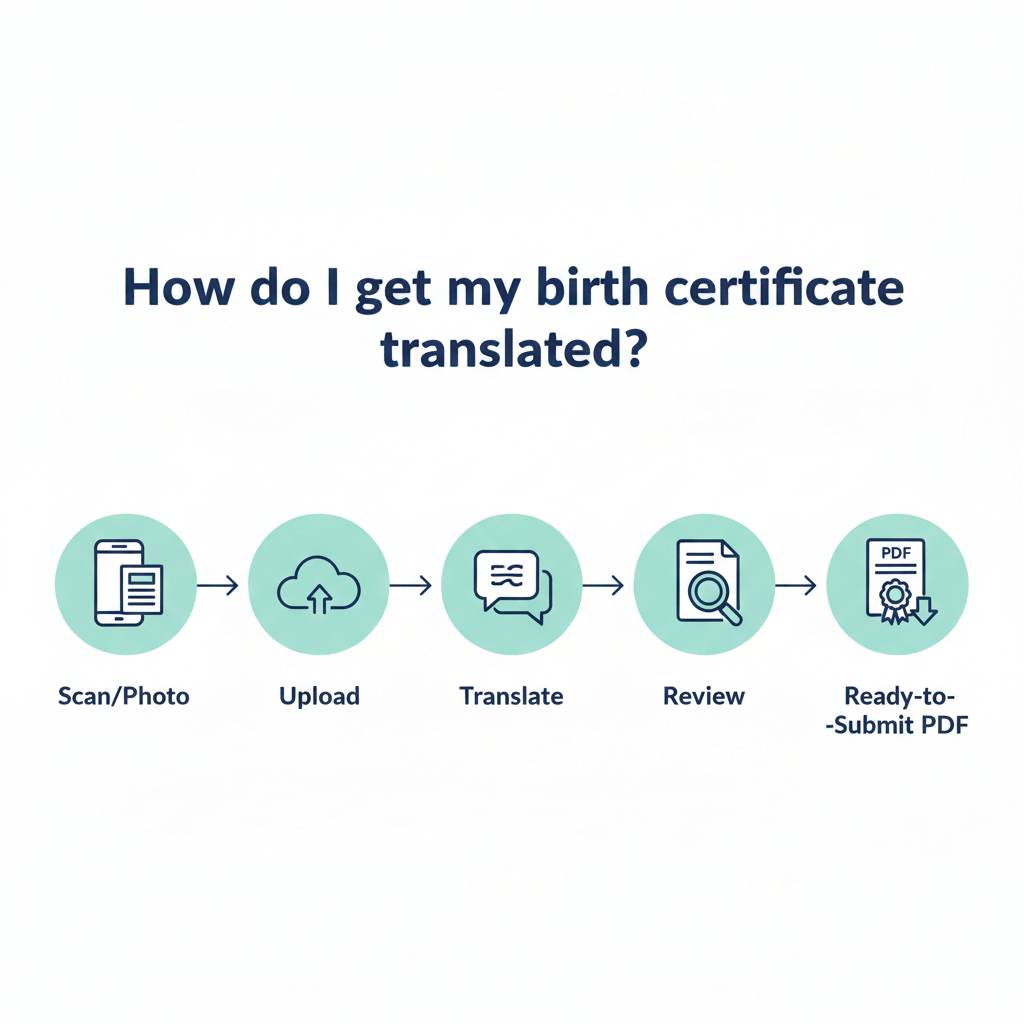
What “translated” actually means for a birth certificate (so it gets accepted)
A birth certificate translation isn’t just converting a few key lines into English.
A proper birth certificate translation includes:
- Every visible word (not summaries, not “main fields only”)
- Stamps, seals, annotations, marginal notes, and back-page text
- Headings, labels, and issuing authority details
- Any handwritten entries (and a note if something is illegible)
- A translator certification statement signed by the translator
Think of it like this:
If an officer can see it on the original, they should be able to find it in English on the translation.
The fastest way to get your birth certificate translated (in 10 minutes)
Before you contact a translator—or upload your file—do these three quick checks:
- Make sure you have the right version
Some countries issue multiple formats (short form vs long form). For immigration, you’ll usually want the version that shows full parent details and registration information. - Scan it clearly
Use a scanner app if needed, but make sure:
- All edges are visible
- No glare, no blur
- Stamps and raised seals are legible
- Any back side is included if it contains text or markings
- Write your name exactly as it appears on your immigration documents
This avoids inconsistencies between your passport, forms, and translated documents.
Then you’re ready to translate.
Step-by-step: How do I get my birth certificate translated?
Step 1: Confirm what you’re translating for (USCIS vs embassy vs court)
If your translation is for U.S. Citizenship and Immigration Services, the requirements are typically straightforward: certified translation + translator certification.
If it’s for a consulate, court, or another authority, you may need notarization or other formalities.
Step 2: Decide whether you should DIY or use a professional
People often ask:
- “Can I translate my own birth certificate?”
- “Can my friend or family member translate it?”
Technically, some applicants try. Practically, it’s one of the most common ways people trigger delays—because the translation is incomplete, the certification wording is missing, or stamps/notes are skipped.
When DIY is riskiest
- Your document has stamps/seals or handwritten notes
- The language uses non-Latin script (Arabic, Chinese, Cyrillic, etc.)
- Your names require transliteration (multiple acceptable spellings)
- The certificate has dense registration blocks or regional format quirks
- You’re already responding to an RFE or dealing with tight deadlines
Best practice: use a professional who translates these documents daily.
Step 3: Choose a translator who knows what immigration officers expect
When selecting a translator or service, ask (or verify) these points:
- Will you translate every visible element (including stamps, seals, margins)?
- Will you include a signed translator certification with each document?
- Will the translation be delivered as a clean PDF, formatted clearly?
- Can you fix minor edits quickly (names, formatting, missing lines)?
- Is there a secure upload method?
Step 4: Send the translator exactly what they need (so you don’t pay twice)
To avoid rework, give your translator:
- A clear scan/photo of the certificate (front + back if applicable)
- The country/region of issuance
- The language (and dialect if relevant)
- Your name spelling exactly as used on your immigration paperwork
- Any special instructions (deadline, hard copy needed, attorney format requests)
Step 5: Make sure the translation includes stamps, seals, and “invisible” text
This is where many translations fail.
Birth certificates often include:
- Circular seals with text around the edge
- Registry stamps with dates and office numbers
- Margin notes (corrections, late registration, legitimization notes)
- Reverse-side text (issuing instructions, serial tracking, validation codes)
A compliant translation will render these clearly, for example:
- [Seal:] “Civil Registry Office — City of ____”
- [Stamp:] “Received — Date — Office No. ____”
- [Illegible stamp] (if it truly cannot be read)
Step 6: Verify the translator certification statement (this is not optional)
A translation is only “certified” for immigration when it includes a signed statement confirming two things:
- The translation is complete and accurate
- The translator is competent to translate into English
It should also include identifiers like the translator’s name, signature, and date (and ideally contact details).
Step 7: Do a quick quality check before you submit
Use this 2-minute checklist:
Completeness
- Does every stamp/seal/note appear in English?
- Does the translation include the same number of pages as the original?
Names & dates
- Are names spelled consistently with passports and forms?
- Are dates translated clearly (avoid ambiguity like 03/04/05)?
Numbers
- Registration number, book/folio, entry number—present and accurate?
Legibility notes
- If something is unreadable, is it marked as such (instead of being omitted)?

How much does it cost to translate a birth certificate?
Costs vary depending on language, formatting complexity, and urgency. For many common birth certificates, pricing is usually per page.
On USCIS Official Translation, you can view current pricing here: <a href=”https://uscisofficialtranslation.com/pricing/”>certified translation pricing</a>—or get an exact quote instantly by uploading: <a href=”https://uscisofficialtranslation.com/order-form/”>upload your file</a>.
Tip to save money without risking rejection:
Upload a clean scan. Poor-quality images slow translation and increase the chance of errors.
How long does birth certificate translation take?
If your deadline is close, you have three realistic options:
- Standard (often within 24 hours for most certificates)
- Rush (faster turnaround when you’re filing urgently)
- Same-day (possible for many languages and clean scans)
Do I need notarization for my birth certificate translation?
For most USCIS filings, notarization is typically not required—a proper translator certification is what matters.
Notarization may be requested by:
- Certain courts
- Some universities/licensing bodies
- Some consulates/foreign authorities
Common mistakes that cause delays (and how to avoid them)
Mistake 1: Using machine translation without human certification
Tools can help you understand a document, but immigration submissions require accountability—meaning a real translator signs the certification.
Mistake 2: Leaving out stamps, seals, or the back side
If it’s visible, it needs to be translated—or labeled as illegible.
Mistake 3: “Close enough” name spelling
If your translated name doesn’t match your passport spelling, you can trigger questions. Transliteration consistency matters.
Mistake 4: Wrong date interpretation
Many countries use day-month-year. If you don’t spell out the month, you risk confusion.
Mistake 5: A certification statement that’s missing key wording
Some DIY templates omit competence language or fail to identify which document is certified.
A sample translator certification statement (use this to compare yours)
Below is a practical example you can use as a reference. Your translator may format it differently, but the meaning must be clear and complete:
CERTIFICATION OF TRANSLATION ACCURACY AND COMPETENCE
I, [Translator Full Name], certify that I am competent to translate from [Language] into English, and that the attached translation of the [Document Title] is a complete and accurate translation of the original document.Signature: _______________________
Printed Name: ____________________
Date: ___________________________
Contact (email/phone): ___________
Address: ________________________
Where can I go to translate my birth certificate?
You generally have four options:
- Online certified translation service (fastest and easiest for most people)
- Local translation agency (useful if you need in-person help)
- Independent translator (works well if they understand immigration requirements)
- Community/legal aid resources (sometimes available, but quality varies)
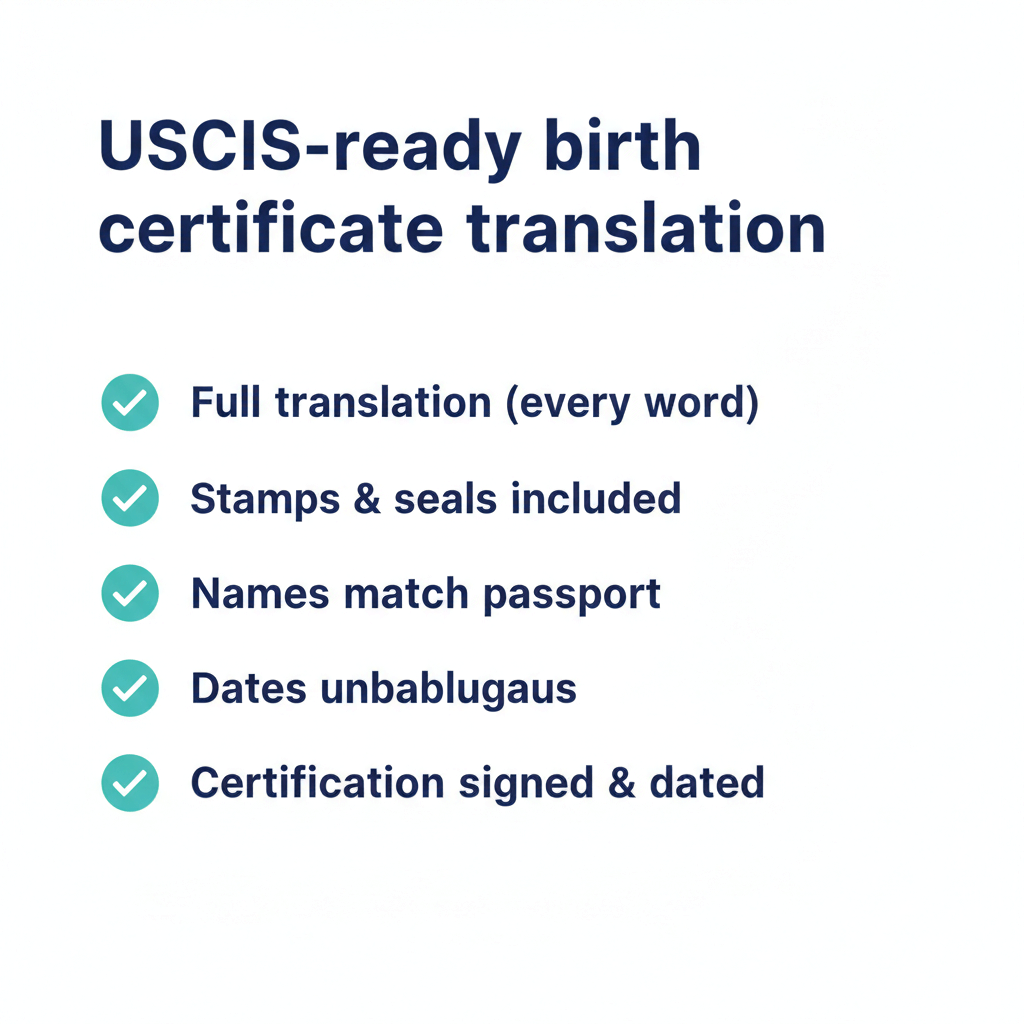
Quick “ready-to-submit” checklist (save this before you file)
Before you submit your packet, make sure you have:
- Original birth certificate copy (front + back if needed)
- Full English translation (no missing parts)
- Translator certification attached (signed and dated)
- Names consistent with passport/forms
- All stamps/seals/notes included in English
What clients typically say (real-world reassurance)
“I needed it fast and didn’t want to risk an RFE. The translation was clean, certified, and accepted.”
“The stamps and margin notes were translated too—exactly what my attorney asked for.”
“Simple upload, clear pricing, and quick delivery. Took the stress out of filing.”
Final step: Get your birth certificate translated the safe way
If you’ve made it this far, you already know what matters: completeness, clarity, and a proper certification statement.
FAQ Section
How do I get my birth certificate translated for USCIS?
Get a full English translation of every visible element (including stamps/seals) and attach a signed translator certification confirming completeness, accuracy, and competence.
Can I translate my own birth certificate for USCIS?
Many applicants try, but it’s risky. Self-translation often leads to missing stamps/notes or incomplete certification wording, which can delay your case.
Does a birth certificate translation need to be notarized?
Usually not for USCIS filings. Notarization may be required by courts, universities, or consulates—but USCIS typically focuses on the translator certification statement.
How much does it cost to translate a birth certificate?
Pricing depends on language, formatting complexity, and urgency. Many services price birth certificates per page and offer rush options.
How long does it take to translate a birth certificate to English?
Turnaround can be as fast as same-day or 24 hours for many certificates, depending on language availability and scan quality.
What should a translator certification statement include?
At minimum: a statement that the translation is complete and accurate, a statement of translator competence, plus the translator’s signature and date (and ideally name and contact details).
