
You’ve finally gathered all your immigration paperwork, only to get stuck on one deceptively simple question:
“Where should I translate my birth certificate so USCIS will actually accept it?”
Get this wrong and you risk delays, Requests for Evidence (RFEs), or even a denied application. Get it right and your birth certificate quietly does its job in the background—exactly how it should.
This guide from USCIS Official Translation walks you through:
- What USCIS really requires from a birth certificate translation
- Who is allowed to translate it (and who definitely shouldn’t)
- The safest places to translate your birth certificate
- How to avoid the most common—and costly—mistakes
- What the process looks like step-by-step with a specialist provider
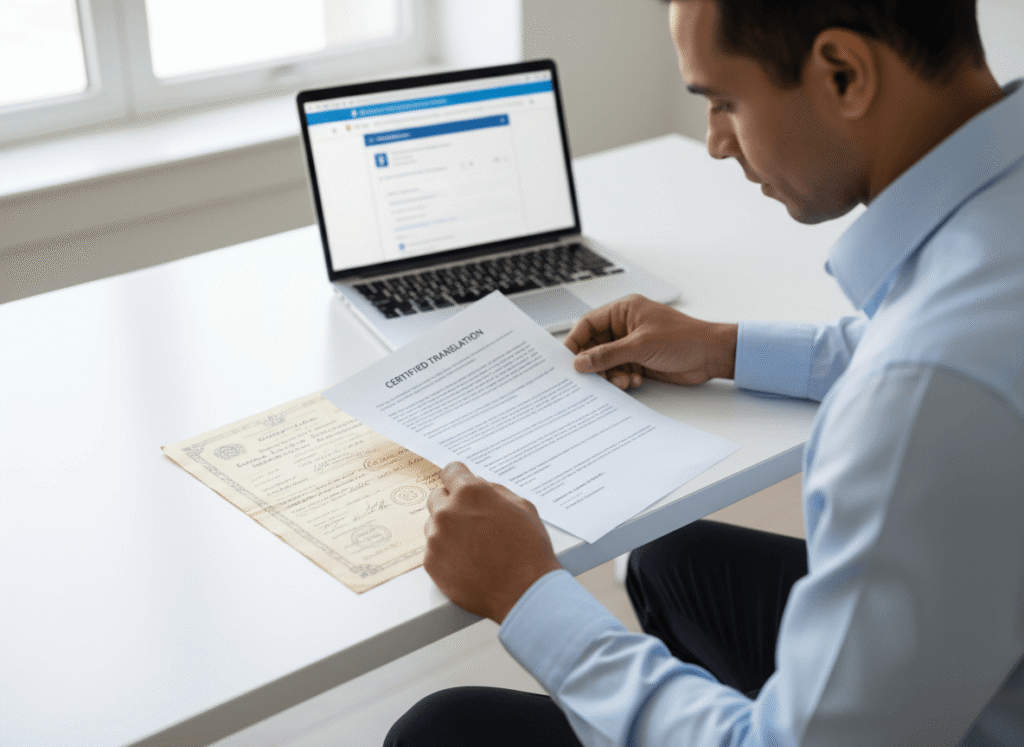
Why your birth certificate translation matters so much
For most people applying to live, work, or reunite with family in the United States, the birth certificate is a foundational identity document. If it’s not in English, U.S. Citizenship and Immigration Services (USCIS) expects a compliant English translation alongside it.
USCIS policy is clear: any foreign-language document must be accompanied by a full English translation plus a certification from the translator confirming completeness and accuracy.
If the translation doesn’t meet these requirements, USCIS can:
- Issue a Request for Evidence (RFE)
- Delay adjudicating your application
- In serious cases, reject the evidence altogether
What USCIS actually requires from a birth certificate translation
Before you decide where to translate your birth certificate, it helps to know what USCIS expects to see.
According to the USCIS Policy Manual and related guidance, a compliant translation must:
- Include a full, word-for-word translation
- Every name, date, stamp, note, and annotation must be translated.
- No paraphrasing, summarising, or “simplifying” the content.
- Come with a signed certification by the translator confirming:
- The translation is complete and accurate, and
- The translator is competent in both the original language and English.
- Be clear and legible
- Typed rather than handwritten
- Formatted in a way that mirrors the structure of the original document as closely as possible
- Be independent
- The translator is usually expected to be someone other than you; many practitioners strongly advise against translating your own documents due to impartiality concern
Who can translate your birth certificate?
When people ask “where to translate my birth certificate”, they’re really asking “who is allowed to do this so USCIS accepts it?”
Let’s break down your options.
1. Professional translation company specialising in immigration
This is the safest and most straightforward option.
A reputable service, such as USCIS Official Translation, will:
- Work with translators experienced in immigration and civil-status documents
- Provide a properly formatted certification statement
- Deliver translations that meet standard USCIS expectations, including word-for-word accuracy and clear formatting
- Offer digital delivery (PDF) and, where needed, printed copies
For most applicants—especially those on tight deadlines—this option provides the best balance of speed, reliability, and peace of mind.
2. Independent professional translator
You can also work with a freelance translator who:
- Is fluent in both the language of the birth certificate and English
- Understands how to handle official documents
- Can provide a written certification with their name, date, contact details, and competence statement
This can work well if your lawyer, community, or friends already know a trusted translator. Just ensure they follow USCIS-style certification wording and translate the document in full.
3. Competent non-professional (high risk)
Technically, USCIS requires a competent translator, not necessarily someone with a specific licence or membership in a professional association.
Some applicants have used a bilingual friend or acquaintance—as long as that person can:
- Translate the document completely and accurately
- Provide their full name, signature, and a certification statement
However, there are serious risks:
- They may not know how to mirror formatting or capture stamps/seals
- They might omit details that seem “unimportant” but matter to USCIS
- USCIS or an officer may look less favourably on an informal translation, increasing the odds of an RFE
For most people, the potential savings do not justify the risk compared to a reasonably priced professional service.
4. You, the applicant (not recommended)
Can you translate your own birth certificate?
In practice, you should not translate your own document. Immigration practitioners widely advise against self-translation, and many reputable services and legal resources state that USCIS expects an independent translator to avoid conflicts of interest.
Where to translate your birth certificate: main options compared
Now that you know who can do it, let’s look at where you can actually go—online or offline.
1. Specialist online birth certificate translation service
For most applicants, the most convenient answer to “where to translate my birth certificate” is:
Use an online service that specialises in USCIS-ready certified translations.
A trusted provider such as USCIS Official Translation typically offers:
- 100% online process – upload a clear scan or photo of your birth certificate
- Fast turnaround – many services deliver within 24 hours for a standard birth certificate, with urgent options available
- Fixed, transparent pricing per page – you know the cost before committing
- Certified translation PDF plus optional printed copy
- Experience with immigration cases, meaning fewer formatting or wording errors
This option is ideal if you:
- Are living abroad
- Don’t have access to a local specialist
- Want a clear, documented trail of payment, delivery, and certification
Call to action:
Upload a clear scan of your birth certificate to USCIS Official Translation today to receive a certified English translation you can confidently submit with your immigration application.
2. Local translation office or language service
If you prefer in-person service, you can look for a local translation company in your city.
Advantages:
- Face-to-face communication if you’re more comfortable discussing details in person
- Easy to ask questions and clarify special requests
- Good option if you also need other local services (e.g. sworn translations in some countries)
Things to check:
- Do they explicitly state that their translations are suitable for U.S. immigration?
- Will they provide an English translation with certification in the proper format?
- Can they deliver a digital copy (PDF) if you’re filing online?
3. Law firms, notaries, and community organisations
In some places, you might find:
- Immigration lawyers who partner with translation services
- Notaries who can notarise the translator’s signature (sometimes requested, though not generally required by USCIS itself)
- Community organisations or non-profits helping with translations for low-income applicants
These can be useful if you’re receiving broader immigration support; just make sure the translation still:
- Includes a proper certification
- Is complete, accurate, and legible
- Comes from someone truly competent in both languages

How to choose a translation provider you can trust
Whichever route you choose, use this checklist to avoid disappointment:
- Immigration focus
- Do they clearly state that they provide translations for USCIS or U.S. immigration cases?
- Proper certification
- Ask to see a sample certification statement (with sensitive data removed). It should explicitly mention accuracy, completeness, and language competence.
- Clear turnaround times
- Standard for a one-page birth certificate is often 12–24 hours, with urgent options for same-day delivery.
- Transparent pricing
- Look for per-document or per-page pricing with no surprise fees for the certification itself.
- Secure file handling
- Check whether the site uses HTTPS and offers secure upload.
- Ideally, documents should be stored only as long as needed to complete the service.
- Real reviews and support
- Genuine client testimonials, independent platform reviews, and prompt responses to questions are all good signs.
What information on your birth certificate must be translated?
A compliant translation includes every element of the original document, not just the “main” details. That usually means:
- Full name of the person
- Date and place of birth
- Full names of parents (sometimes including maiden names)
- Official seals, stamps, and annotations
- Registration or certificate numbers
- Issuing authority and any notes
Step-by-step: how the process works with USCIS Official Translation
Here’s what the process typically looks like when you use a dedicated provider like USCIS Official Translation:
- Upload your document
- Take a clear, flat photo or scan of your birth certificate (all corners visible).
- Upload it through a secure online form.
- Get an instant quote
- See the price up front, usually based on language pair and length.
- Confirm turnaround time (for example, standard 24 hours with faster options available).
- Place your order
- Enter your contact details and pay online via a secure checkout.
- Professional translation
- A qualified translator with experience in civil-status documents prepares a full, word-for-word English version.
- Quality check and certification
- A second linguist or reviewer checks spelling, dates, formatting, and consistency.
- A certification statement is added, signed, and dated.
- Delivery
- You receive a PDF copy of the certified translation by email.
- Where needed, you can also request a printed, signed copy by post.
- Use it for your application
- Print and attach the translation to your application packet, or upload the PDF if you’re submitting online.
- Keep the digital version safely stored for future immigration steps that may also require it.
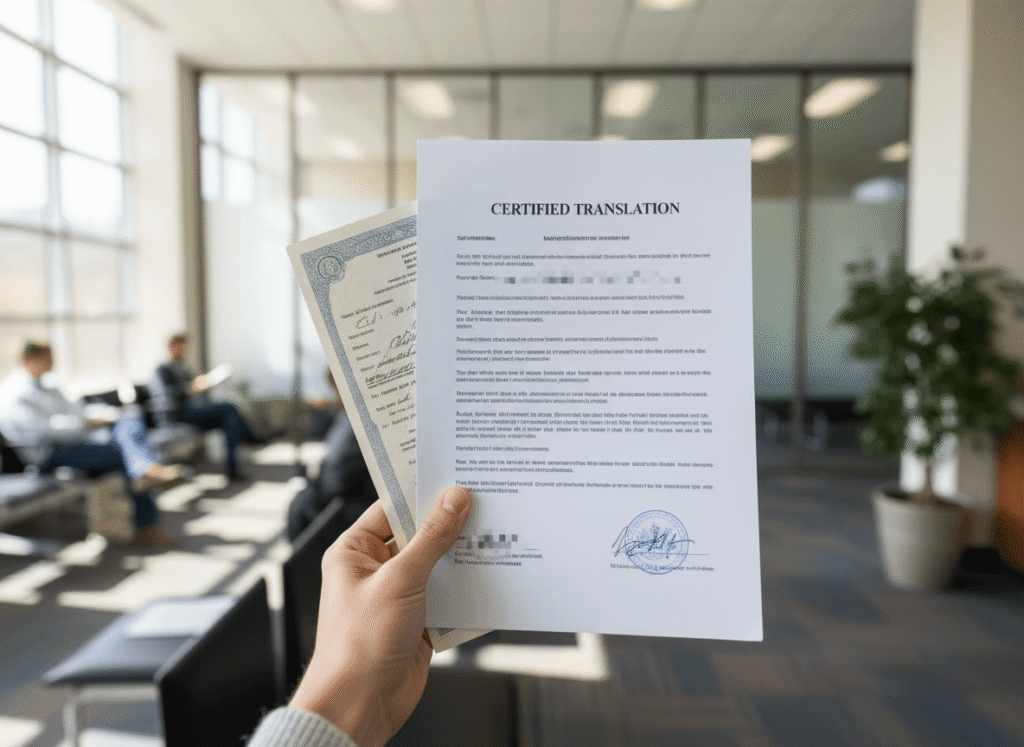
Common mistakes that cause RFEs—and how to avoid them
Even when people choose the right place to translate their birth certificate, small errors can cause unnecessary stress. Here are the pitfalls to avoid:
1. Partial or “summary” translations
USCIS expects complete translations, not summaries. If the translator leaves out stamps, handwritten notes, or “unimportant” fields, an officer may doubt the document’s reliability.
2. Missing or weak certification
A translation without a proper certification statement can be treated as incomplete. Make sure your translation includes:
- Full name and signature of the translator
- Statement of accuracy and completeness
- Statement of language competence
- Date and (ideally) contact details
3. Self-translation or family translation
It might be tempting to save money, but using yourself—or a close family member—as the translator risks being viewed as self-serving and can trigger extra scrutiny.
4. Inconsistent names and dates
If the spelling of your name on the birth certificate doesn’t match your passport, or if dates are converted incorrectly from another calendar, USCIS may ask questions. A careful translator will flag and handle these issues correctly.
5. Illegible scans or photos
Even the best translator can’t fix a blurry or cropped image. Use:
- Good lighting
- A flat surface
- High-resolution scanning or clear smartphone photos
How much does it cost to translate a birth certificate?
Pricing varies by provider and language pair, but reputable services commonly:
- Charge a fixed price per page, often somewhere around $20–$50 for a standard birth certificate, including certification
- Offer faster delivery options (for an extra fee) if you need the translation urgently
When comparing prices, pay attention to:
- Whether the certification statement is included
- Whether there are extra charges for revisions, additional copies, or postage
- The turnaround time you actually need
What if my birth certificate is missing or incorrect?
Sometimes the question isn’t just “where to translate my birth certificate” but “what if my birth certificate is a problem?”
USCIS instructions acknowledge that some people cannot obtain a standard birth certificate—for example, where records were never created, destroyed, or are incomplete. In those cases, you may be able to submit alternative evidence, such as:
- A certificate of non-availability of birth records
- Church or hospital records created close to the time of birth
- Sworn affidavits from older relatives or witnesses
If you do have a birth certificate but it contains errors or inconsistencies (wrong spelling, incorrect date, etc.), consider:
- Obtaining a corrected certificate from the issuing authority, or
- Including supporting documentation (and legal advice where necessary) to explain the discrepancy
In all cases, any alternative documents you submit that are not in English will also need certified translations.
Frequently asked questions about translating your birth certificate
1. Can I translate my own birth certificate for USCIS?
You should assume no.
While USCIS emphasises that the translator must certify competence and accuracy, not that they hold a specific licence, immigration lawyers and reputable services strongly discourage self-translation.
Using an independent professional greatly reduces the risk of RFEs and removes any suggestion that the translation might be biased.
2. Do I need a notarised translation?
USCIS typically requires a certified translation, not a notarised one.
However:
- Some applicants still choose notarisation as an extra layer of formality, or
- Other institutions (such as foreign consulates or certain courts) may require notarised translations
If you’re unsure, review the specific instructions for your form or consult an immigration professional.
3. Do I have to submit the original birth certificate?
For many applications (such as adjustment of status), USCIS will accept copies of civil documents plus certified translations at the filing stage. You are usually expected to bring originals to your interview for inspection.
Always check the latest instructions for your exact form to see whether originals, copies, or both are required.
4. How long does it take to translate a birth certificate?
For a standard, clearly legible birth certificate, many professional services offer:
- Standard delivery: around 12–24 hours
- Express or same-day delivery for urgent cases, often at a higher fee
Complex documents, unusual languages, or unclear scans may take longer. If your immigration deadline is tight, order early and choose a provider that clearly commits to a delivery window.
5. Do children’s birth certificates need translation too?
Yes. Any birth certificate not in English that is being used as part of an immigration case—whether for a child, spouse, parent, or other relative—should be translated with the same level of care and certification.
If you are filing for multiple family members, you can usually translate all birth certificates through the same provider and keep everything consistent.
6. Can I use a machine translation and just have someone sign it?
No. Automated translation tools can make serious errors with names, dates, place names, and official terminology. Submitting a machine-generated translation—even if someone “signs” it—is risky and unnecessary.
USCIS expects a translation created and reviewed by a competent human translator who is responsible for its accuracy
