
If you’re applying for a US visa, green card, citizenship, work permit, or any other immigration benefit, your birth certificate is one of the first documents immigration officers look at. If it isn’t in English, you’ll need a proper translation – and getting this wrong can mean delays, Requests for Evidence (RFEs), or even rejection.
The good news: you don’t need to stand in line at a consulate or hunt for a translator “near me” in a panic. You can get a fully compliant, certified English translation of your birth certificate safely online – often within 24 hours – as long as you choose the right provider and make sure it meets USCIS requirements.
This guide explains:
- Exactly what USCIS expects from your translated birth certificate
- The main places where you can get your birth certificate translated (with pros and cons)
- How online translation services like USCIS Official Translation work
- Costs, timelines, and common mistakes to avoid
- Clear answers to the most common questions people ask before filing

Why Your Birth Certificate Translation Matters So Much
For most immigration applications, a birth certificate is a core identity and civil status document. It helps prove:
- Your full legal name
- Your date and place of birth
- Your parentage and family relationships
What USCIS Actually Requires From Your Translated Birth Certificate
Before you even decide where to get your birth certificate translated, it helps to understand what “good enough” looks like in the eyes of an immigration officer.
1. Full, word-for-word translation
USCIS and related guidance require that the translation be complete and accurate, meaning
- Every printed word on the birth certificate is translated
- Stamps, seals, marginal notes, handwritten annotations – all included
- Names, dates, and places are carefully transcribed and formatted in a way that avoids confusion
If something is illegible, a professional translator will usually indicate that (for example, “[illegible stamp]”) rather than guessing.
2. A formal certification statement
USCIS doesn’t just want the translation – it wants a signed statement from the translator confirming that
- The translation is complete and accurate
- The translator is competent in both English and the original language
The certification typically includes:
- Translator’s full name
- A statement of fluency and accuracy
- Translator’s signature (wet ink, not an e-signature service)
- Date
- Contact details (address, sometimes phone/email)
This is what makes your document a certified translation suitable for USCIS.
3. No specific licence, but clear competence
Contrary to what many people think, USCIS does not require the translator to be sworn by a court, be an ATA member, or hold a specific government licence. The law focuses on competence and a proper certification statement, not on a formal title.
That said, using a provider that specialises in USCIS document translation greatly reduces the risk of technical errors that could trigger an RFE.
4. Separate certification for each translated document
If you’re translating more than one document (for example, birth certificate, marriage certificate, and police record), each one should have its own certificate of translation.

Where Can I Get My Birth Certificate Translated? 5 Options Compared
Let’s look at the main places you can get your birth certificate translated – and which option makes the most sense if you’re filing with USCIS.
Option 1: Dedicated online translation agency (best for most people)
For most applicants, the easiest and safest option is a professional online translation service that specialises in certified translations for immigration.
What this usually looks like:
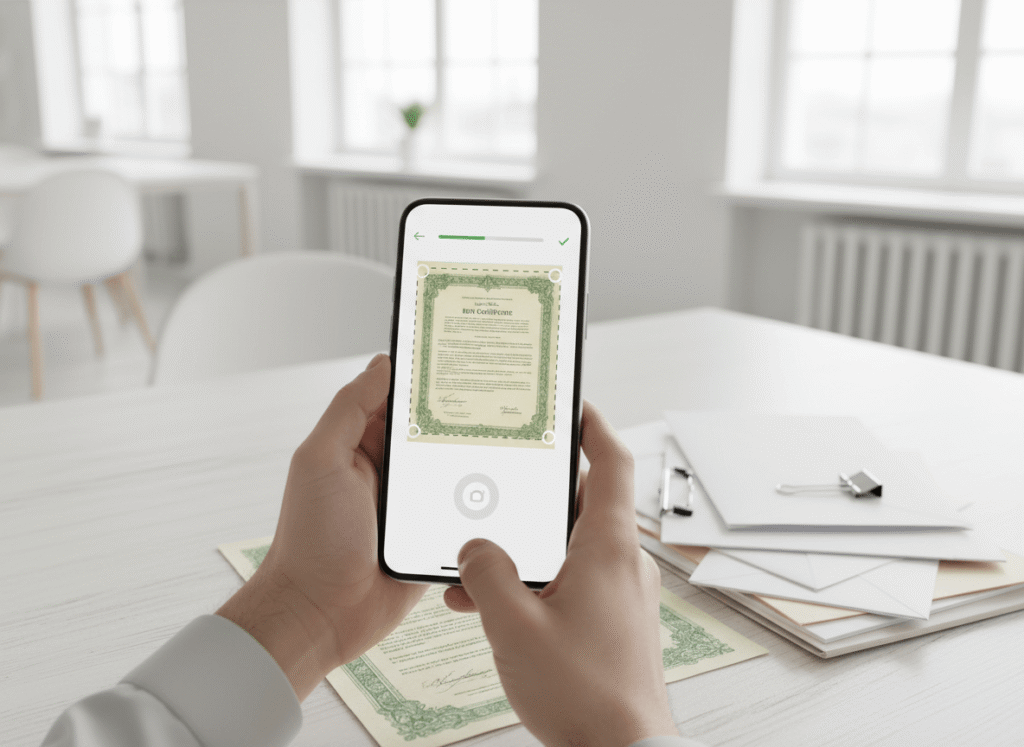
- You upload a clear scan or photo of your birth certificate
- The provider assigns a professional, human translator
- A certified translation (PDF) is delivered by email, often within 24 hours, with the option of a hard copy by post
A specialist service like USCIS Official Translation is designed around immigration requirements from day one, with translators trained specifically on USCIS-compliant formats and certification wording based on 8 CFR 103.2(b)(3).
Typical advantages:
- Built-in compliance with USCIS translation rules
- Fast turnaround (often 24–48 hours, with rush options)
- Clear, per-page pricing
- Secure online upload – no posting originals
- Digital and paper copies available
Best for: Anyone filing with USCIS who wants speed, convenience, and high acceptance rates without needing to “shop around” locally.
Option 2: Local translation office or language school
Some cities have local translation agencies or language schools offering document translation.
Pros:
- In-person discussion if you’re more comfortable face-to-face
- Helpful if you need to combine translation with other services (for example, sworn statements in your home country)
Cons:
- Limited opening hours
- Not all local providers understand USCIS rules in detail
- Often slower and sometimes more expensive than online specialist services
Option 3: Immigration lawyer or accredited representative’s preferred translator
Some immigration lawyers work with trusted translators or agencies.
Pros:
- The lawyer knows the translation provider and trusts their work
- Helpful if your case is complex and the lawyer wants the translator to add explanatory notes for unusual documents
Cons:
- May be more expensive than going directly to a translation agency
- You may have less choice over timelines and price
Option 4: Friends, colleagues, or community translators
Under US rules, the translator does not necessarily have to be a professional. Anyone who is competent in both languages and willing to sign the certification could, in theory, translate your birth certificate.
However, in practice there are important caveats:
- Close family members are often discouraged or rejected as translators because they aren’t seen as independent.
- Many RFEs are triggered by informal translations that miss small but important details (like seals or handwritten notes).
- Your friend may not be comfortable signing a legal certification statement.
Option 5: Machine translation or translating it yourself
Tools like Google Translate are extremely powerful – but they are not acceptable on their own for USCIS document translation. Official guidance and experienced practitioners are clear that translations must be complete, controlled, and backed by a proper certification, not machine output.
Some resources note that self-translation may technically be possible for certain informal documents if you provide a proper certification letter, but for birth certificates and key identity records this carries serious risk:
- Potential perception of bias
- Greater chance of unnoticed errors
- Higher risk of RFEs
How an Online Birth Certificate Translation Service Works (Step-by-Step)
Here’s how the process typically works with a specialist service like USCIS Official Translation:
Step 1: Prepare a clear scan or photo
- Lay the birth certificate flat in good light
- Capture the entire page, including edges, seals, and stamps
- Ensure text is sharp and legible
Most services accept PDF, JPG, or PNG.
Step 2: Upload your document securely
On USCIS Official Translation you simply:
- Upload your file using a secure, encrypted form
- Select the original language and target language (usually [your language] → English)
- Specify that the translation is for USCIS immigration
Step 3: Receive a quote and turnaround time
For standard birth certificates, most professional services charge a fixed per-page rate, often in the range of roughly $20–$60 per page, depending on language, complexity, and any extras such as notarisation or apostille.
Step 4: Human translators do the work
Your document is assigned to a translator experienced with:
- Vital records from your specific country
- USCIS formatting expectations
- Transliteration of names and place names
They will translate every element of the document and prepare a certificate of translation accuracy that meets 8 CFR 103.2(b)(3).
Step 5: Review and delivery
You’ll usually receive:
- A certified PDF ready to upload or print
- Optionally, printed copies by post, if you prefer to submit a paper package
Certified vs Notarised Translation: What Do You Actually Need?
A common source of confusion is the difference between a certified translation and a notarised translation.
Certified translation
A certified translation is what USCIS cares about. It includes:
- The translation itself
- The translator’s signed certification of accuracy and competence
This is what’s required under 8 CFR 103.2(b)(3) for any non-English document submitted to USCIS.
Notarised translation
A notarised translation means that a notary public has witnessed the translator’s signature and confirmed their identity. The notary does not check the quality of the translation itself.
Multiple reputable sources are clear on this point:
- USCIS does not require notarised translations for standard immigration filings like I-485.
- Some other authorities – such as certain courts, state DMVs, or the US Department of State for passport applications – may require notarisation or additional legalisation.
How Much Does It Cost to Get a Birth Certificate Translated?
Prices vary, but most reputable immigration-focused services charge per page for standard vital records.
Typical ranges drawn from recent industry information:
- Simple, common-language birth certificates: often around $20–$35 per page
- Less common languages or handwritten documents: may be higher
- Extras such as notarisation or apostille: additional flat fee
With USCIS Official Translation, pricing is designed to be transparent and predictable, so you know what you’ll pay before you commit – with no hidden surcharges for “USCIS formatting”.
When comparing services, be wary of:
- Very low prices that may hide machine translation or incomplete work
- Extra charges for the certification itself (this should always be included)
How Long Will My Birth Certificate Translation Take?
For standard birth certificates, many specialist providers quote
- 24–48 hours as a typical turnaround
- Same-day or urgent service for time-sensitive filings (for an extra fee)
Factors that affect timing:
- Language pair (some are harder to staff)
- Quality of your scan/photo
- Length and complexity (multiple pages, attachments, heavily handwritten sections)
USCIS Official Translation is structured around immigration timelines, so you can match your translation turnaround to your filing deadline instead of the other way round.
Common Mistakes That Lead to RFEs or Delays
Plenty of RFEs could have been avoided with a better translation from the outset. Common issues mentioned by practitioners and guidance include
- Incomplete translation (missing stamps, notes, or reverse side of the document)
- No certification, or a certification missing key elements (no statement of competence or no signature)
- Certification signed by a company representative only, not the actual translator, which has been a particular enforcement focus in recent years
- Use of machine translation or obviously non-professional language
- Inconsistent spelling of names and places compared with other documents
- Poor-quality scans that make sections illegible
Why Choose USCIS Official Translation for Your Birth Certificate?
When your future in the United States depends on a stack of documents, you want the birth certificate translation to be the part you never think about again.
USCIS Official Translation is built around that idea:
- Human translators with immigration experience – no machine-only output
- Translations prepared to comply with 8 CFR 103.2(b)(3) and USCIS Policy Manual guidance on foreign-language evidence
- Clear, fixed pricing for birth certificate translations
- Fast turnaround with options for urgent cases
- Secure, encrypted upload and strict confidentiality
- Certified PDFs plus optional printed copies ready for your attorney, NVC, or consular interview
Frequently Asked Questions
Where can I get my birth certificate translated quickly for USCIS?
You can use a specialist online certified translation service that focuses on immigration documents, such as USCIS Official Translation. These services let you upload a scan of your birth certificate, pay securely online, and receive a certified PDF that meets USCIS requirements – often within 24 hours.
Can I translate my own birth certificate for USCIS?
For important identity documents like birth certificates, self-translation is strongly discouraged. While some guidance suggests that any competent person may certify a translation, in practice USCIS expects a neutral, disinterested translator and can question translations done by the applicant or close family.
To minimise risk, it’s far safer to use a professional service that offers certified translations specifically tailored for USCIS.
Does USCIS require my birth certificate translation to be notarised?
No – USCIS does not generally require notarised translations for birth certificates or most supporting documents. The key requirement is a complete English translation plus a translator’s certification of accuracy and competence.
However, other organisations (courts, state DMVs, the US Department of State) may sometimes require notarisation or additional legalisation steps, so always check the instructions for any non-USCIS use of the translation.
What format should I use when sending my birth certificate for translation?
Most providers accept:
- PDF scans
- Clear JPG/PNG photos
Make sure all edges, seals, and stamps are visible and the text is sharp. If your document has information on the front and back, capture both sides. High-quality images help the translator produce a precise, USCIS-compliant translation without delays.
Will USCIS accept a scanned copy of the translated birth certificate?
For many applications, you can initially submit scanned copies of your civil documents and certified translations. USCIS may later request original or certified copies if needed.
That’s why most translation services provide a certified PDF, which you can print or upload depending on how you’re filing (online or by post).
What if my birth certificate is old, damaged, or not available?
If your birth certificate is unavailable, incomplete, or seriously damaged, US immigration rules allow for secondary evidence such as a certificate of non-availability plus alternative records (church records, school documents, sworn affidavits, and so on).
In that situation, you may need:
- Official confirmation from the civil registry that a standard birth certificate cannot be issued
- Alternative documents supporting your birth details
- Certified English translations of all of the above
