
If you’re asking “where can I get a death certificate translated?”, you’re probably trying to move something important forward: an immigration case, probate, inheritance, a bank release, an insurance claim, or an overseas registration.
At the same time, it’s an emotionally heavy document. The last thing you need is a rejection because a stamp wasn’t translated, a date was formatted incorrectly, or the translator’s certification didn’t meet the receiving office’s rules.
This guide shows you exactly where to get a death certificate translated, how to choose the right option, what the translation must include, and how to avoid the most common reasons official institutions push back.
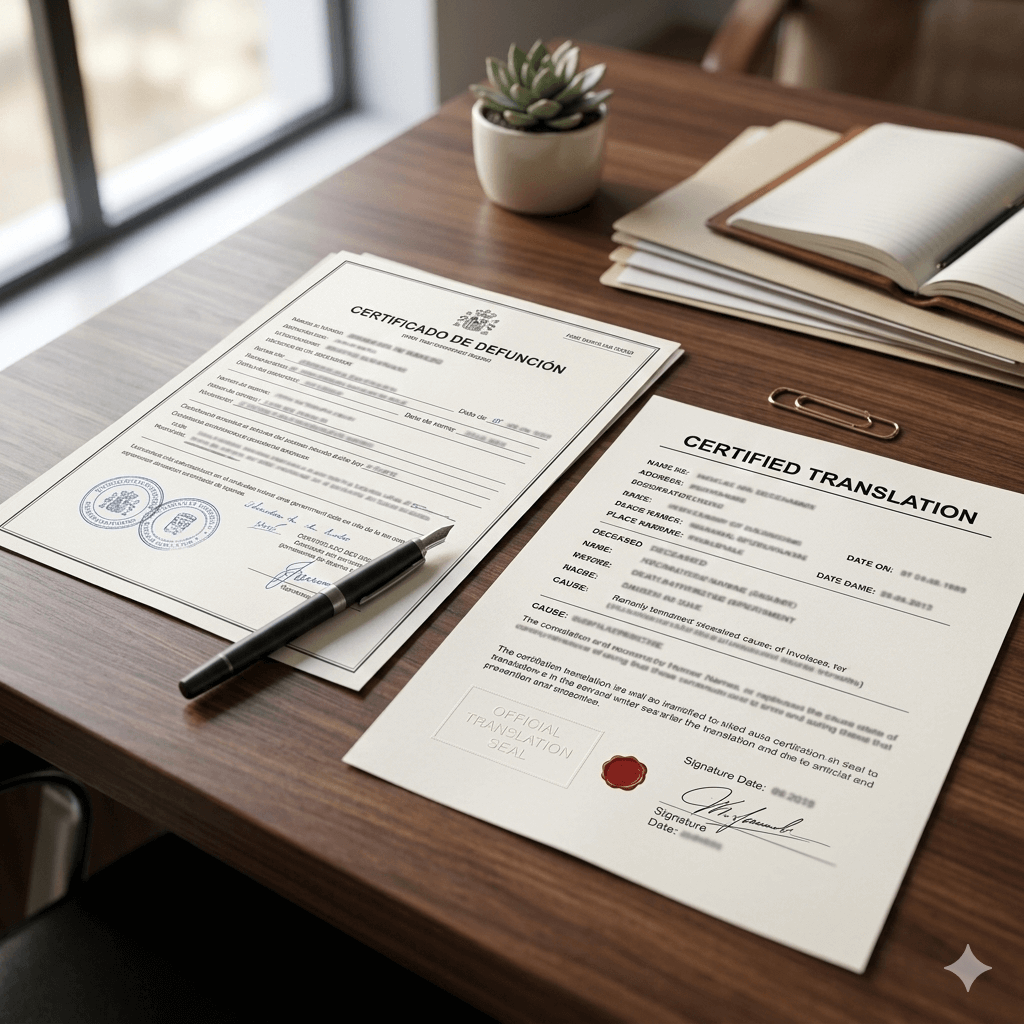
The quick answer: the safest places to get a death certificate translated
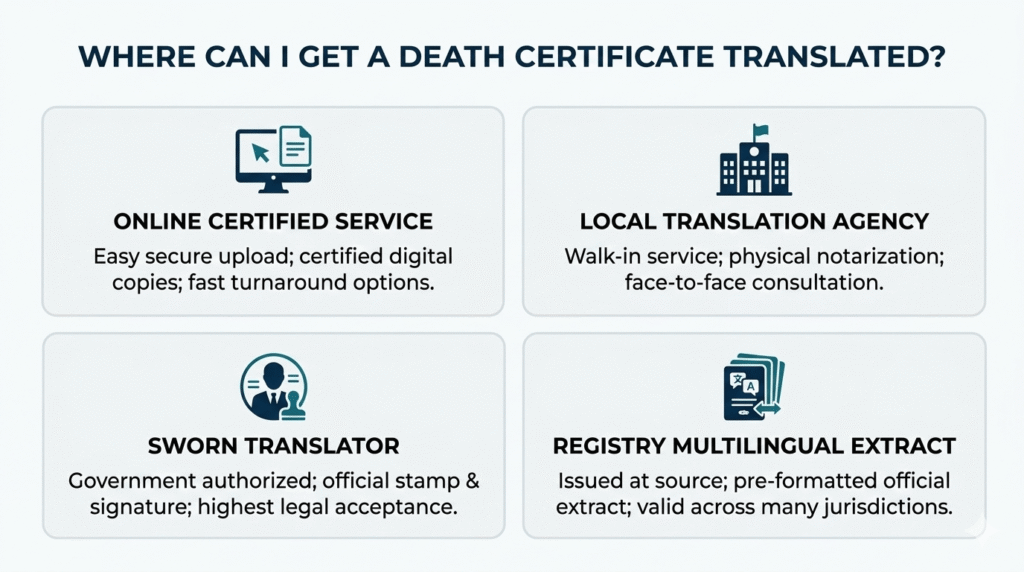
You generally have four reliable options:
- A specialist certified translation service (online)
Best for USCIS filings and most official uses when you want a fast, submission-ready result with the correct certification. - A local professional translator or translation agency (“near me”)
Best if the receiving institution requires in-person verification, wet-ink signatures, or you prefer a local point of contact. - A sworn translator (only when the destination country legally requires it)
Common in some European jurisdictions and legal settings where the translator must be court-appointed/authorised. - A consulate/registry-issued multilingual extract (rare, but worth checking)
Some countries can issue a multilingual version of civil records, which may reduce or remove the need for translation.
If your translation is for a USCIS case, start here: USCIS Certified Translation Services (upload your document and receive a quote in minutes). If you’re not sure whether you need certified, notarised, or sworn, read: Certified vs Notarised Translation.
First: what is the translation being used for?
The “right” translation depends less on the document and more on who will receive it. A death certificate might be used for:
Immigration (USCIS, consular processing, visa applications)
Typical need: certified translation into English (complete, accurate, with a translator certification statement).
Probate, estate, inheritance, and court matters
Typical need: often certified translation; sometimes notarised or sworn depending on jurisdiction, court rules, or local counsel’s preference.
Banks, pensions, insurers, and government agencies
Typical need: certified translation; occasionally notarisation if they have internal policy requirements.
International use (overseas property, foreign courts, cross-border administration)
Typical need: may involve apostille/legalisation plus a specific translation format (and, in some countries, a sworn translation).
Practical tip: Ask the receiving office one sentence that clears up 90% of the confusion:
“Do you require a certified translation only, or does it need notarisation or a sworn translator?”
What “certified translation” actually means (and what it doesn’t)
A certified translation is not a fancy stamp for decoration. It’s a translation package that includes:
- A full, word-for-word translation of all text on the document
- Translation of stamps, seals, signatures, and handwritten notes (often as bracketed labels like:
[Stamp],[Seal],[Signature],[Illegible]) - A signed translator certification statement (sometimes called a “Certificate of Accuracy”)
A simple certification statement (example format)
Most institutions want a statement that clearly says the translation is complete/accurate and the translator is competent.
A clean, commonly accepted structure includes:
- Translator’s name
- Statement of competence
- Statement the translation is complete and accurate
- Signature
- Date
- Contact details
If you may need notarisation as well, you can see a ready-to-use format here: Translation Notary Sample (Free Template).
Where can I get a death certificate translated (in detail)?
Option 1: An online certified translation service (fastest, most straightforward)
This is usually the best route if you want:
- Speed (often 12–24 hours for urgent cases)
- A clean, consistent format suitable for upload/printing
- The correct certification statement included automatically
- Clear pricing and predictable turnaround
If you’re submitting to USCIS or want an “official-use ready” package, the simplest start is to upload your document and let a specialist handle the formatting and certification:
- Start here: Order Form – Upload Your File
- See pricing first: Translation Pricing
Why this often wins over DIY: A death certificate isn’t just text. It’s dates, registries, stamps, marginal notes, abbreviations, and official phrasing that must be handled consistently.
Option 2: A local translator or translation agency (“near me”)
A local provider can be ideal if you need:
- Wet-ink signatures and physical delivery
- Local notarisation logistics
- A face-to-face service (or a provider your solicitor already knows)
If you go local, don’t just search and click the first listing. Use the checklist below to avoid paying twice.
Option 3: A sworn translator (only when required)
Some countries and courts require a sworn/authorised translator (court-appointed, ministerially authorised, or similarly recognised). This is not the same as a standard “certified translation”.
If your receiving authority explicitly says “sworn translation” or “official sworn translator”, use:
Sworn Translation Services
Option 4: A multilingual extract from the issuing authority (sometimes possible)
In a few jurisdictions, civil registries can issue documents in multiple languages or provide an official extract. If you can obtain an English version from the issuing authority itself, you may not need a separate translation.
This is uncommon for death certificates, but it’s worth checking—especially if:
- The document is recent
- The issuing office provides international forms
- You are dealing with consular processing
What to look for in a death certificate translation service (a rejection-proof checklist)
Use this as your “before you pay” filter. A reliable provider should confirm:
1) Completeness (not “summary translation”)
- Every field translated (including codes, marginal notes, footnotes)
- Stamps/seals described, not ignored
- Handwritten notes accounted for
2) Accuracy you can verify
- Names match passports and other filings (including spelling and diacritics)
- Dates are consistent and clearly formatted (especially when day/month order could be confused)
- Places, registries, and certificate numbers are preserved
3) Proper certification statement
- Signed and dated
- Includes the translator’s competence statement
- Includes basic contact details so the translation is attributable to a real person
4) Layout discipline
- The translation mirrors the original’s structure (headings, sections, tables)
- Anything unclear is marked as such (
[Illegible]) rather than guessed
5) Confidential handling
- Secure upload
- Limited access (not “anyone on a marketplace can open your file”)
If you want a provider that’s built around these checks, start with: USCIS Certified Translation.
What you need to send (so your translation isn’t delayed)
To get an accurate death certificate translation, provide:
- A clear scan or sharp photo (all corners visible, no glare)
- All pages, including reverse sides if there are stamps/notes
- Any attachments that came with the certificate (registry extracts, endorsements, legalisation pages)
- If you have it: the intended use (USCIS, probate, bank, embassy, overseas court)
If the document includes stamps or seals: don’t cover them. Even if they are not “words,” they are part of what the receiving office expects to see addressed.
Ready to proceed? Use the secure upload here: Upload Your File.
Do you need notarisation, apostille, or sworn translation?
This is where people lose time—because requirements vary.
Certified translation
Most common requirement for official purposes, including many immigration submissions.
Notarised translation
A notary typically verifies the identity of the signer (often the translator’s affidavit), not the linguistic accuracy. Some institutions still ask for notarisation as an added formality.
If you’re unsure whether notarisation is required (or you’ve been told “get it notarised”), use:
Notarised Translation Service
and the template here: Translation Notary Sample
Sworn translation
Only required when the receiving country/authority demands an authorised sworn translator.
If your receiving authority uses wording like “sworn,” “assermenté,” “court translator,” or “official sworn translator,” go here:
Sworn Translator Service
Apostille/legalisation
This typically authenticates the public document for international use. Whether the translation also needs legalisation depends on the destination country and the receiving institution’s policy.
If you’re dealing with cross-border probate or overseas property, confirm whether they want:
- Apostille on the original death certificate, and/or
- Notarised translation (sometimes required before additional legal steps)
Cost and turnaround: what you should expect
Pricing varies by language, urgency, and whether the translation is certified/notarised/sworn. As a benchmark, most death certificates are 1–2 pages, and the fastest services price per page.
With USCIS Official Translation, pricing is transparent and flat-rate:
- Basic certified translation: see Pricing
- 12-hour rush options (when available)
- Sworn translation option (when required)
Practical reminder: “Per page” usually means per page of the original document, not word count. If your death certificate includes a second page of endorsements or notes, it counts—and it should be translated.
Common mistakes that cause delays (and how to avoid them)
Here are the issues that most often trigger pushback from caseworkers, courts, and institutions:
- Stamps and seals not translated (or not acknowledged at all)
- Dates rendered ambiguously (03/07 could be 3 July or 7 March)
- Names inconsistently spelled across documents (accents removed in one place but not another)
- Cause-of-death fields mishandled (especially if abbreviated or medical)
- Translator certification missing key statements (competence + accuracy/completeness)
- Partial translations (“key information only”)
- Illegible text guessed instead of marked and explained
If you want the simplest path to “submit-ready,” start here: Start Your Translation Order.

A practical, 3-step way to get your death certificate translated (and move on)
- Upload a clear scan/photo
Use the secure order form: Upload Your File - We confirm requirements, price, and turnaround
If your case needs notarisation or sworn translation, we’ll align it before work begins. - Receive a submission-ready translation package
Delivered as a clean PDF, formatted to mirror the original, with the correct certification statement.
Prefer to speak to someone first? Contact Us.
Real-world scenarios (to help you choose the right option)
Scenario A: USCIS filing (family petition, adjustment, or supporting evidence)
You typically need: certified English translation with a proper translator certification statement.
Best route: online certified translation service with correct formatting.
Scenario B: Bank release or pension claim involving a death overseas
You typically need: certified translation, sometimes notarised depending on the institution’s internal rules.
Best route: certified translation first; add notarisation only if requested.
Scenario C: Probate or inheritance across borders
You may need: certified translation + apostille/legalisation and, in some jurisdictions, a sworn translation.
Best route: confirm the destination requirement in writing, then match the translation type accordingly.
A small trust check before you submit
Before you upload or file, take 30 seconds and confirm the translation includes:
- All pages translated
- Stamps/seals/signatures accounted for
- Clear rendering of names and dates
- A signed certification statement
- A professional, readable layout
If you’d like us to handle this end-to-end, you can start here in minutes:
Get Started – USCIS Certified Translation
FAQs
1) Where can I get a death certificate translated for USCIS?
The most reliable option is a professional certified translation service that provides a full English translation plus a signed certification statement. You can start with USCIS Certified Translation Services.
2) Can I translate a death certificate myself?
Even if you’re fluent, self-translation can create credibility issues and increases the risk of omissions (stamps, marginal notes, formatting). For official submissions, it’s safer to use a neutral professional translator.
3) Do I need a notarised translation of a death certificate?
Not always. Many institutions accept certified translation without notarisation. Notarisation is typically only needed if the receiving office specifically requests it. If you’ve been asked for notarisation, see Notarised Translation Service and Translation Notary Sample.
4) How long does death certificate translation take?
Most one-page certificates can be completed quickly once a clear scan is provided. Turnaround depends on language pair, formatting complexity, and whether notarisation or sworn translation is required.
5) What should be included in a certified death certificate translation?
A full translation of every element on the document (including stamps and notes), presented clearly, plus a signed certification statement confirming competence and accuracy/completeness.
6) Do I need a sworn translation for a death certificate?
Only if the receiving country or authority legally requires a sworn/authorised translator. If you’ve been told “sworn translation,” use Sworn Translation Services.
