
If you’re pricing a birth certificate translation for immigration or another official purpose, you’re probably trying to answer two questions fast:
- What will it cost?
- Will it be accepted the first time?
Most people pay $25–$40 per page for a properly certified translation that’s ready to submit. Your final total depends on how the provider defines a “page,” whether you need rush delivery, and how complex the document is (stamps, marginal notes, handwriting, multiple pages).
If you want the simplest baseline: a standard one-page birth certificate is usually priced as one page by most certified-translation providers.
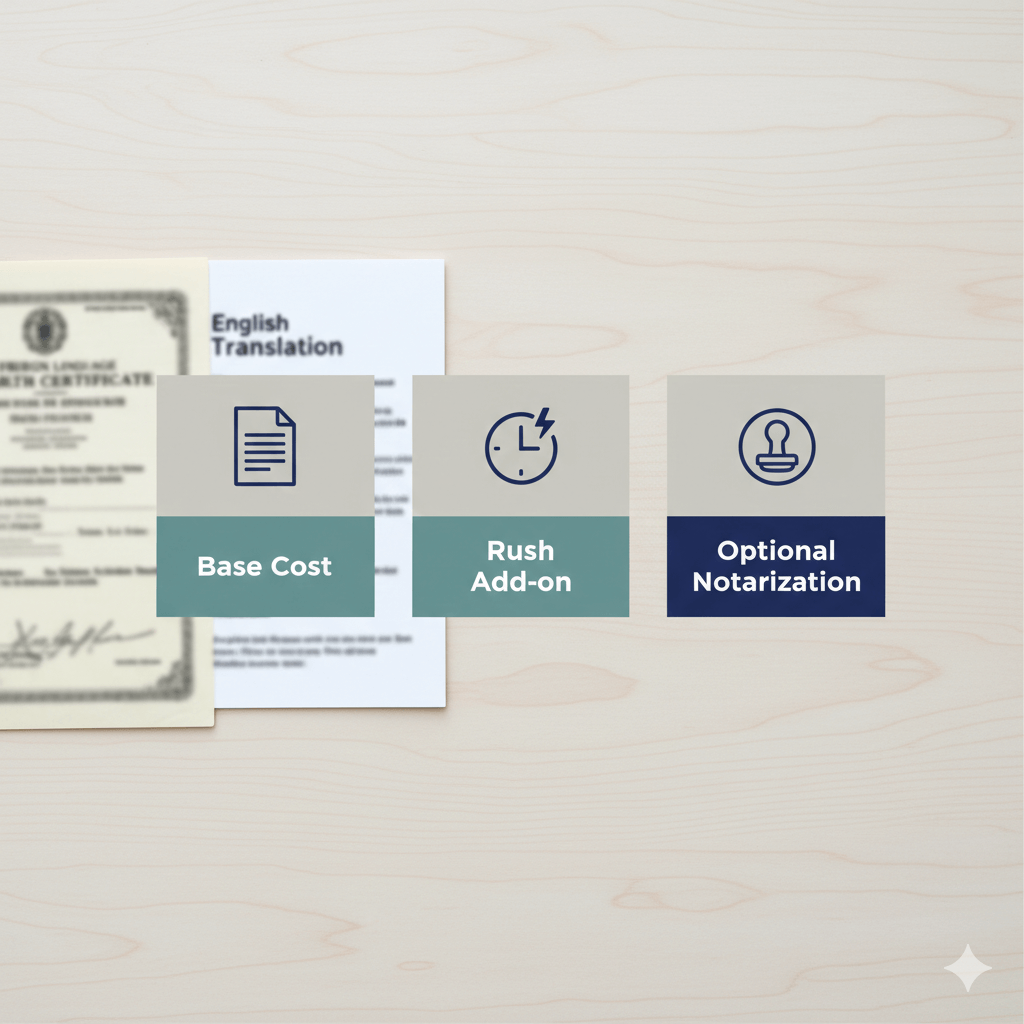
The “real world” price range for birth certificate translation
Here’s what you can typically expect in 2026 for a certified birth certificate translation used for filings with USCIS and other official submissions:
- Standard certified translation: $25–$40 per page
- Rush turnaround: typically +$5 to +$15 per page (or a fixed rush fee)
- Notarization (when requested): usually a flat add-on fee
- Sworn translation (only for specific authorities/countries): higher than standard certified
USCIS Official Translation pricing (simple and flat):
- $24.99 per page (certified translation package)
- 12-hour rush: +$10 per page
- Sworn translation: $79.99 per page (when a sworn translator is specifically required)
What you’re paying for (and what you should always receive)
A proper certified translation for a birth certificate isn’t just “English text.” It’s a submission-ready package designed to avoid delays.
You should receive:
- A complete English translation (not a summary)
- Formatting that’s easy to compare against the original
- A signed Certificate of Accuracy / translator certification stating the translation is complete and accurate and the translator is competent to translate
- Clear labels for stamps, seals, handwritten notes, and marginal notes
- A note for unreadable text (marked as “illegible,” not guessed)
If any of these are missing, you’re not really comparing like-for-like on price.
Why prices vary so much between providers
Two quotes can look wildly different even when they’re both “certified.” Here’s why.
1) How a “page” is defined
Some services define a page as:
- One uploaded page/image, or
- Up to ~250 words, or
- One side of a document (front/back can count as two)
Birth certificates often include stamps, margin notes, or reverse-side text. If a provider counts both sides separately (or uses a word-limit definition), the total can rise.
2) Document complexity (the hidden cost driver)
These features typically increase the time needed (and sometimes the price):
- Multiple official stamps and seals
- Handwritten annotations
- Dense “registry” layouts with tables, codes, and abbreviations
- Multi-page extracts or attachments
3) Language pair and rarity
Common language pairs (e.g., Spanish to English) are usually at the lower end. Less common pairs can cost more due to availability and specialist review needs.
4) Turnaround time
If you need it fast, you’re paying to jump the queue and/or add additional quality checks under time pressure.

A simple way to estimate your total cost in under a minute
Use this quick formula:
Total cost = (pages × per-page rate) + (pages × rush add-on, if needed) + add-ons (only if requested)
Common add-ons:
- Notarization (only if the receiving authority specifically requests it)
- Hard-copy delivery (some applicants want physical copies for records)
- Apostille/legalization (only for use abroad, not standard for USCIS filings)
If you’re not sure what applies, the safest approach is to price it first as standard certified translation, then only add extras when you’re certain they’re required.
Cost examples you can copy and compare
Example A: 1-page birth certificate (standard)
- 1 page × $24.99 = $24.99
Typical use: USCIS filing, passport submission, school enrollment, employer records.
Example B: 1-page birth certificate (rush)
- 1 page × $24.99 = $24.99
- Rush: 1 page × $10 = $10.00
Total: $34.99
Typical use: deadlines, RFEs, last-minute filing windows.
Example C: 2-page birth certificate (stamps + notes)
- 2 pages × $24.99 = $49.98
(Add rush only if you truly need it.)
Tip: if your document includes a reverse side, marginal notes, or an attached registry extract, treat it as more than “just one page” when budgeting.
Certified vs notarized vs sworn: what most people misunderstand
Certified translation
This is what most official processes mean when they say “certified translation”:
A complete translation plus a signed certification statement.
Notarized translation
Notarization generally verifies the identity of the signer, not the accuracy of the translation. It can be required by some institutions, but it’s not automatically required just because something is “official.”
Sworn translation
A sworn translation is a specific legal category used by certain countries/courts/authorities. It’s not the default requirement for most USCIS submissions, but it can matter for consular or foreign-government processes.
If you’re unsure which one you need, the fastest way to avoid paying for the wrong thing is to match the translation type to the exact request from the receiving authority.

What makes a birth certificate translation “acceptable” for USCIS filings
A clean translation is the one that makes an officer’s job easy.
A USCIS-ready birth certificate translation typically has:
- All visible text translated (including seals/stamps/annotations)
- Consistent spelling of names (aligned with passports and forms)
- Dates rendered clearly (avoiding day/month confusion)
- A proper certification statement attached
If you want to reduce the risk of delays, avoid “cleaned up” translations that omit repetitive stamp text or margin notes. Those details are exactly what flags “incomplete” submissions.
Price traps to avoid (even if the quote looks great)
- Ultra-low price with no certification statement
- Machine translation sold as “certified” without a real human signer
- Hidden fees added after upload (formatting, stamps, “complexity” charges)
- Per-word pricing with a high minimum that quietly exceeds a per-page quote for short certificates
A good quote is transparent about what’s included, what counts as a page, and what will cost extra (if anything).
The fastest way to get an exact quote (and avoid back-and-forth)
To get an accurate price quickly:
- Take a clear photo or scan (show the full page edges).
- Include both sides if there’s any text, stamps, or notes.
- Confirm how you want names spelled in English (especially for transliteration).
- Choose standard or rush based on your real deadline.
If you’re ready, upload your birth certificate and you’ll typically get a fixed quote immediately—no guessing, no surprises.
FAQs
How much to translate a birth certificate for USCIS?
Most applicants pay $25–$40 per page for a certified translation. The final cost depends on page count, how “page” is defined, and whether you add rush service.
Is birth certificate translation priced per page or per word?
For short civil documents, pricing is most commonly per page. Longer documents are often priced per word. Always confirm how the provider defines a page.
Do I need a notarized birth certificate translation for USCIS?
Usually, no. USCIS generally cares about a complete translation plus a signed certification statement. Notarization is typically only needed if another authority specifically requests it.
Can I translate my own birth certificate to save money?
Some people do, but it’s risky. A translation must be complete, accurate, and properly certified by a competent translator. Mistakes or missing details can cause delays and rework that costs more than doing it properly once.
What is a Certificate of Accuracy (translator certification)?
It’s a signed statement attached to the translation confirming the translator is competent and the translation is complete and accurate. This is a key part of an “official” certified translation package.
How fast can I get my birth certificate translated?
Standard turnaround is often 1–2 working days for short documents. Many services offer 24-hour and even faster rush options for an additional fee.
