
If you’re asking, “how do I translate a birth certificate to English?”, you’re usually trying to submit it for immigration, a visa, a green card, or another official process. The good news: the rules are simple. The hard part is getting the details exactly right—names, dates, stamps, handwritten notes, and the translator’s certification—so your case doesn’t get slowed down by avoidable errors.
This guide walks you through a clean, USCIS-ready method to translate your birth certificate into English, with a copy-paste certification statement and a final “ready to submit” checklist.
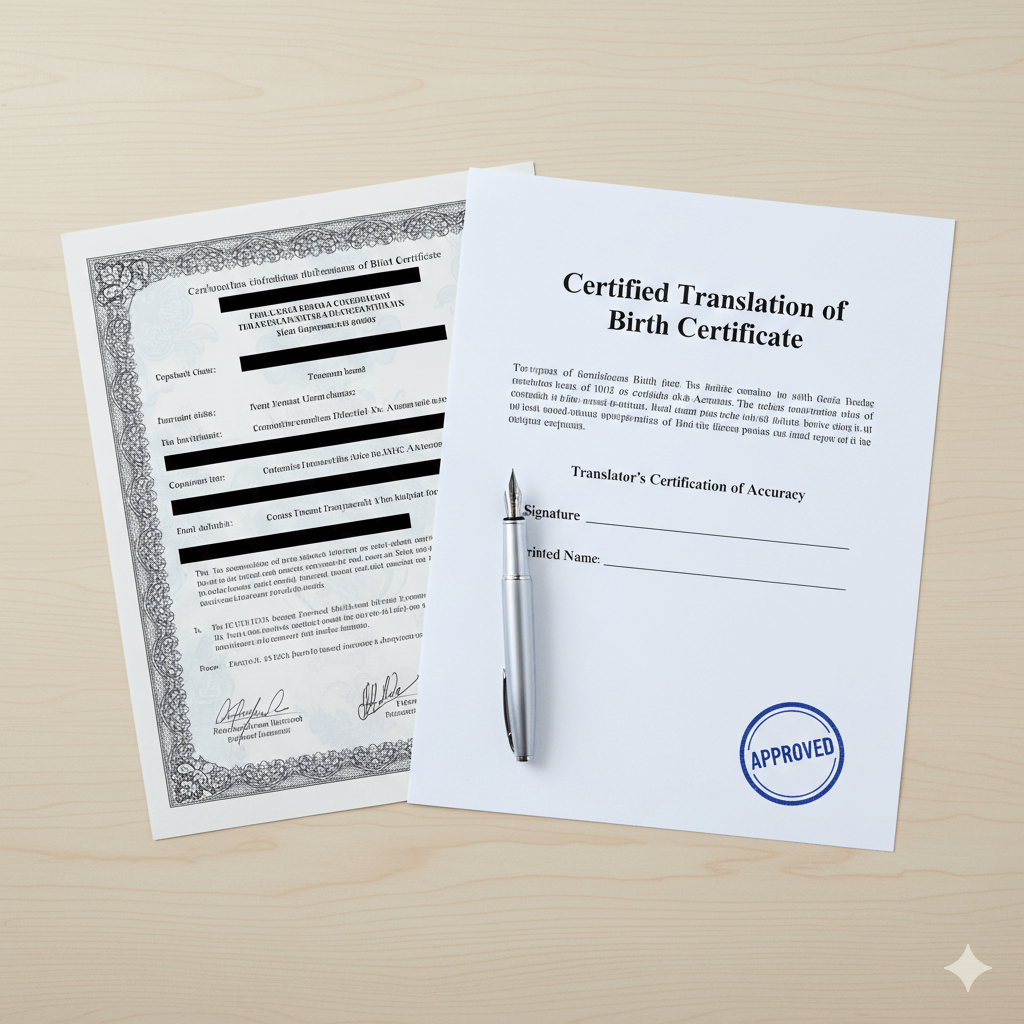
What an acceptable English birth certificate translation must include
A complete birth certificate translation is not just the “main text.” It should include everything that appears on the document, such as:
- All printed fields (names, dates, places, registration details)
- All handwritten entries
- Stamps and seals (and what they say)
- Marginal notes, corrections, amendments
- Registration numbers, book/page references, certificate numbers
- Any multilingual text, abbreviations, and official titles
And it must be paired with a translator’s signed certification confirming the translation is complete, accurate, and translated by someone competent in both languages.
If you want the safest route, use a professional service that delivers a ready-to-submit PDF with the certification included. If you’re doing it yourself (or using a friend/colleague), follow the steps below closely.
Before you start: get your document set up properly
1) Use a high-quality scan or photo
Aim for:
- Bright, even lighting (no shadows)
- Full document visible (all corners)
- High resolution so stamps and handwriting are readable
2) Make sure you have the right birth certificate version
Some countries issue:
- “Short form” and “long form”
- Extracts vs. full entries
- Newer re-issued certificates with amendments noted elsewhere
If you have multiple versions, keep them together and translate the one you plan to submit (or translate both if you’re unsure and time is tight).
3) Decide your output format
For official use, your translation should be:
- Typed (not handwritten)
- Clearly laid out
- Easy for an officer to match line-by-line to the original
Step-by-step: translate a birth certificate to English the right way
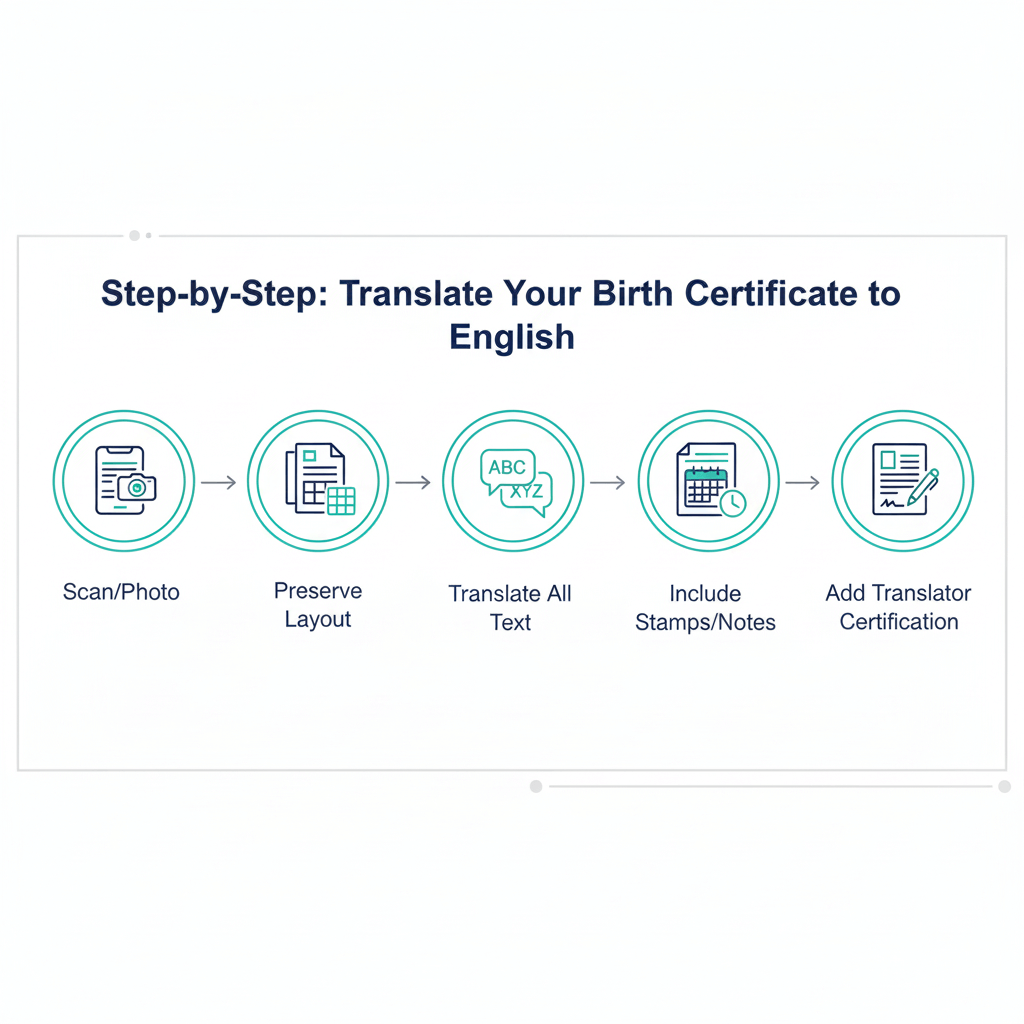
Step 1: Recreate the structure so it’s easy to compare
You don’t need to design it perfectly, but you do need clarity.
Choose one of these reliable formats:
Option A (best for clarity): “Field-by-field” layout
- Use English field labels
- Put the translated content next to each label
- Add notes for stamps/seals and handwritten items
Option B: “Mirror layout”
- Keep the same order as the original document
- Translate line-by-line, preserving headings and sections
Tip: If your birth certificate is in a table format, reproduce a simple table in English. Officers love documents they can verify in seconds.
Step 2: Translate every visible element (yes, even stamps)
This is where most DIY translations fail.
Include translations for:
- Registrar stamps (office name, district, authority)
- Round seals (even if partially readable)
- Annotations like “Certified True Copy,” “Extract,” “Duplicate,” “Re-issued”
- Handwritten corrections or marginal notes
If something is unreadable, don’t guess. Use one of these:
- [illegible]
- [illegible stamp]
- [partially illegible: “…Office of ___”]
Step 3: Standardise names, spellings, and identity details
Birth certificates often use:
- Diacritics (Á, Ç, Ñ, Ø)
- Multiple surnames
- Different order (family name first)
- Local spellings that differ from passports
Best practice for official use:
- Translate the meaning of labels (e.g., “Nombre” → “Name”), but do not “translate” personal names.
- Keep spelling consistent with the document, and add a note if the passport spelling differs.
Example note you can use:
- Name appears as “Mohamed Ali” on this certificate; passport spells “Muhammad Ali.”
Step 4: Handle dates and places to avoid confusion
Dates can be written differently across countries (DD/MM/YYYY vs MM/DD/YYYY).
To prevent mistakes:
- Write the month in words: 12 January 2024 (not 12/01/2024)
- Keep the original format in brackets if it helps: 12 January 2024 (12/01/2024)
For places:
- Translate administrative terms (e.g., “Province,” “District,” “Municipality”)
- Keep official place names as they appear, especially if they’re legal jurisdiction labels
Step 5: Translate titles and civil-registry terminology correctly
Common birth certificate terms you’ll see:
- Civil Registry Office
- Registrar / Registering Officer
- Certificate Number / Entry Number
- Book / Volume / Page
- District / Municipality / Prefecture
- Date of Registration (not always the same as date of birth)
- Place of Birth (hospital/city)
- Mother’s full name / Father’s full name
- Maiden name / surname at birth
- Remarks / annotations / amendments
If you’re unsure about a specific term, translate it plainly and consistently, and avoid inventing official titles that aren’t on the document.
Step 6: Add “Translator Notes” for anything that needs context
Translator notes are useful for:
- Handwritten text clarity
- Seals that are partially readable
- Abbreviations
- Unique local formatting
Keep notes neutral and bracketed, such as:
- [Translator’s note: text is handwritten]
- [Translator’s note: seal partially legible]
Step 7: Attach the translator’s certification statement (copy-paste)
Every translated birth certificate should include a signed certification statement. Place it at the end of the translation, on its own block.
Copy-paste template (edit the brackets):
Translator’s Certification
I, [Full Name], certify that I am competent to translate from [Language] into English and that the foregoing is a complete and accurate translation of [Document Name].
Signature: ___________________________
Printed Name: [Full Name]
Date: [Date]
Address: [Address]
Phone/Email: [Phone or Email]
If you’re submitting multiple documents, use a separate certification for each one unless the receiving authority explicitly permits a combined certificate that lists every document.
Mini example: what a clean English translation section looks like
ENGLISH TRANSLATION OF BIRTH CERTIFICATE
Certificate Number: 014872
Book/Volume/Page: Book 12 / Volume 3 / Page 44
Date of Registration: 03 March 2002
Child’s Full Name: Maria Fernanda Lopez Garcia
Date of Birth: 27 February 2002
Place of Birth: San Miguel Hospital, San Salvador
Mother’s Full Name: Ana Lucia Garcia Perez
Father’s Full Name: Carlos Alberto Lopez Martinez
Remarks/Annotations:
- [Handwritten] “Corrected spelling of mother’s surname on 05 May 2005.”
- [Stamp] Civil Registry Office — District of San Salvador
(Then add the Translator’s Certification.)
Common mistakes that cause delays (and how to avoid them)
1) Missing stamps, seals, or marginal notes
Fix: Translate every mark, even if it’s just [stamp: …].
2) Guessing illegible text
Fix: Use [illegible]. Never guess.
3) Inconsistent spellings across documents
Fix: Match the birth certificate, then add a short note if another document uses a different spelling.
4) “Summarising” instead of translating
Fix: Translate word-for-word content. Don’t rewrite or shorten.
5) Forgetting the certification statement
Fix: Always include the signed certification block.
6) Using machine translation for an official record
Fix: Don’t. Birth certificates are dense with legal terms, abbreviations, and stamps—this is exactly where automation creates risky errors.
Do you need notarisation for a birth certificate translation?
Usually, no—a proper certified translation with a signed translator certification is what’s required for most USCIS filings. Notarisation may be requested for other purposes (certain courts, foreign authorities, or specific institutions), but it’s not a substitute for a correct translation and certification.
If you’re unsure, check the instructions for the exact process you’re filing under—or use a translation provider that can add notarisation if you end up needing it.
Can I translate my own birth certificate into English?
This is one of the most searched questions—and the most misunderstood.
Even if you’re bilingual, translating your own vital record can create complications because you’re personally connected to the outcome. Some people do it successfully, but it’s a high-risk choice: if anything looks inconsistent or “too informal,” you can lose weeks responding to follow-up requests.
A safer approach is a neutral third-party translator (professional or otherwise) who can confidently sign the certification and provide contact details if requested.
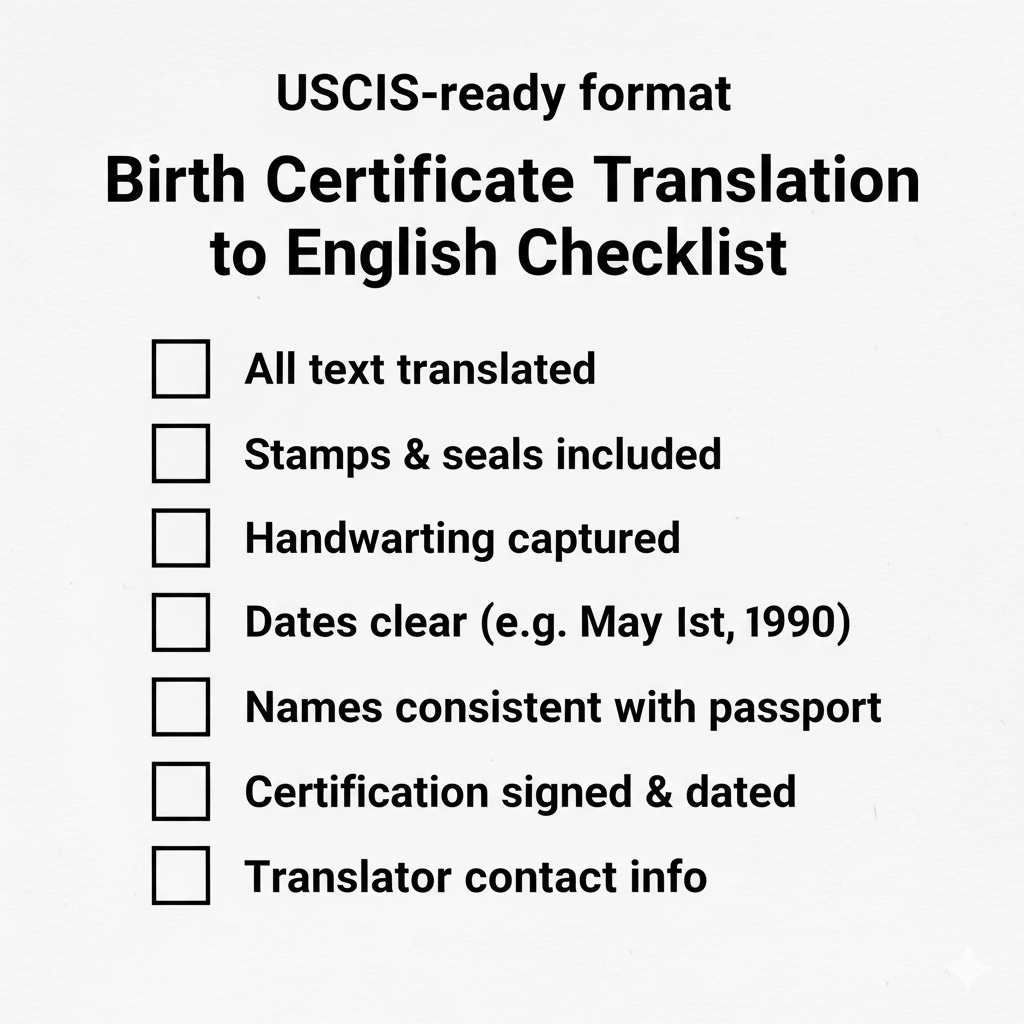
Ready to submit? Use this “birth certificate translation” checklist
Before you submit your translation, confirm you have:
- A clear copy of the original birth certificate
- A complete English translation that includes:
- All printed text
- All handwritten text
- All stamps/seals/notations
- Any marginal notes or corrections
- Dates written clearly (month in words recommended)
- Names spelled consistently (with notes if needed)
- A signed Translator’s Certification with:
- Translator name
- Language pair
- “complete and accurate” wording
- Signature + date
- Contact details
If you want a fast, ready-to-submit certified translation without stress, you can upload your birth certificate to USCIS Official Translation and receive a certified PDF prepared for official submission.
Frequently asked questions
How do I translate a birth certificate to English for USCIS?
Translate every visible element on the document (including stamps and notes), type the translation clearly, and attach a signed translator certification stating the translation is complete, accurate, and done by someone competent in both languages.
What should a translator certification statement say?
It should state the translator is competent to translate from the source language into English and that the translation is complete and accurate. It should also include the translator’s name, signature, date, and contact details.
Does USCIS require a “certified translator” for a birth certificate translation?
USCIS generally requires a certified translation (meaning the translation includes a signed certification statement). It typically does not require a specific licence or credential—what matters is completeness, accuracy, and a proper certification.
Do I need notarisation for a birth certificate translation?
In most USCIS cases, notarisation is not required if the translation includes the proper signed certification. Notarisation may be requested by other agencies or in special situations.
Can my family member translate my birth certificate?
A family member technically may be able to translate if they are truly competent and can sign the certification. However, it can look biased and create avoidable questions. A neutral third party is usually safer.
How long does a certified birth certificate translation take?
It depends on document complexity and how busy the translator is. Many professional services can turn a standard one-page birth certificate around quickly, but always plan extra time if the document includes dense stamps, handwritten notes, or multiple pages.
