
Yes, if your bank statement is not in English or Welsh, you will usually need a certified translation before submitting it with a UK visa application. That applies whether the statement is being used to show savings, regular income, maintenance funds, sponsor support, or overall financial stability. A bank statement written in another language can create avoidable delays if the decision-maker cannot clearly verify balances, account holder details, dates, and relevant transactions.
For many applicants, the real question is not simply whether translation is needed, but how much of the statement must be translated, what the certification should include, and how to avoid paying for unnecessary work. That is where applicants often get stuck.
If you need a certified translation for a bank statement, payslip, sponsorship letter, or other financial evidence, upload your file and get a fast review before you submit your visa documents.
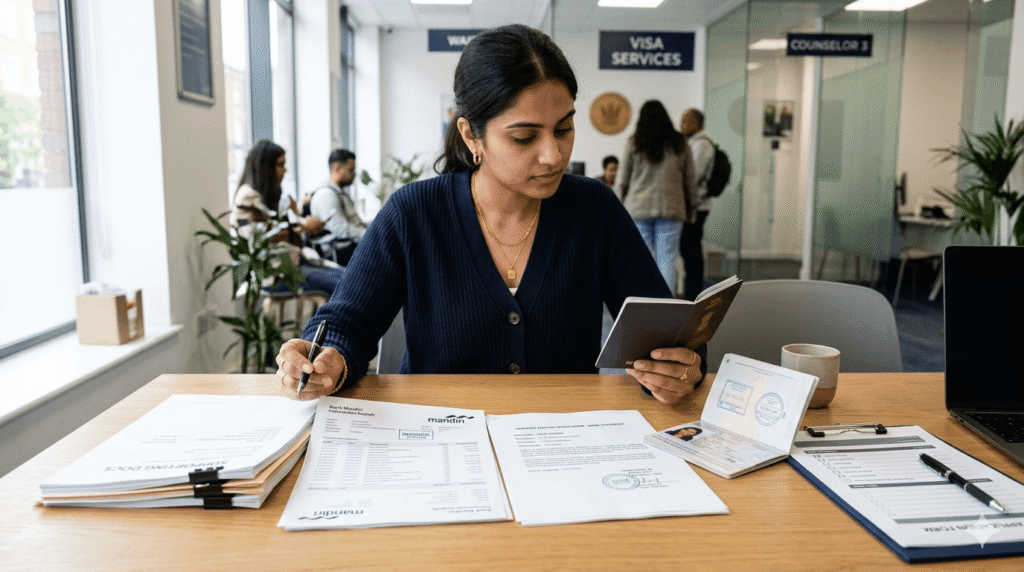
The straightforward answer
If the document is already fully in English or Welsh, you generally do not need to translate it.
If the document is partly or fully in another language, you should treat it as needing a certified translation.
That includes cases where:
- the statement header is in another language
- transaction descriptions are in another language
- account terms or notes are in another language
- balances, dates, or banking labels are not clearly understandable in English
- your bank issues a bilingual statement, but key parts are still not in English
The safest approach is simple: if a Home Office caseworker cannot independently verify what the document says, translate it.
Why bank statements matter so much in visa applications
Bank statements are not just routine paperwork. In many visa categories, they are core evidence. They may be used to assess:
- available cash savings
- regular salary payments
- source of funds
- financial support from a sponsor
- maintenance requirements
- genuine access to funds
- consistency between your application form and your supporting evidence
Because they carry so much weight, errors in bank statement translation can have a bigger impact than people expect. A mistranslated balance, unclear deposit description, missing page, or incomplete certification can weaken the credibility of the entire financial evidence bundle.
When bank statement translation is usually required
You will normally need a translation if you are submitting bank statements for any of the following:
Visitor visa applications
Applicants often submit personal or sponsor bank statements to show they can cover travel, accommodation, and living costs during the trip.
Student visa applications
Financial evidence may be required to show tuition funds, maintenance funds, or sponsor support.
Spouse, partner, and family visas
Bank statements are commonly used to support income, savings, ongoing relationship evidence, or sponsor finances.
Work visa applications
Some routes involve supporting documents related to maintenance, salary, or employer-linked evidence.
Settlement and citizenship-related applications
Where financial history forms part of the documentary package, foreign-language statements should be translated clearly and professionally.
What the translation should include
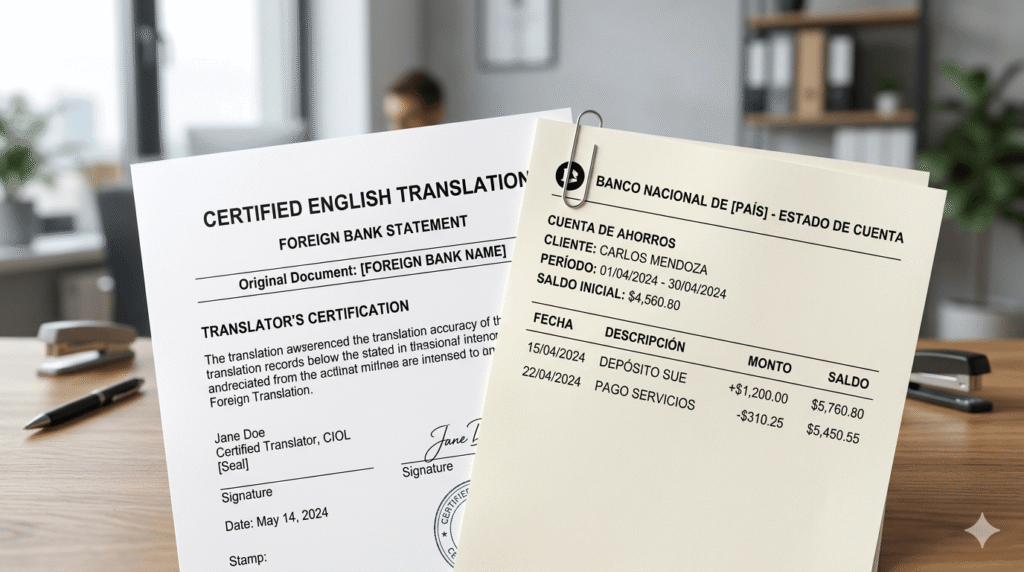
A proper certified translation of a bank statement should make the financial evidence readable, complete, and credible. In practice, that means the translation should cover the information the caseworker needs to assess the document confidently.
This usually includes:
- bank name
- account holder name
- account number or partially masked identifier as shown on the original
- statement period
- opening and closing balances
- currency
- transaction dates
- incoming and outgoing transactions relevant to the application
- headings, notes, and labels appearing on the original
- any stamps, seals, or official notes shown on the statement
The translation should also be paired with a certification confirming that it is an accurate translation of the original, along with the translator’s details and the date. UK government guidance for foreign-language documents repeatedly requires a full translation that can be independently verified, and it specifies the certification details expected.
Do you need to translate every page of a bank statement?
Usually, you should assume that every page you are relying on should be translated unless there is a very clear reason otherwise.
This is where many applicants overpay or underprepare.
In most personal visa cases
If you are relying on a full statement period, the safest route is to translate the pages that contain:
- your identity and account details
- the statement dates
- the balances
- all transactions relevant to the funds being assessed
- any notes that explain unusual credits, transfers, or deposits
In some specialist business or sponsor contexts
There are situations in official guidance where not every transaction needs to be translated, as long as the translation is sufficient for the authority to assess the financial position and includes all transactions relevant to the application. That is not a blanket rule for every personal visa case, but it does show that relevance matters.
Practical rule
If a page helps prove your funds, identity, source of money, or continuity of the statement period, include it in the translation scope.
A good translator or document review team should tell you whether you need:
- full translation
- selected-page translation
- partial translation with relevant sections only
- translation plus a short note identifying what has been intentionally excluded
Can you submit a bilingual bank statement instead?
Yes, if your bank can issue an official English version, that is often the cleanest option.
Before paying for translation, ask your bank:
- Can you issue the statement in English?
- Can you export a bilingual statement?
- Can you provide an official stamped English summary for the same period?
If the English version is complete and clearly matches the original financial record, you may not need a separate certified translation at all.
This is one of the easiest ways to cut cost and speed up submission.
What makes a bank statement translation acceptable?
A translation is far more likely to be accepted when it is:
Complete
No important parts are skipped, cropped, summarised, or paraphrased.
Accurate
Balances, dates, names, banking terms, and transaction descriptions are translated faithfully.
Consistent
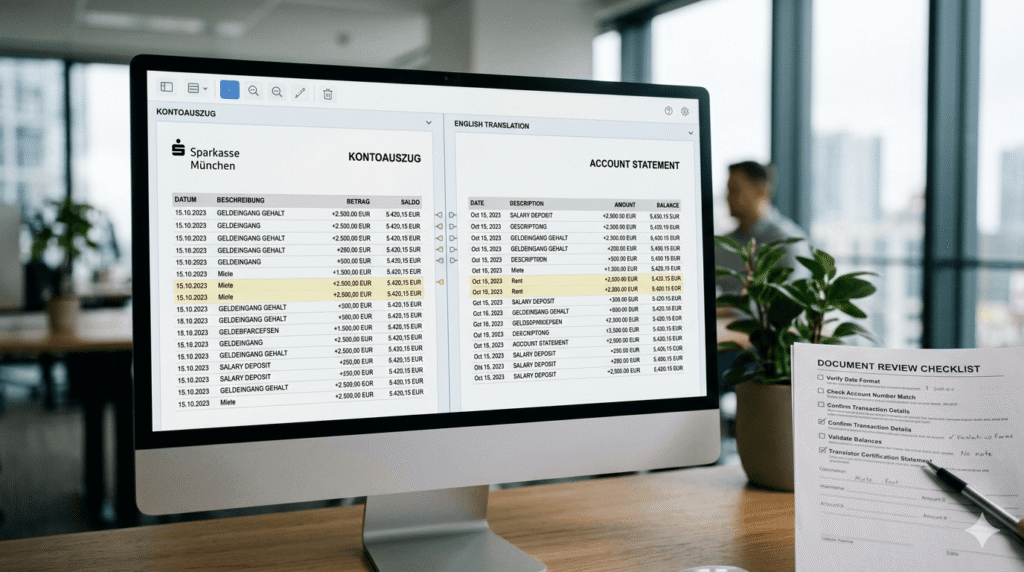
The translation matches the original layout closely enough for the reviewer to compare the two.
Certified
The translator confirms the translation is accurate and provides the details expected for official use.
Readable
Amounts, dates, and narrative transaction details are easy to follow.
If you are unsure whether your current translation is strong enough, compare it against this benchmark: could a caseworker understand the origin, ownership, amount, and timing of the funds without guessing?
What applicants get wrong most often
1. Translating only the first page
The first page may show the account holder and summary, but the caseworker may also need to review the underlying transactions.
2. Using a machine translation printout
Free tools can be useful for personal understanding, but they are not a safe final submission format for official financial evidence.
3. Omitting the certification
A perfectly good translation can still create problems if it lacks the proper certification details.
4. Ignoring unusual deposits
Large transfers, cash deposits, overseas remittances, or irregular credits may need clearer translation because they can affect how the funds are assessed.
5. Sending poor scans
Blurred numbers, cropped margins, or missing pages make even a correct translation less persuasive.
A smarter way to decide how much translation you need
Here is a practical review method that works well before you order:
Translate the statement in full if:
- the whole statement is in another language
- the visa depends heavily on those funds
- there are multiple relevant transactions throughout the period
- the source of funds could raise questions
- you want the lowest-risk submission
Consider a narrower scope only if:
- the key evidence appears on limited pages
- the statement is very long and repetitive
- a qualified translator can clearly identify which pages are essential
- the translated set still allows a full understanding of your financial position
Always keep these pages in scope:
- statement header page
- account holder details
- statement period
- all pages containing relevant credits, balances, and explanations
- any page with official notes or unusual entries
Example scenarios
Example 1: Visitor visa with savings only
You are relying on three months of savings in a foreign bank account. The statements are entirely in Spanish. You should normally translate the statement pages showing your details, the statement period, balances, and the transactions demonstrating the funds remained available.
Example 2: Spouse visa with salary payments
Your monthly salary lands in a non-English account, and you are using that history to support your financial position. Translate the pages showing the salary entries, date pattern, employer references if shown, and the running balance.
Example 3: Sponsor support
Your parent or spouse is sponsoring your trip and their bank statements are in Arabic. Translate the sections that show account ownership, available funds, relevant incoming payments, and the statement continuity for the required period.
Example 4: Large one-off transfer
You received a recent large deposit from the sale of land or property. The statement alone may not be enough. Translate the statement and any supporting source-of-funds documents that explain the transaction.
Does the currency need to be converted?
Not necessarily. A foreign currency statement can still be valid evidence. What matters first is clarity, authenticity, and the ability to assess the funds. However, it can help to present a simple supporting note or cover letter explaining the approximate equivalent in pounds sterling on the date of application, especially if the visa category has a specific threshold.
The translation itself should not guess or rewrite the bank figures. It should reflect the original document faithfully.
Certified translation vs notarised translation for bank statements
For most UK visa uses, what matters is a proper certified translation rather than a notarised one.
A certified translation is usually the right starting point because it provides:
- a complete English rendering of the original
- a signed statement of accuracy
- translator identification and contact details
- a clear date of certification
Notarisation is only worth adding if:
- a solicitor, embassy, or receiving body specifically asks for it
- the statement is being reused for another legal process outside the visa application
- you want an extra layer for a separate authority with stricter document preferences
For most applicants, ordering notarisation when it is not required just increases cost and turnaround.
How long does bank statement translation take?
That depends on:
- number of pages
- language pair
- scan quality
- urgency
- whether the work is full translation or selected-page translation
- whether formatting must closely mirror the original
Simple bank statements are often handled quickly, but longer financial bundles take more time because the translator must preserve accuracy on numbers, dates, transaction lines, and notes.
If you have a deadline, use a service that reviews the file before confirming turnaround. That is usually safer than relying on a generic page estimate.
For urgent submissions, same-day translation services may be useful where the file is clear and the document set is manageable.
How to reduce cost without weakening your application
Applicants often assume the only choice is “translate everything” or “risk rejection.” In reality, there is a middle path.
You can often reduce cost by:
- asking your bank for an English or bilingual statement first
- providing clean PDFs instead of phone screenshots
- grouping only the pages relevant to the application
- translating related supporting documents together
- getting a file review before ordering
- avoiding last-minute rush fees where possible
The key is not to cut corners. It is to remove unnecessary pages while protecting the clarity of the evidence.
What a strong submission looks like
A well-prepared bank statement evidence pack usually includes:
- The original bank statements in clear PDF or scan form
- A complete certified translation of the relevant content
- Supporting documents for unusual deposits if needed
- A short explanation if the funds come from savings, sponsor support, sale proceeds, or cross-border transfers
- Consistency across all financial evidence in the application
This kind of submission is easier to assess and less likely to trigger follow-up questions.
Why applicants choose a specialist translation provider
Financial documents are one of the easiest places for small mistakes to cause disproportionate problems. A specialist provider helps by:
- spotting pages that are essential
- translating banking terminology correctly
- keeping amounts and dates consistent
- attaching the right certification
- presenting the translation in a format suited to official review
Many applicants also want privacy, speed, and a quick answer on whether the file even needs full translation. That is why a review-first process tends to work best.
If your bank statements, payslips, or financial evidence need to be translated for official use, request a certified translation and get your documents checked before you submit them.
“Fast, clear, and accepted without issues. Our translated financial documents were easy to submit and saved us a lot of stress.”
Final answer
If your bank statement for a UK visa is not in English or Welsh, you should usually provide a certified translation.
If the statement is partly in another language, do not assume it is safe to submit as-is.
If you want to avoid overpaying, first check whether your bank can issue an English version. If not, have the statement reviewed so you can confirm whether you need a full translation or only the pages that are truly relevant to the application.
When the financial evidence is important, clarity is worth more than guesswork. A properly translated bank statement can make the difference between a smooth review and an avoidable delay.
Need help with a bank statement, sponsor evidence, or proof-of-funds bundle? Start your project here and get a clear answer on what needs translating.
Frequently asked questions
Do I need to translate bank statement for UK visa if only a few parts are in another language?
Usually, yes. If any key part of the statement is not in English or Welsh, the safest option is to submit a certified translation of the relevant content so the document can be independently verified.
Can I translate my own bank statement for a UK visa?
That is not the safest approach. For official submissions, a professional certified translation is usually the better option because it strengthens credibility and avoids questions about independence and accuracy.
Do UK visa bank statements need a certified translation or a notarised translation?
In most cases, a certified translation is what matters. Notarisation is usually only needed if a specific receiving body asks for it separately.
Can I translate only the relevant pages of a bank statement for a UK visa?
Sometimes, yes, but only if the translated pages still allow a clear assessment of your financial position. The safer option is to have the statement reviewed first so you do not exclude something important.
What should a certified bank statement translation include?
It should include the translated financial content plus a certification confirming accuracy, the translation date, and the translator’s identifying details.
Will a UK visa accept an English bank statement issued directly by my bank?
Often yes, provided it is complete, clear, and suitable for the application. An official English version from the bank is often the most efficient option.
