
If you’re dealing with immigration paperwork, probate, insurance, or an overseas authority, a death certificate often becomes the one document that must be handled with extra care. The wording is formal, the details are sensitive, and small “edge” items—stamps, registration numbers, handwritten notes—can matter just as much as the main text.
So, who can translate a death certificate?
In most official scenarios, you need a competent, independent translator (or a translation company) who can provide a complete English translation plus a signed certification statement confirming the translation is accurate and that they are competent in both languages.
If you want the fastest, lowest-risk route, you can start here: Upload your death certificate for a certified translation via our secure order form:
https://uscisofficialtranslation.com
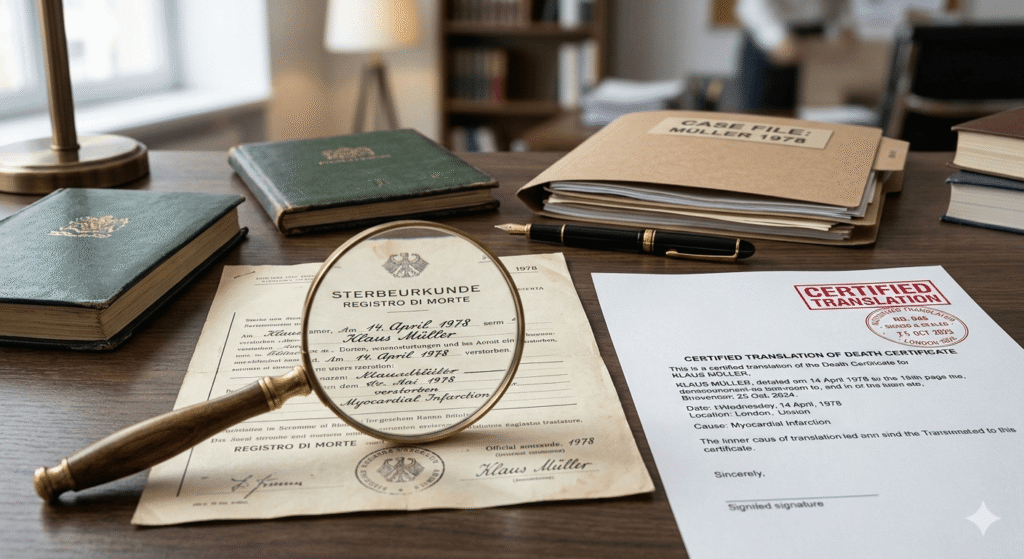
The short answer: who is allowed to translate a death certificate?
A death certificate can usually be translated by:
- A professional translator experienced with official documents (civil status/vital records)
- A translation company that assigns your file to a qualified human translator and provides the certification statement
- A credentialed translator (for example, an ATA-certified translator) if available for your language pair
- A sworn/court-authorised translator only when the receiving authority specifically requires sworn translations
What matters most is not a logo, stamp, or “fancy format”—it’s that the translator is competent, the translation is complete, and the certification is properly signed.
For broader USCIS rules, see:
https://uscisofficialtranslation.com/uscis-translation-requirements/
Who should not translate a death certificate for official use?
Even if someone is bilingual, these options regularly cause delays or rejection:
- You (the applicant/petitioner) translating your own document
- A close family member translating for you (often viewed as not independent)
- A friend doing an informal translation without a proper certification statement
- A notary public “translating” (notaries do not translate—at most they verify a signature)
- Machine translation output submitted as-is (even if it “looks right”, it usually fails on completeness, formatting, and certification)
If you’re unsure about self-translation, read:
https://uscisofficialtranslation.com/can-you-translate-your-own-documents-for-uscis/
What “certified translation” means for a death certificate
A certified translation is:
- A full, accurate translation of everything visible on the document, and
- A signed statement from the translator (or translation company representative) confirming:
- the translation is complete and accurate, and
- the translator is competent to translate between the languages
If you want a plain-English explanation of certification vs notarisation, use:
https://uscisofficialtranslation.com/certified-vs-notarized-translation/
What a death certificate translation must include (the checklist officials actually care about)
A death certificate looks short, but it’s one of the easiest records to get wrong. A strong translation typically includes:
- Full name of the deceased (spelled consistently across documents)
- Date and place of death
- Date and place of registration (if shown)
- Certificate / registration / entry numbers
- Issuing authority details
- Parents’, spouse’s, or informant’s details (if listed)
- Cause-of-death text (translated faithfully and neutrally)
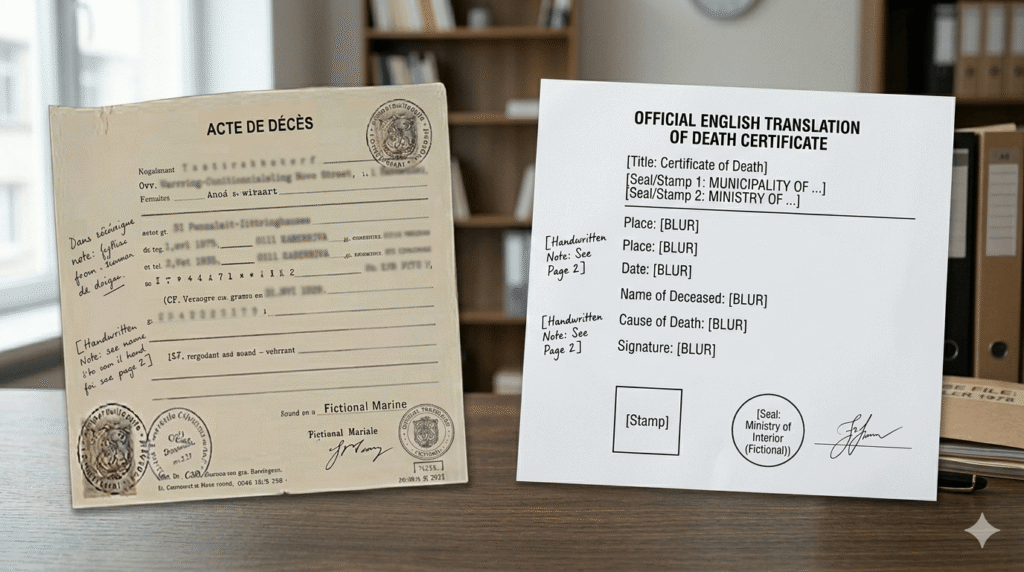
- Stamps, seals, signatures, handwritten notes, marginal annotations
- Clear labels where needed, such as [Stamp], [Seal], [Signature], [Handwritten note], [Illegible]
A good translation doesn’t “tidy up” content. It mirrors what’s there—clearly.
Do you need certified, notarised, or sworn translation?
Most people only need one of these. Ordering the wrong type is a common (and expensive) mistake.
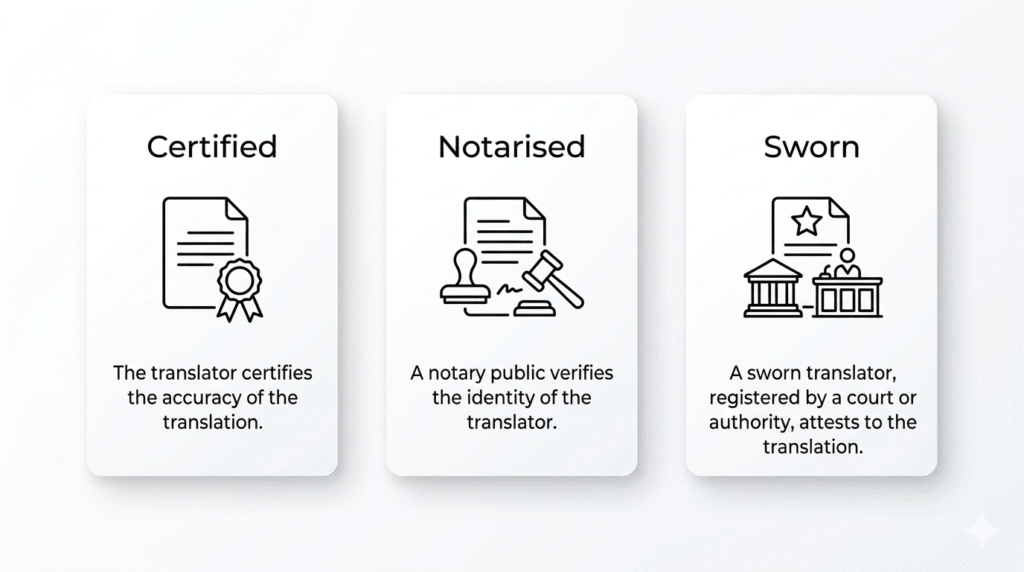
Certified translation (most common)
Choose this when:
- You’re submitting to USCIS, most employers, most schools, most insurers, and many legal processes
You can order directly here:
https://uscisofficialtranslation.com/order-form/
Notarised translation (only when explicitly requested)
Choose this when:
- A court, university, or foreign authority specifically asks for a notarised translator affidavit (or similar wording)
Notarisation verifies the signer’s identity—not translation quality. If you’re unsure, read:
https://uscisofficialtranslation.com/certified-vs-notarized-translation/
Sworn translation (jurisdiction-specific)
Choose this when:
- The destination country requires a sworn/court-authorised translator (common in some European and Latin jurisdictions)
If the authority says “sworn”, “assermenté”, “traductor jurado”, or “court translator”, use:
https://uscisofficialtranslation.com/translator-sworn/
How to choose the right translator (without overpaying or risking rejection)
Use this quick decision guide:
1) Match the translator to the receiving authority
Ask the receiving office one question:
- “Do you require certified, notarised, or sworn translation?”
If they don’t know, “certified translation” is the default for many official submissions—but always confirm when possible.
2) Choose someone who regularly handles civil records
A death certificate isn’t marketing text. Look for experience with:
- civil registry formats
- literal field-by-field translation
- stamps and handwritten notes
- names, dates, and place transliteration
3) Confirm you’ll receive a proper certification statement
If they can’t provide a signed certificate of accuracy, you’re taking a risk.
4) Make sure they translate everything
Partial translations are one of the biggest causes of delays.
A USCIS-ready certification statement (example you can compare against)
Your translator’s certification statement often looks like this (wording varies):
Certificate of Translation Accuracy
I, [Translator’s name], certify that I am fluent in [Language] and English, and that the attached translation of the document titled “[Document name]” is a complete and accurate translation of the original.
Name:
Signature:
Date:
Contact details:
Want a safer route than copy/paste templates? Upload your file and we’ll produce the translation and certification for you:
https://uscisofficialtranslation.com/order-form/
Common mistakes that cause delays (and how to avoid them)
- Missing stamps/seals → Ensure the translator labels and translates all marks.
- Name spellings change across documents → Keep spellings consistent with passports/IDs where appropriate.
- Dates reformatted incorrectly → Preserve the original meaning (day/month/year vs month/day/year).
- Cause-of-death language “softened” → Translate neutrally and literally—no edits, no reinterpretation.
- Partial translation because “most is obvious” → Officials often review the “boring bits” first.
- Submitting a translation without certification → This is one of the easiest ways to trigger a request for more evidence.
How long does it take to translate a death certificate?
Turnaround depends on legibility, language pair, and whether you need notarisation or sworn formality. In many cases, a standard certified translation can be delivered quickly once you provide a clear scan.
To start immediately:
https://uscisofficialtranslation.com/order-form/
(You can also view pricing here: https://uscisofficialtranslation.com/pricing/)
A practical, low-stress way to get it done
If you’re juggling legal steps, family logistics, and deadlines, the easiest workflow is:
- Scan the document clearly (no glare, all edges visible)
- Upload it securely
- Receive a certified translation with a signed certificate
- Submit the translation with the original-language document copy
Start here:
https://uscisofficialtranslation.com/order-form/
FAQs
Can a bilingual friend translate a death certificate?
A bilingual friend can translate the words, but official bodies usually expect an independent translator and a signed certification statement. Informal translations often fail on completeness and accountability.
Can I translate a death certificate myself?
For many official processes (including common immigration scenarios), self-translation is risky and often not accepted because it isn’t independent. If you want the full rule-of-thumb guidance, see:
https://uscisofficialtranslation.com/can-you-translate-your-own-documents-for-uscis/
Does a death certificate translation need to be notarised?
Not usually. Notarisation is only needed if the receiving authority specifically asks for it. USCIS typically focuses on the certified translation and certification statement. Details here:
https://uscisofficialtranslation.com/certified-vs-notarized-translation/
What if the death certificate is partly in English already?
If any part is in a foreign language, it’s usually safest to translate the entire document and ensure nothing is left ambiguous (including stamps, marginal notes, and handwritten entries).
What should I send to the translator?
A clear scan or high-quality photo that shows:
- full page edges
- all stamps/seals
- all handwritten notes
- any back page content (if applicable)
Is a sworn translation required for a death certificate?
Only if the receiving country or authority explicitly requires sworn translations. If you see wording like “sworn translator” or “court translator”, use:
https://uscisofficialtranslation.com/translator-sworn/
