
If you’re submitting an Acta de Nacimiento for immigration, school, court, or official records, you typically need a complete English translation plus a signed translation certification.
This guide walks you through the exact process—what to translate, what to watch out for (Mexican naming and registry details trip people up), and how to submit your translation confidently.
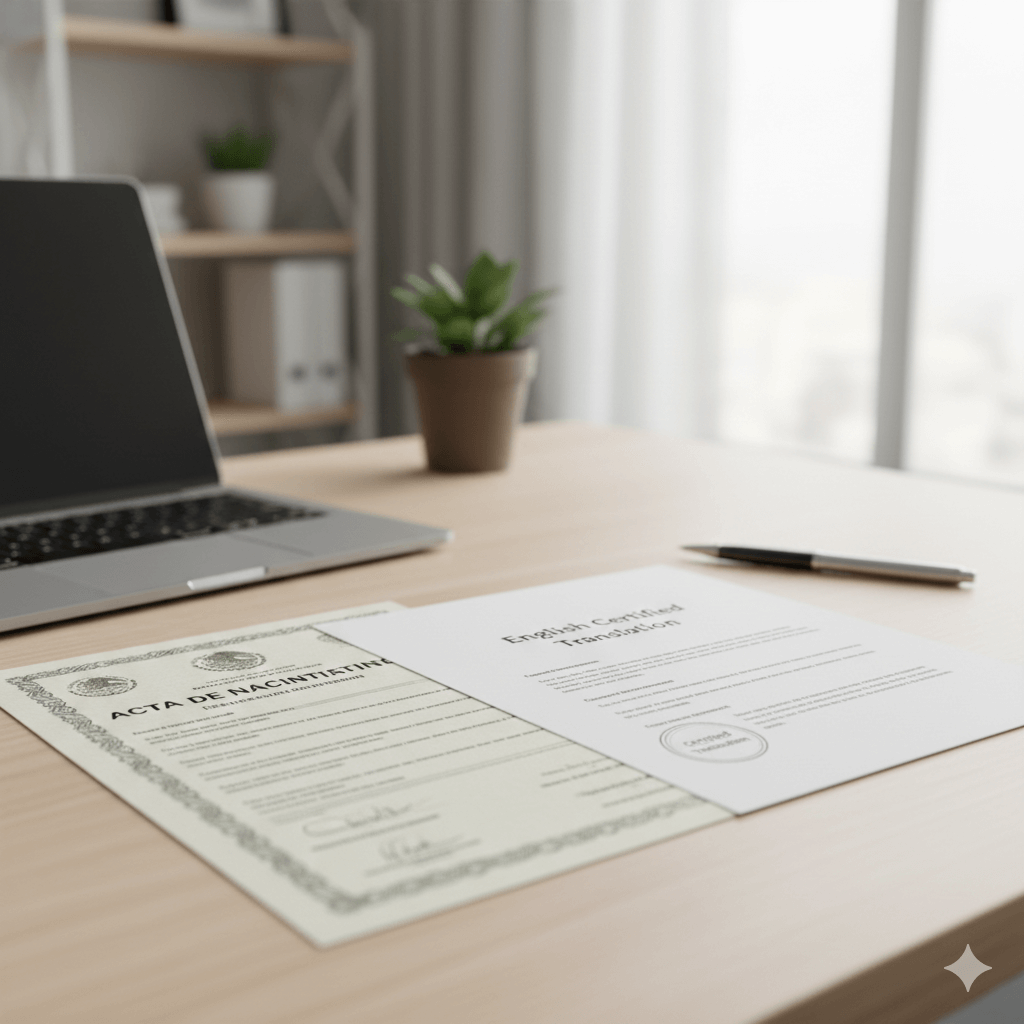
The “USCIS-ready” standard in plain English
For official use with U.S. Citizenship and Immigration Services, your translation should be:
- Complete (every word, stamp, note, label, and field)
- Accurate (no guessing, no “summary translation”)
- Properly certified (signed statement confirming accuracy and translator competence)
If your translation is missing key elements—like marginal notes, stamps, or registry fields—it can cause delays, Requests for Evidence (RFE), or extra back-and-forth when you least need it.
Quick checklist before you start
Make sure you have:
- A clear scan or photo of the Acta (front and back if there’s anything printed/stamped)
- Any attached pages (annotations, corrections, additional notes)
- Your target use (USCIS, National Visa Center, DMV, school, court, employer)
- Your deadline
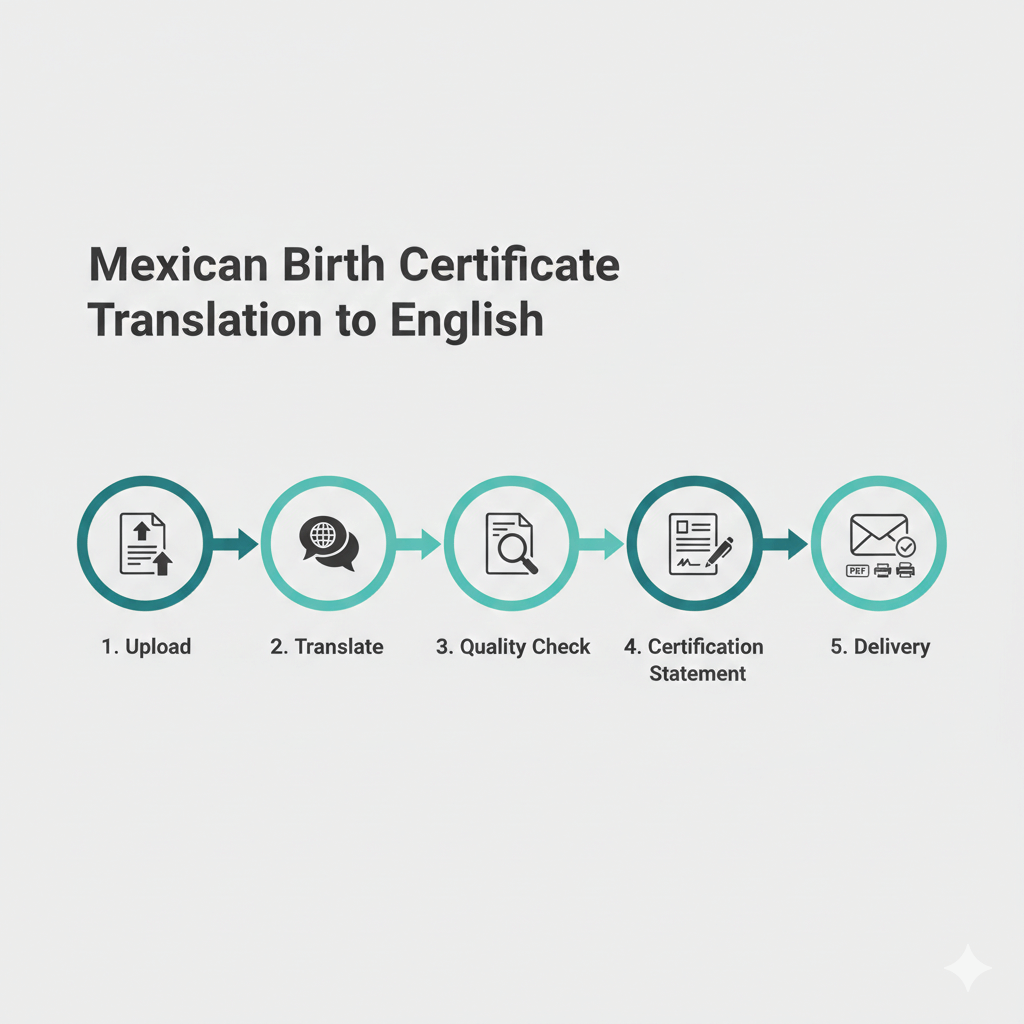
Fastest path: Upload a clear image/PDF and request a certified translation with certification included.
Step-by-step: how to translate a Mexican birth certificate to English
1) Get a clean, readable copy (this matters more than people think)
Mexican birth certificates may be:
- Older handwritten or stamped formats
- Modern digital “Acta” formats with QR codes
- Documents containing marginal notes (adoptions, recognitions, corrections)
Use this scan rule: if you can’t read it comfortably on your phone screen, the translator can’t translate it reliably.
Quick scan tips
- Use bright natural light
- Keep the document flat
- Capture the full page edges
- Don’t blur stamps, seals, signatures, or QR blocks
If your copy is unclear, it’s often faster to obtain a cleaner version than to fight with an unreadable scan.
2) Identify what must be translated (spoiler: it’s not just “the main text”)
A strong Acta translation includes everything, such as:
- Headings and section titles
- Names and surnames exactly as shown
- Registry fields (book/page/act number)
- Dates and places
- Civil registry office details
- Stamps, seals, signatures
- Notes in the margins
- QR text content if printed as readable text
- CURP (if present) and identifying codes/folios
Even small items like “Oficialía”, “Libro”, “Tomo”, “Foja”, “Acta”, “Entidad Federativa”, “Municipio” matter because they help an officer verify the record’s structure.
3) Handle Mexican names correctly (this is where DIY translations fail)
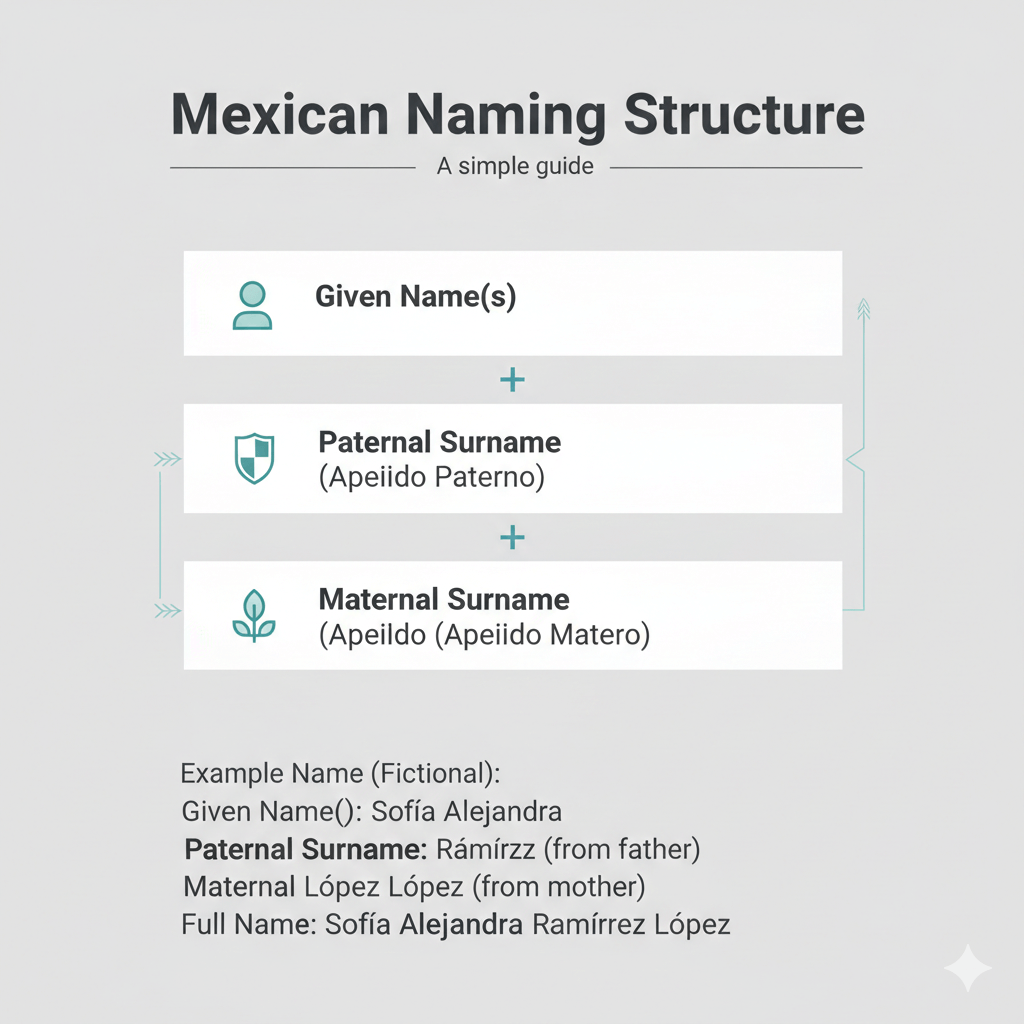
Mexican naming conventions commonly include:
- Given name(s)
- Paternal surname (Apellido Paterno)
- Maternal surname (Apellido Materno)
The biggest mistake is turning two surnames into a “middle name” or dropping one surname entirely.
Best practice: Keep the name order exactly as shown, and do not “Americanize” it. If the person uses one surname day-to-day, that’s fine—your translation should still reflect the Acta precisely.
4) Translate dates and locations in a way officials understand
Mexican documents may use date formats that confuse English readers.
Best practice:
- Translate month names into English
- Keep numeric dates unambiguous
- Preserve place names as written (and translate labels like “State of”, “Municipality of”)
Example formatting approach:
- Spanish: “12 de marzo de 2001”
- English: “12 March 2001”
5) Include stamps, seals, signatures, and notes the right way
You don’t “translate” a seal image, but you do account for it.
Use clear notations like:
- [Stamp: Civil Registry Office]
- [Illegible signature]
- [Round seal present]
- [Handwritten marginal note: partially legible]
This is essential because officials need to see that nothing was ignored.
6) Add a proper certification statement (the piece many people forget)
A certified translation isn’t just the English text—it includes a signed certification confirming:
- the translation is complete and accurate, and
- the translator is competent in both languages
Here’s a practical example you can model your certification on:
Certificate of Translation Accuracy
I, [Translator Full Name], certify that I am fluent (competent) in English and Spanish, and that the above/below translation of the attached document is a complete and accurate translation of the original document in Spanish to the best of my knowledge and ability.Translator Name: [Name]
Signature: ____________________
Date: [Date]
Address: [Address]
7) Quality-check your translation like an officer would
Before submission, do this 60-second verification:
- Names match the original exactly (including accents if shown)
- Dates are clear and consistent
- Every label/field is translated (no skipped boxes)
- All stamps/notes/signatures are accounted for
- The certification is signed and dated
- The translation is presented cleanly (easy to compare against the original)
Can you translate your own Mexican birth certificate?
People ask this a lot.
In many cases, what matters is that the translator is competent and provides the correct certification. But self-translation can raise issues if:
- your translation misses stamps/marginal notes,
- the certification looks informal,
- the formatting is messy,
- or the name structure is mishandled.
If the document is high-stakes, it’s usually safer to use an independent professional.
When do you need notarization or apostille?
For most USCIS filings, what you typically need is a certified translation (translation + signed certification). Notarization is a separate step that confirms the signer’s identity; it doesn’t automatically improve translation quality.
That said, some courts, schools, employers, or consular processes may request notarization. If you’re not sure what your receiving authority expects, use the safer route: certified translation first, then notarize only if specifically requested.
A real-world “Acta de Nacimiento” translation trap to avoid
Scenario: Your Acta shows two surnames, but your passport shows one surname, or your U.S. documents reflect a shortened name.
What not to do: Change the translation to match your passport.
What to do instead: Translate the Acta exactly as written. If needed, attach an explanation elsewhere in your application (not inside the translation) so the translation stays faithful to the source document.
Ready to translate your Mexican birth certificate fast and correctly?
If you want a clean, certified, submission-ready translation without second-guessing formatting or certification wording.
You’ll receive:
- A complete English translation
- A signed certification page
- Clear formatting that’s easy for officers to review
What clients say
- “Fast, clear, and accepted without questions.” — Daniel R., Spanish to English
- “They handled the stamps and notes perfectly.” — María G., Spanish to English
- “I was worried about my two surnames—this came back flawless.” — Luis M., Spanish to English
FAQ
How long does it take to translate a Mexican birth certificate to English?
Many applicants choose same-day or 24-hour turnaround when deadlines are tight. Timing depends on scan clarity and whether the Acta includes marginal notes, extra pages, or handwritten sections.
Do I need a certified translation for a Mexican birth certificate?
For official use, you typically need a complete English translation plus a signed certification statement from the translator confirming accuracy and competence.
Does the translation need to be notarized?
Often, certified translation is what’s requested. Notarization may be required only if your receiving authority explicitly asks for it.
What should be translated on an Acta de Nacimiento?
Everything: names, dates, locations, registry fields, stamps, seals, signatures, and marginal notes. Nothing should be skipped.
Can a family member translate my Mexican birth certificate?
A family member may be able to translate if they’re competent and provide proper certification, but it can create avoidable risk. An independent translator is usually the safer choice for high-stakes filings.
What if my Mexican birth certificate has a QR code?
If the QR area includes printed text, that text should be translated. If it’s only a scannable code image, it should be noted as present (not translated as content).
