
A foreign birth certificate is one of the most important documents in a U.S. immigration case—because it proves who you are, where you were born, and (often) who your parents are. If it’s not in English, you’ll need a complete English translation with the right translator certification. Get this wrong and you risk delays, a request for evidence, or having to redo it under time pressure.
This guide walks you through the exact process—what to translate, how to avoid common pitfalls, and how to submit it cleanly the first time.
The simple rule that keeps your case moving
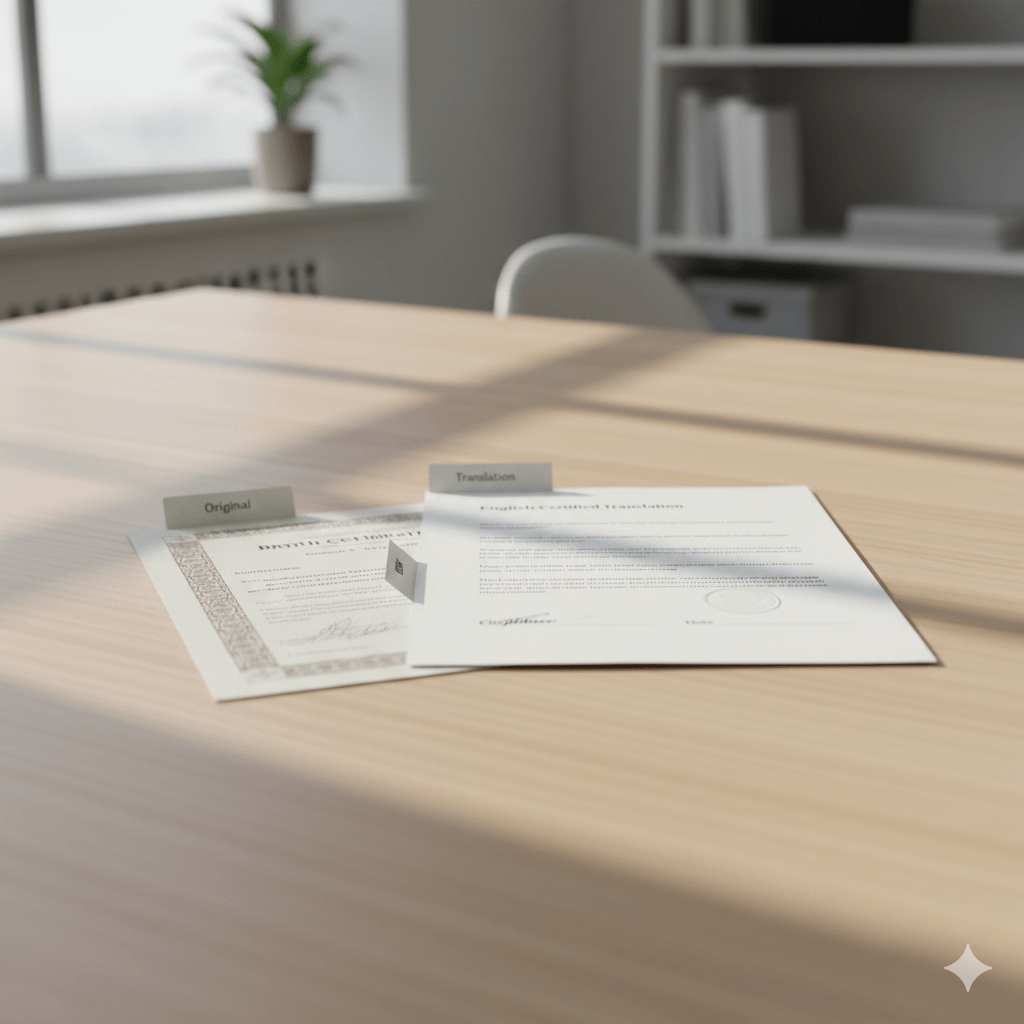
For immigration filings with U.S. Citizenship and Immigration Services, a proper birth certificate translation has two parts:
- A complete English translation of everything on the document
- A signed certification statement from the translator confirming:
- the translation is complete and accurate, and
- they are competent in both languages
That’s it. No mystery. The problems usually come from the details people overlook—stamps, handwritten notes, reverse-side text, inconsistent spelling, or missing certification wording.
Quick-start checklist
If you do nothing else, follow this:
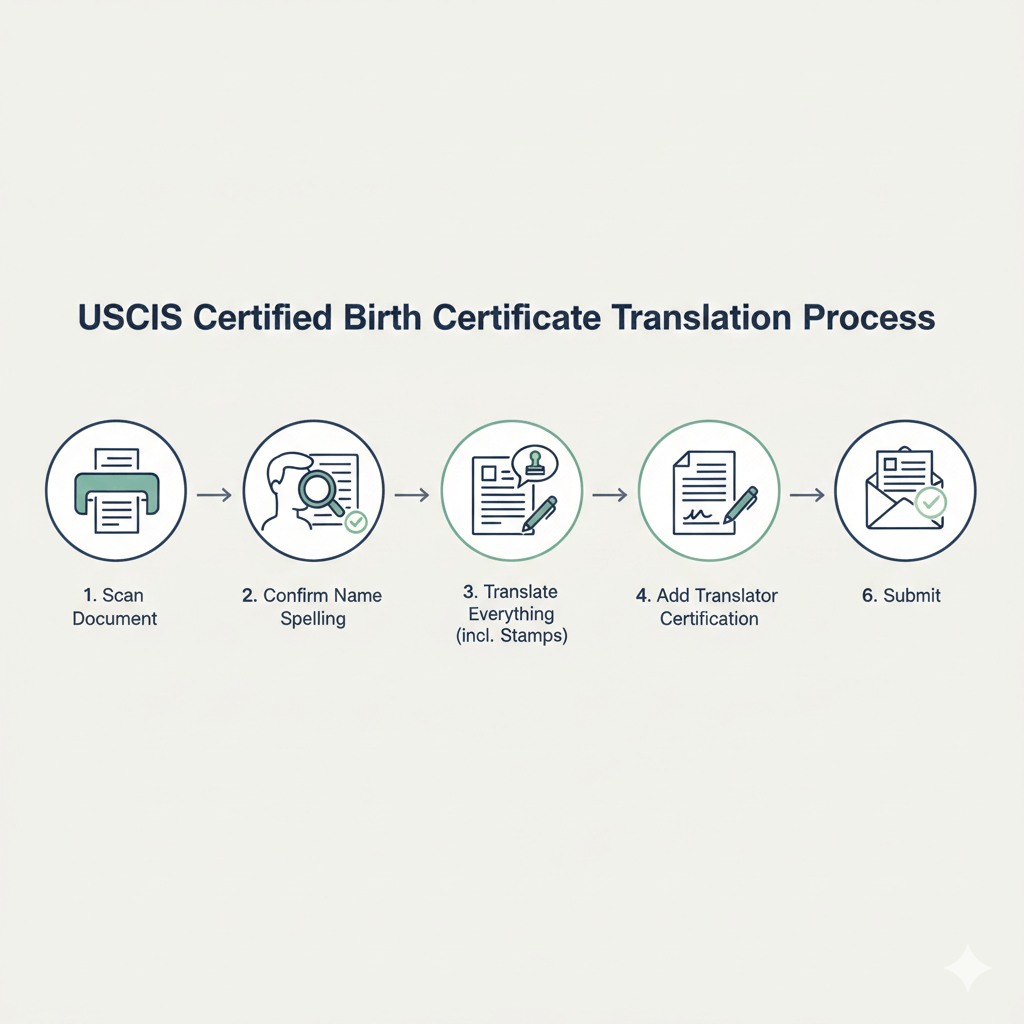
- Scan or photograph your birth certificate clearly (front and back).
- Confirm how your names must appear in English (match your passport and USCIS forms).
- Use a qualified translator or service that provides a signed translator certification.
- Make sure every stamp, seal, note, and margin entry is translated (even if it looks “unimportant”).
- Submit the original-language copy + the English translation + the certification together in one neat package.
Step-by-step: how to get your foreign birth certificate translated
Step 1: Get a clean, readable copy of the document
USCIS can’t accept what they can’t read—and neither can a translator.
Use these quality basics:
- Capture the entire page, including borders and corners
- Make sure names, dates, registry numbers, stamps, and signatures are sharp
- Include front and back
- If there are multiple pages, scan them in order
Tip: If your birth certificate has faint ink or embossed seals, take a second photo at a slight angle to make the impression visible.
Step 2: Decide what the “correct English version” of names should be
This is where many avoidable delays start.
Before translating, decide:
- What spelling of your name matches your passport
- Whether accents/diacritics should be kept or simplified (e.g., José vs Jose)
- How multi-part names should appear (two surnames, patronymics, or compound family names)
Your translation should be consistent with:
- Your passport
- Your USCIS forms (I-130, N-400, I-485, etc.)
- Any prior filings you’ve made
If your birth certificate spelling differs from your passport, the translation should reflect what’s on the certificate, but you may want to include a brief translator note like: “Name appears on document as ___.” (This is normal and often helpful.)
Step 3: Choose the safest translation option
You usually have three choices:
- A USCIS-focused online certified translation service (fastest, most consistent formatting)
- A professional freelance translator experienced with immigration documents
- A local translation office that provides certified translations with proper certification wording
Most applicants choose an online service because it’s fast, easy to upload, and the output is formatted for USCIS review.
Step 4: Ensure the translation includes everything USCIS expects
A USCIS-ready birth certificate translation typically includes:
- A clean English layout that mirrors the original document’s structure
- A full translation of all printed text
- Translation of stamps, seals, handwritten notes, marginal entries, registry marks, and reverse-side text
- A translator certification statement (signed)
Step 5: Confirm the translator certification wording is present
Your certification does not need to be complicated. It must be clear and complete.
A common compliant format looks like this:
I certify that I am competent to translate from [Language] into English and that the translation is complete and accurate.
It should also include:
- Translator’s name
- Signature
- Date
- Contact details (commonly included and often helpful)
Step 6: Do a final “RFE-proof” review before you submit
Before you upload or mail your application, check:
- Names and dates are consistent with your forms
- Place names are spelled consistently
- All stamps/notes are translated (even if they’re partially illegible—those should be flagged as such)
- The translator certification is signed and included
- The original-language birth certificate copy is included with the translation
What must be translated on a foreign birth certificate
People often translate only the “main” fields and forget everything else. USCIS language is simple: full translation.
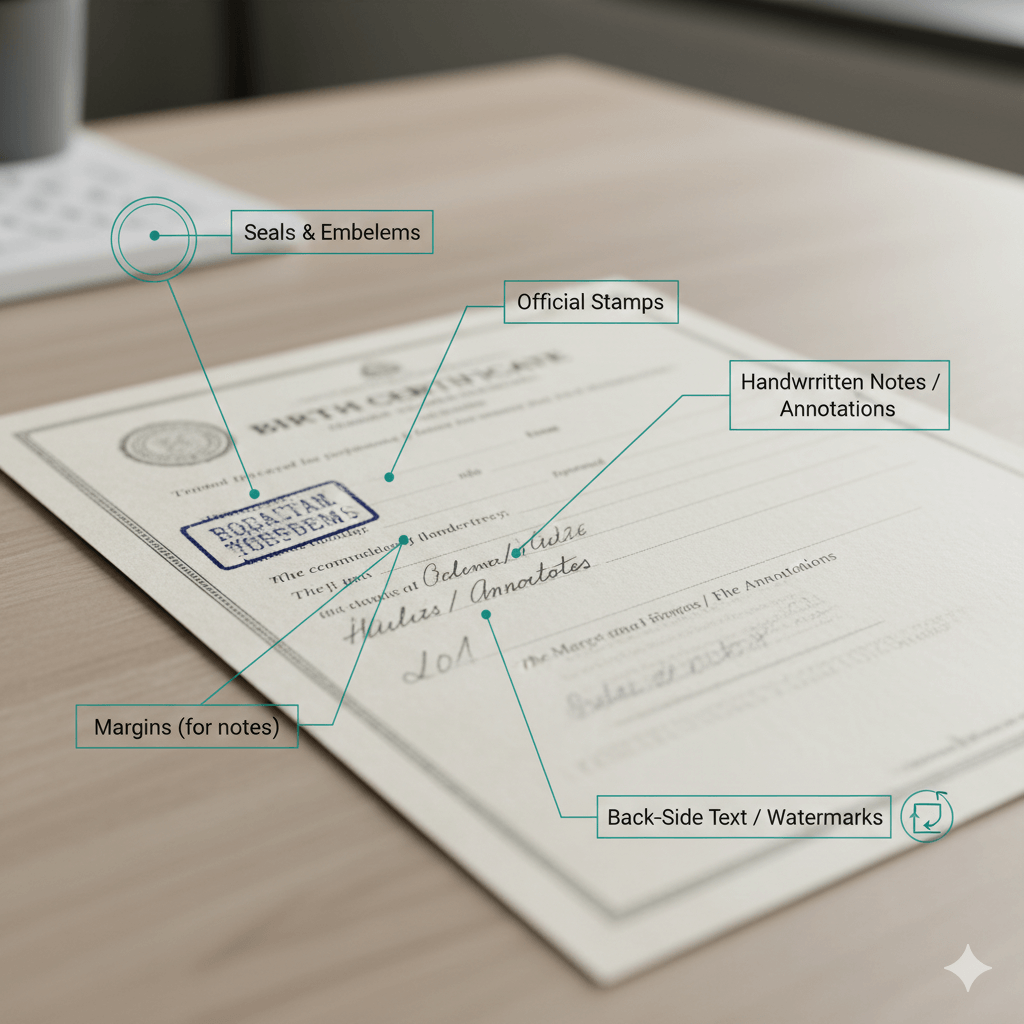
That includes:
- Names (child, parents)
- Dates and places (birth, registration, issuance)
- Document title and issuing authority
- Registry numbers and book/page references
- Official stamps and seals
- Handwritten corrections or marginal notes
- Annotations such as “late registration,” “amended,” “certified copy,” or “extract”
- Reverse-side text (often contains legal language or authentication notes)
If your certificate is an “extract” or short-form record, it may still be acceptable—but requirements vary by country and case type. When in doubt, it’s smart to check the correct civil document format for your country and whether alternatives exist if a long-form certificate isn’t available.
The biggest mistakes that cause delays
Here are the patterns that most often lead to a redo:
1) Partial translations
Commonly missed:
- Marginal notes
- Back-side endorsements
- Stamps that look decorative but contain text
2) Missing or weak certification statements
USCIS needs a certification that explicitly confirms:
- competence, and
- completeness and accuracy
3) Inconsistent spelling across documents
Example issues:
- Different romanisation of a city name
- Different surname ordering
- Different spelling with/without accents
4) Machine translation output
Even if it “looks right,” machine translation can:
- mistranslate legal terms
- scramble name order
- miss subtle annotations
- create weird formatting that raises credibility questions
5) Poor scan quality
If the certificate is blurry, the translation may include uncertainty notes—and that can invite questions. Always start with the clearest copy you can.
Can you translate your own birth certificate
You’ll find conflicting advice online because the legal rule focuses on competence and certification, not family relationships. In real cases, however, self-translation is often a bad trade-off: it can look biased, and a birth certificate is a core identity document.
Practical guidance:
- If this document is central to identity (birth certificate, marriage certificate, police certificate), an independent professional is the safest path.
- If you’re translating casual evidence (messages, informal letters), risk tolerance may be different.
Certified vs notarized vs apostille
These get mixed up constantly.
Certified translation
This is what USCIS typically requires:
- Full translation + translator certification
Notarized translation
Notarisation usually means:
- a notary witnesses the translator’s signature (or a translator affidavit)
USCIS usually does not require notarisation, but some courts, schools, employers, or state agencies may. If you’re submitting your translation somewhere other than USCIS, confirm the requirement first.
Apostille
An apostille authenticates a document for international use under a treaty process. It is not a substitute for translation. Some authorities may require both:
- apostille/legalisation of the original, and
- a certified (or notarised) translation
If you’re not sure which applies, you can upload the request letter (or tell us the destination authority) when you start your order, and your project manager can confirm what you actually need.
How long it takes and how much it costs
Most birth certificates are one page (sometimes two), so turnaround is usually fast once the file is readable and complete.
At USCIS Official Translation:
- Pricing starts at $24.99 per page
- Standard delivery is typically within 24 hours
- Rush options are available if you’re on a deadline
A real-world example of what “complete” looks like
Imagine a Spanish-language birth certificate with:
- a main printed section (name, parents, place of birth)
- a marginal note stating a later name correction
- a stamp from the civil registry
- a handwritten registry clerk signature
A complete translation:
- translates the main fields exactly
- includes a “Notes/Annotations” line translating the margin note
- labels and translates the stamp text (even if partially illegible)
- notes signatures and handwritten elements as such
This is the difference between a translation that “looks fine” and a translation that is designed to be accepted without questions.
How to submit your translated birth certificate cleanly
Whether you’re uploading online or mailing a packet, aim for clarity:
- Put the foreign-language copy first
- Follow with the English translation
- Follow with the translator certification (if separate)
- Keep file names simple (e.g.,
Birth_Certificate_Original.pdfandBirth_Certificate_Translation.pdf)
If you’re filing multiple documents, keep each document’s translation paired with its original. It reduces confusion for the officer reviewing the file.
Want the safest path with the least friction
If you want a USCIS-ready translation with correct formatting, signed certification, and support if you get questions later:
- Start here: Upload
- Or review requirements first: USCIS translation requirements
- Need help choosing the right approach? How We help?
FAQs
Do I need to translate my foreign birth certificate for USCIS
If your birth certificate contains any non-English text, you generally need a complete English translation with a signed translator certification.
What is a certified birth certificate translation
A certified birth certificate translation is a complete English translation accompanied by a signed statement from the translator confirming it is complete and accurate and that they are competent in both languages.
Does USCIS require notarized translation for a birth certificate
Usually, no. USCIS typically requires a certified translation, not a notarised one. Notarisation may be required by other authorities, so always confirm the destination requirement.
Can I translate my own birth certificate for immigration
Even if you’re bilingual, it’s a high-risk choice for a core identity document. An independent translator or professional service is the safest option to avoid delays.
How much does foreign birth certificate translation cost
Cost depends on length, language pair, and turnaround time. Many birth certificates are one page, so pricing is often per page.
How long does it take to translate a birth certificate to English
With a clear scan, many certified translations are completed within 24–72 hours, with rush options available depending on provider capacity.
