
If you’ve been asked to submit a birth certificate in English—whether for immigration, a visa, school, employment, or a legal process—you usually need more than “a translated version.” You need a translation that’s complete, formatted clearly, and accompanied by the right certification so it’s accepted the first time.
This guide walks you through the exact steps to get your birth certificate translated into English, what to check before you pay anyone, and the common mistakes that cause delays.
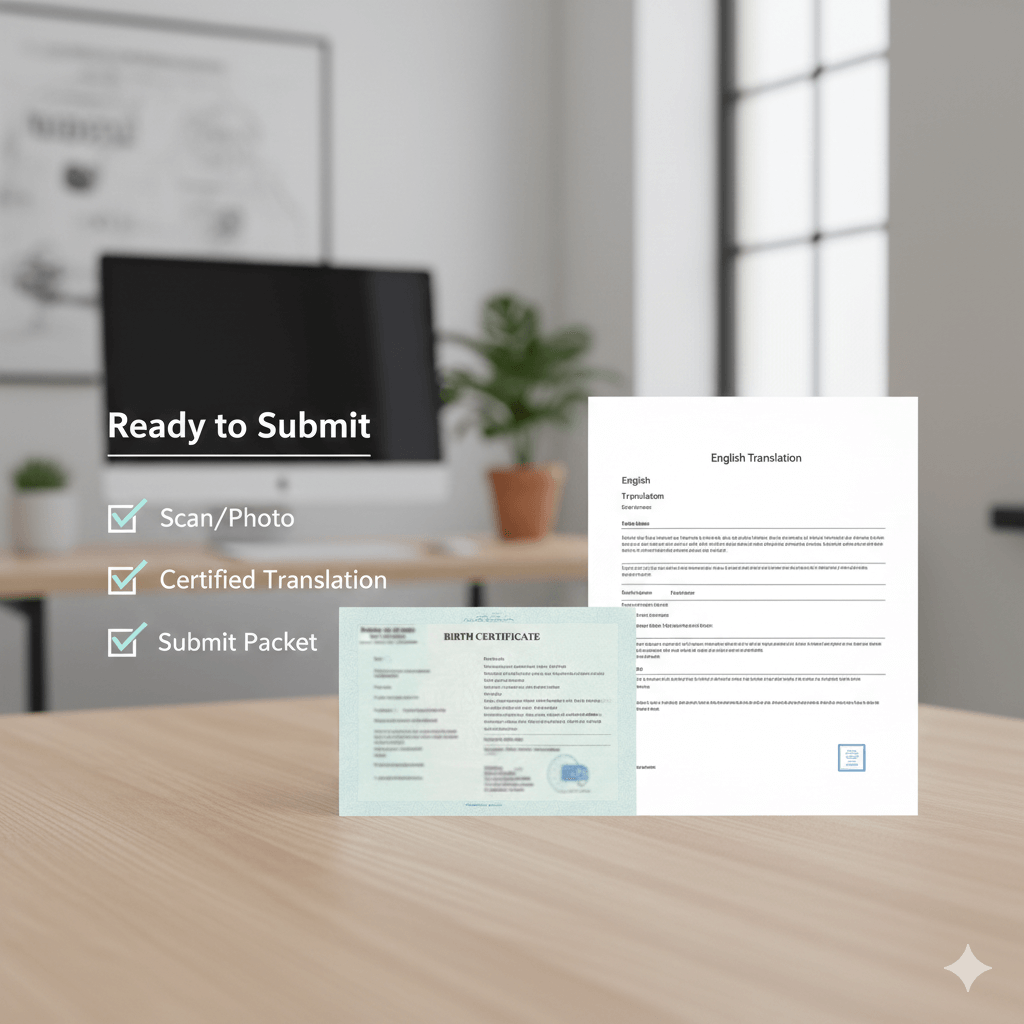
What “certified” birth certificate translation actually means
When an authority asks for a certified translation, they typically mean:
- A full English translation of everything on the birth certificate (including stamps, seals, handwritten notes, marginal notes, and registration details)
- A signed certification statement from the translator or translation company confirming the translation is complete and accurate and that the translator is competent in both languages
In plain terms: the certification is what turns a translation into something an official reviewer can rely on.
Step 1: Confirm who asked for the translation (requirements change by use case)
Before you translate anything, identify the destination:
- US immigration / USCIS filing: usually needs a certified translation (not notarisation in most cases)
- Court, university, or certain consulates: may ask for notarisation, sworn translation, or specific formatting
- Multiple uses (immigration now, consulate later): you may want add-ons (notary, hard copy) to avoid redoing the translation
Step 2: Get a clean scan or photo (this matters more than people realise)
A translation can only be as accurate as what the translator can read. Use this checklist:
- Photograph in good lighting, no glare
- Keep the document flat, not curved
- Capture all edges, seals, and stamps
- Include the back page if there are notes, stamps, or registration information
- If the certificate is faded, take two photos: one normal + one with slightly higher contrast
If something is illegible, don’t guess—ask your translator how to handle unclear text properly.
Step 3: Decide who should translate it (and who shouldn’t)
You generally have three safe options:
Option A: A specialised certified translation service (fastest for most people)
Best when you want a smooth process, clear formatting, and a certificate that’s ready to submit.
Option B: A professional independent translator
Great if you already know a trusted professional who regularly produces certified immigration translations.
Option C: A local translation office (in-person)
Useful if you prefer drop-off and collection, but timelines and consistency vary.
What to avoid
- Anyone who offers a “translation” without a proper certification statement
- Anyone who says they’ll translate only the main text and skip stamps/notes
- Anyone who can’t confirm what the certification includes
Step 4: Make sure the translation includes everything (the “nothing omitted” rule)
A birth certificate often includes details people accidentally skip, such as:
- Registration number / book / folio / act number
- Issuing authority, registry office, municipality
- Marginal notes (corrections, late registrations, annotations)
- Seals and stamps (even if they look decorative)
- Handwritten elements (signatures, notes, approvals)
- Date formats that can be misread (e.g., 03/07/2001)
Step 5: Check formatting (the goal is clarity, not creativity)
A good certified translation is easy for an officer or reviewer to scan quickly:
- Headings are clear (e.g., “Translation of Birth Certificate”)
- Fields follow the original layout where possible
- Names, places, and dates are consistent with how they appear across your application
- Any stamps/seals are noted in brackets (e.g., “[Round stamp: Civil Registry Office]”)
Step 6: Confirm the certification statement is complete (copy-and-paste example)
Here’s what your certification statement should cover—clearly and simply:
- The translation is complete and accurate
- The translator is competent in both languages
- The translator’s name, signature, date, and contact details
Sample certification wording (example):
“I certify that I am competent to translate from [Language] into English, and that the foregoing translation is complete and accurate to the best of my ability.”
Your translator or agency may use slightly different wording—that’s normal—as long as the essentials are present.
Step 7: Choose delivery format (digital is usually enough, hard copy is sometimes helpful)
In many cases, a digital PDF is perfectly acceptable and easiest to upload with an application.
You may want hard copy shipping if:
- your attorney requests a physical file
- you’re submitting printed packets
- you need the translation for another authority later
You can also add notarisation if a specific authority explicitly asks for it.
Cost and turnaround: what to expect (and what changes the price)
Most birth certificates are one page, so pricing is often simple.
What influences cost:
- Language pair and handwriting/stamps complexity
- Urgency (standard vs rush)
- Add-ons (notary, apostille, hard copy shipping, extra copies)
The “ready to submit” checklist (use this before you file)
Use this quick checklist to avoid the most common rework triggers:
- Every word on the certificate is translated (including stamps, seals, notes)
- Names match your passport and application spelling
- Dates are unambiguous (month spelled out if needed)
- Places and issuing authority are clearly translated (no guessing)
- Certification statement is included and signed
- You’re submitting the translation together with a copy of the original
Quick answers to common scenarios
“My birth certificate already has some English on it—do I still need a translation?”
Sometimes yes. If the English is partial, unclear, or mixed with another language, many applicants translate it anyway to keep things straightforward.
“I need this for USCIS—do I need notarisation?”
Often no, unless someone specifically requests it. If you’re juggling multiple authorities, notarisation can be added so you don’t redo the translation later.
“What if I don’t have a birth certificate?”
You may need an alternative civil record or secondary evidence, depending on the process you’re dealing with. If the authority gave you instructions, follow those first.
FAQs
How do I get my birth certificate translated into English for immigration?
Get a complete English translation of every element on the certificate and ensure it includes a signed translator certification stating accuracy and competence.
Can I translate my own birth certificate into English?
Some processes may allow it, but it can create credibility issues and avoidable mistakes. Many applicants use a neutral professional to reduce risk.
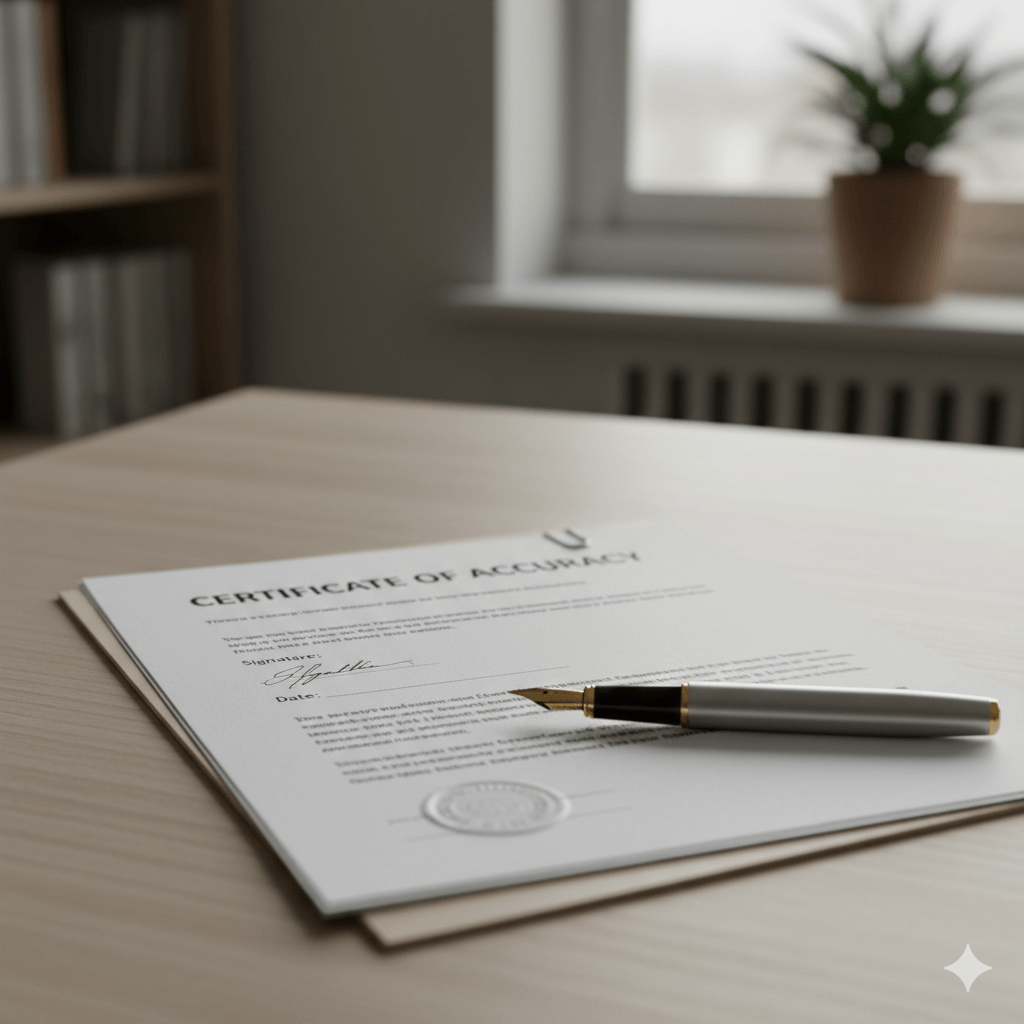
What is a translation certificate of accuracy?
It’s the signed certification statement attached to the translation confirming the translation is complete and accurate and the translator is competent in both languages.
Do I need a notarized translation for a birth certificate translated into English?
Only if the authority specifically asks for notarisation. Many immigration submissions rely on a certified translation with a signed certification statement.
How long does it take to translate a birth certificate into English?
Many certified translations can be completed within 24 hours, depending on language, clarity, and whether rush service is requested.
How much does a certified birth certificate translation cost?
Costs vary by provider and urgency. Many single-page birth certificates fall within a per-page rate, with extra fees for rush, notary, or shipping.
If your birth certificate isn’t in English, you’ll usually need an English translation for your USCIS filing. The part that trips people up is not the translating — it’s getting the format and certification right so your case doesn’t stall with a request for more evidence.
This guide shows you exactly how to get a birth certificate translated to English the USCIS-ready way, including a copy-paste certification statement, a practical quality checklist, and the most common mistakes that cause delays.
The 60-Second Checklist
Before you do anything else, make sure your final package meets these basics:
- A full English translation of every visible element on the certificate (including stamps, seals, handwritten notes, marginal text, back-side text, and registration details)
- A signed translator certification stating:
- the translation is complete and accurate
- the translator is competent to translate into English
- The translator’s printed name, signature, date, and contact details
- A clear copy of the original birth certificate submitted alongside the translation
If any one of these is missing, that’s where people run into avoidable delays.
What “Certified Translation” Means for a Birth Certificate
For USCIS purposes, “certified translation” typically means:
- Your birth certificate is translated into English completely
- A real person signs a short statement confirming accuracy and competence
It does not usually mean:
- a government stamp
- an embassy stamp
- notarization (in most USCIS situations)
- a specific licence or membership requirement
What matters is that the translation is complete, readable, consistent, and properly certified.
Do You Need a Professional Service or Can You Do It Yourself?
USCIS does not generally require you to use a particular company. What they require is a certified translation produced by someone competent.
That said, your birth certificate is one of the documents that most directly supports identity and eligibility. Many applicants choose an independent, qualified translator (rather than themselves or a close relative) for one simple reason: it reduces credibility questions and prevents common formatting/certification errors that trigger delays.
A simple rule to decide
Choose a professional if any of these are true:
- The certificate includes handwritten text
- There are stamps, seals, marginal notes, corrections, or multiple pages
- Names include non-Latin script (Arabic, Cyrillic, Chinese, etc.) and must match passports/forms precisely
- You are filing on a deadline and want the lowest risk path
If your document is very simple, clearly printed, single-page, and you already understand the certification and formatting requirements, a DIY approach can work — but only if done carefully.

Step-by-Step: How to Get a Birth Certificate Translated to English
Step 1: Confirm you have the right version of the birth certificate
Use the version you will actually submit with your immigration packet. Many countries have multiple formats:
- short form vs long form
- extract vs full record
- older handwritten versions vs newer printed versions
If your certificate has a front and back, submit both sides and translate both sides.
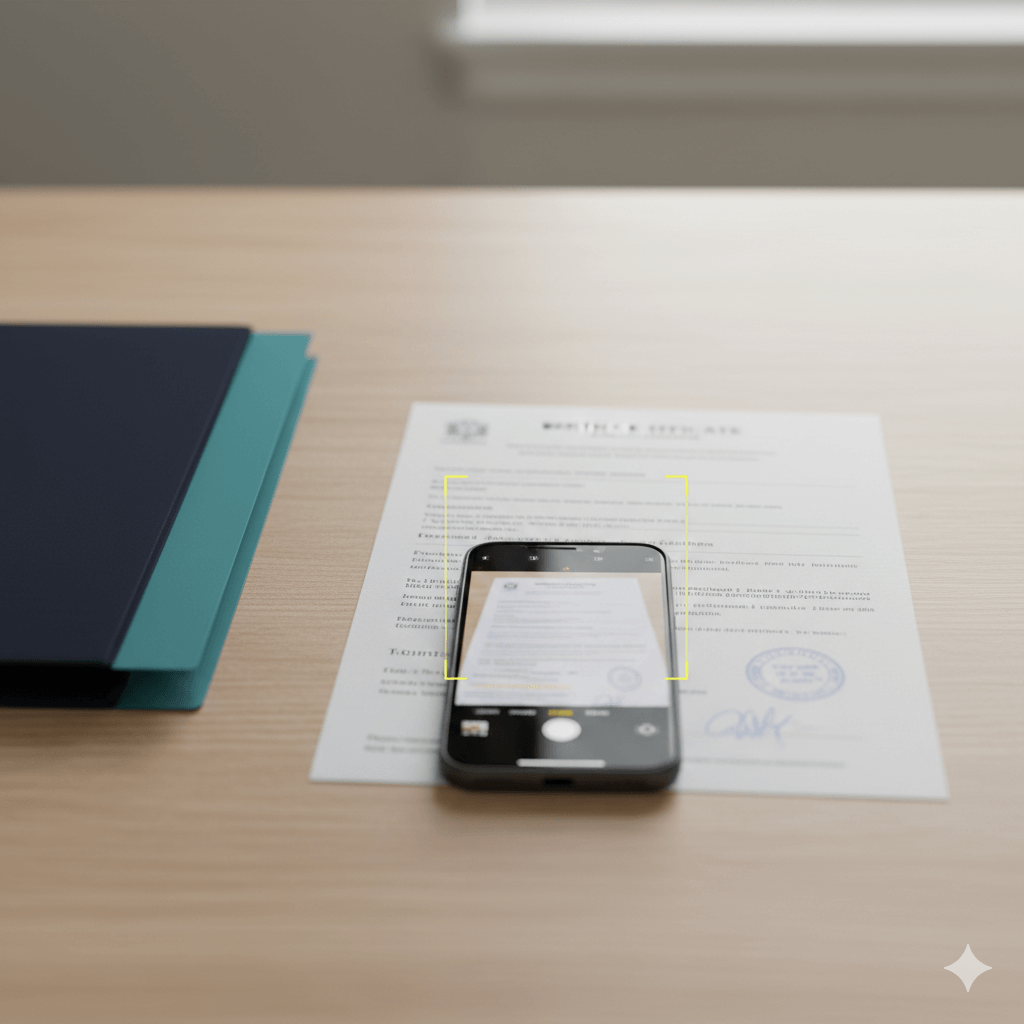
Step 2: Create a clear scan or photo
A translation can only be as good as what’s visible.
Use these quick rules:
- Bright, even lighting (avoid shadows)
- Flat image (no angles, no fingers covering edges)
- High resolution so stamps and fine print are readable
- Capture the entire page, including borders and corners
If a stamp is faint or a handwritten note is hard to read, that’s a red flag: clarify it before translation or be prepared for a conservative translation note.
Step 3: Decide how names will appear in English
This is one of the biggest causes of inconsistencies.
Your translation should reflect what the birth certificate says, but your English spellings must also be consistent across:
- your passport
- your USCIS forms
- other supporting records (marriage certificates, national IDs, etc.)
Practical tip for non-Latin alphabets
If your name is originally in Arabic, Cyrillic, or another script, choose one spelling that matches your passport and use it consistently. Small spelling shifts can create avoidable questions.
Step 4: Translate everything you can see — not just the “main fields”
A proper birth certificate translation includes:
- headings and field labels
- the registration number and book/page references
- stamps, seals, endorsements, annotations
- signatures (as labels, not the person’s name unless it’s printed)
- handwritten notes (as best as legible)
- any disclaimers, footnotes, or legal text printed on the record
If something is illegible, the translator should indicate that clearly and conservatively (without guessing).
Step 5: Mirror the layout so it’s easy to compare
USCIS officers review quickly. You want the translation to be easy to match line-by-line.
A strong format usually looks like this:
- Title at the top: English Translation
- Document label: Birth Certificate
- Then a structured, field-based layout matching the original order
You do not need fancy design. You do need clarity.
Step 6: Add a translator certification statement
This is the step people forget or do incorrectly. A certification is typically a short paragraph plus the translator’s identity/signature details.
Use the copy-paste wording below.
Copy-Paste Translator Certification Statement
Paste this at the end of the translation (or on the last page), then add the translator’s details and signature.
CERTIFICATE OF TRANSLATION ACCURACY
I, the undersigned, certify that I am competent to translate from the original language of the attached birth certificate into English, and that the foregoing translation is a complete and accurate translation of the document.
Translator printed name: ___________________________
Signature: _______________________________________
Date: ____________________________________________
Address: _________________________________________
Phone/Email: _____________________________________
This is the core language USCIS expects to see: completeness, accuracy, and competence — plus a real person’s signature and contact details.
Does the Translation Need to Be Notarized?
In most USCIS cases, notarization is not required. A proper translator certification is what matters.
Notarization may be requested in other situations, such as:
- certain state agencies or courts
- foreign consular processes
- employer or licensing boards with their own rules
If someone specifically asks for a notarized translation, don’t assume USCIS rules apply — follow the requesting authority’s instructions.
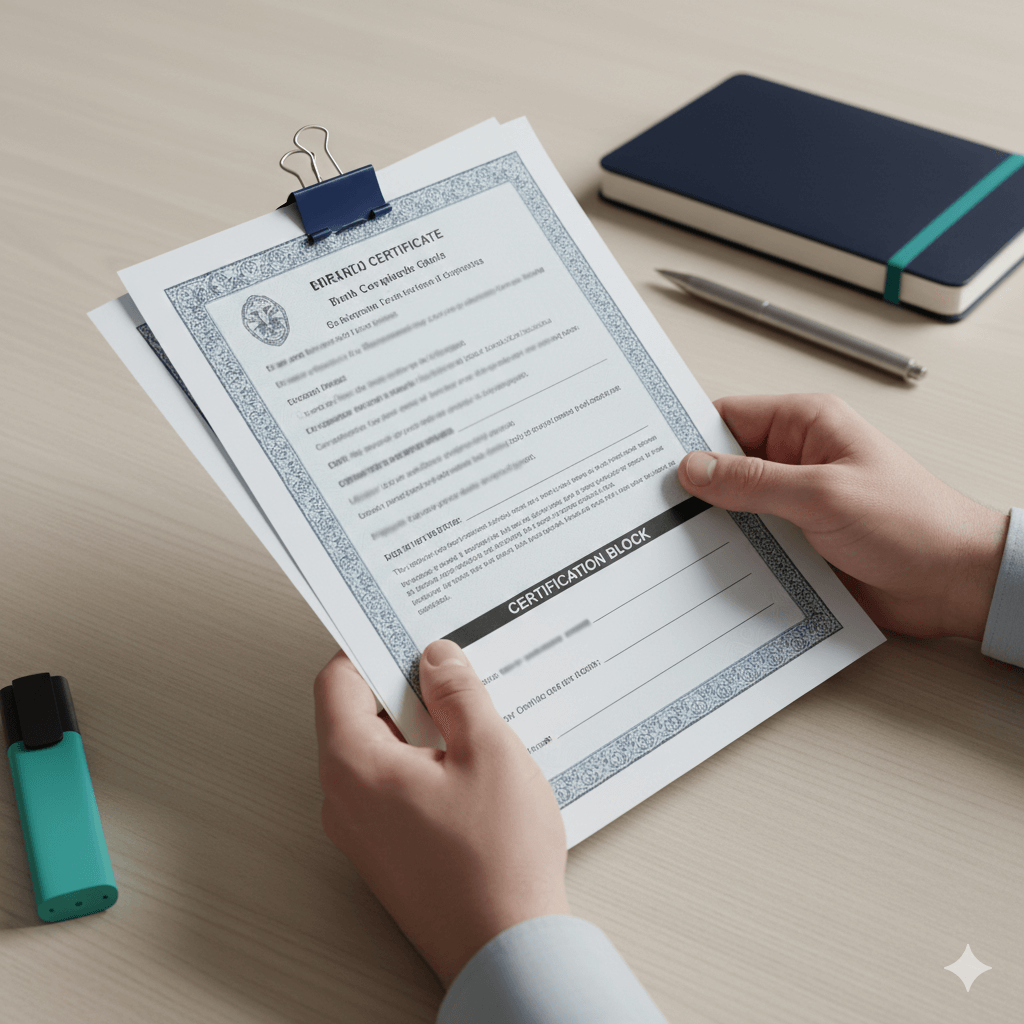
What the Final “USCIS-Ready” Package Should Look Like
When you’re done, you should have:
- A clear copy of the original birth certificate
- The full English translation
- The translator certification statement (signed and dated)
Keep everything clean and legible. If submitting digitally, use a single PDF where possible and make sure scans are not blurry.
Common Mistakes That Cause Delays
These are the patterns that trigger requests for more evidence:
1) Missing stamps, seals, or marginal notes
Even a small stamp can matter because it can indicate registration validity or amendments.
2) Partial translation or summaries
A “translated summary” is not a full translation. USCIS expects a complete translation of what’s on the document.
3) No certification, or a weak certification
If the certification doesn’t explicitly state completeness/accuracy/competence, it’s not doing its job.
4) Names and dates don’t match other paperwork
Common issues:
- switching surname order
- inconsistent transliteration
- mixing date formats (day/month vs month/day)
5) Guessing illegible handwriting
A careful translation flags unclear text instead of inventing it.
A Practical Quality Check Before You Submit
Use this quick review list:
- All text translated: including stamps, signatures (as labels), and back-side text
- Names consistent: match passport spelling and your forms
- Dates consistent: reflect the original date format correctly
- Places consistent: city/region names are translated or transliterated consistently
- Numbers match: registration numbers, ID numbers, book/page references
- Certification complete: signed, dated, includes contact details
- Readable file: no blur, no cropped edges, no shadows
If you want the lowest-risk path, this is the moment to catch issues — before they become delays.
Real-World Scenarios That Trip People Up
Certificates with multiple languages on the same page
If your birth certificate is bilingual, you still need a complete English translation of all non-English content, and the translator certification still applies.
Certificates with “amendment” stamps or corrected entries
Those notes matter. They often explain legal corrections to names, dates, or parent details.
Countries that use patronymics or multiple surnames
Spanish naming conventions, patronymic systems, and compound surnames are common sources of mismatches. A careful translation preserves the structure while keeping the English spelling consistent with your identity documents.
If You Need It Done Fast and Correctly
If you’re working against a filing deadline, the safest route is a human translation that includes:
- complete translation of every element
- clean, USCIS-friendly formatting
- proper certification statement
- a fast turnaround option
Upload a clear photo or scan of your birth certificate and request a quote — you’ll know the exact cost and timeline before anything starts.
Frequently Asked Questions
How do I get a birth certificate translated to English for USCIS?
Get a complete English translation of the entire document and attach a signed translator certification stating the translation is complete and accurate and the translator is competent to translate into English.
Can I translate my own birth certificate to English?
USCIS generally focuses on whether the translation is complete, accurate, and properly certified by a competent translator. Many applicants choose an independent translator to avoid credibility concerns and common certification errors.
What makes a birth certificate translation “certified”?
A certified translation includes the full English translation plus a signed statement from the translator confirming accuracy, completeness, and competence — along with the translator’s name, signature, date, and contact details.
Does USCIS require a notarized translation?
In most cases, no. USCIS typically requires a certified translation with the translator’s signed certification, not notarization. Notarization may be needed only if a different authority specifically requests it.
How long does it take to translate a birth certificate to English?
Most birth certificates can be translated quickly once a clear scan is provided. Timing depends on language, complexity (stamps/handwriting), and whether you need expedited service.
How much does it cost to translate a birth certificate to English?
Cost depends on the language, legibility, and complexity of the record. A simple, single-page certificate usually costs less than multi-page or heavily stamped documents. The most accurate way is to request a quote using a clear scan.
